


“Have you been hacked?” “Who got to you?” “Blink, three times if you need rescuing.”
These were just a few of the responses I got on social media after saying the latest jobs report (released last Friday) was strong.
Look, I understand the unease. We’re living under an administration that lies relentlessly. We have a president who, less than a year ago, fired the head of the Bureau of Labor Statistics and attempted to install a crank in her place after the numbers didn’t go his way.
Those are real reasons to worry and I’m not asking you to blindly trust the government. Instead, I want to give you some information about how these numbers are put together, what it would take to mess with them, and what tampering might look like if it were actually occurring.
Because here’s the thing: I still believe the jobs report. But I also know it’s not enough for me to simply tell you that. Instead, I want to equip you to assess the evidence for yourself and make your own informed judgment.
Why these facts feel uncomfortable
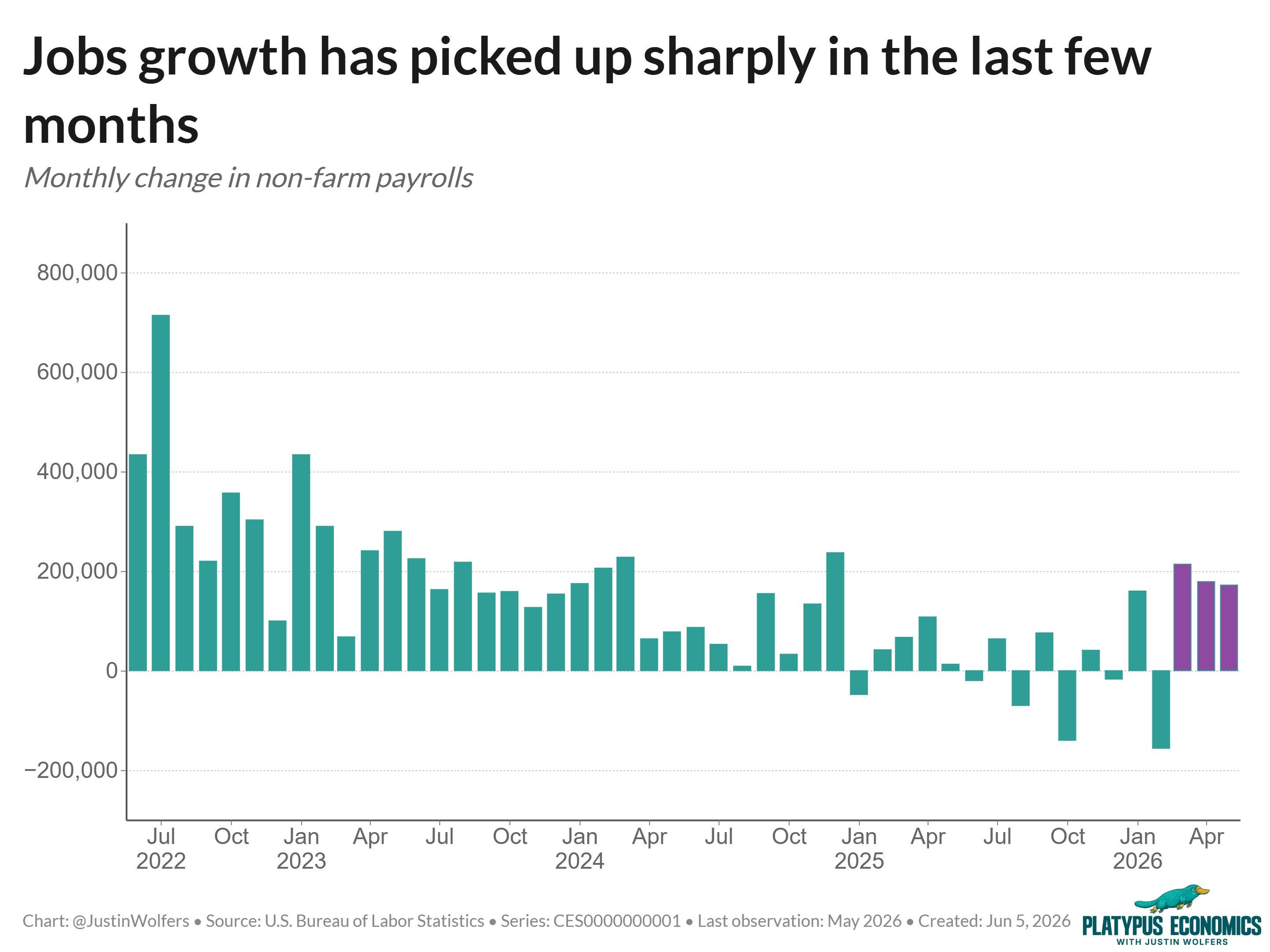
The latest government report said that non-farm payrolls rose by 172,000 in May, while the unemployment rate held steady at 4.3%.
For many, just hearing those numbers—which sound pretty strong—was jarring. And the reaction was immediate: Impossible. Fake. Propaganda.
That instinct is incredibly human. We like stories that make the world feel coherent. And we prefer facts that slot neatly into the picture that’s already in our heads.
But economics begins precisely where that instinct ends. Economics tells us to start with the reality, and then build our story to make sense of it. Don’t start with a story and choose which facts you’re willing to admit.
Or, to put it in Platypus Economics terms, sometimes the world hands you a platypus. The first time the Europeans saw a platypus, many called it a fraud. George Shaw, a British zoologist and museum curator, checked the pelt for stitches, believing someone had sewn a duck’s beak onto a beaver.

But the problem wasn’t that the platypus was fake, it just didn’t fit the model already in their heads, leading them to deny the reality right in front of their eyes.
And I think that’s what’s happening right now with the labor market. This latest report doesn’t fit many people’s preferred story, so rather than update their story, they reject the evidence. That’s bad economics. And it gets dangerous very quickly.
Why the BLS scare was real
That being said, the appeal of this type of emotional response has understandably been heightened by very real concerns coming from the Trump administration, and its mistreatment of information.
The BLS scare was real. Last year, after a weak jobs report, President Trump fired BLS commissioner Erika McEntarfer, and accused the agency of dishonesty with absolutely no evidence. I remember that moment extremely well. I was asleep in a hotel room in Tokyo when my better half, also an economist, shook me awake at 6 a.m. to share the news.
The BLS is one of our country’s core truth-telling agencies. It measures so much of what matters: unemployment, payrolls, inflation, and productivity. The basic plumbing of our economic reality. So this was unprecedented, and scary.
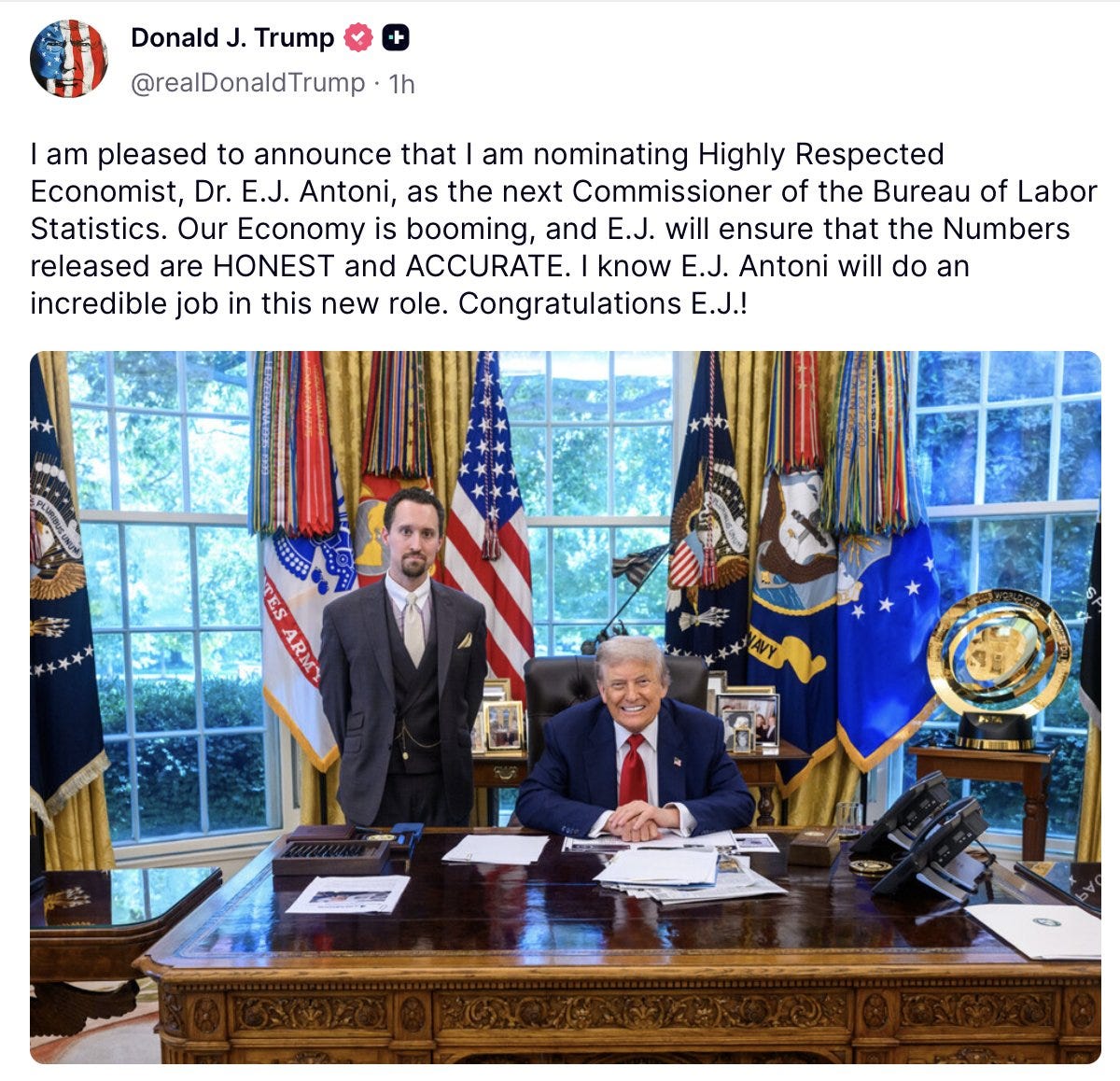
And the story got worse from there. The administration put forward a partisan hack named E.J. Antoni. He had no knowledge of running a bureau, no experience studying labor, and no background collecting statistics. But he did have one qualification–he was at the Capitol on January 6th.

You should worry when leaders attack statisticians. You should worry when they sack people for publishing unwelcome facts. And you should worry when they try to install loyalists in truth-telling institutions.
But you should also ask—what happened next?
How the institution quietly held
The public heard about the firing, and the crackpot nominee. But while everyone was staring at the circus, the Bureau of Labor Statistics kept producing data the way it always has.
That means career staff, routine processes, standard release schedules, and overlapping internal checks. The acting leadership stayed in the hands of the long-term professionals and the cranks never got near the seat of power.
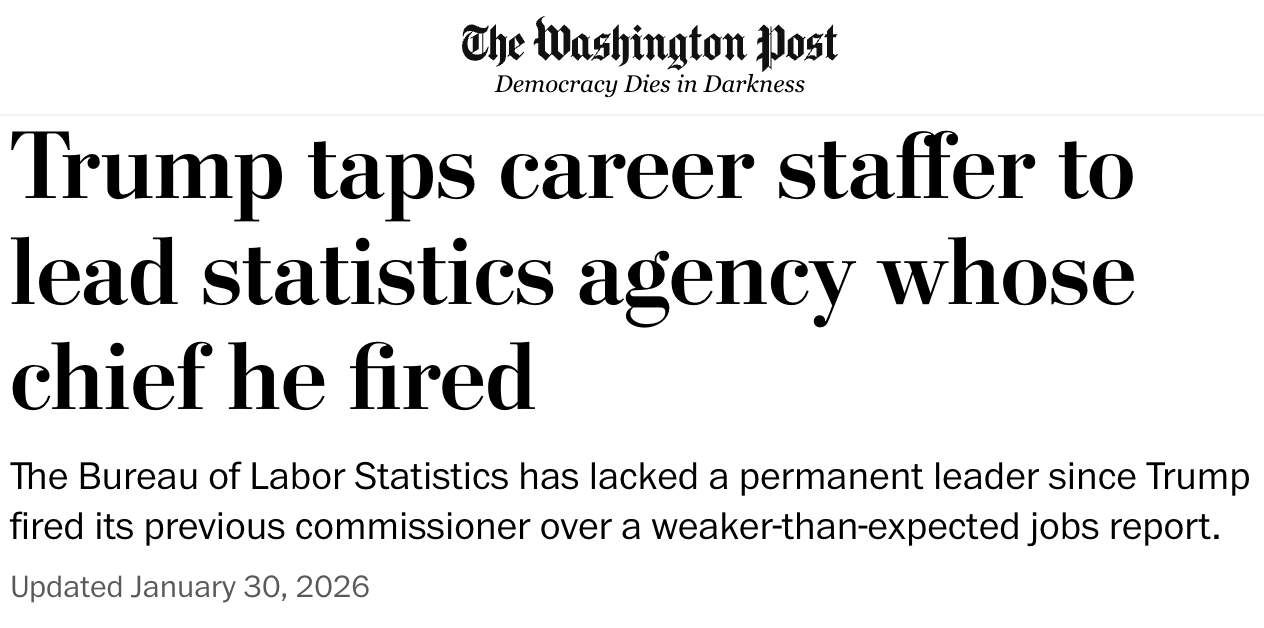
The president was ultimately forced to withdraw his nomination of the charlatan E.J. Antoni, and the replacement nominee—Brett Matsumoto—looks like exactly the sort of person a normal White House would nominate for the job. He’s a career public servant, a statistician, and a social scientist. He could have been easily appointed by either a Democrat or a Republican; in other words, he’s the anti-Antoni.
So we avoided the worst-case scenario that so many of us feared. More than that, the Bureau of Labor Statistics remains in very good hands today. The president did real damage to public trust, but he didn’t get his way. Our official economic statistics survived, and that survival is part of the reason I’m willing to make the next argument.
Why I believe the numbers
I know how the BLS data is put together. I know there are dozens of people and processes that sit between the president’s whim and the final published number. I know exactly how big the conspiracy would have to be to fake this thing. And I know this administration leaks like a sieve.
At a personal level, I personally know many of the people who put these numbers together. I know their integrity. I know that they’d call me if things were going wrong. And—even more importantly—I know what the tells would be in the data if the processes were being rigged.
That’s why I believe the numbers, but you need to know how to check for yourself. And I’d like to give you a few clues.
First, the jobs report isn’t just one number from one source. It combines two separate surveys:
The Current Population Survey provides the unemployment rate and additional information about who’s working, who’s looking for work, and who’s dropped out of the labor force.
The Current Employment Statistics Survey measures the number of people on employers’ payrolls.
With two different instruments measuring closely related statistics, we’re not hanging the entire story on one survey, one method, one lever, or one set of statisticians.
Second, we can look inside the data. The results from each individual response to the household survey is posted online in the form of microdata. And researchers from outside the government can and do dig into it every single month. They test it, challenge it, and cross-check it. And no one has found anything fishy so far.
Third, the payroll data is checked against broader administrative records including the Quarterly Census of Employment and Wages, which gathers unemployment insurance records from every state. This is important: it is extremely difficult—if not impossible—for a federal government to falsify state records.
Fourth, we’ve got private sector smell tests. Beyond the employment data collected by the BLS, the payroll company ADP has records of how many checks it’s printed, Bank of America has account linked data, Homebase tracks small business and hourly worker data, and Paychex has its own small business employment measure.
All of these measures are imperfect, and none are as precise or comprehensive as the numbers we get from BLS. But if the government numbers were being systematically falsified, this broader ecosystem would start to smell funny.
That’s one of the wonderful things about the American statistical system. We’re a big economy with a lot of ways to measure the things we care about. None of our statistics dwell alone in the dark.
I do want to add one important nuance. Government data, like all data, involves scientific judgments. Good statisticians can and do argue about how to make the numbers more accurate. That’s science, and it’s healthy.
But it’s a completely different claim from saying the numbers are dishonest. That should only be done when you’ve got more than a suspicion. And if you care about truth—if you care about the scientific method—you should fight back against that confusion.
What distorted data really looks like
By now, you’re probably wondering what it would look like if our government were actually distorting the data.
I’ve been an economist for a while, and I’ve seen authoritarian regimes mess with their numbers. It turns out that it’s pretty uncommon to invent a number entirely out of thin air. The real playbook is more subtle, and more dangerous.
Instead of making up numbers, they:
Attack the credibility of the statisticians.
Sack or intimidate those who publish unwelcome facts.
Reduce the transparency of the process.
Suddenly change methods without reason.
Create discontinuities that make it hard to compare data before and after a regime came to power.
Change the frequency of data releases.
Stop publishing data they don’t like.
President Trump started at the top and was working his way through this list. Antoni—had he been appointed—was willing to keep up the fight.
They were stopped.
I’m not naive. I’m not saying that governments never distort data. I remain vigilant and I hope you do too. But I also know what manipulation looks like. And what I see right now is an administration that has flirted with it, but—at least so far—hasn’t produced a fabricated number.
Which brings us, finally, to my interpretation.
Why the labor market looks strong
In this report, we saw a payroll gain of 172,000 in May, alongside upward revisions for March and April. Those are the facts.
But saying that these numbers are good news, and therefore you should feel more upbeat about the labor market is my interpretation. A reasonable person can disagree about how upbeat to be. Different people will put different weights on different parts of the report.
But this is my read, and I want to tell you how I got there.
Many have pointed out that these numbers are much lower than many of the reports we saw under Biden. That’s true. Payroll growth of 172,000 would have looked pretty middling during the big snapback from COVID when millions of people were flooding back into an economy that had been temporarily switched off.
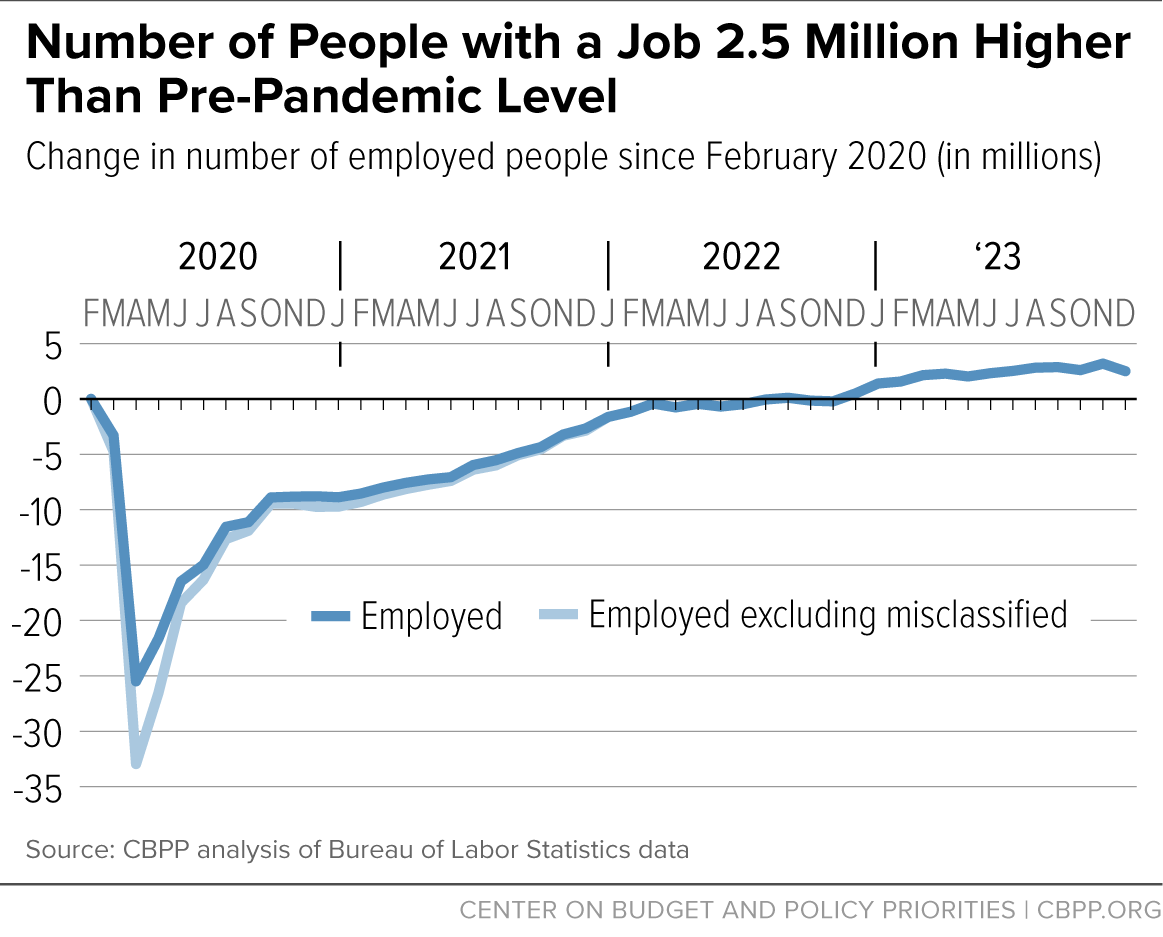
But that comparison is the wrong benchmark for today.
Today we’re more or less back to normal. Actually, we’re in a new normal. And that’s because the Trump administration’s crackdown on immigration has led population growth to virtually stop for the first time in decades. Which also means the economy doesn’t require the same pace of job creation to keep the labor market healthy.
And so, according to our new benchmark, 172,000 jobs is a pretty solid number. And it comes after two prior months of solid numbers.
That doesn’t mean everything in the economy is perfect or everyone is thriving. Macro data and personal experience can—and do—diverge. You may be struggling, while the aggregate is doing okay.
But to me, this report says that panic over a possible recession should cool down. The labor market is holding up better than many feared. And the economy is still adding jobs at a healthy clip relative to the supply of available workers.
That’s what makes these pretty good numbers.
Truth over tribalism
Here’s the thing I really want to leave you with: If I only ever give you facts that make you feel good, I’m not telling you the whole truth. That’s a tell that I’m not doing my job and you should listen to me less. It’s a test you should apply to any commentator in any domain.
A healthy society depends on institutions that tell us uncomfortable truths. We don’t get to keep the parts of reality that flatter our worldview while throwing away the rest. That’s not economics, it’s not science, and—over time—it’s not democracy either.
And if every inconvenient fact is dismissed as propaganda, we don’t just lose one jobs report. We lose our ability to spot the platypus.
(By the way, Platypus Economics released a video about Brett Matsumoto’s nomination back in February—before we were officially Platypus Economics. Check it out here to learn more, including why revisions make BLS data even more trustworthy.)


