



It was my absolute pleasure to sit down with one of my favorite public intellectuals, historian Heather Cox Richardson, to talk about the American economy—where it’s been and where it’s headed. We covered a lot of ground, but the thread we kept coming back to was inequality. She provided the grand historical arc, and I talked about the economic consequences.
We’ll get to the oomph of it all in just a moment, but first a personal aside. It’s rare that I’m intimidated by folks I talk with. But Heather is so prolific, so well read, and so beloved — a national treasure, no less — that I’ll admit to being more than a little bit nervous. I can share that she’s as lovely in conversation as she is thoughtful in print.
Back to the economics of our conversation…
When you’re talking with an historian, we’re not reviewing last month’s inflation numbers. It’s a longer sweep, viewed through a bigger lens. And for an economist, that means talking about institutions.
They’re central to thinking about the effects of inequality on economic performance. Here’s why: A healthy set of economic institutions gives everyone an incentive to bake a bigger pie; an unhealthy set gives folks an incentive to steal their neighbor’s slice, instead.1 And when wealth gets particularly concentrated, those at the top stop inventing better electric cars (or baking pies) and start lobbying for carve-outs (pie-stealing, with better lawyers). Which is why I believe the biggest threat from inequality runs through our democracy.
Here are some numbers: Elon Musk spent $250 million to help swing a presidential election, and has enough left over to do it for thousands more. And now the president is on track to earn $8 billion during his second term (largely through a cryptocurrency industry he regulates), far exceeding the roughly $2 billion Republicans spent to elect him. Buying the presidency has become profitable, and our democratic institutions were not built to deal with this reality.
Despite these very real threats, the historical record offers hope. Wealth inequality in America over the past century is a U-shaped curve: sky-high during the Gilded Age and through the Great Depression, dramatically lower by the 1950s and 60s, and back up today.
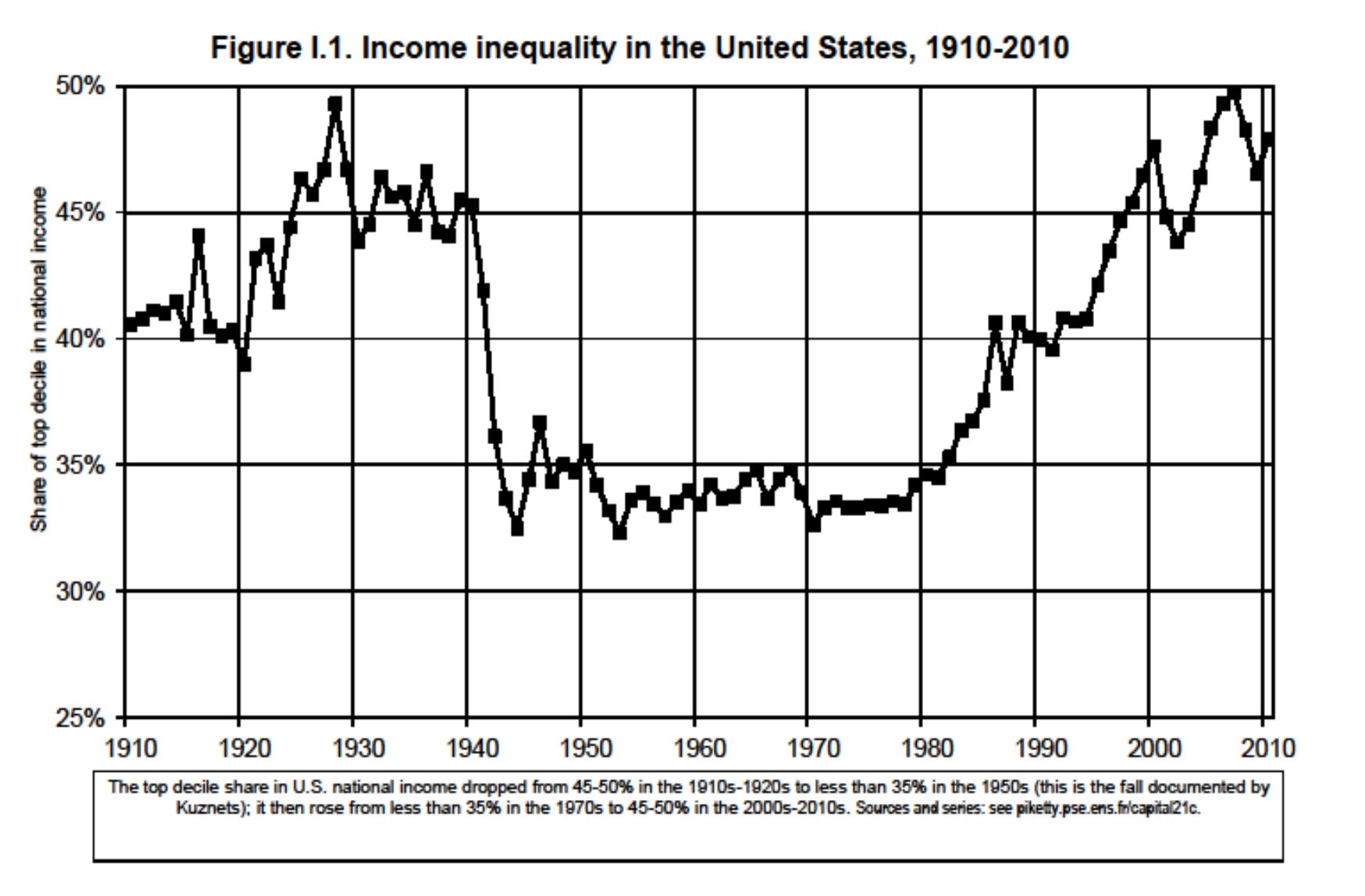
My students often feel these are forces beyond anyone’s control, but they’re not. We compressed inequality once before through policy choices, and there’s no reason we can’t do so again.
We’ve made enormous progress on other fronts as well: movements toward racial equality, women’s liberation, and LGBTQ+ rights. These movements not only made America fairer, but made the pie bigger, too. Jobs are now allocated to a greater degree by talent, rather than demographic characteristics. Point is, not everything is an equity-efficiency trade-off. That’s a point worth emphasizing: Sometimes we really can make the economy both more equitable and more efficient.
All of this brings us to our current moment, and the choice in front of us today: artificial intelligence. Whether the economic transformation is one-tenth the size of the Industrial Revolution or twice as big, it’s already begun—and none of the rules have been written. The decisions we make now about how AI’s gains are shared will shape the American economy for the next fifty years (or more).
We’ve fixed lopsided economies before, and can write these rules well, too. But only if we understand that we—not “the economy”—are the ones holding the pen.

I’m not a big one for footnotes on the internet, so think of this as both an acknowledgment and a recommendation for further reading. Growing the pie versus stealing your neighbor’s slice is just a pie lover’s way of describing what Acemoglu, Johnson and Robinson call “inclusive” versus “extractive” institutions. Their Nobel citation (and accompanying materials) provides a worthwhile and accessible introduction.


