If you’ve found it hard to keep track of Trump’s trade war, that’s not on you. It’s on him. Trade policy has turned into one of those horror-movie zombies. You think it’s dead. It sits up. Comes back even uglier. And keeps on coming back.

I want to try to help you make sense of what’s happened, where we are now, and where we might be going.
The legal battle is chaotic
The Constitution gives the legislative branch (Congress) the power to tax. Tariffs are a tax, and so the power to impose tariffs also belongs to Congress.
Congress has given presidents a narrow set of tariff powers for specific situations, including national security concerns, sudden emergencies, and specific unfair trade practices. These powers allow the White House to move quickly when needed, but were intended as limited tools for specific purposes.
President Trump decided that they were broad enough to wage a global trade war entirely on his own. So far, the courts haven’t agreed, but we’re currently in the third round of this legal fight.
Round 1. Trump announced broad tariffs–ostensibly under the International Emergency Economic Powers Act (IEEPA)–with great fanfare on April 2, 2025 . . . aka “Liberation Day.”
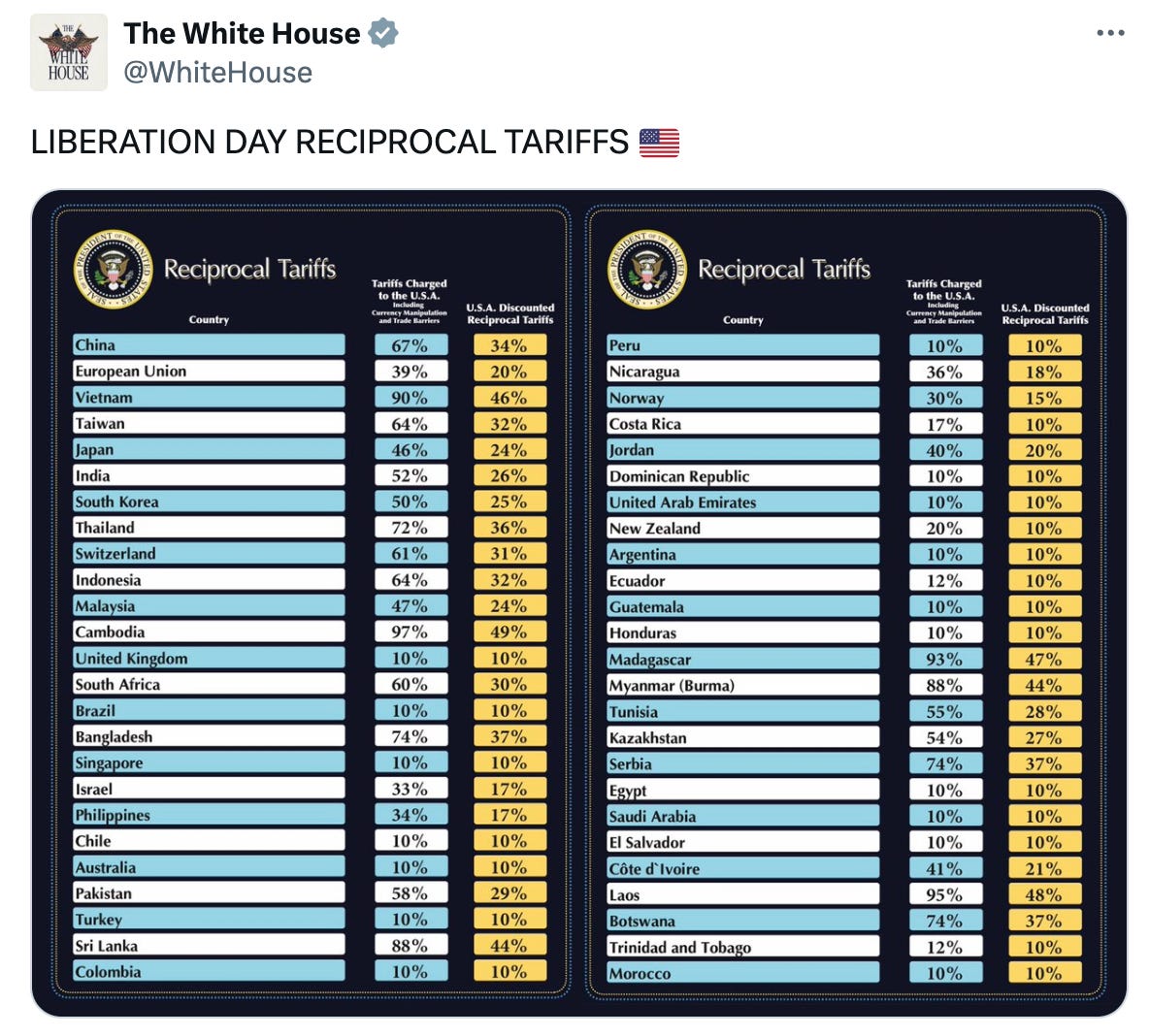
These tariffs were set at different rates for different countries, determined using a bizarre calculation based on their trade balance with the United States.
Ten months later, the Supreme Court ruled that Congress didn’t actually give the President the power to impose those tariffs. As a result, the federal government is now in the process of refunding most of the tariff money it collected.
Round 2. After losing that case, the President quickly announced a new, temporary worldwide tariff of 10 percent under Section 122 of the Trade Act of 1974.
This law is intended for a pretty narrow international-payments problem — a balance of payments crisis. Balance of payments crises were a thing in the days of fixed exchange rates. But today, we have a floating exchange rate, and the balance of payments always balances.
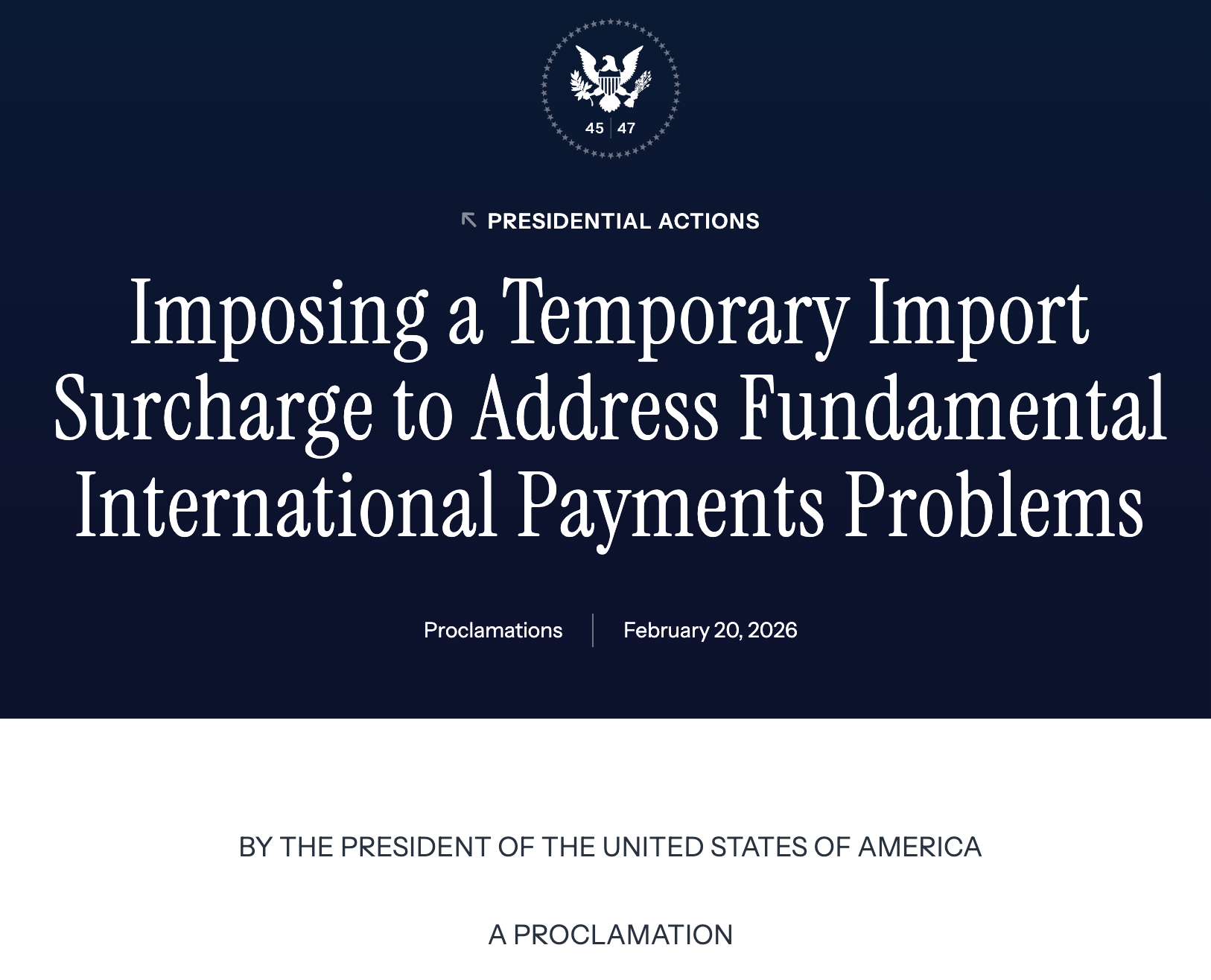
So again, the court ruled these illegal.
Subsequently a Federal court ruled they may be legal.
There’s still litigation sloshing around about all of this, and no one is seeing a refund of these tariffs anytime soon.
Regardless, the law only ever permitted temporary tariffs. It allows for 150 days of tariffs, and that limit runs out soon — likely before the major cases will get appealed. Good job, justice system.
Round 3. The White House is again trying to implement tariffs. This time they’re using a more formal trade-investigation process, wrapped in the language of forced labor.
The tariffs in question
I want to take a beat to explain the different types of tariffs a government can impose.
First: we’ve got industry-wide tariffs.
These are aimed at a specific sector — steel, aluminum, copper, pharmaceuticals — and typically apply no matter which country the goods come from.
These were the big story during the first Trump Administration. They’re still around and still matter, but they’re not the main story today.

Second: national tariffs.
These tariffs hit basically every good coming from a specific nation. This was the big Liberation Day strategy, and they were placed on a very broad set of countries.
Third: Once those got struck down, the White House tried world-wide tariffs. That’s the 10 percent global surcharge that’s also been ruled illegal and is set to expire soon.
Fourth: What the administration is trying next are technically national tariffs, but effectively world-wide-ish.
What makes them different from before is they’re now “investigation-based.” The administration’s justification comes from a claim that other countries are engaging in “unfair trading practices.” Importantly, Section 301 of the Trade Act of 1974 gave the White House the ability to retaliate in response to unfair trade.
It’s this fourth round of tariffs where the forced-labor theory comes in. But here’s the thing: U.S. law already blocks imports made with forced labor.
Nevertheless, the administration’s claim goes like this: If another country doesn’t seriously stop those goods from entering its market, then their producers are getting a leg up and creating unfair competition for American workers.
Now, I’d be hard pressed to believe the President has suddenly developed big feelings about the exploitation of the world’s downtrodden. But this path offers something the last two didn’t: Hearings. Comments. Findings. A nice fat legal paper trail.

And courts usually give the executive branch much more grace in these circumstances than when they simply declare a giant emergency out of nowhere.
Notice that all of these fights are about the legality of tariffs. None are about what is most likely to be effective, or efficient.
So where does this leave us? Same trade war. Better lawyers. Worse economics.
The latest plan is the oddest
Under this new, forced-labor theory, the administration has proposed tariffs on 60 economies.
Why 60? Well, 60 is enough to cover 99.4 percent of U.S. imports. From that fact alone, it’s clear this is not a narrow action taken against a few obvious bad actors. Rather, it covers the entire trading world that matters.
The rates are 10 percent for some economies and 12.5 percent for the rest. And what determines which rate a country receives? This is where the whole thing gets properly silly.
The lower 10 percent bucket includes economies that already have a forced-labor import prohibition, have promised one in an Agreement on Reciprocal Trade, or have some partial regime that sort of counts. Which means the reward for better behavior is 2.5 percentage points. That’s a rounding error dressed up as diplomacy.
It’s so transparently bad faith that most trading partners aren’t going to bother offering any tighter rules around forced labor. They’ll see, correctly, that it’s beside the point.
The White House wants these tariffs in place quickly, and it can probably get them there by mid-to-late July. Which lines up awfully neatly with the previous, temporary global tariff running out. Funny that.
Some simple economics on why these tariffs don’t much help
Now, economically-speaking, there are a few big reasons why this newest version of the trade war is even worse than what came before.
First: world-wide tariffs give you less leverage, not more.
You say to one country: if you don’t do X, we’ll raise tariffs on you. That works because the threat is specific. But if our retaliation involves also raising tariffs on all of their competitors, it’s not much of a stick.
Second: the chaotic nature of the Trump tariffs provides little incentive for anyone to want to cooperate with the United States.
The United States has formal trade agreements and informal deals with many countries. But the President still wakes up every couple of months and decides to impose a whole bunch of new tariffs just because he feels like it, on the flimsiest of rationales.
If we don’t put any teeth into delivering concessions to our trading partners, they’re not going to put any teeth into the concessions they’re offering.
Third: these tariffs are too unstable to drive investment.
If you want tariffs to reshape the economy, firms have to believe they’ll last. These won’t, because no Trump tariff ever does.
A firm doesn’t build a factory because of this week’s headlines. It builds a factory if it believes the policy will still be there years from now.
So even if you believe in smart tariffs (and I’ll be honest — I’m not sure that I do), these are not it. These tariffs are chaotic, unclear, ever-changing, and transitory. To be direct: they are dumb tariffs.
Which means we’ll get all the costs, with few of the benefits.

If you want to create tariffs that actually stimulate investment, you need them to be durable. And the only way you do that is by passing them through Congress. Why? Because it’s hard to get Congress to get anything done — including reversing its earlier choices.
That raises the fourth problem: Presidential tariffs enable crony capitalism.
There’s a reason Trump doesn’t want to work seriously with Congress on tariffs. When the White House is the one to impose tariffs, the President is the one who gets to grant carveouts, hand out exceptions, push companies around, and dole out favors.
Tariffs by presidential proclamation may be worse for the economy, but they are much better for the President and his mates.
Where this leaves us
The courts did not end Trump’s trade war. They blocked one version of it. And the replacement, too. But now we’re on to version three.
This third attempt will likely survive, not because it’s smarter or more principled, but because it comes wrapped in a process that courts are more likely to tolerate.
Along the way, the administration lost sight of its broader objectives.
Yes, the smarty-pants lawyers succeeded in getting the boss a tool that he’s long wanted to wave around. But these tariff powers won’t deliver for the American people: No deals. No onshoring. Not much revenue. No leverage. No re-industrialization. No jobs. A trade deficit that won’t budge.
And in return, we get more opportunities for corruption. Greater uncertainty. Allies who won’t trust us, and a weaker place in global affairs.
And you and I will end up paying higher prices, too.
Father’s Day Sale
Actually, one price in this economy is falling. It’s our first ever Platypus Economics Father’s Day Sale.