


Since Donald Trump returned to office, nearly all — 86%, to be precise — of net new payroll jobs have gone to women. What’s more, women now outnumber men in non-farm payroll jobs, making up 50.02% of the total.
So why is job growth tilting so hard toward women? And what does it say about our economic policies and politics? Are they keeping with the labor market we actually have — or stuck idealizing a past that’s unlikely to return?
Women are pulling ahead
Let’s look at the numbers.
Over the course of the second Trump administration, the U.S. economy has added 468,000 payroll jobs. Women received 403,000 of those, leaving men with 65,000.
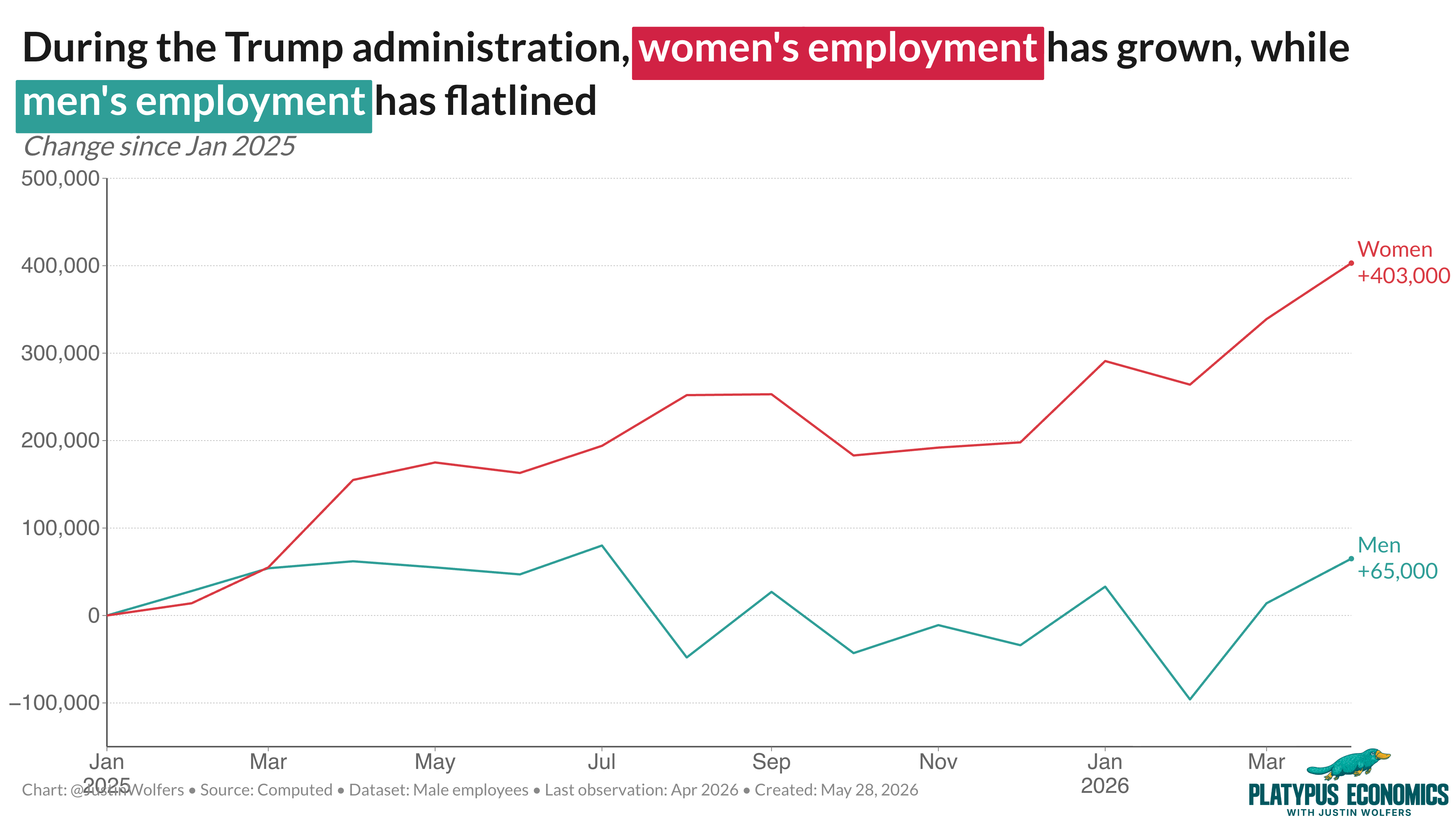
And over that same stretch, the crossover happened: women now hold slightly more non-farm payroll jobs than men.
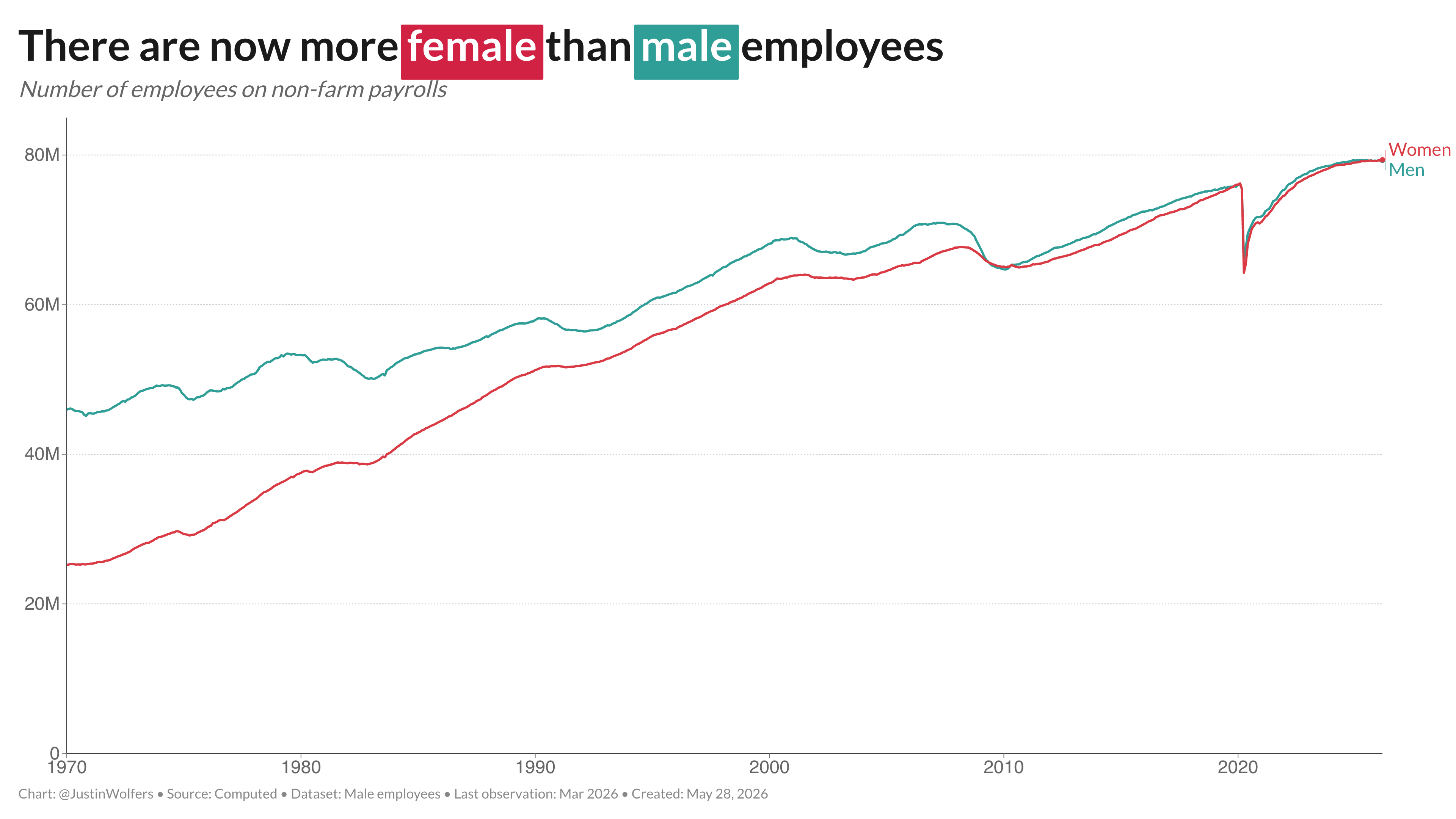
This is the latest chapter in a story 50 years in the making.
In 1970, men outnumbered women on non-farm payroll by a ratio of nearly two-to-one. Over the next half century, women’s numbers rose quickly, while men’s grew more slowly and occasionally plateaued. Over time, the gender gap narrowed, then closed — and now it’s flipped.
What’s driving this
There are two main mechanisms for how this shift could have occurred:
Employers may have started hiring relatively more women than men across many different industries. Or,
The industries adding the most jobs are those already dominated by women.
The first possibility implies that the gender composition of individual workplaces changed; the second implies that the composition of the economy changed.
To isolate which mechanism was at play here, I conducted a few analyses.
First, I sorted all industries (as defined by the BLS) into three categories — mainly female, mainly male, and roughly even — based on their gender composition as of January 2025.
The picture became clear: the mainly female category added 828,000, the mainly male category lost 218,000, and the roughly equal group lost 142,000 jobs since the start of Trump’s second term.
So, female-heavy industries are the ones that are actually growing.

Next, I conducted an Oaxaca-Blinder decomposition — or shift-share analysis — to separate the shift in industries where jobs were created from changes in who got a job within a given industry.
This analysis allowed me to ask a very specific question: if each industry kept the exact same male-to-female ratio as it had back in January 2025 — and the only thing that changed was which industries grew and which shrank — how much of the job-growth gender gap would this explain?
In other words, does compositional change by industry explain this story?
The short answer: yes.
Actually, the pattern of job growth across industries explains more than the observed gender gap. This means that within industries, we’re actually seeing a shift toward men. (Mathematically, the two effects must add up to the total.)
This led me to wonder which specific industry — or industries — were driving this. To find out, I plotted every industry for which we have gender data, comparing how female it was in January 2025 to how fast it’s grown since then.
One industry stood out: healthcare.
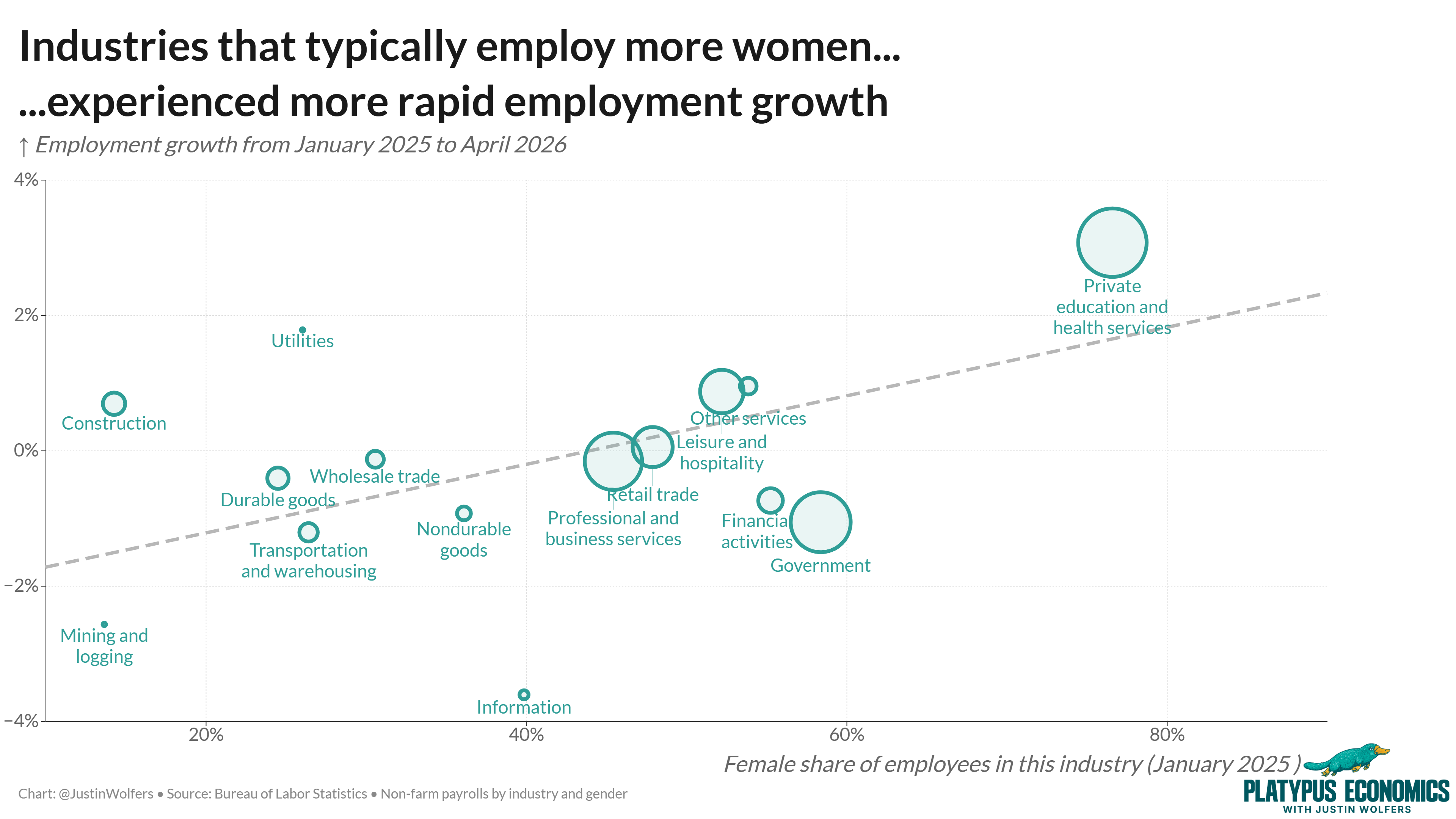
The official category — private education and health services — started out more than 75% female, and added over 800,000 jobs over this period. So nearly all the action in terms of female job growth occurred in this single sector.
Our debates are outdated
A lot of our political debates are still tied to the old industrial picture of work — a heroic breadwinner who makes tangible items with his hands. That’s a fine picture for a 1970s campaign ad, but it’s wildly disconnected from our 2026 reality.
And when our politics continue to romanticize one kind of work while the labor market is busy creating another, policymakers start to make mistakes.
They try to revive jobs that belong in the past. They launch trade wars in the hopes of restoring a labor market that no longer exists. They subsidize the work that fits an outdated idea of dignity — and undervalue the work that’s actually putting food on the table.
A little history is instructive here.
In the mid-to-late 19th century, a majority of Americans worked in agriculture. Today, that number is around 1%. This shift didn’t occur because food became any less important. Rather, agricultural productivity improved so dramatically that we no longer need tens of millions of people to grow all the food we want.
And as societies get richer, most people don’t spend their extra income on even more wheat.

The same basic story has also played out in manufacturing. Like agriculture, this sector still matters enormously — America continues to produce vast quantities of industrial goods — but technological advances allow us to manufacture far more with far fewer workers than before.
Modern factories, like modern farms, are often more machines than people.

Nor do we keep buying extra washing machines.
This is one of the deepest truths about economic development: as productivity rises in some sectors, labor gets freed up to go to others. And as incomes rise, demand shifts. At this moment, it’s shifting towards services — especially those delivered person to person.
Those services include healthcare, childcare, education, and elder care. These are the things that make a rich life feel like a full life.
From this vantage point, the rise in healthcare jobs is neither a fluke nor a surprise. This a central story of what happens when a country gets richer, more productive, and yes — older.
We need to reinvent work
All of this brings us to a crucial, final point: there is nothing inherently female about this work — about helping a patient stand up, moving medical equipment, running diagnostics, doing rehab support, or transporting people through hospitals.
In fact, many healthcare settings are actively trying to recruit more men.
These jobs require reliability, strength, competence, patience, and responsibility. And if it’s where the labor market is growing, we need to help men see that opportunity, too.

My partner, Betsy Stevenson — former chief economist at the Labor Department and member of President Obama’s Council of Economic Advisers — has made a similar point: if we want job growth for men to match that for women, men may need to move toward the industries that are actually growing.
And a serious jobs agenda should care less about whether work comes with a hard hat or scrubs, but whether it’s needed, paid, respected, and available.
Good economics starts with the world as it is. In a rich, productive, and aging economy like ours, that requires recognizing that a lot of tomorrow’s dignity and opportunity will be found in the service sector.
Today, these jobs are often coded as feminine — referred to as the “pink-collar” economy. But if we’re going to get this transition right, we need to embrace one more important truth: real men wear pink.


