


You’ve probably heard some rumblings from Washington about a gas tax holiday.
It’s is a policy that sounds like relief — and sure polls like relief — but gets the economics wrong in almost every direction.
And it’s not just one side being silly. It’s a bipartisan blunder.
President Trump has thrown his support behind Sen. Josh Hawley’s legislation that would suspend the federal gas tax for 90 days. Meanwhile, Democratic senators Mark Kelly and Richard Blumenthal have put forth a similar proposal, and Rep. Josh Harder wants to suspend the tax through the end of the year.
But a gas tax holiday mistakes the problem, blunts the signal, and makes a shortage much harder to manage. It also provides the least benefit to those who need it most, and will likely fatten the bottom line of oil companies even further.
The Real Tax is the Iran Tax
The federal gas tax is an extraordinarily precise 18.4 cents per gallon. The bright sparks who passed it 30 years ago apparently forgot about inflation. As a result, it has fallen away from being consequential, to relatively minor.
But the cost that’s really hammering households right now is not a gas tax. It’s what I call the “Iran tax” — the extra that you’re paying for energy because of the war with Iran. An actual tax raises revenue for the U.S. government; this one raises revenue for oil companies.
Before the war began, the average price of gas in the United States was just under $3 a gallon. Now it’s up to about $4.50. That surcharge — of roughly $1.50 per gallon — is about eight times larger than the federal gas tax.
Which means a gas tax holiday simply does not get to the heart of the issue. The real burden isn’t the 18.4 cents the Washington taxman adds, but the much bigger $1.50 the Washington war has added.
We can see this effect in real time. Every time the president de-escalates the war, the price of oil falls… pretty dramatically. And when oil prices fall, gas prices follow.
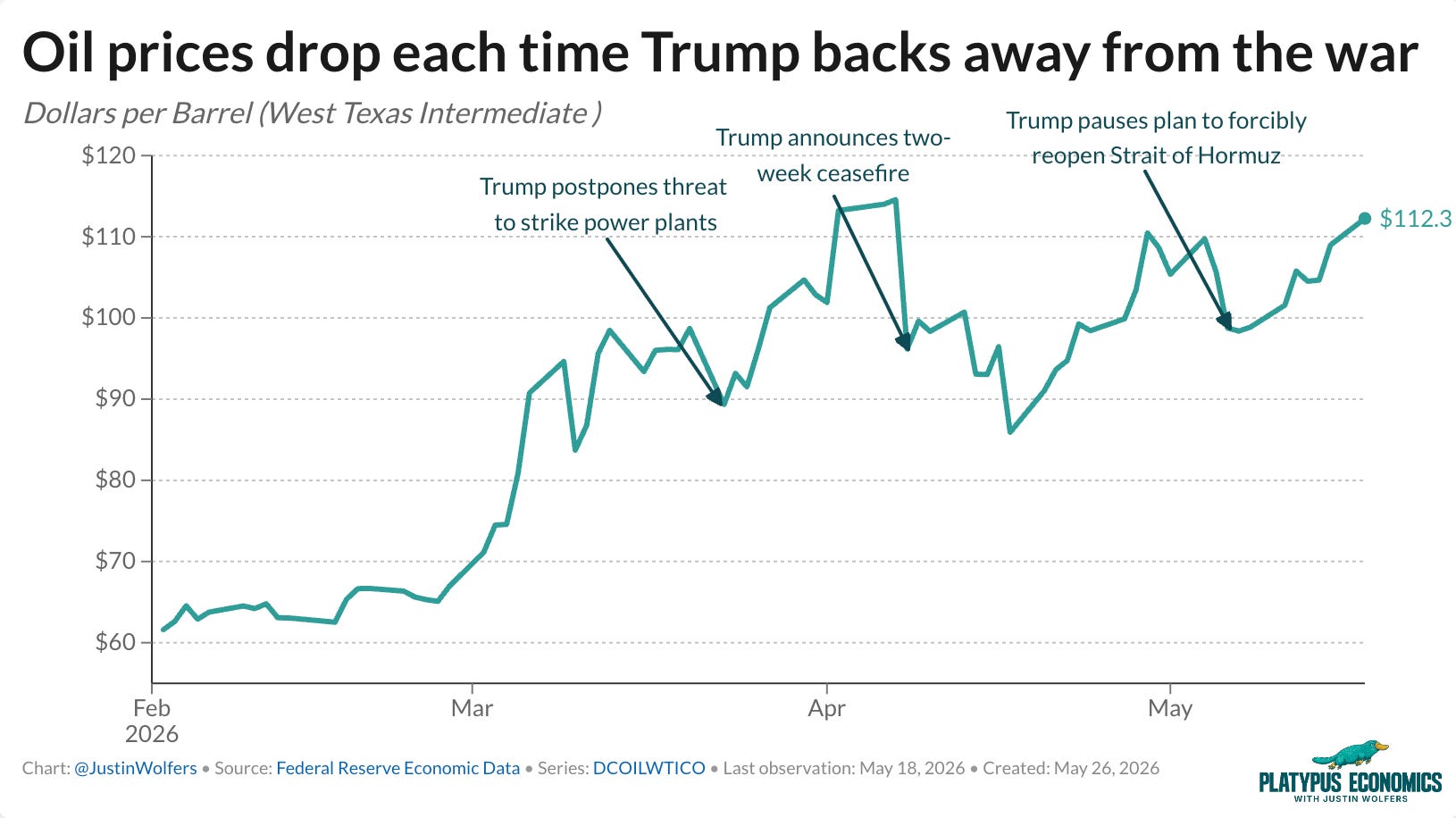
So if you want the biggest, fastest, cheapest way to cut gas prices, don’t fiddle with an 18.4 cent tax. Reopen the Strait of Hormuz. Turn up to the talks. Push for peace. Calm markets instead of frightening them.
For a little added context, American gas taxes are extraordinarily low by rich-country standards. Even when you combine federal and state-level taxes, no other OECD country has lower rates than we do.
In much of Europe, gas taxes are several dollars per gallon, not cents.
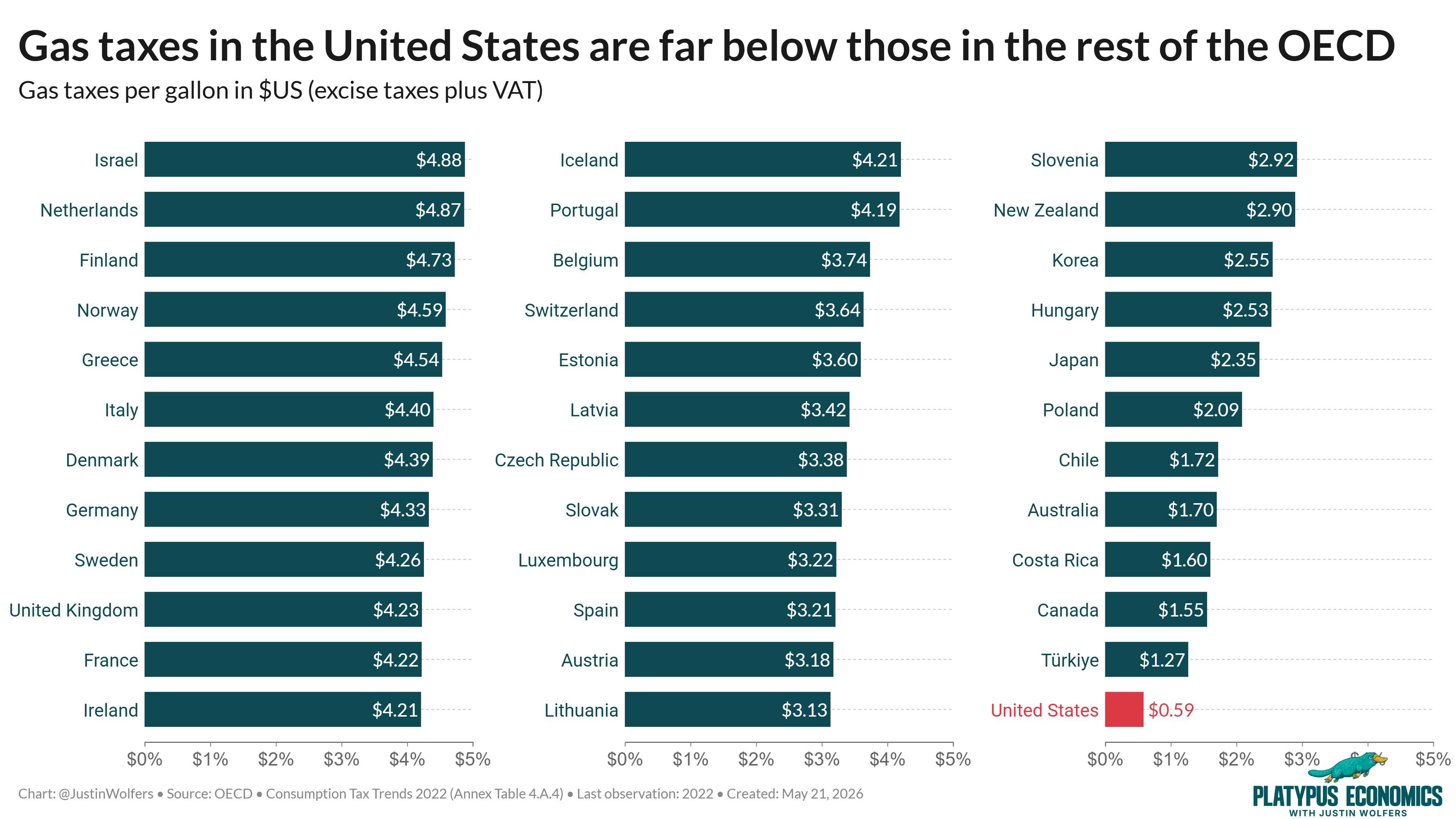
So no, Americans are not being crushed by some unusually heavy tax. If anything, we consume too much gas and tax it too lightly given the pollution and congestion that driving causes.
And while that’s not the most essential point I’d like to make, it’s worth acknowledging that vilifying the gas tax is a very American piece of political folklore.
Cheap Gas Won’t Solve A Supply Shock
Now I want to explain some of the economics.
What we have right now is an adverse supply shock: There’s less oil reaching the world market, causing gas prices to rise. This is simple supply and demand (welcome to Econ 101).
But if there’s not enough fuel to go around, making gas cheaper is not a solution.
Yes, it’s painful. Yes, it’s annoying. Yes, it’s frustrating. But the higher prices are doing a job. They’re telling each of us that oil is scarce, and we need to cut back. The high price gives each of us an incentive to combine errands, delay a non-essential trip, carpool, and maybe drive a little less.
A gas tax holiday? That blunts that signal.
Think of it this way: You don’t solve a drought by subsidizing showers. If there’s a traffic jam, don’t cut tolls. And in a blackout, making air conditioners cheaper won’t help.
So if there is an oil shortage — don’t cut gas taxes. That works against the very mechanism, the price signal, that helps an economy adjust when supply goes down.
Those Who Need Most Get Least
Another issue with a gas tax holiday is that it is poorly targeted social policy.
A gas tax targets gasoline purchases, not need. Which means those who buy the most gas get the biggest subsidy. And in the United States, richer households overwhelmingly buy more gas.
The poorest one-fifth of Americans spent an average of $1,200 on gas in 2024. Meanwhile, the richest one-fifth spent nearly $4,000 — more than three times as much. So a gas tax holiday would end up sending three times as much cash to the richest households as to the poorest ones.
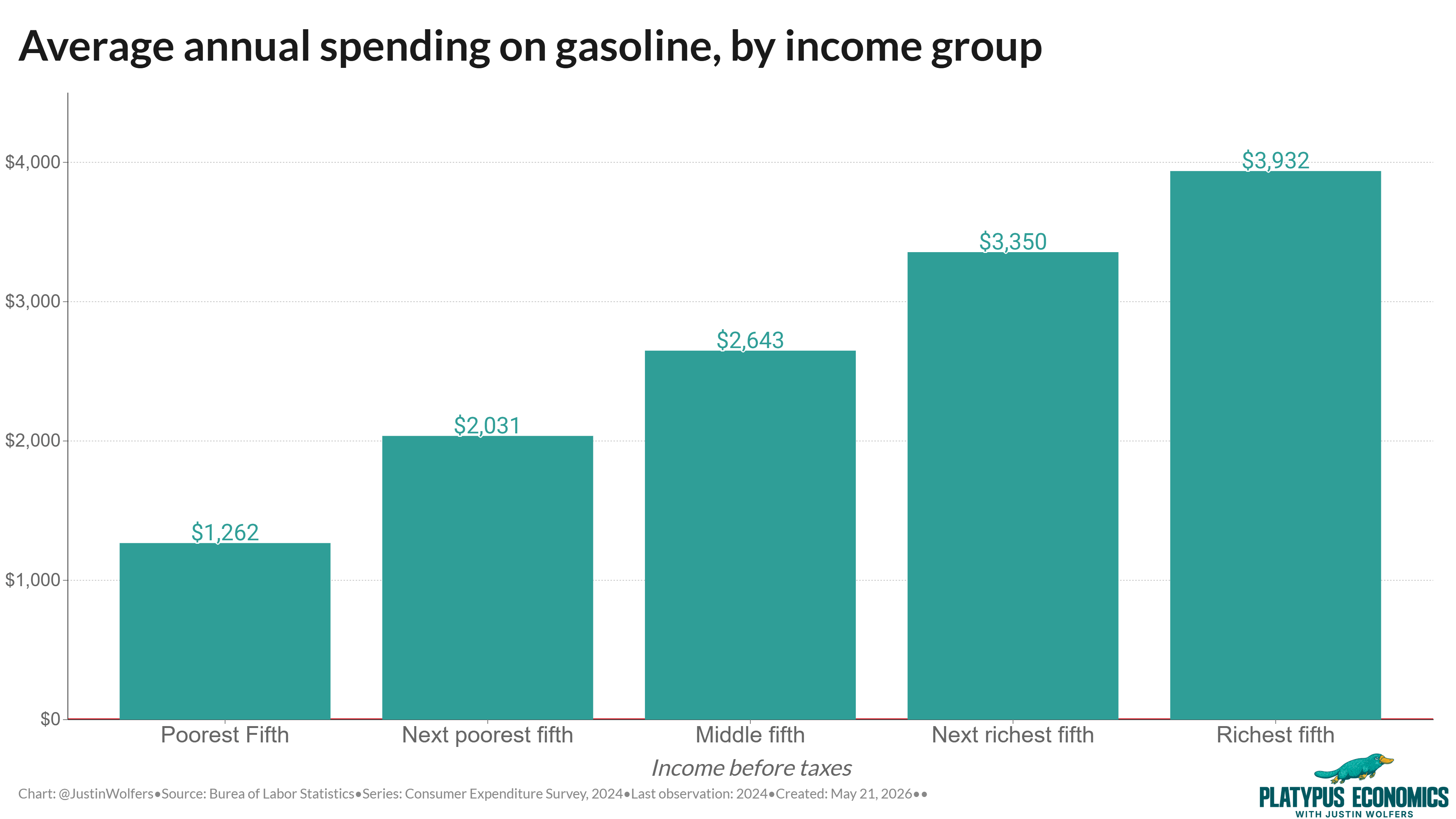
Now, these are averages. Some low-income families do depend heavily on a car, and for them higher gas prices can really bite. But that’s a case for targeted aid. If we genuinely want to help those in need through an energy shock, we can provide assistance based on hardship, not on gallons burned.
Impact vs. Incidence — How Oil Companies Win
Any time a government talks about taxes and subsidies, it’s important to distinguish between the impact and the incidence of their proposals.
Let me translate.
The impact of a tax is who legally pays it. It gets the headlines. The incidence is who actually ends up bearing the cost after prices adjust. In other words, lawyers (and not coincidentally, Congressional reps) obsess about the initial impact, but incidence is what really matters for your life.
When you cut the gas tax, drivers might initially see a lower price. And because of that lower price, they’ll want to drive a bit more and buy a bit more fuel. Notice something important: The tax cut doesn’t create any more oil or reopen shipping lanes. It doesn’t rebuild refinery capacity or cause tankers to suddenly materialize.
So now you’ve got more demand chasing the same constrained supply — which leads prices to go back up. This means some of the tax cut gets bid away into higher gas prices. Those higher gas prices end up in the pockets of suppliers as higher profits. It ends up fattening the wallets of those folks who are already benefiting from the aforementioned “Iran tax.”
That’s not just bad optics, it’s bad economics.
We don’t know precisely what percentage of a federal gas tax holiday will end up helping drivers versus the oil industry. The best evidence we have comes from studies of state-specific gas taxes. My friends at the Penn Wharton Budget Model have a useful set of studies and a useful rule of thumb.
They reckon that consumers keep about 72 cents of every dollar of a state-specific gas tax cut. However, this is likely an upper bound for how much relief customers would experience from a national holiday. That’s because during state-specific holidays, fuel can flow in from elsewhere in the country to offset increased demand. But when the tax is suspended at a federal level, there are no other states that can send over extra fuel to meet the extra demand. National supply is much less flexible.
Because of this, I’d wager about half the money we’d spend to cut the federal gas tax would end up in the pocket of consumers, while the other half would go upstream. That’s far from a precise estimate, but I’m fairly confident it’s less than 72%, and it’s definitely more sensible than assuming drivers would pocket the full 18.4 cents per gallon.
We’ve Seen This Movie Before
If you’ve been around a while, all of this might sound pretty familiar.
That’s because we’ve done this same silly dance before.
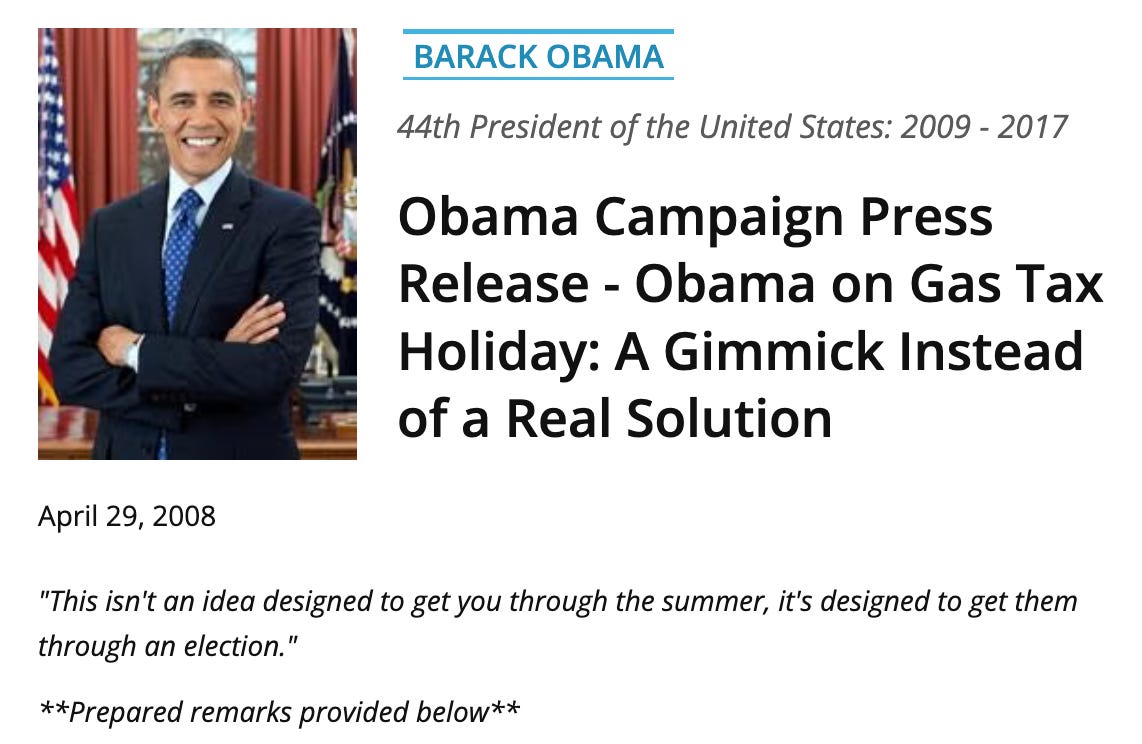
During the 2008 presidential election, John McCain called for a gas tax holiday, while Hillary Clinton — in her primary against Barack Obama — endorsed a similar plan. (Obama opposed it.)
In response, economists lined up against the idea. I wrote a rather cranky piece daring anyone to find a coherent economist willing to defend it, and George Stephanopoulos posed the challenge directly to Clinton on air, asking her to name one credible economist who supported her proposal. She famously responded: “I’m not going to put my lot in with economists.”
Ouch.
So, we’ve seen this all before. The same gimmick, the same fake relief, the same pandering politics, and the same refusal to ask whether a policy actually gets to the heart of the problem we face.
The Broader Lesson — Data Over Vibes
If there’s one lesson I’d like you to take from this latest frustrating debate, it’s this:
You cannot evaluate policy by vibes alone. You can’t simply decide that a policy sounds like it might help struggling families and therefore conclude it’s a good idea.
You have to ask the harder questions.
What problem are we really trying to solve? How will markets respond? Who will get the money, and who will get left out? Are we making the underlying problem better — or worse?
On each and every one of those scores, the gas tax holiday falls short.
We need to help people — absolutely. But we need to do so in ways that actually help.


