


The U.S. economy created 162,000 jobs in August. That’s more than most economists expected — Wall Street was looking for 50,000 to 60,000. It’s the sixth consecutive month of job growth in the second Trump administration. Unemployment sits at 4.1 percent.
I’m smiling today, and here’s why. I hate unemployment. That’s one reason I became an economist. It’s a scourge — it hurts people, it hurts their sense of themselves, it hurts their families. And right now it’s 4.1 percent, which is low. There is plenty in this economy to be unhappy about. That fact isn’t one of them.
So I want to spend most of this post on a different question, because it’s the one almost nobody asks and it’s the one that tells you what kind of country this is becoming.
Instead of only asking how many jobs we’re adding, let’s ask: what jobs are we adding? Who is taking them?
The hard hat economy never showed up
This is an administration that talks about big boofy blokes in hard hats and steel-toed boots. Manufacturing coming home. The 1960s, all over again. That rhetoric is the entire justification for the tariffs.
That, to be brief, has not happened.
Since January 2025, the U.S. economy has created nearly a million jobs in health care and social assistance.
The rest of the economy, taken together, has shed jobs.
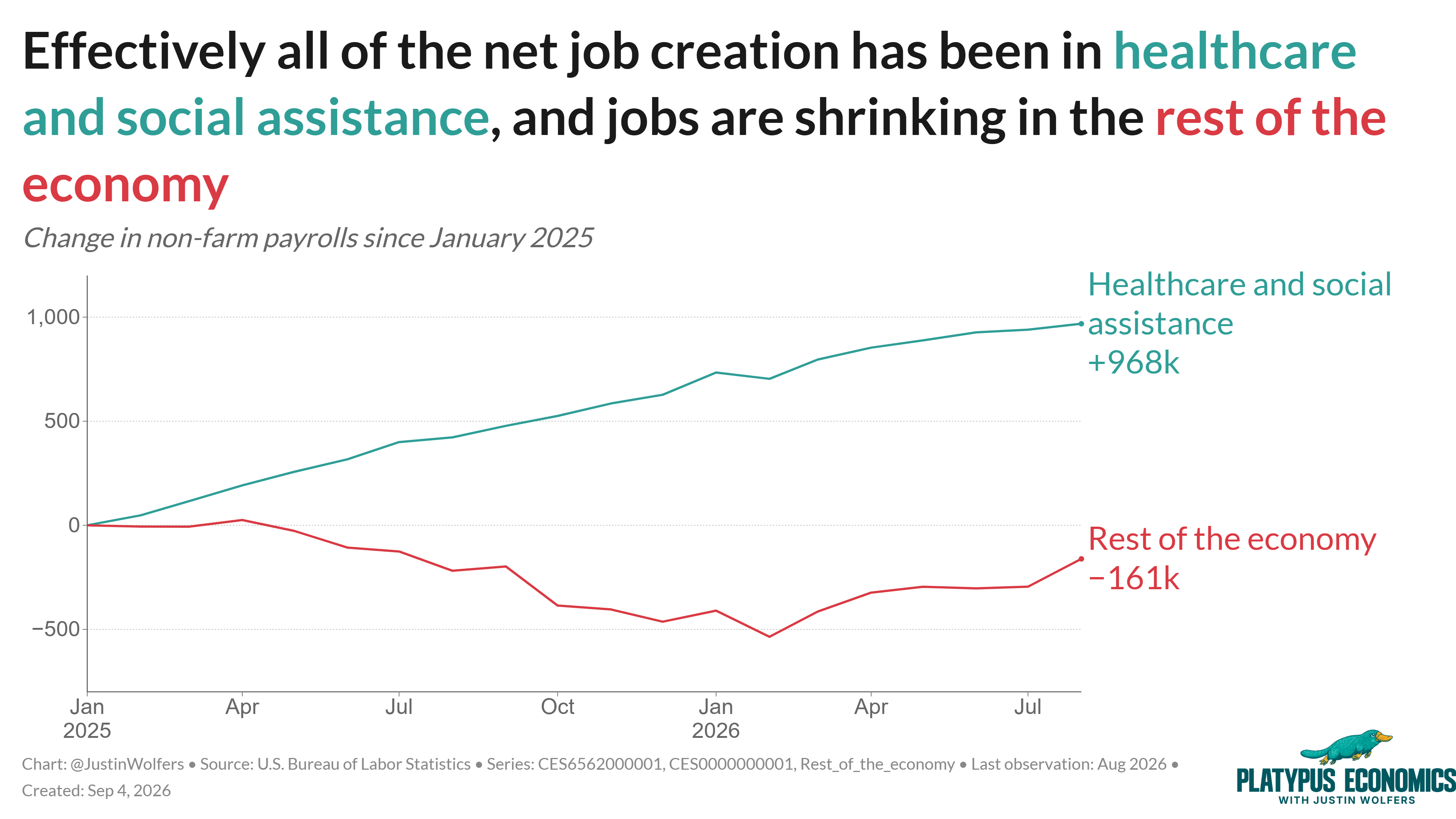
That is not a story about tariffs and industrial revival. That’s a story about an aging country getting richer and buying more care. As people age, they need more health care. As people get wealthier, they want more of it. This is a services economy shifting further toward services, and it’s been doing that for decades regardless of who’s in the White House or what they say about factories.
I don’t want to downplay these numbers: August was a reasonably good month for the non-health-care economy, with growth spread fairly widely. That’s a true improvement on the rest of the Trump term. But one month doesn’t rewrite eighteen.
The reality of our labor market is very different from the rhetoric coming out of Washington.
And almost all of it went to women
Here’s the part that surprised me most in the whole report.
Only 7 percent of the jobs created in the second Trump term have gone to men. Ninety-three percent have gone to women. Over roughly a year and a half, that’s on the order of 60,000 jobs for men against 747,000 for women.
We may be on the cusp of a male jobs recession.
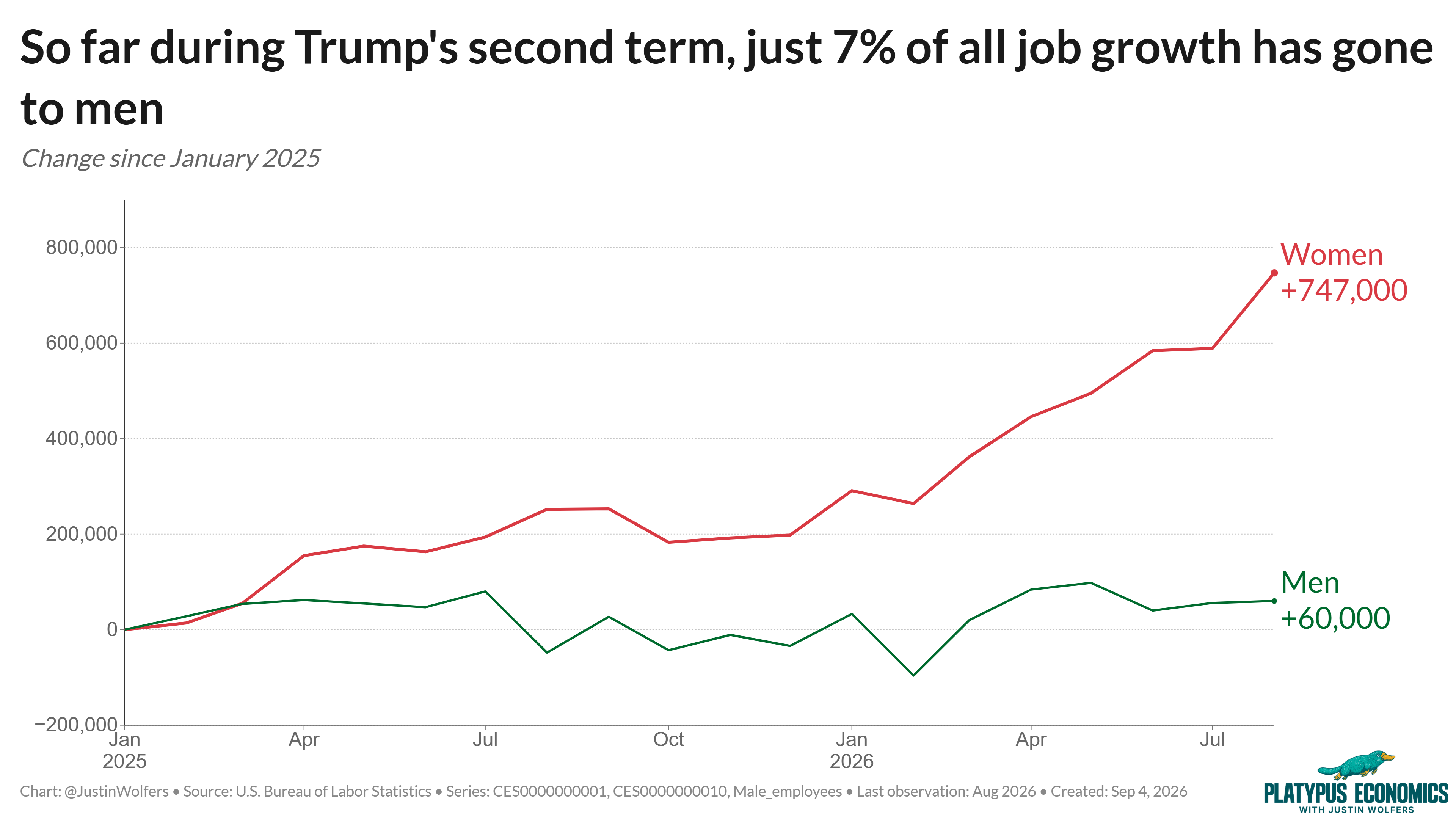
I want to be careful about what I’m claiming here, because this is not a story about hiring preferences or anyone’s politics. It’s mostly a story about industry mix. If your net job growth is almost entirely in health care and social assistance — well, those sectors employ women in large majorities. As a result, nearly all your net job growth goes to women. The composition of the jobs determines the composition of the workers.
This is where the rhetoric comes in. A tariff policy built around the industries men have historically worked in is not going to move a labor market whose growth is coming from nursing homes and clinics and home health agencies.
We’re going to keep watching that one.
The paycheck problem
Now the part that’s worrisome regardless of which sector you’re in.
Nominal wage growth — that’s the number on your paycheck, written in dollars — has been falling for a few years running. It’s now at 3.1 percent, the lowest rate in years.
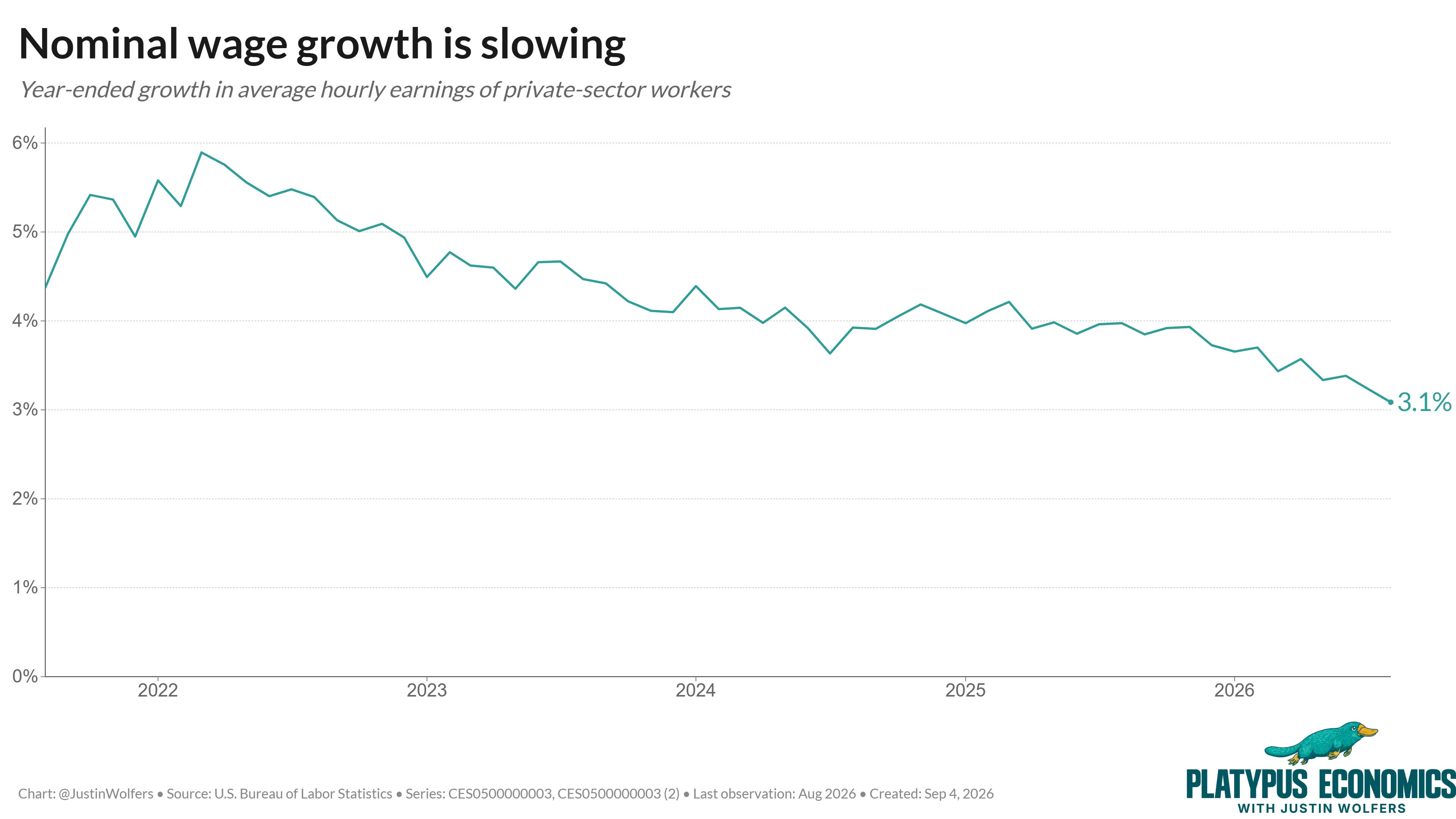
What matters for your actual purchasing power is how wages move relative to prices. I won’t know exactly what August looked like until the inflation data arrives. But I don’t need to wait to tell you the direction.
Real wages are falling. Prices are running ahead of paychecks.
That’s why it’s harder to put food on the table. That’s why an economy with 4.1 percent unemployment and six straight months of job growth can still feel like it’s squeezing you. A job is not the same thing as a raise.
What Quiet Kevin does next
Wage growth matters for a second reason: it’s one of the biggest costs businesses face. I know you probably don’t think of yourself as a cost — you’re a benefit — but that’s how it enters the inflation arithmetic.
The Wall Street Journal already has people out saying this report removes an obstacle to a Fed rate increase. The logic runs like this: inflation is the Fed’s first responsibility, inflation is too high, and if the labor market no longer needs the Fed’s protection, the Fed can pivot to prices.
Fair enough. Let me offer another perspective that I think isn’t getting enough play.
The Fed is meant to be looking at the future of inflation. It knows it’s dealing with a supply shock right now from the war in Iran and the tariffs. And the Fed knows that those effects fade in due course. The enduring cost pressure behind inflation over the long run is… wages.
And I just told you nominal wage growth is falling, and, indeed, is low. If productivity growth exceeds one percent, then it's likely that wage growth of three percent will — eventually — lead to inflation below two percent.
So a dove on the Fed — a patient dove — could read this report and say: fine, the labor market isn’t demanding that we keep rates down, but I’m also more confident today that inflation is coming down on its own, and so maybe we don't need higher rates, either.
I think that’s a real argument. It’s not the narrative in financial markets, and it’s probably not the mood at the Fed. Federal funds futures — basically a betting market on the Fed’s next move — got a little more confident of a hike after this report. So Quiet Kevin may be about to become Hiking Kevin. And if he does, look out.
Before you tell me the numbers are fake
One last, brief thing.
Every time good economic news lands, I hear that the administration must have cooked the books.
I’ll be straight with you: this administration lies frequently, and it has recently tried to interfere with a lot of our statistical infrastructure. I’ve got a long piece on that coming next week.
However, these numbers are not that. They look fair dinkum. And think about what the conspiracy would require — publishing miserable numbers last month and lovely ones this month. That’s not how you rig a scoreboard.
Serious statisticians produced this. Nothing in it looks awry. Hold your conspiracy theories and let’s argue about the economy instead.
Because there’s plenty to argue about. In the medium run, we can think about AI, the hiring issues affecting young people, and wages not keeping up with prices. A lot of this economy is delivering for the owners of businesses rather than the workers in them.

But what isn’t up for debate: we spent a year and a half being told that the point of all this disruption was to bring back the hard hat and the steel-toed boot. Yet the data shows an aging country hiring nurses and aides and social workers, overwhelmingly women, while everything else treads water.
You can have opinions about whether that’s the economy you wanted. What you can’t do is keep describing a different one.
Post-Script: A Normal Response from the White House
Alright, folks. Just when you thought the jobs news was all in, Trump suggests a response so bizarre it’s hard to know what to make of it.
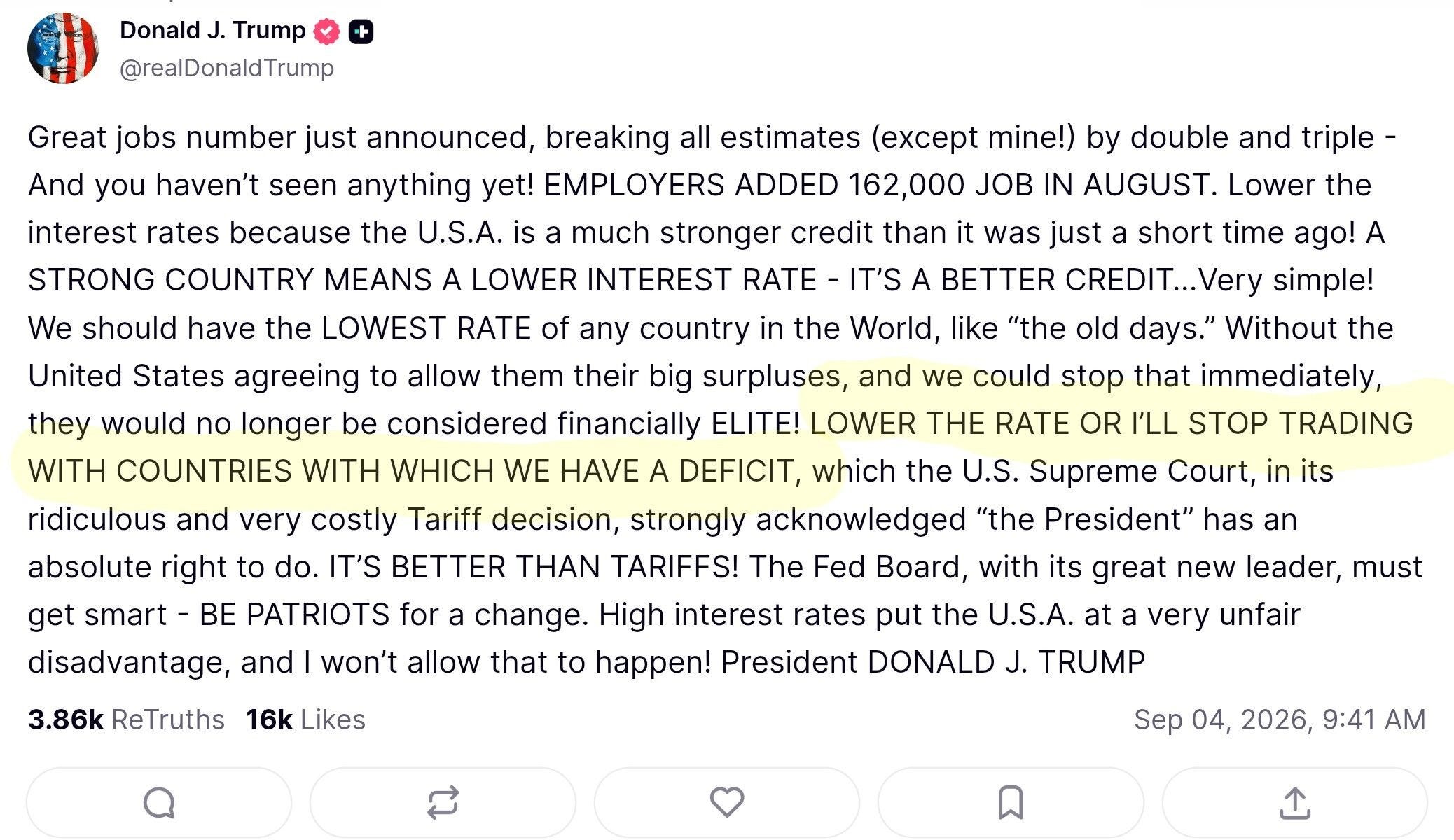
If I’m reading this correctly, the president is threatening the Fed… with tariffs. Actually, not tariffs — the Supreme Court ruled that unconstitutional. So it's sanctions. I'm not kidding.
And there’s more madness. The end result is that the president is posting through objectively good news in a way that may actually undermine your confidence in our economic future.
Another excellent post, Justin, although I might push back on the importance of wages on inflation (not your point that real wage growth is negative, because that is correct and a problem). Excess aggregate demand and supply shocks (at least in the short run) are the key determinants of inflation. In most cases, wages respond to prices, not the other way.
Hope to see you at ELC and at John’s memorial seminar.
Insightful, Justin. I’m also an econometrician but at 81, have a bit more bark on me than you at your tender age. I started professional life in the Steel Industry, Youngstown Steel, and was there in 1974 when Lykes Brothers Steamship Company pulled off the first LBO, and sold all the piece parts. 15,000 people lost their jobs that day (mostly men) along with another 75,000 or so who their wages supported in the community. Today the city has shrunk to half its former size, and has an economy based mostly on the local university and Health Care. Seems your point is made.