


The stock market is breaking records. Corporate profits are booming. And yet plenty of us look at our paychecks and don’t quite feel the boom.
There’s one big idea that can explain this disconnect. It’s called labor’s share of income. It’s how we divide our economic pie between workers and owners. The labor share measures the share of income that goes to workers.
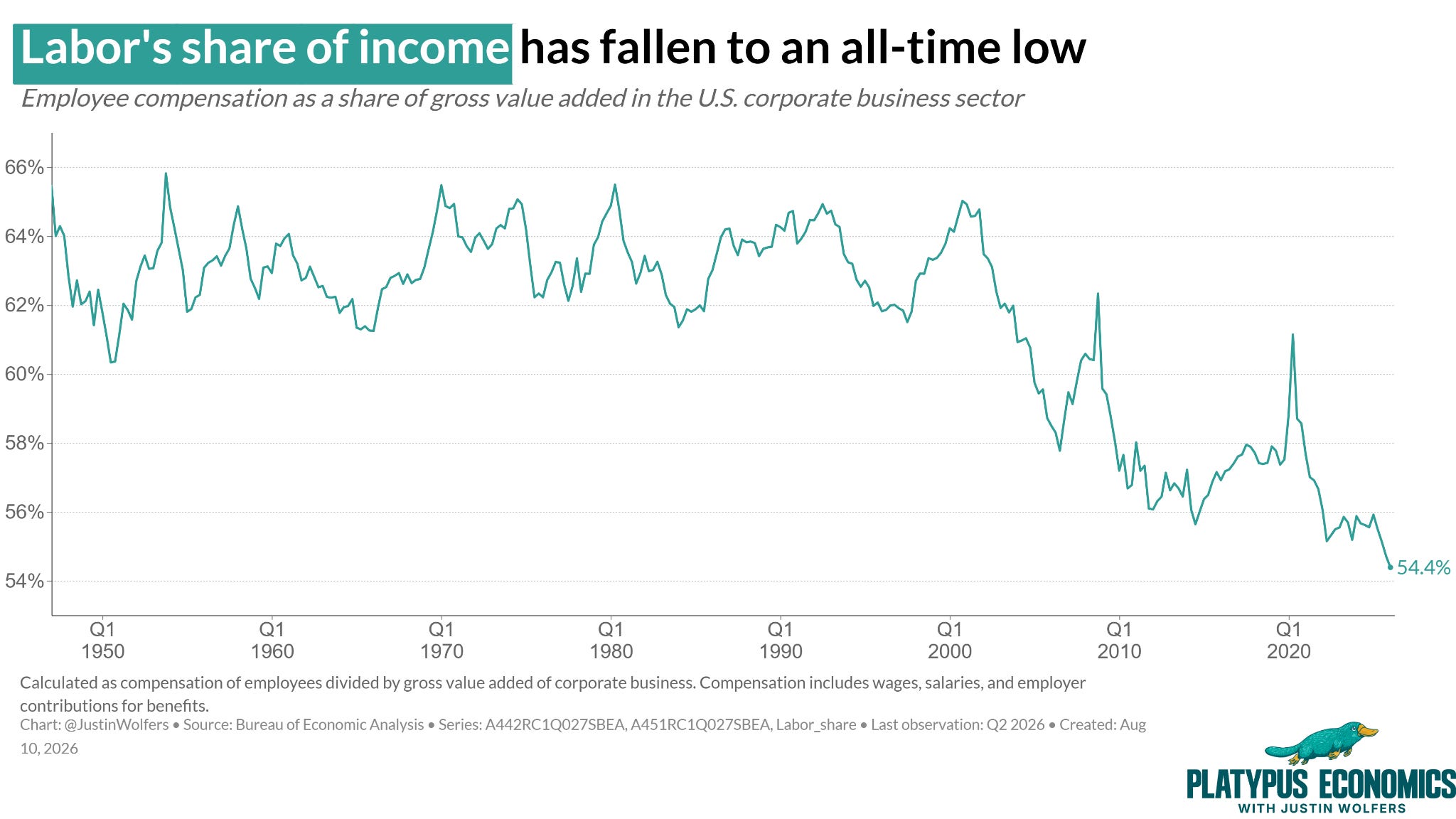
Right now, workers are getting just 54 cents of every dollar of income America generates. That’s the lowest share on record.
It follows that our economic pie is increasingly being served to owners who get profits, dividends, rents, interest and other forms of capital income.
Today I want to ask: what’s going on with the labor share?
Workers vs Owners
For decades, workers received roughly 62 to 65 cents of every dollar of income generated in America. That includes wages, but also benefits like health insurance and retirement contributions. The number bumped around a bit during booms and recessions, but remained remarkably constant. Indeed, John Maynard Keynes once called the constancy of the labor share “a bit of a miracle.”
Then, around 2000, something changed.
Labor’s share started falling. It bounced back briefly during the pandemic, then resumed its slide. Today it’s around 54 cents on the dollar.
To be clear: I’m not saying that workers are poorer than they were 30 years ago. On average, they’re doing better. The size of our economic pie has grown, and so a smaller slice of a bigger pie still adds up to more pie.
My point, instead, is to focus on the change in how we slice that pie. It matters because the split between workers and owners is one of the most important factors driving who gets what from our economy.
But it’s a factor that’s easily overlooked. Last week, Treasury Secretary Scott Bessent went on CNBC and declared that the “K-shaped economy is over.” A couple of days later, he posted the following chart on X to make the case:
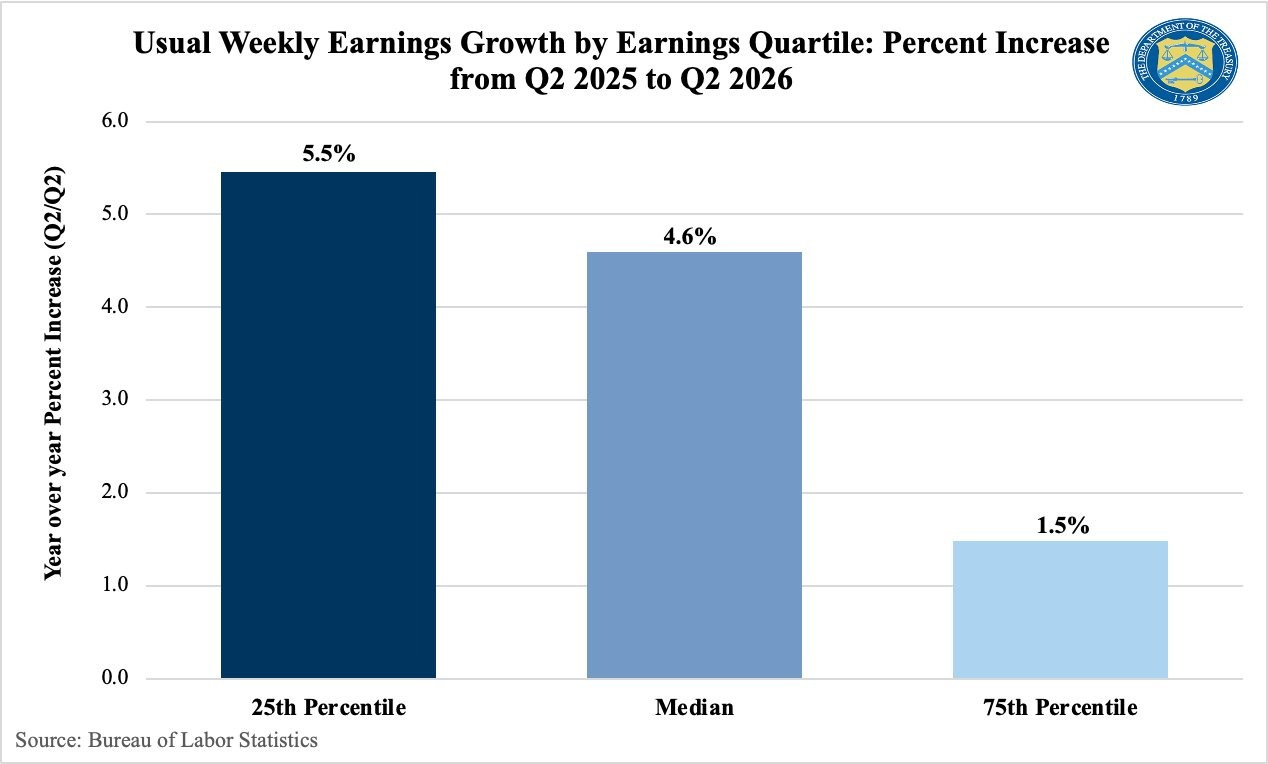
The chart is basically right — at least as far as it goes. Over the past year, weekly earnings did indeed rise faster for lower-wage workers than for middle-wage workers, and faster still than for higher-wage workers.
That’s good news. But Bessent’s chart is answering a narrower question than it appears to. It’s inviting you to focus on what’s happening to labor income, without even considering capital income.
He’s relying on a mental shortcut that many of us use. Most of us are workers, so when we think of income, we think of wages. But that misses the income owners get as profits, rent, interest payments, and dividends. Bessent is effectively inviting us to ignore the 46 cents on every dollar of income that’s paid to owners.
Let’s not fall for this misdirection. When you’re interested in what’s happening to income, make sure to track what’s happening to all income — including both wages and profits.
Follow this advice, and you’ll realize that while Bessent is right that lower-paid workers are gaining on higher-paid workers, he’s stayed quiet about an even more consequential shift in which workers as a whole are losing ground to owners.
All of this matters enormously because labor income and capital income are distributed very differently. Most families benefit when wages rise, but only the rich see big gains when capital income rises.
The Treasury Department estimates that the top 10% of American families receive about two-fifths of labor income, but roughly four-fifths of positive capital income. Most of us don’t spend much time thinking about capital income because most of us don’t get much of it.
And at the very top, the difference gets wild:
The top 1% gets about one-tenth of labor income, but over half of capital income.
And the top 0.1% gets roughly 4% of labor income and nearly a third of capital income.
Point is, shifts from labor toward capital have a huge effect on how much of our economic pie we each get.
Is the decline real?
Before we declare that workers are getting the narrowest slice of the pie on record, we should make sure we’re measuring the division of that pie properly.
And when it comes to measuring labor’s share, it gets tricky, quickly. There are two big issues to track: net versus gross income, and the income of business owners. Let’s take them in turn.
Issue #1: Net income versus gross income
Here’s the issue: Some of the money going to owners isn’t really income anyone gets to spend.
Businesses have things that wear out. Trucks get old. Machines break. Buildings deteriorate. Software becomes obsolete. Replacing all that costs money, and we call that cost depreciation.
The 54% labor-share number counts income before subtracting those costs. That is, it’s based on gross income. We take everything workers receive in wages and benefits, and divide it by the total income businesses generate.
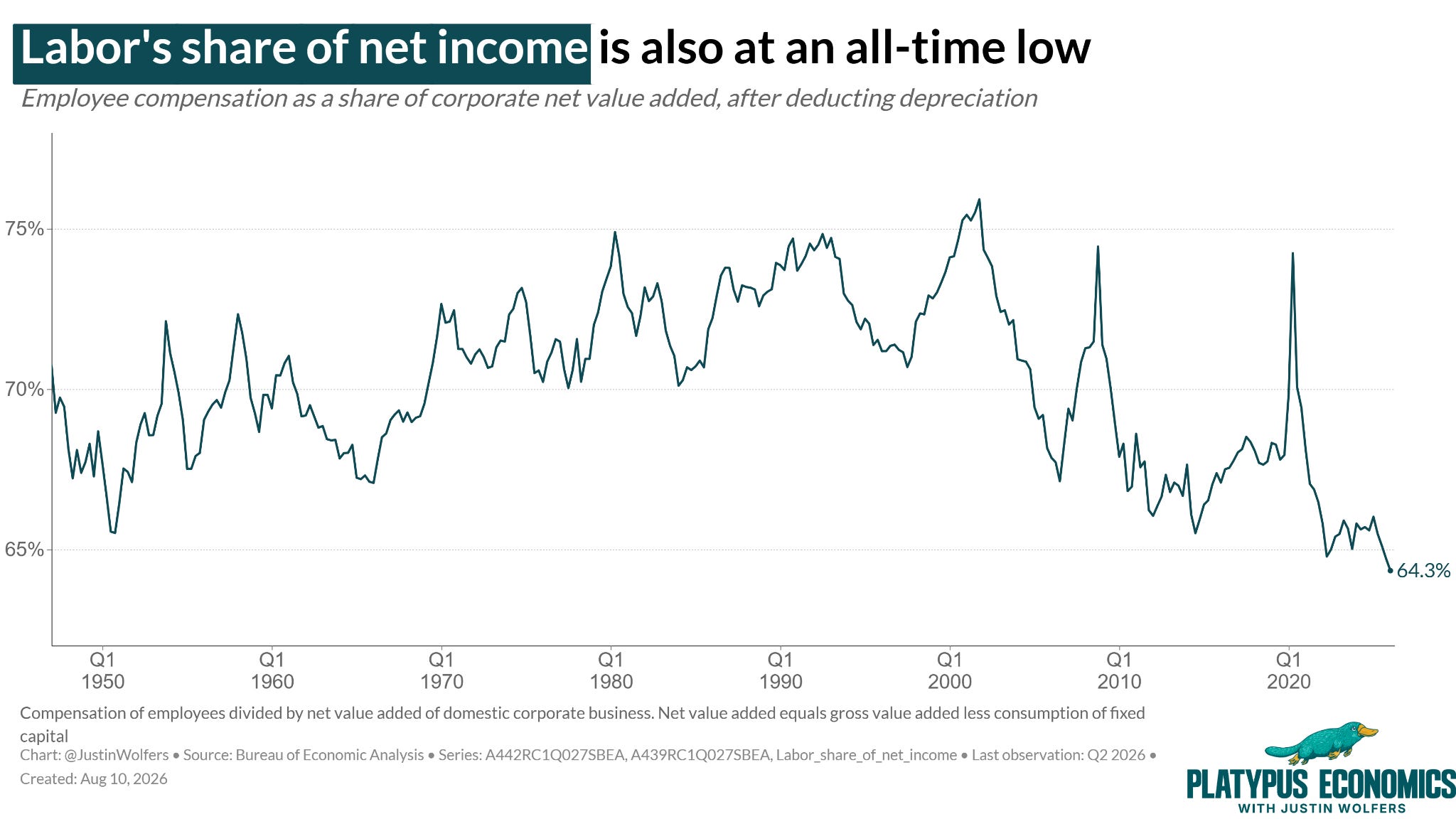
We could — and perhaps should — focus on labor’s share of net income instead. So I repeated the same calculation but first subtracted depreciation the measure of income we use in the denominator. This gives us what economists call the net labor share: 64.3%.
This adjustment changes the level of the labor share, but not the story: Even by this alternative measure, workers are getting a historically small share of net income.
Issue #2: The work done by business owners
The second complication is that sometimes it’s hard to know whether a dollar is earned as a wage or a profit.
To see this, let’s put you in charge of your own consulting firm. As the boss of your one-person firm, you’re both the worker and the owner. As such, it’s hard to tell which dollars to count as wages, and which as profits. This creates opportunities for some creative accounting.
Owners of some kinds of firms (S-corporations) can often reduce their tax bill by reporting less of their income as wages and more as profits. Others (owners of C-corporations) face the opposite incentive and can do better by reporting more of their income as wages.
Tax rules act as a bit of a constraint. The IRS requires business owners to pay themselves a “reasonable wage.” But this is a bit of a loose idea, and business owners often find the most “reasonable wage” to be the one that leads them to pay lowers taxes.
And so changes in the tax code that shift these incentives can lead business owners to relabel wages as profits (or the reverse).
Economists Matt Smith, Danny Yagan, Owen Zidar and Eric Zwick have shown that changes in how business owners report their income — along with shifts in how businesses are legally organized — account for roughly one-third of the measured decline in the labor share over recent decades.
That’s a meaningful correction. I call it a correction because it diagnoses some of the fall in labor’s share as the same dollars of income being relabeled, rather than re-allocated.
Even so, after accounting for this shift, there’s still been a remarkable fall in labor’s actual (rather than reported) share of national income.
How big is the shift?
Okay, let’s step back and get a sense of the scale. How meaningful is this shift in how we slice our economic pie?
The American economy produces roughly $30 trillion of income each year. That means:
One percentage point of national income is about $300 billion.
Spread across American workers, that’s nearly $2,000 per worker per year.
Suppose we say — somewhat conservatively — that labor’s share has fallen by about 5 percentage points. This means that annual wages are roughly 5 × $2,000 = $10,000 lower per worker per year.
So yes, the stakes here are huge. Any discussion of inequality that misses the shift from labor to capital is missing a big part of the story. (Secretary Bessent, take note.)
To be clear: the economy hasn’t lost those dollars — they’re now going to owners as profits, dividends, interest and rent. The same math implies that capital income per work has risen, an average of $10,000 per worker per year. But that’s a bit like saying that, on average, you and Warren Buffett are doing pretty well. That’s true, but it doesn’t really tell the story. In reality, most folks experienced a big part of that shift away from labor, and a much smaller elite enjoyed the shift of income toward capital.
They might be giants
So why did capital’s share grow?
One view is that we increasingly live in a Walmart world.

I don’t actually mean Walmart specifically, rather an economy built around giant firms with incredible logistics, sophisticated software, global supply chains, and the ability to serve millions more customers without hiring millions more workers.
Think about two restaurants:
The first is your local joint. There’s a terrific cook, a few servers, an old cash register, and a noisy kitchen.
If business doubles, this restaurant probably needs a lot more people.
The second, a chain. It invests in automated ordering, centralized purchasing, standardized kitchens, delivery software, efficient logistics, and national marketing.
Those systems cost a fortune to build. But once they exist, sales can rise much faster than payroll.
And if chains like this take market share from smaller, more labor-intensive restaurants, then labor’s share will fall across the entire restaurant sector— even if the labor share within each restaurant remains unchanged.
That’s close to what economists Joachim Hubmer and Pascual Restrepo find has happened in manufacturing and retail. In their story, neither kind of firm becomes stingier with workers. Instead, technology gives large firms the ability to automate, scale up, and capture more of the market. Those firms tended to use less labor for each dollar of sales.
By their telling, as the share of these superstar firms grew, labor’s share of the economy shrank.
Power shapes who gains
Technology can make the economic pie bigger. But it doesn’t decide how to slice the pie. We do.
When a company becomes more productive, the gains have to go somewhere. Customers might get lower prices. Workers might get higher pay. Owners might get higher profits. Governments might collect more tax. Usually, everyone get a bit. How much they gain depends on bargaining power.
When workers have leverage — because jobs are plentiful, unions are strong, or businesses are competing hard for staff — their slice of the economic pie gets bigger.
But when workers have fewer options, owners get more of the pie.

Globalization changed that balance.
International trade has brought enormous benefits: lower prices, bigger markets, and good jobs in export industries. But it also made it easier for some companies to move production elsewhere.
And sometimes the threat matters even when the job never actually moves. If your boss can credibly say, “we could move this factory to a low-wage country,” your bargaining position just got weaker. You might choose not to push for a pay rise, and in return your boss agrees to keep your job in America (for now). Notice that workers can lose out even if the factory never moves. It’s enough for your boss to have that option.
There’s a broader point here: The way the pie gets divided is not handed down from the heavens. Markets shape it. Rules shape it. Technology reshapes it. Norms matter. So does history. Politics can rewrite rules. In brief, Power matters.
AI raises the stakes (and rewrites the rules)
The stakes in the centuries-long conflict between labor and capital are about to get a whole lot bigger. That’s because AI might be about to upend how we bake our economic cake.
Whether that leads workers to get a more generous slice depends on one important — and as yet unresolved — question:
Does AI make workers more valuable, or make workers less necessary?
One possibility is that AI works for people. For instance, it helps a nurse spend less time on paperwork, a teacher build better lesson plans, and a small business do things that once required an entire back office.
In this case, AI makes people more productive. Workers get more done, firms earn more, and some of those gains show up in higher wages and better jobs.

The other possibility is that people work for AI. In this case, AI automates the tasks workers used to perform, strip judgment out of jobs, monitors employees closely, and allow companies to produce more stuff with fewer people.
As a result, workers become easier to replace — and owners capture more of the gains.
Economists Daron Acemoglu and Pascual Restrepo offer a useful way to think about these two possibilities. Technology can create new tasks where people remain especially valuable. That tends to increase demand for workers, and could boost labor’s share. Or it can automate existing tasks that people used to do. That pushes the other way.
You might recognize these ideas from a recent post about a past technological revolution:

A lot of ink has been spilled about how much AI will enlarge our economic pie. This new distributional perspective highlights that it’s just as critical to consider who becomes more valuable as a result.
If AI makes workers more productive and workers share in those gains, we get higher wages, better jobs, shorter workweeks, and a richer society.
But if AI mostly replace workers with computers — and the gains flow overwhelmingly to the people who own the technology — then the pie gets bigger but most workers won’t gain much (and may even lose).
The scale of the ensuing shift from workers to owners could dwarf what we’ve seen over recent decades. The stakes here are enormous.
* One more thing (for my nerdy friends)
When I create these newsletters videos, I often crunch a few numbers in Stata, with whom I’ve got a paid partnership.
Today, I used it to compare labor’s share of income with and without depreciation. You can follow along with this worksheet here!
I never enjoyed economics in college and the greedy profit maximization I saw in my business career left me cold. Prof. Wolfers has be engaged in a new classroom and learning new things every day.
Wolfers tells us that In the Republican Reaganomics era political decisions that favored the wealthy (or "owners" described in this piece) were supposed to "trickle DOWN" economic benefit to all from the owners or wealthy patrons. Is that working for you? Instead, Republican policies that favor the rich owners seem to have put all economic benefit on an "elevator UP" to the billionaires. And then he points out that shifts in income of workers and owners results in and relies on POWER.
The "volume" or number of "workers" is greater than the "owners." How do workers use the power of volume to move to a more balanced distribution of wealth and/or income? What - besides wage bargaining - do workers have to shift economic benefits from their work?
Hi Justin, Good posting. Got me thinking about my own journey through life (I’m a boomer). When I entered the labor force, 100% of my income was wages. When middle aged, I left a very good position to start a company so then my income became a mix of profits and wages. Then I retired and now almost all of my income is from investments (retirement plan and 401K rolled over to an IRA plus capital gains, interest, and dividends from investments made with after tax money). So I wonder how much of the statistics are driven by my very large generation taking this path? In addition, when I view these types of statistics or, as in this case, read someone else’s take on them, It gives the impression that people are either laborers, investors, rich, poor, or middle class etc. Hey, maybe you could write a post about trends in upward mobility in the US. What do you think?