


Dario Amodei, co-founder and CEO of Anthropic, has warned that artificial intelligence could wipe out half of all entry-level white-collar jobs within five years, possibly pushing unemployment to 10% or 20%.
And yet, today I want to talk about bootmakers in Victorian England.
Bear with me.
I’m just back from a conference where I heard a terrific new paper presented by Hillary Vipond, a brilliant young economic historian. And I’d like to share the carefully researched story she told about a previous technological revolution.
Victorian bootmaking is not the same thing as a large language model, but history is a useful reminder that some outcomes that sound unlikely — namely, a labor-saving technology transforming the nature of work without cutting the number of workers — can actually be pretty plausible.
A New Technology Arrives
Take yourself back to the mid-19th-century England.
Bootmaking, as an industry, was huge. There were about 220,000 English bootmakers in 1851, making it the fifth-largest occupation in the country. Roughly one in thirty workers made boots.
Back then, bootmaking was craft work. It involved cutting leather, shaping it, stitching the upper together, attaching the sole, and finishing the product. This was skilled, hands-on work and a bootmaker might know the whole trade, from leather to laces.
But in the late 1850s, this profession got hit by a radical new labor-saving technology as the sewing machine was adapted to heavy boot leather.

Now a machine could stitch the leather upper together much faster than anyone could by hand. And workers using the new technology could produce more than four times as much as workers using the traditional methods.
Importantly, this breakthrough didn’t stay contained in one stage of production. Once the stitching got faster, the rest of the process became the bottleneck, creating pressure to speed up the other steps.
Suddenly, the old craft system started giving way to something much more mechanized, and an entire industry had to work out what happened next.
Cheaper Boots, More Boots
For bootmakers, this was not some abstract “future of work” seminar. This was their trade, their skills, their livelihoods. And in at least one bootmaking district, thousands went on strike for more than a year as they tried to stop this new technology from remaking their industry.
But before jumping into the impact on labor, I want to pause on the implications for the market for boots.
If a new technology lets each worker make many more boots per hour, then the cost of making boots falls. If the cost of making boots falls, then boots tend to get cheaper. And when boots get cheaper, more people buy more boots.
That step matters.
A lot of debate around automation skips from “this saves labor” straight to “therefore there will be fewer jobs.” But that leaves out the work done by markets and prices.
Prices adjust. And in doing so, they stimulate a greater quantity demanded.
This is where I want to introduce you to a charming character named William Stanley Jevons. He was an English economist, and a bit of a polymath. He actually spent a few years working in Australia — at the Sydney Mint — before going back to Britain to complete his education.
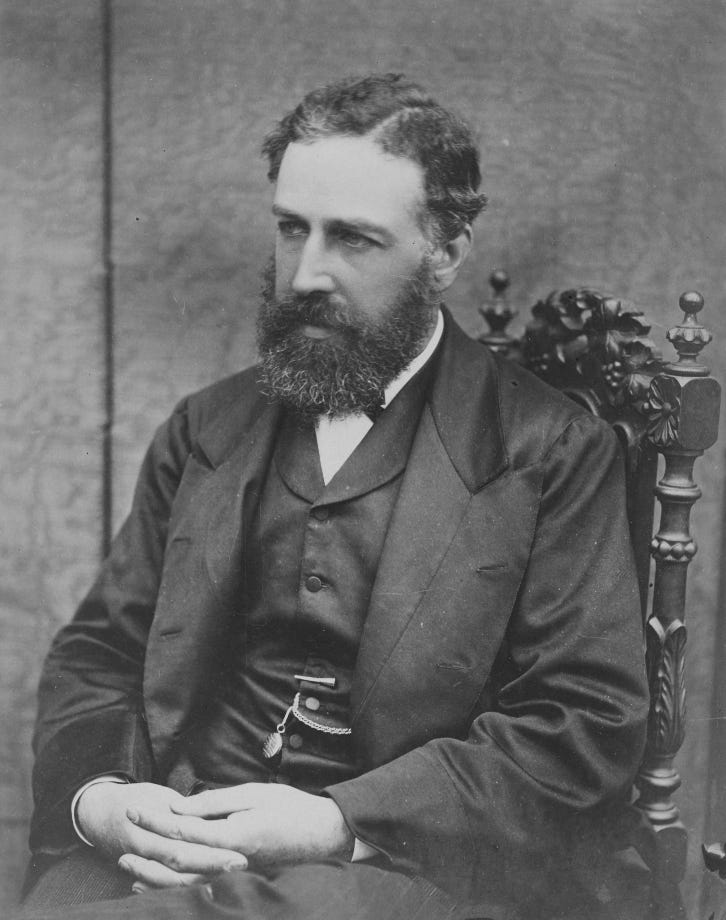

Now, Jevons never wrote about boots, but he cared a lot about coal. And the puzzle he noticed was this: When steam engines became more efficient, Britain didn’t use less coal. In fact, it used even more. And that’s because efficiency made coal-powered activity cheaper, which made more of it worth doing.
That idea — that finding ways to use a resource (like coal or labor) more efficiently might lead you to end up using more of it — is called the Jevons paradox. Though if you think hard enough about it, it’s not really that paradoxical.
The broader forces here are often described by economists as “creative destruction.” It’s a useful term, but it can mislead if you stare only at the destruction bit. There’s also the creative bit: new technologies create new demand, new tasks, new firms, and new forms of work.
And in this story, that part mattered quite a lot.
Jobs Survived, But Changed
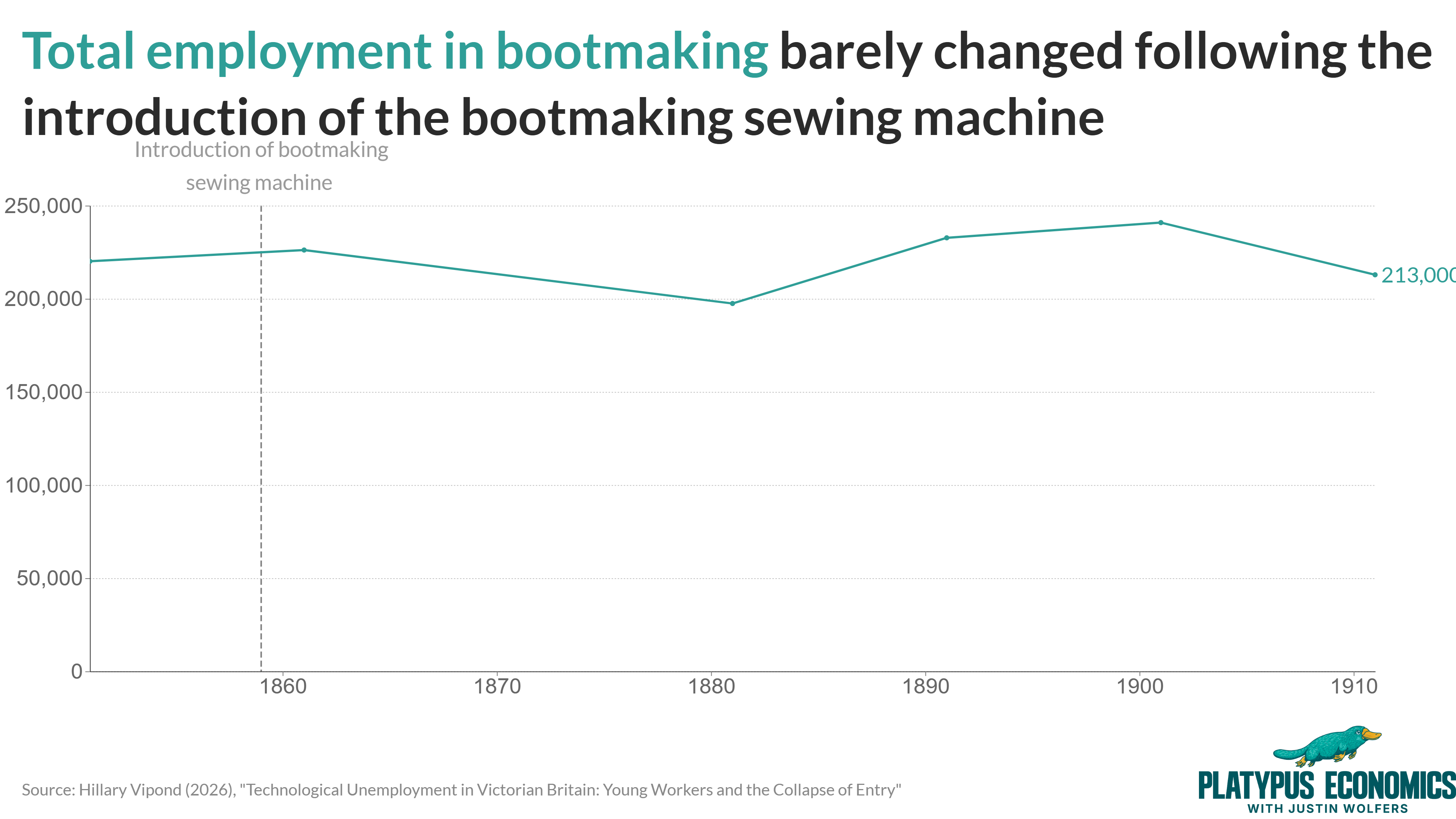
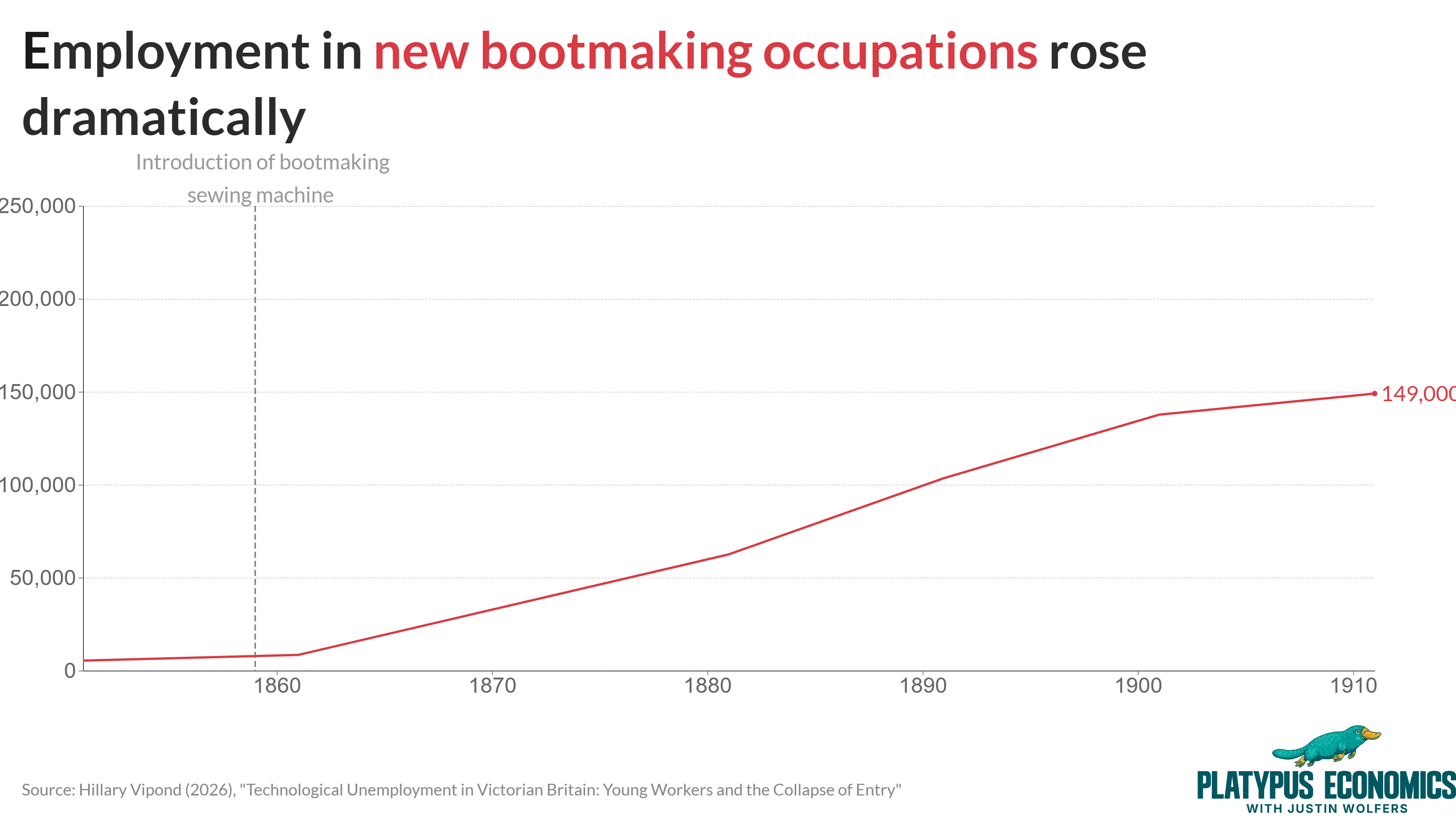
Now for the astonishing headline: English bootmaking went through a full technological revolution, and employment barely budged. There were about 220,000 people working in this industry in 1851, and about 213,000 in 1911. That’s remarkably little net change across sixty years of upheaval.
But beneath that calm surface, the work was remade.
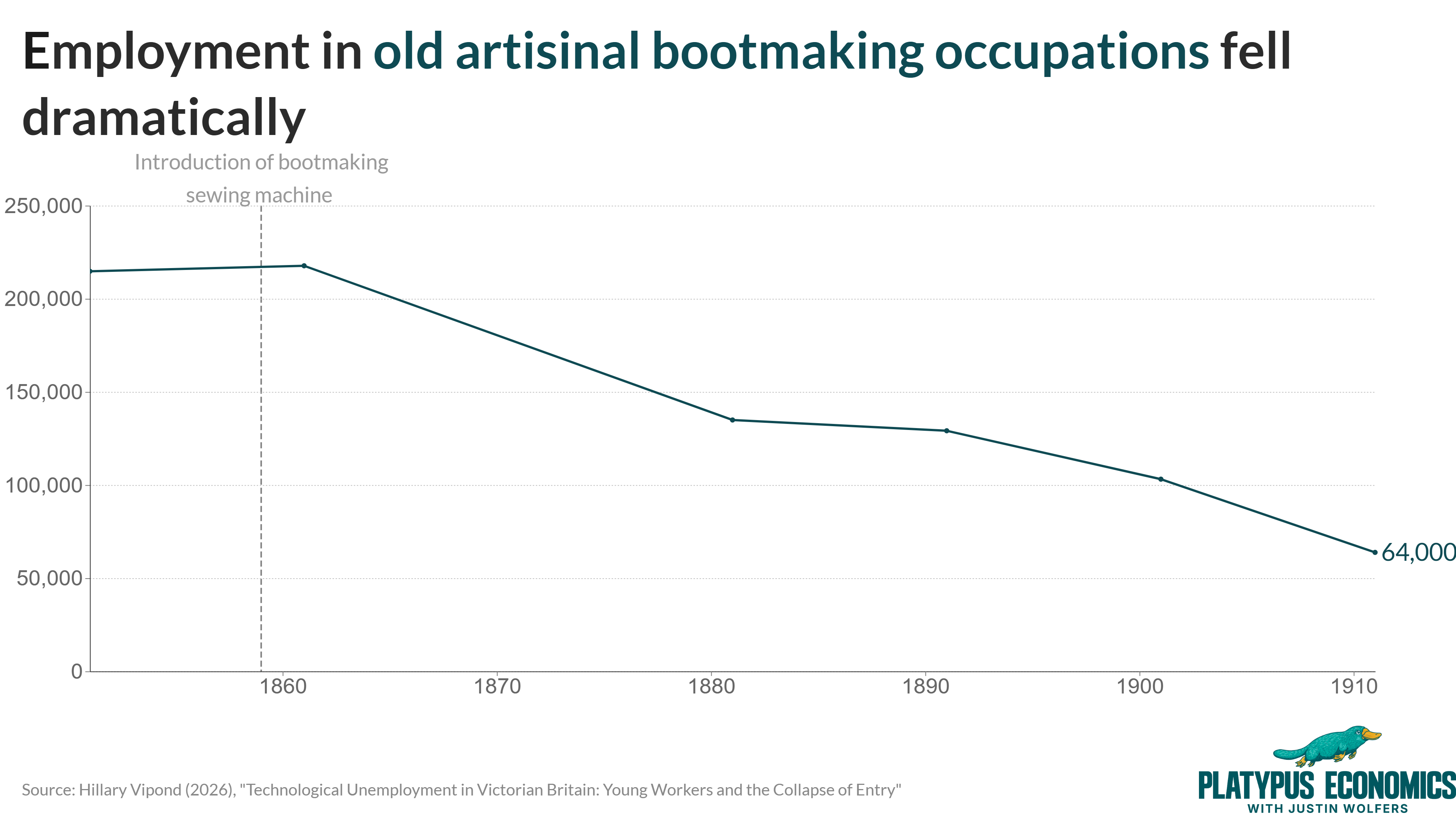
The old craft world was built around occupations like cordwainers, binders, closers, and cloggers. As mechanization spread, those occupations shrank dramatically.
And in their place came a much more factory-shaped world: machinists, riveters, and operators.
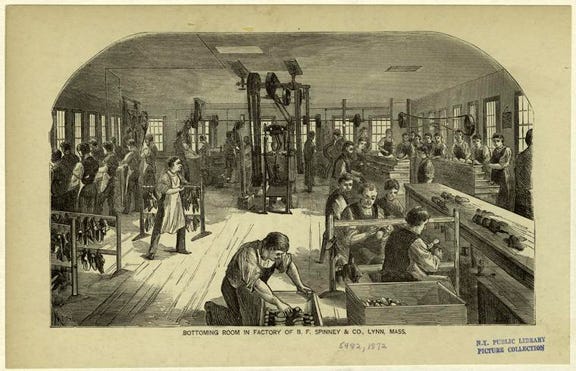
There were also jobs created to coordinate the new, more complex organization of work. Some are obvious, like managers, foremen, and supervisors. But there were also new roles for accountants, clerks, and wholesalers.
Here’s some arithmetic: Roughly two-thirds of the jobs in the old artisanal occupations disappeared and were replaced by almost the same number of new jobs in the factory-related occupations.
This two-sided nature of technological change — jobs destroyed and jobs created — helps explain some of the anxiety around AI right now.
When people imagine AI, it’s very easy to picture the destruction: occupations disappearing as large language models take over their tasks. Right now, that’s anxiety about the first rung of the career ladder getting kicked away.
What’s much harder to picture are occupations that don’t yet exist: new tasks. New firms. New ways of organizing work. You can’t picture them, because nobody knows what they’ll look like yet.

But the story of Victorian bootmakers reminds us that a big technological shock does not always mean a collapse in the total number of jobs. Sometimes the big change is actually a deep reorganization of the work itself.
A Change in Place
The next part of the story is about geography.
Old-school artisanal bootmakers used to be spread pretty much everywhere across England. So the end of that way of making boots cut jobs in nearly every part of the country.
But with the new jobs were not so evenly distributed. They were tied to factories and larger enterprises, and these larger bootmaking companies were clustered heavily in just a few places.
Just two counties, Northamptonshire and Leicestershire, captured nearly half of the jobs in the newly created occupations.
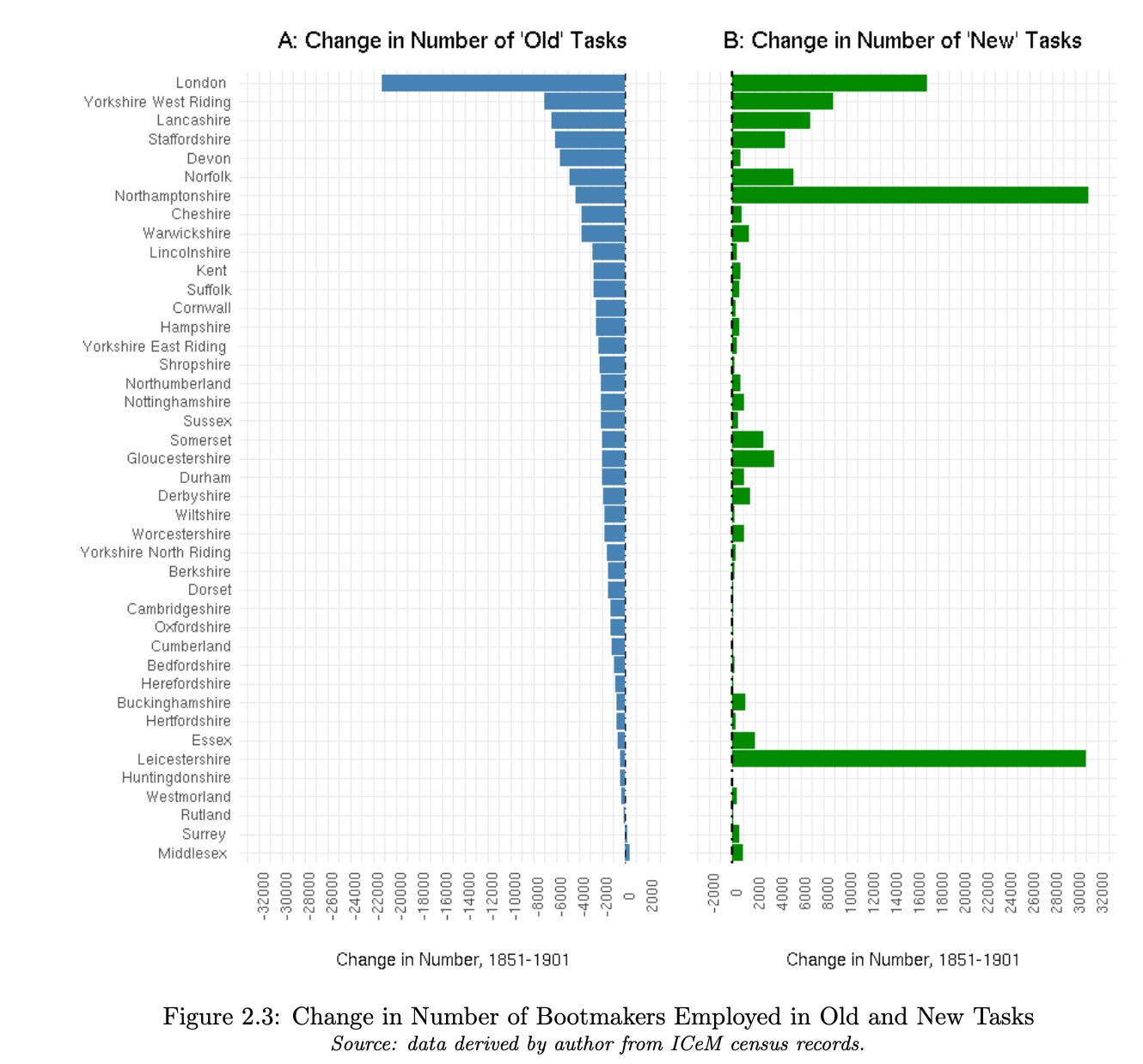
So while bootmaking survived in the aggregate, it increasingly lived at different addresses.
But importantly, this all played out over several decades. Most of the incumbent artisans didn’t actually lose their jobs. Instead, the next generation increasingly stopped entering the dying occupations, and entered new ones.
It wasn’t painless. But it could have been a whole lot worse.
Lessons for AI
So what does this tell us about AI? Maybe less than you might hope.
This history doesn’t predict what AI will do to the economy, but it might help widen the range of outcomes you can imagine.
The story of the Victorian bootmakers puts a good-news version of technological change in sharp focus: A major new technology arrived and transformed production, but it did not lead to a mass displacement of existing workers.
Slow adjustment and persistent demand helped shield many incumbents while the industry changed around them. New tasks emerged and new jobs were created. And the pace of change may be central to why it played out that way.
I chatted with the author of this research, Hillary Vipond, and she told me she thinks the pace is a big deal. In this case, the technological change was slow enough to grandfather older workers through the transition — if AI moves much faster, that gentler adjustment may be much harder to achieve.

But if the AI transformation slows down a bit, it’s possible we could get more of the promised productivity gains without all the promised unemployment. Maybe the creative part of “creative destruction” has time to arrive, and new tasks and firms emerge quickly enough to absorb the shock.
Economics is pretty good at helping us think through mechanisms. It’s much worse at giving us certainty about the future. This story by no means settles the AI debate, but it teaches us how to think about it more clearly.
Rather than just asking how many jobs might be destroyed when a new technology arrives, we should ask what might be created and how quickly that transition will happen. Also: Will the new work show up in the same places, inside the same firms, for the same people? Or will those change, too?
It’s much easier to imagine destruction than creation. But that is an asymmetry in our imaginations, not in the economy. Your task: As you think about AI, try to bring both the creation and destruction parts into focus.
Great piece today. I firmly believe that the doom and gloom of people wanting new things to fail is failure to see what might be, indeed is already happening. Sure there are failures and bad things, but how do we survive if we stay status quo?
On another note, I'm not happy with Delete Me; I subscribed on your advice, but I don't see that they've cleaned up, reduced my spam - phone calls, email, messages to any degree. Maybe you should take another look at what they say they will do as opposed to what they actually Don't do!
Having personally survived the rise of the computer industry (I wrote my first code in 1962) and the subsequent .Com meltdown, far more recent technology transitions than bootmaking, I'll say your analysis is completely correct. And I do believe the AI revolution will be forced to slow down as no company wants to adopt a system that will indiscriminately hack other companies and their own. The lack of sanity around AI adoption is completely the product of Trump and his friends in the AI business. We still have a federal system, and states are still "the laboratories of democracy."
I am personally using Claude AI Code and I find it makes mistakes about 5-10% of the time. I spend a lot of time testing and debugging the code that Claude writes. I even drew in Fable 5 to critique the code produced by Opus 4.8. I've found that I don't need to know any particular coding language any more, but I do need a strong grounding in basic principles of coding. I suspect the change to primarily AI coders to be far less dramatic than many currently envision, for exactly the reasons you state: we will need other people with other skills to take advantage of the increased coding productivity. Back in the 1970s I did an analysis for my then-supervisor that coding represented only about 7% of the total task to produce a working software system. Automating the coders won't make that big of a change in the overall requirements for labor. Again, this is all just what you said in this article.