


Last week, I looked at the White House’s “tax-free diesel” plan. That’s an executive order letting truckers fill up with the red-dyed, normally untaxed fuel usually reserved for farm equipment like tractors and bulldozers.
You can catch up on that here:
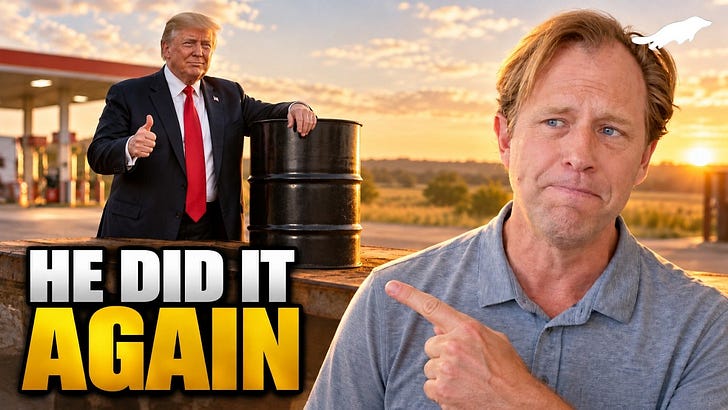
Now it’s time for The Professor Is In, where I sit down with my producer Augusta to answer audience questions. Think of this like office hours — my door is open, come on in.
The high prices question
One question Augusta asked me: If high prices are a way of rationing scarce diesel, is there any economic case for politicians pushing prices down?
My answer: there’s only so much diesel (at least in the short run). If you make it cheaper for truckers, they buy more, and that leaves less for farmers. If you make it cheap for everyone, you get long lines, where whoever is first is not necessarily the person who needs it the most. High prices shout: who really needs this?
But there’s an asterisk.
The Kim Kardashian Problem
Imagine this. It’s Thanksgiving, and there’s one slice of pumpkin pie left. Everyone around the table has already had their first helping. So your mum — who is a very good economist — holds an auction. She’s going to sell this pie to whoever values it most. I bid $5, you bid $10 because you love pie, and so you get the pie. Fair enough.
But what if Kim Kardashian is also at dinner? She doesn’t even really like pumpkin pie (I don’t either, for the record). But she bids $20, just because she can. The pie means almost nothing to her, but neither does holding on to another $20 bill. So she wins the auction, and the pie goes to her.
The problem is that markets allocate goods to those with the greatest willingness to pay. But this blends two different things: how much you want something, and how much money you have.
Efficient doesn’t mean ethical
Diesel is mostly bought by businesses, and so there, I’m fairly relaxed. If an extra gallon of diesel can make your company an extra $10 in profit, you’ll probably bid for it, whether you’re a big company or a small one. For consumer goods, I’m more worried. When economists call an outcome “efficient,” we’re saying that goods go to whoever is willing to pay the most. There are values hidden inside that definition. Those values may not be yours. They’re often not mine.
A market will reach an equilibrium. Is that equilibrium fair? That’s a different question. Kim getting a slice of pie while someone else goes hungry could be an equilibrium, but it’s also kind of bad.
More on tax-free diesel
Other questions Augusta put to me:
Who pays for roads if diesel taxes are forgiven?
Is a fuel tax an efficient way to pay for roads?
How on earth can I not like pumpkin pie?
Finally, how should voters weigh October surprises?
This red-dyed diesel relief runs October through December. The G7 diesel announcement landed just before the midterms. And we’ve resumed buying diesel from Putin with the first tranche due to arrive just before the midterms. This is after we decided not to fund a regime at war with Ukraine.
It’s never my job to tell anyone what to think. I can only offer a framing. As voters, we are the bosses of politicians. The president, congress — they work for us.
A policy that arrives the day before an election is often an admission: I could have dealt with this problem earlier… but I didn’t. Or normally I would think this is bad policy, but I’m okay with that if it helps me get re-elected. It treats voters as if we’re short-sighted, and easily fooled — that a last-minute pre-election promise of goodies will make us forget about the pain we endured during the rest of the year. It’s disdainful, and I don’t enjoy being treated with disdain.
Being the boss means deciding if you want serious governance. If so, don’t be impressed by gimmicks in October. If anything, it makes me feel resentful.
The oil and diesel crunch is a product of the war in Iran. The time to think about how oil markets would react to the war with Iran was a month before it started. Not seven months into a “four-to-six-week” war. When you’re playing with people’s lives, you have an obligation to at least do your homework.
One more request as we head into fall: I still need a theory of why anyone likes pumpkin pie. You can explain it to me in the comments.
Watch the full episode for the rest.
Something that Justin should be continually reminding his readers of, even when it comes to diesel, is that oil generally speaking is a global product. And the price is set globally not locally. That is why American Oil executives are collecting huge bonuses this year for the windfall profits that they have made from selling oil in the United States just like coals in Newcastle. But unlike the lesson of the aphorism, they are cashing in despite the fact that the United States is awash in Oil.
And back to Trump‘s motivation for buying Russian diesel. It is all about the Kompromat. Whenever Trump says “Russia, Russia, Russia, it’s a hoax”, you can automatically draw the conclusion that it is not a hoax. Trust me, it was Putin who called Trump over diesel, and to pass on the message that he would like Trump to do something about the pesky Zelenskyy, not Trump who called Putin.
Justin -- the efficiency argument doesn't change if Kim K loves pumpkin pie rather than hates it. She still has the most money and can outbid everyone for the last piece. But at least it's going to someone who appreciates it and won't just feed it to the dog under the table (woof!). But if we think about next year's Thanksgiving dinner, doesn't allowing Kim to pay more for the last piece of pie incent mom to purchase more pie for next year? Maybe she can sell another piece to Uncle Jeff Bezos (although that would reduce the amount his wife could donate to UM)? The point is that the more efficient outcome might seem less "fair" today, but it provides the signal to supply more in the future so everyone is full. Efficiency versus equity is a long running debate.