


On Friday, the G7 announced that it’s going to release 100 million barrels of oil and fuel products from its emergency stockpiles. President Trump is calling this a major concession from Europe that will bring down diesel prices and help American consumers.
Except, when you look closely, almost nothing new has happened. The G7 — that’s Canada, France, Germany, Italy, Japan, the United Kingdom, and the United States — agreed to do something they’d already said that they’d do.
The concession they won here? The U.S. agreed not to do something it should never have contemplated doing.
I don’t want to be too cynical. Gas and diesel prices are at near-record highs, and people are hurting. Taking action on that is good.
But in this case, the action the G7 took seems to mostly be leaders agreeing that leaders should be seen as trying to solve the crisis that leaders caused.
Actually doing something? Well, that’s probably going a step too far.
The road to the crisis
On February 28th, the United States attacked Iran. Shipping through the Strait of Hormuz quickly became hazardous, which was a problem, since nearly a quarter of the world’s oil and petroleum products passed through the strait in 2025. Once that became dangerous, the world’s energy markets were thrown into chaos. You’ve probably noticed that if you’ve tried to fill up your gas tank any time in the past seven months.
Enter the International Energy Agency, or IEA. The IEA is basically a club of the world’s advanced economies. When the world is hit by an energy shock, the IEA gets together to respond. Back in March they convened and agreed to draw down their emergency stockpiles and make 400 million barrels of oil available.
When they published the country-by-country plan a few days later, it actually added up to more than that — 426 million barrels total. That was the biggest emergency release in the agency’s history.
How large it was relative to the problem the war caused is something we’ll get into in a bit.
The thing I want you to notice for now is that this March agreement was agreed to in March. And that was a while ago.
Enter Donald Trump. Global disruptions mean that diesel prices keep rising. That hurts truckers, farmers in harvest season, construction firms, basically anyone who runs a big diesel engine. Oh, and if you hadn’t noticed — there’s a midterm election coming up.
So Trump floated a plan. Or sort of a plan. And he sort of floated it.
The president announced that he was going to ban exports of diesel from the United States. This is after he banned diesel exports from Russia and Iran. If you’re noticing that the president gives the same treatment to our own country as he gives to our enemies, that’s well-spotted. The plan was not well received, and I actually wrote at the time about what a bad idea it was:

A week later, Trump said he was still thinking about the plan. A few days after that, he said he’d never really been serious. So the administration’s position seems to be that it had a plan that it liked and disliked and was going to implement but that it was never serious about.
Then, last week, the leaders of the G7 met by video conference. Trump’s version of the story is that he dropped the threat to ban U.S. diesel exports, and in return, Europe agreed to release a massive amount of diesel.
That’s what he said. Perhaps more relevant is what the actual announcement says. It pledged a coordinated release of 100 million barrels of oil, diesel, and other fuels over four months. There was also a pledge that G7 countries will do their best to avoid energy export restrictions.
But what does this really mean? Who committed to what, in response to what, and does any of it matter?
Things start to get mushy
The world’s leading economies had already agreed to release 400 million barrels back in March. They hadn’t fully delivered on that pledge. So did Trump’s posturing get us anything new? Or is this just a promise to finish the earlier job?
Let’s look carefully at the G7 communiqué (and let’s all appreciate that I finally got to use the word “communiqué”). The key sentence says that, taking into account commitments that have already been fulfilled, the G7 will implement its commitments.
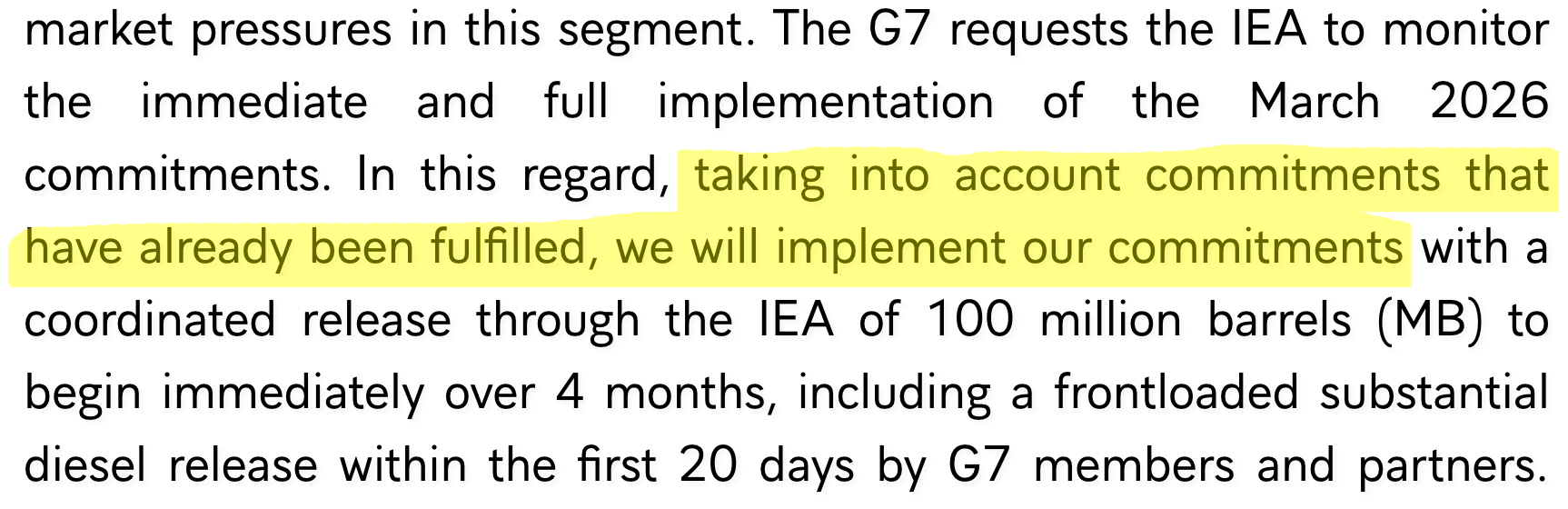
Read that slowly. They’re going to implement their commitments, taking into account commitments that have already been fulfilled. I read that sentence several times, and it had the warm, gooey texture of bureaucratic oatmeal.
Here’s what I think it means. Countries promised roughly 400 million barrels in March. They’ve delivered a lot of that, and there are roughly 100 million barrels left in the commitment. So the G7 is now saying, hey, let’s deliver the rest of what we already agreed to deliver. And we’ll try to get it done within the next four months.
This is an agreement to agree that they agree about the earlier agreement. Glad we agree on that.
There’s also a timing problem. The White House said that this was going to be a four-to-six-week war. We’re now seven months in. The emergency release, which was agreed to in the war’s first two weeks, will finish at the end of this new four-month window. So, close to the war’s first anniversary. Good work, everyone.
There’s one more wrinkle here. On September 29th, three days before the president called this a massive European contribution, the U.S. Department of Energy asked oil companies whether they wanted to take up to 40 million barrels from America’s emergency reserve. The department described this as part of completing America’s 172-million-barrel commitment that came under the March agreement.
That leaves us with an awkward question. Are those 40 million American barrels part of the G7’s 100 million? If so, when the president takes credit for Europe’s 100 million barrels, roughly 40% of them may be American oil we already owed.
I’ve dug into this pretty deeply. The honest answer is, it’s hard to tell. I’m pretty confident the U.S. is delivering another 40 million barrels from storage to the world market. The only thing I’m unsure about is whether that American 40 million is part of the G7’s 100 million barrel package. It’s impossible to say more, because neither the G7 nor the IEA has told us who owes the 100 million barrels that are meant to come online. Maybe the U.S. owes 40 of that 100. Maybe not.
Maybe you should interpret this lack of clarity as speaking to a lack or seriousness about this agreement. Maybe not. But it is striking to me that when I recently sought a travel reimbursement from my university, it involved a lot more paperwork than this 100 million barrel “commitment.”
The milk jug and the bathtub
Let’s take the most generous version of this for a second. Let’s say all 100 million barrels are new commitments to deliver extra oil to the world market. If that’s true, is it a lot?
I want you to build a simple habit here. Don’t be impressed by the number of zeros on a commitment. Compare it to the size of the problem.
The world produces about 100 million barrels of oil a day. So, this package equals roughly one day of global production. The release is spread over four months, which means that over the next 122 days, the world will get 123 days of oil supply. That sounds absurdly small because it is absurdly small.
The scale of the problem looks like this: before the war, the Strait of Hormuz carried about 20 million barrels a day. In August, which is the last month I could find good data for, the strait carried about 8 million. That’s a gap of 12 million barrels a day. The G7 package works out to about 0.8 million barrels a day (100 million over roughly 122 days). The daily gap is 15 times larger than the fix.
Imagine a bathtub with a huge drain. It’s draining 12 gallons a minute, which is enough to fill (and refill) a kitchen trash can. The G7 arrives, heroically, to refill the tub. To do it, they bring a single jug of milk that isn’t even full.
A commitment without commitments
There’s another word for a commitment without real commitments. It’s called a hope. You could also call it a wish, or maybe an intention. Here, we can use the term “press release.” Or in french, communiqué.
The communiqué promises a “front-loaded substantial diesel release” within 20 days. That sounds reassuring until you start asking questions. How many barrels will be diesel? Which countries will release the fuel? Which barrels are new and which are left over from March? When will each country deliver, and what happens if they don’t? The “agreement” doesn’t answer any of these questions.
“Substantial” isn’t a number. It’s an adjective.
A real commitment has teeth. It comes with a public scorecard, one that lets the U.S., Germany, France, Japan, the IEA, and the citizens of these countries all check whether the countries involved did what they promised. This deal has none of that. It doesn’t have a supply plan. Instead, it has a headline and a deadline.
That deadline presents a calendar of its own. Twenty days after the October 2nd announcement is October 22nd. The U.S. midterm elections are on November 3rd. The G7 doesn’t explain why it’s so important to get diesel to market just before the American election, but I suspect you can work out your own theory here.
Follow the money (or the people with money).
You don’t have to take my word for any of this. The people who trade diesel futures don’t care whether a press release sounds strong. They care about the price of a gallon of fuel. So let’s see how they reacted.
On the morning of October 2nd, the president got ahead of the G7 announcement by posting to Truth Social that Europe had agreed to release a “massive amount” of diesel immediately.
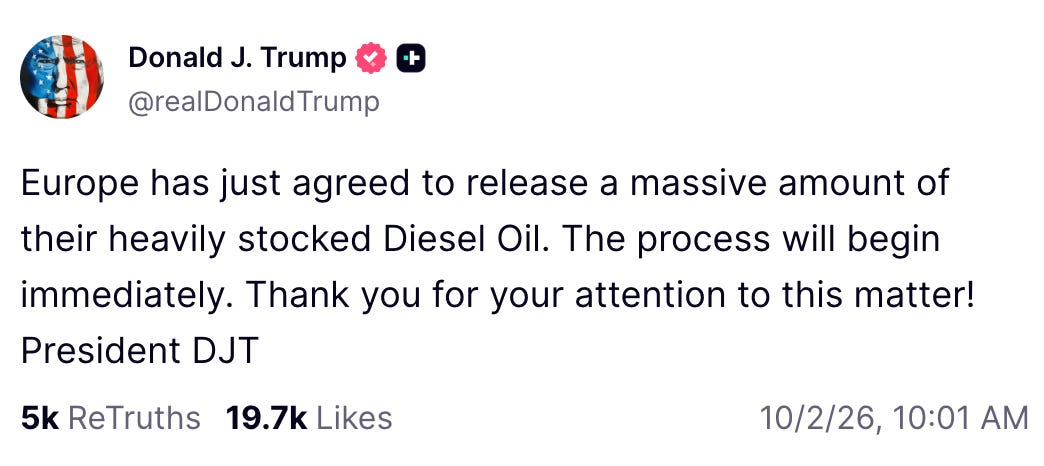
After this, diesel futures dropped fast. About an hour later the actual communiqué arrived with no diesel quantity, no country allocations, and no evidence the barrels were new. Within hours, futures had climbed back to about $4.55 a gallon wholesale, fully undoing the earlier drop.
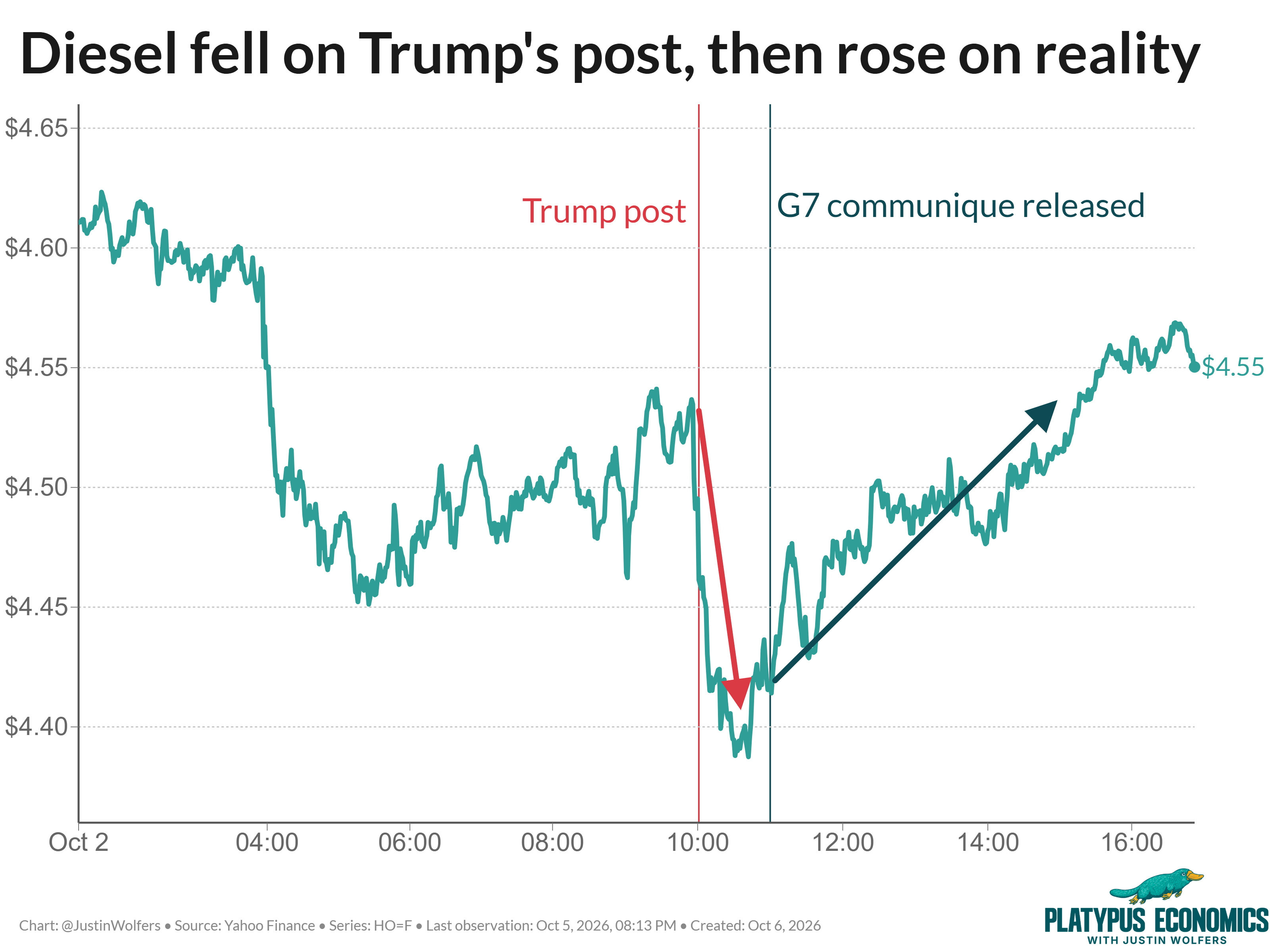
Traders liked the possibility of a massive European diesel release. Then, they read what the G7 had actually committed to and realized that nothing much had happened. By the end of the day, the price was essentially unchanged.
The futures market also gives us a longer-term read. Before the Iran war, traders expected diesel to wholesale around $2.35 a gallon for years. The day before the G7 announcement, they expected near-term prices of roughly double that, easing gradually but staying well above pre-war levels. On the next trading day after the announcement, the curve had barely moved.
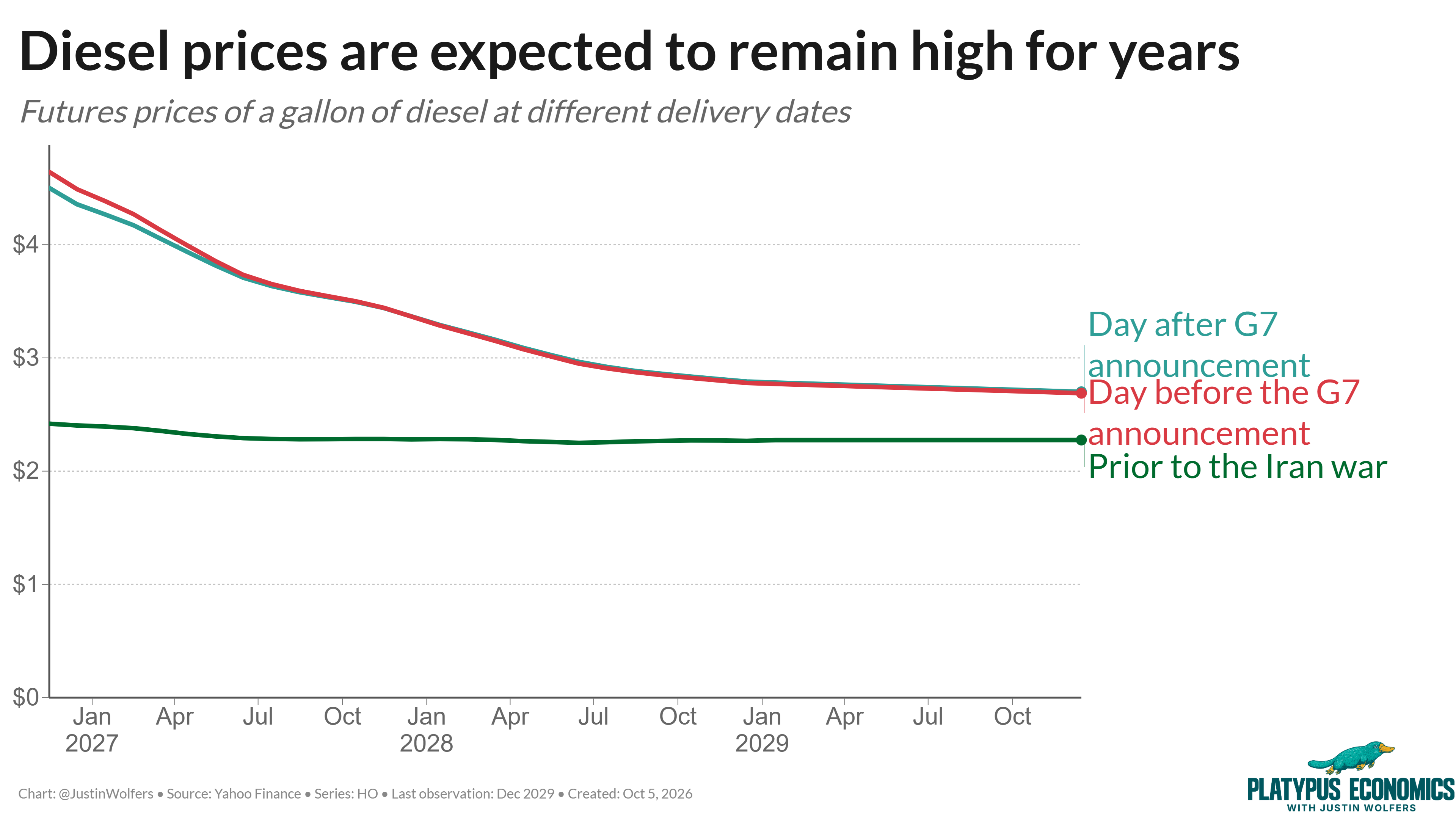
Diesel is expected to stay expensive for years. That’s the market’s verdict. The underlying shortage persists, even if some barrels shift over the coming weeks.
New compared to what?
Much of the media reporting on this deal breathlessly emphasized the size of the release while missing the problems. There’s no new oil, the barrels barely make a dent, and the promise is a vague statement of intentions. I don’t say that with malice. Journalists are generalists, and 100 million barrels has a lot of zeros. Economists spend years learning to be unimpressed. Instead of admiring the zeros, we count them.
You can do that too. When someone — especially a politician — waves a number at you, you should ask three questions. Is it new? Is it large? Is it enforceable? To answer those, you need to know what you’re comparing the number to.
This announcement fails on all three. It isn’t new, it isn’t large, and it isn’t enforceable. It’s the appearance of doing something without the thing actually getting done.
It isn’t new, it isn’t large, it’s bullshit so to speak
Dear Professor Wolfers. An engineering colleague of mine once said about data, “if you can’t put a number on it, it is insignificant.” My interpretation is that this is the gist of your argument. Nicely done.