


On Monday night, at a campaign rally in Nebraska, President Trump signed an executive order that he reckons will bring down the price of diesel. He’s trying to do this using something called “red-dyed diesel.”
Here’s what the order does. It takes a bunch of diesel that farmers use, and it opens that pool up to truckers. Then, it promises those truckers a tax break. That’s a tax break only Congress can actually deliver — and Congress isn’t the one making the promise here.
When this is all done, the President will have addressed everything except the underlying supply problem. And we will get a bunch of painful unintended consequences for our trouble.
This is the most recent in a line of attempts by the president to bring prices down. Earlier this week I dug into the G7’s recent announcement that they’re going to release 100 million barrels of oil over the next four months. Trump has been touting that as a way to bring prices down too, but surprise: there’s less there than meets the eye, perhaps even nothing:
By now, the administration’s fuel policy announcements have addressed nearly everything except the thing that pushed prices up in the first place. The war in Iran continues. On the home front, the president is trying to deal with high prices by changing tax rules around a product most people have never heard of.
Don’t feel bad if you’re one of those people. Red-dyed diesel isn’t mysterious. It’s diesel… with red dye in it.Same socks in different colors
Nearly everyone who drives on American highways pays a federal tax to fund those roads. That tax goes towards building roads, repairing roads, maintaining roads, and so on. When trucks fill up with diesel, there’s a federal highway tax of 24.4 cents per gallon already built into the price.
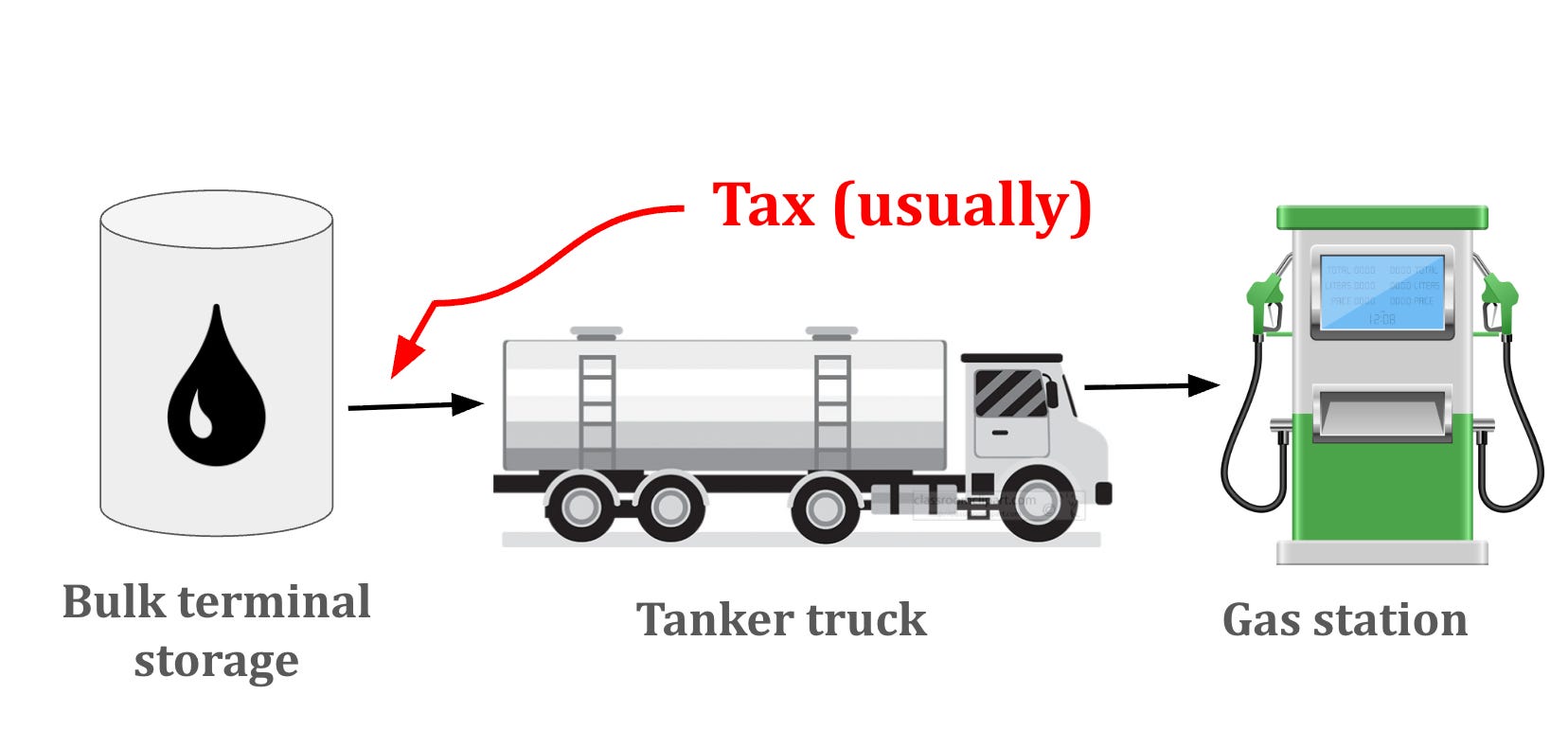
Most of us never see this tax. That’s because the driver doesn’t write the check. Instead, it gets collected way back up the supply chain, when fuel leaves the terminal on its way to the pump. By the time you see the price, it’s already got the tax factored in.
Now for the twist that makes this all possible. Not every American vehicle is meant for the road! Tractors, combine harvesters, bulldozers, mining equipment; these all run on diesel and do their main work off the highway. They’re also important pieces of equipment. It wouldn’t be quite fair to charge them a highway tax… and so, we don’t.
This creates a tricky situation. You’ve now got the exact same fuel, selling at two different prices. How do you stop someone from buying the cheap, untaxed stuff and using it to drive on the highway?
You dye it red!
Imagine a parent with twins. They buy a 10-pack of white socks and dye half the pairs. Now it’s easy to tell them apart at a glance and you know which belongs to whom. But they’re still exactly the same socks.
Red diesel like that, but for diesel. It’s ordinary diesel, and the government’s dyed it so you can tell right away if the tax on it has already been paid.
And by the way: the government does check. Inspectors dip a stick into a truck’s fuel tank and see what color comes out. If it’s red, you owe the tax, plus a penalty of $1,000 or $10 a gallon, whichever is bigger.
Fun fact: This is where the term “caught red-handed” comes from.
Okay, no, it actually isn’t. I’m an economist, not an etymologist. But it’s a nice metaphor for visualizing it.
I read the order so you don’t have to
With all this in mind, why is anyone fiddling with diesel colors? The answer: diesel is crazy expensive right now. A few weeks ago, the national average hit a record $6.52 a gallon. It’s eased a little since then, but it’s still roughly two and a half bucks more than it was a year ago. People are hurting. You might be one of them.
So, here’s the plan. For a limited time, truckers can fill up with red diesel and no one will penalize them for it. The White House says that this will save a trucker 24.4 cents a gallon, which, depending on the size of the tank, is about $60 a fill-up.
The hold on that penalty runs from October 5th through December 31st. October to December. Which month falls in between those two? Oh right: November. I will leave it to you to read between the lines on the significance of that month.
The White House’s logic goes like this: give truckers access to the diesel that doesn’t have a 24-cent tax on it, and the price they pay for diesel will fall by 24 cents.
That is not how economics works. Everything is connected. What the White House is doing, economists call partial equilibrium analysis. That really just means you’re telling the first chapter of the story. The cheap diesel now available to truckers has to come from somewhere. But where?
Two pools with limited water
Picture two swimming pools next to each other. They’re almost touching. The only thing between them is a wall.
The pool on the left is clear diesel. That’s where the truckers swim! The pool on the right is red diesel. That’s where farmers, miners, and construction crews swim. That wall in between them is tax law. Truckers aren’t allowed in the red pool.
By the way, I don’t endorse swimming in diesel.

What the president has done with this executive order is knock down that dividing wall. Now the water sloshes around between the two pools and truckers can swim wherever they like.
But how much water is there in the pools? Exactly the same amount as before.
And that water level is already low. Diesel is expensive because there isn’t enough of it, and that’s not because of tax law. The war with Iran knocked out refineries across the Middle East and Ukrainian drones have taken a chunk out of Russia’s refining capacity. In places where crude oil is flowing, there aren’t enough refineries that can turn it into diesel.
You don’t fix a shortage by rearranging what you’ve already got.
If there’s no new diesel, then every red gallon a trucker takes is one a farmer doesn’t get. This is a crucial time of year for the people using diesel. October means Halloween, and Halloween actually began as a harvest festival. This is harvest season, and combines are running from dawn to dusk. Combines use a lot of diesel fuel right now.
While all that is happening, truckers are going to start pulling up to the farm fuel depot.
What happens when more people chase that limited supply? The price goes up. Red diesel gets a whole lot more expensive. In some places farmers may simply not be able to get it. That push and pull keeps going until the two pools find their level. Red gets more expensive, clear gets cheaper.
So what does all this splashing around do to the cost of living?
Not much.
Truckers pay a bit less because they can now buy red diesel. But then red diesel gets more expensive, so farmers pay a lot more. Most of this policy is a transfer from farmers to truckers. That’s good if you’re a trucker and not so good if you’re a farmer.
What about everyone else? Diesel runs through the whole supply chain that gets food to our grocery stores. This policy cuts fuel costs for the people driving the food to the store, but it raises fuel costs for the people growing that food. The cost of growing food and getting it to market doesn’t really fall for the rest of us.
By the way, farmers aren’t the only people losing here. If you heat your home with heating oil, that’s a substance pretty close to diesel. It's basically red diesel. Your heating bill will be going up too. You can feel good, though, knowing you made a trucker better off.
Here’s the really strange part of all this. We don’t have enough diesel. So we put in a tax break for truckers… which makes them more keen to buy diesel. That raises the demand during a shortage. So the diesel price for sellers, on average, rises.
Which means that the big winners here are the people who don’t actually need help. Diesel suppliers are already making enormous profits because of high prices. This policy boosts their prices and their profits while the rest of us struggle with bills.
Saying that cutting taxes for truckers addresses cost of living is nonsense. It’s the kind of nonsense one could imagine being bought and paid for by diesel companies.
Congress has the power of the purse
Now it’s time for me to back up and admit something: I’ve oversimplified a bit. Let’s get back into the weeds.
At his rally, the president called this tax-free diesel. The executive order says something different. It calls this tax deferred. And it also says the president wants this tax to be forgiven.
The president — any American president — does not have that power. The Constitution says that decisions about taxes rest with Congress. So the president is kind of, sort of, maybe, pinky-promise saying that he’ll work with the next Congress to forgive these deferred taxes. He doesn’t know who he will be in the next Congress. Will it be his friends? Will they cooperate?
When you buy red diesel for a truck that drives on the highway, you still owe that highway tax. That’s still the law, even with this order. The difference is that you can pay it later — after the election! It’s buy now, pay later, for diesel. Four easy installments.
When exactly is “later”? No one’s quite sure yet. Treasury has until this weekend to work out the details. I know — you’re surprised that they announced a policy without figuring out the implementation. So am I.
What happens next depends on who believes the president. If you’re a trucker and you think the president’s tax forgiveness will go through, then red diesel really is 24 cents cheaper. You come cannonballing into the red pool. Truckers win, and farmers lose.
Now let’s take what I think is a more likely scenario. Truckers mostly don’t believe the tax will be forgiven. In that case, red diesel isn’t really cheaper than the regular clear stuff. You might save 24 cents at the pump today, but you owe 24 cents to the IRS later. Why do all that extra paperwork for no savings? In this world, nobody switches and this order does basically nothing.
In reality, we’ll probably land somewhere in between. No matter where we land, this policy does not address the underlying diesel shortage.
Keep reading past the first chapter
Here’s what I want you to take from this. When a politician promises to make something cheaper, that’s usually because they’re doing partial equilibrium analysis. They tell you what’s in the first chapter — that’s the “partial” here — and they hope you don’t keep reading.
You deserve the rest of the story. And you can get it by asking a few questions, like: Where is the diesel coming from? Is there actually any more of it? If not, then who is going without or getting less? If there’s no more diesel, we’re just reshuffling this problem. We’re not solving it.
There isn’t a drop of extra water in the pool because of this order. But you don’t need me for any of this. We walked through this together and you did the economics yourself.
America doesn’t have a shortage of red dye. We have a shortage of diesel.
One of your best. I am not one to "gush," but you really are good at this. I sat through a lot of dry-as-dust economics lectures back in school and you are hitting one ball after another out of the park. Thank you!
Wonderful analysis, Justin. I was driving today and saw that diesel here in Southern California is more than $8.00 a gallon. Regular gas is at least $6.00--more at some stations.