


I sat down for another episode of The Professor Is In to answer your follow-up questions about labor’s declining share of income. That’s the share of our economic pie that goes to workers. And the big story? It’s fallen to what may be an all-time low.
Your comments and questions pushed me toward some really big issues.
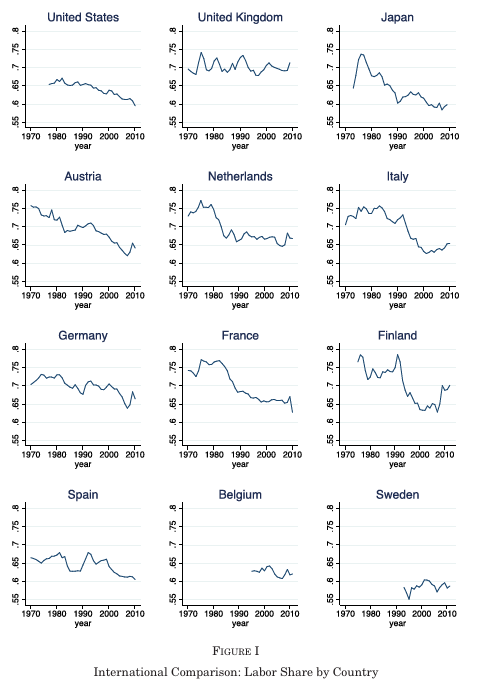
This story extends far beyond the United States. Across industrialized countries, workers have been getting a smaller cut of the pie for decades. That suggests shared forces are doing much of the work — bigger “superstar” firms, weaker union bargaining power, and possibly a common intellectual catalyst with roots in the Reagan-Thatcher era.
Rising monopsony power may also be part of the story. A monopolist is the only seller of a product. A monopsonist is the only buyer. And when you’re selling your labor to one of only a handful of big employers hiring in your space, you don’t have much power. If they want to pay you less, whatcha going to do? We’ll visit Hershey, Pennsylvania, for a taste of the problem.

Any conversation about problems should eventually turn to solutions. And the comments section offered a sharp reminder. Thank you. It led Megan and me to a rich discussion about how to rebuild labor’s share:
stronger, more constructive unions;
shared ownership, like Australia’s superannuation system, which turns workers into owners of the stock market; and
changes in norms.
That’s only a partial list. But it’s a start.
The current AI moment gives us a chance to write the rules for a fairer future. The “MeganBot 2000” thought experiment shows why new technologies could produce either a utopian or dystopian future. It highlights the critical role that ownership plays in deciding this. And that opens up plenty of policy possibilities for ensuring that AI works for us, rather than the other way around.

Join us to dive deeper into these issues, and keep those comments and questions coming, so we can continue to figure out this crazy world we live in. Together.
Your questions are extremely important and even more so as work becomes more automated. Unions in my opinion are not a viable option. It’s too hard to organize the huge number of employers needed to serve everyone effectively and unions have not made themselves proud for ethics and honesty.
As a former partner in a global management consulting firm I strongly support requiring some element of ownership of any qualifying entity and that means an established and successful entity.. It does two things unions don’t do. First, it gives employees a vested interest in the success of the employer and employees often see things that can be helpful but have little to gain by pointing them out. Second, unions traditionally have an adversarial relationship to the employer. It’s far better for employees to want their employers to be successful and share in the fruits of that success.
Dear Dr. Wolfers
Your comment
"shared ownership, like Australia’s superannuation system, which turns workers into owners of the stock market....."
What a concept. Can you imagine the reaction this idea would have in the US from the capital elites if they were subjected to sharing profits and ownership with their workers. This is reminiscent
of the Industrial Syndicalist movement, describing those who produce the product/service should own the means of production with the applicable profits.
Before the idea is dismissed, we might recall during the Great Depression of nearly 100 years ago that Joseph Kennedy, the Wall Street swindler, bootlegger, adulterer, Ambassador, and father of a president, stated "I would sacrifice half of my fortune if I could be assured that I could keep the other half." Joe was terrified; he thought the pitchfork and torch bearing rabble was going to even the score.
Times of crisis can lead to greatness in thought, actions, and accomplishment. Never, ever, ever quit, as Churchill espoused.