


Something extraordinarily dangerous just happened.
The United States Census Bureau published a report claiming that 24,000 noncitizens voted in the 2020 election.
Let me be clear: This report is propaganda.
Traditionally, the Census Bureau has been one of the unsung heroes of our federal government. It collects and reports truths about the United States, and its work forms the basis for our shared understanding of who we are and what’s going on.
It tells us where people live, where businesses are opening, where poverty is rising, where children need schools, where communities need hospitals, and whether government policies are actually working, as well as how many congressional districts each state gets.
Those facts are how citizens hold power accountable.
But this report is unlike any produced in the Bureau’s history. A typical Census report is produced by nonpartisan career statisticians using established rules, procedures, and high-quality statistical methods. Not this time. This report was produced by outside partisans — folks brought in from the America First Policy Institute, a Trump-aligned advocacy shop with an election agenda.
The statistical methods are shoddy, the usual standards and procedures were ignored, and the findings bear little relation to the truth. For the first time ever, the Census Bureau has produced low-rent partisan nonsense.
That means the government has turned an essential, truth-telling institution into a machine for producing and disguising political claims. When that happens, the country loses more than a single honest number.
It loses its grip on reality.
Okay, the road ahead. I’m going to spend some time in the statistical weeds (but I’ll focus on intuition over math). That’s because I want to show you what’s happening, not just tell you. But if you’re allergic to the weeds, then read the next section, and then skip to the end.
This report has nobody behind it
Voting reports should be business as usual for the Census Bureau — it publishes one after every national election.
These reports — like all Census Bureau research — are signed by their authors. They tell you what they measured and where the data came from. They provide detailed tables, report error rates, and indicate the level of confidence you can have in the results. They’re written by career civil servants using well-established statistical methods, and each report goes through several rounds of expert review. The reviewers are usually listed.
None of those elements exist in this report.
(There’s something that does look official, but there’s less to it than meets the eye: a Disclosure Review Board number. This simply means the report was checked to make sure that it wouldn’t reveal your personal information. That’s important, but it merely shows that the report didn’t violate privacy laws; it is not a measure of statistical quality.)
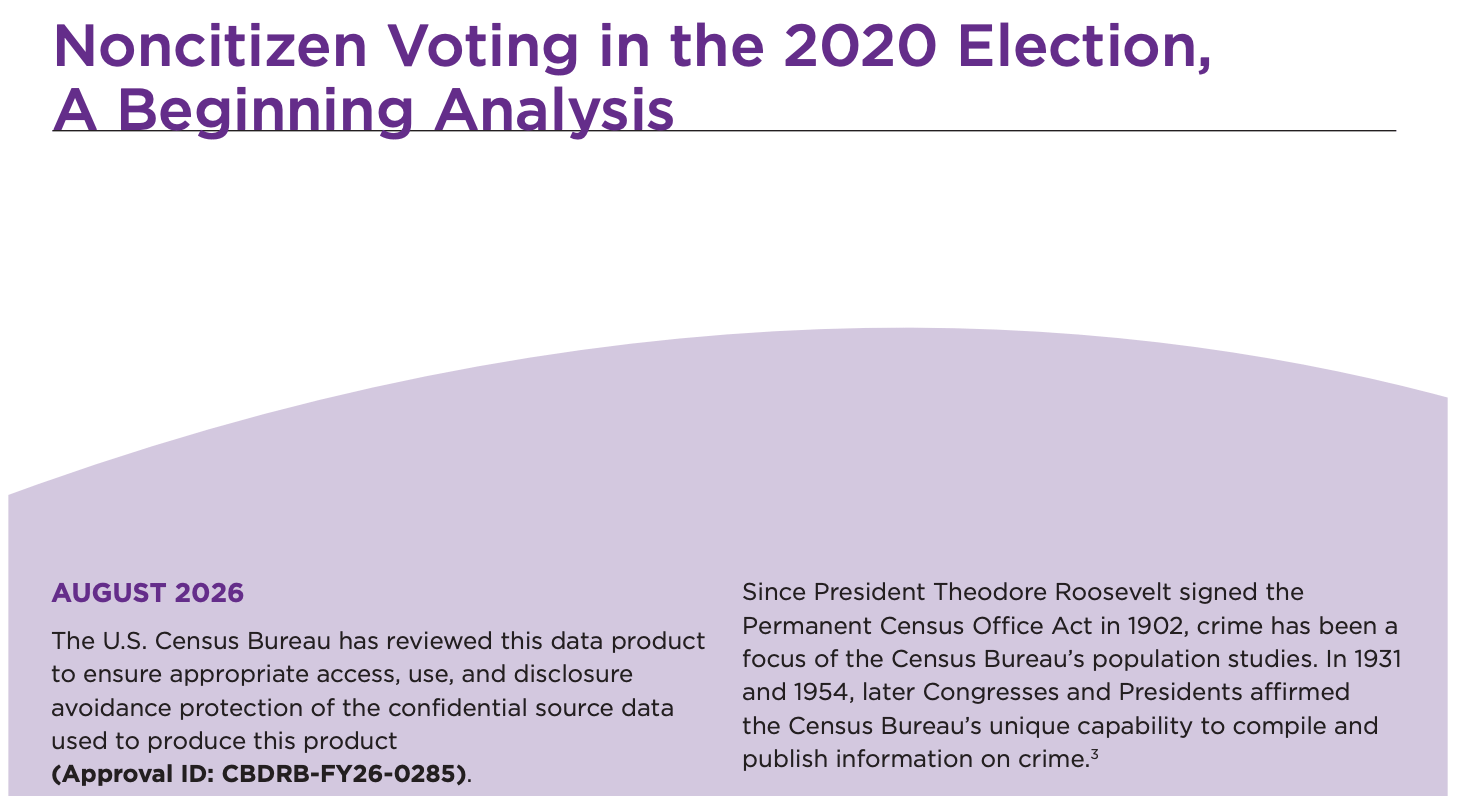
There’s no author, report number, or named reviewers. It does not provide an error rate, nor specify the level of uncertainty. It claims to have “high confidence” in its methods — with no explanation of what that actually means.
There is nothing in this report that can help us figure out whether the analysis is actually correct. And the real statisticians inside the Census Bureau don’t want their names anywhere near it.
Small errors can fake a scandal
To know whether someone who voted was ineligible, you need two pieces of information about the same person: Did they vote? And were they a citizen at the time they voted?
There’s no national database that tells us both things, so the people behind this report had to build one. And the method used here is important. Hold on, this is going to get wonky (but hopefully it’ll be interesting!).
To build their database, Census (or those claiming to be Census) started with a commercial voter file. This is a private company’s database, assembled from state registration rolls and voter-history records. It lists names, addresses, and whether each person participated in the November 3, 2020 election.
Then, they tried to match the people in those records with government databases on citizenship and immigration status. Crucially, the commercial voter file did not include Social Security numbers. (And it only included birth dates for voters in some states.) That’s a really big deal, and all of the nonsense is downstream of this.

Without Social Security numbers, connecting the commercial voter file to government databases on citizenship and immigration is a tricky and imprecise endeavor. You need to determine, say, whether Gus D. Platypus from 42 Wallaby Way voted, and then you need to find the same Mr. Platypus in the government’s citizenship databases. That’s harder than it seems.
When there’s no perfect match for Gus’s name, gender, address, and birth date, this system will often look for similar names (e.g., Gus David Platypus), old or nearby addresses (perhaps Gus recently moved to 3 Highview Crescent), or perhaps only a partial birth date (as many databases record big piles of people as being born on the first of the month).
Most of the time, the system works. But sometimes there are errors. A voting record that belongs to one person can get attached to a citizenship record belonging to an entirely different person — a wrong-person match.
The Census Bureau has studied matching errors before. We don’t know the error rate for this report on the 2020 election, or this exact voter file, but we can draw on analyses of previous attempts to link commercial and government records.
According to that earlier Census study, the most cautious approach yielded a false-match rate of 0.146%.
That percentage is tiny, but this country is huge. Across roughly 128 million voter records, that would still get you about 187,000 wrong-person matches. Combine that with the fact that roughly one in nine adults in the United States is not a citizen, and you could easily end up concluding that there are 21,000 apparent noncitizen voters even if every voter were a citizen.
That’s not far off from the 24,000 “found” in this report. And a false-match rate of 0.146% is the friendly assumption. A less generous estimate puts the error rate at 0.185%, which would produce 26,000 “false-positives” — people who appeared to be noncitizen voters but were not.
Where there’s a smoke alarm, there’s (only sometimes) fire
An analogy might be particularly illuminating here: I’ve never had a house fire. But I’ve certainly had my smoke alarm go off a few times. It would be absurd for me to count every alarm as a house fire.
A smoke alarm isn’t a measure of fires. It’s simply a warning that there might be a fire. Sometimes it’s right; sometimes it isn’t.
The analogy is pretty straightforward here. In both cases, the measurement is usually pretty accurate. For instance, my smoke alarm is nearly always correct: most of the time it’s silent, which is the right signal when there’s no fire in my home. Likewise, the statistical method used to match people across databases is nearly always correct. But both methods can sometimes give a false alarm — a false positive.
That’s a big deal when you’re trying to measure extremely rare events (like fires, or voter fraud) because the rare errors can overwhelm the extremely rare events. And that’s the basic story of what’s happening in this report. Effectively, it’s trying to use the number of times a smoke alarm goes off as a measure of the number of fires. It finds 24,000 cases where a statistical smoke alarm went off, and announces 24,000 fires (that is, illegal votes).
(An aside: This is all about false positives. If voter fraud were more common, one would also need to account for false negatives.)
An added wrinkle is that false positives may be even more common in the very communities this report targets. In many immigrant communities it’s quite common for people to share common names. The Census Bureau says its ten most common surnames account for 14.2% of Hispanic Americans, while for White Americans, they only cover 4.4%.
That’s why past Census research has shown that it’s harder to take a Hispanic person in one database and find that same person in another. (Serious researchers would test whether matching errors like this differ across groups. As you’ve probably guessed — this report does not.)

Okay, that’s the problem of false matches — a real voter is matched to someone else’s citizenship record, which can mislabel them as an ineligible voter. And that error alone could easily account for all of the findings in this report.
Old records create false accusations
There’s a second type of error that can trigger false accusations: The computer could match the correct people while still getting their citizenship status wrong.
This occurs when Census connects a naturalized citizen to an outdated immigration record. If it fails to find the newer record indicating this person was naturalized prior to Election Day, they may be flagged as a noncitizen voter.
Let’s return to the case of Gus D. Platypus. He may have moved to the U.S. in 2001, spent time on a student visa, then obtained a green card, and finally took the citizenship oath in October 2020. That means any statistical match based on data that’s current only through September 2020 will “see” Gus as a noncitizen, and hence a fraudulent voter. The reality, of course, is that he had every right to vote.
Census’s own citizenship research explains why this is a real worry: The Social Security Administration isn’t automatically notified when a noncitizen with a Social Security number becomes a naturalized citizen. Those updates may arrive late or not at all. So if Census’s citizenship information was even a few weeks out of date, people naturalized during that gap could be falsely labeled noncitizens.

That’s not random noise but a second source of error that only points in one direction. We call this an asymmetric error, and it biases the exercise toward finding apparent noncitizen voters who are actually citizens.
Here, the report (accidentally) flashes a giant warning light. It says it found roughly 63,800 people whose old immigration records initially made them look like noncitizens, but who had actually become citizens prior to the election.
That’s not a reassuring footnote but proof that the raw data were full of citizens who looked like noncitizens. Furthermore, the report doesn’t tell us how complete the cleanup was. Suppose it found 72.5% of the people in that situation. Then the other 27.5% would be about 24,000 citizens it missed.
This error alone could explain the headline number.
Look, I don’t know whether that’s what happened. And neither do you. And that’s because the report doesn’t tell us. Nor does it give us any of the information we would need to figure it out.
Census ignored its own rules
Census’s own standards say that when it links your voting record to databases that speak to your citizenship status, it must evaluate the linkage. It must test whether it joined the right people. It must measure link rates and error rates. It must explain its assumptions, limitations, error sources, and the way those limitations affect the result.

And its transparency standards say qualified people should be able to understand who sponsored the work, who conducted it, what files were used, how the algorithm worked, what quality measures were used, and what could have gone wrong.
In other words: If you want to claim 24,000 people voted illegally, you have to show your work.
This report doesn’t even try. Which brings us to the question of leadership.
Since 2012, federal law has said that the Census Bureau should be headed by a Senate-confirmed director who is appointed “without regard to political affiliation” and has experience collecting, analyzing, and using statistical data. That law was intended to strengthen this Bureau’s professional independence.
Right now, that Senate-confirmed job is vacant.
Robert Santos was the last Senate-confirmed director of the Census Bureau. He resigned in January 2025, and the Trump administration hasn’t nominated a permanent replacement. Instead, George Cook, a Trump political appointee, is performing the duties of Census director in an acting role — which means he hasn’t been vetted by the Senate.
Now, we don’t know whether Cook personally approved this report. (The report doesn’t tell us who approved it.) But we do know the Bureau is currently led by a political appointee in a temporary role, not by the politically independent, Senate-confirmed leader that Congress designed the office to have.
We also know that this report was released under that leadership.
What’s more, the Census Bureau’s own standards require many levels of review. So who did those reviews? Did they actually happen? Who signed off? Who decided that an unsigned document — produced by external partisans — was suitable to publish under the authority of the United States Census Bureau?
Once again: the report doesn’t say.
Democracies depend on truth-finding institutions
Information that can be trusted is critical to democracy.
This is why the Census Bureau is supposed to be nonpartisan. Once facts are made to serve the people in power, the public loses the ability to judge those people in power.
We saw a version of this institutional fight play out at the Bureau of Labor Statistics. President Trump fired its commissioner after a jobs report he disliked. The first partisan nominee faced serious Senate resistance, including from Republican senators, and the White House withdrew him before the Senate held a confirmation hearing. The Senate later confirmed Brett Matsumoto, an economist with real experience in inflation and economic measurement.

That’s what a guardrail looks like. The pressure came. And the institution pushed back.

At Census, the guardrail failed. And we need only look around to see how other countries pay for this kind of failure.
When Argentina manipulated official inflation and GDP statistics, that manipulation had real consequences for regular people: pensions, wages, and bonds are all tied to official inflation figures. The International Monetary Fund eventually censured Argentina over these inaccuracies.
Greece offers another examle. There, investors stopped believing the government’s debt and deficit numbers, so they charged more to lend that government money. That meant more tax dollars went to interest payments, leaving less for schools, roads, health care, and everything else people need. These skyrocketing interest rates also led to a fiscal crisis.
Trusted statistics are economic infrastructure. Breaking them has major consequences.
When false allegations get dressed up as official statistics, there are also immediate costs. ProPublica reports that federal investigators have been pulled from work involving drug trafficking, human trafficking, money laundering, and child exploitation to pursue large numbers of alleged noncitizen-voting leads.
That’s what propaganda is. Not inconsequential lies, but lies that send the country chasing smoke alarms while real fires burn.
Mature industrial democracies don’t make official statistics in party backrooms. They don’t hide authors or conceal error rates. They don’t take a computer’s first guess and present it as a criminal verdict. And they don’t hear the smoke alarm and start filing insurance claims.
They check for the fire. They publish methods. They publish limitations. They let critics test the work. And if the work is wrong, they correct it.
That’s how a country keeps track of the truth.
The Census Bureau was built to provide facts that outlast whoever happens to be president. Facts that businesses, local governments, and citizens depend on to make consequential decisions and hold leaders accountable.
If we lose reliable facts, we lose our ability to see understand reality and fix what’s wrong. We lose democratic accountability. And we lose an important foundation of our prosperity.
Finally, if you found this useful, I’m worried this story isn’t getting noticed, so please share it.
Thank you for your excellent work applying your knowledge and stats skills to expose threats to our nation.
Even if true, the error rate is very tiny and would likely not effect the outcome of any election. Nevertheless, it will be used to justify policies that would lead to the disenfranchisement of millions.