



Another week, another avalanche of economic news. At the end of the week, I sit down with Stacey Vanek Smith to sort through it all, for the podcast series we call Off the Clock. Think of it as two mates sitting down over a well-deserved beer and doing what good friends do: talking economics. Join us as we try to sort through what really mattered, what’s noise, and a few nuggets of good news.
Here are the issues we think are worth a deeper dive:
The Fed raised interest rates by a quarter point this week.
That’s big. But to Stacey’s eye, the real message was that this was a unanimous vote. After months of political pressure for lower rates, all 12 voting members lined up together. If you listen to the pod, you might even hear me belt out the chorus of Solidarity Forever (along with a mischievous — though false — claim that it was heard from Fed headquarters). Maybe they didn’t sing, but they did signal that the Fed won’t be bullied by the president.
What the president wants. It’s worth pausing on the president’s demand. He wants low interest rates — he’s said as low as one percent.
Stacey asked what’s wrong with that. It’s a pretty good question. After all, the cocktail of lower rates, more borrowing, more building, and more spending sounds pretty enticing. But that’s not the end of the story. Politicians have a long history of pushing for low rates with an eye to stimulating an election-eve sugar high, hoping to get re-elected before the inflationary hangover sets in.
I think there might be something else going on here: Fiscal dominance. That’s the term that economists use for when monetary policy is set with an eye to reducing the monthly payments on our national debt, rather than keeping inflation and unemployment under control.
Here’s the problem. If you lower rates to reduce our debt payments, you’ve probably cut them to below the rate you need to keep inflation stable. The economy quickly overheats, and inflation rises. In effect, you inflate the debt away. That might work once, but it’s not a good long-term practice. Do it a couple of times, and see if anyone will ever lend to you again.
Why does everything still feel so darn expensive? Stacey has been out and about talking with regular folks about the economy. Take it from here, people see an affordability crisis out there. Since the pandemic, groceries are up 32%, gas 57%, energy 45%, and rent 33%.
As an economist, my instinct — which is never popular at dinner parties — is to note that this is only half of the affordability story. The other half: what happened to paychecks?
The answer: wages are rising, but unevenly, and not for everyone. Folks who switch jobs are scoring raises that help them not only keep up with prices, but sneak ahead. But those who stick with the same boss are, on average, falling behind.
Stacey suggested we needed a better story — one that also nods to how all of this makes people feel.
And maybe feelings really matter. Stacey argued that feelings are central to understanding the economy. Fear changes spending. Confidence changes investment. Expectations can even change inflation.
Keep listening, and you’ll hear me make a comparison between my podcast pal, and the great John Maynard Keynes. Stick around for it because you’ll even hear Stacey make an amazing animal spirits joke.
Chart Versus Chart
My favorite part of the week is when Stacey and I each try to best each other in describing our economic lives in a chart. It’s the comparative lit major versus the econ PhD. Stacey keeps winning, but I hope that this week I kept it close. Don’t forget to vote, below.
Stacey’s Chart: The Bacon Cheeseburger Economy
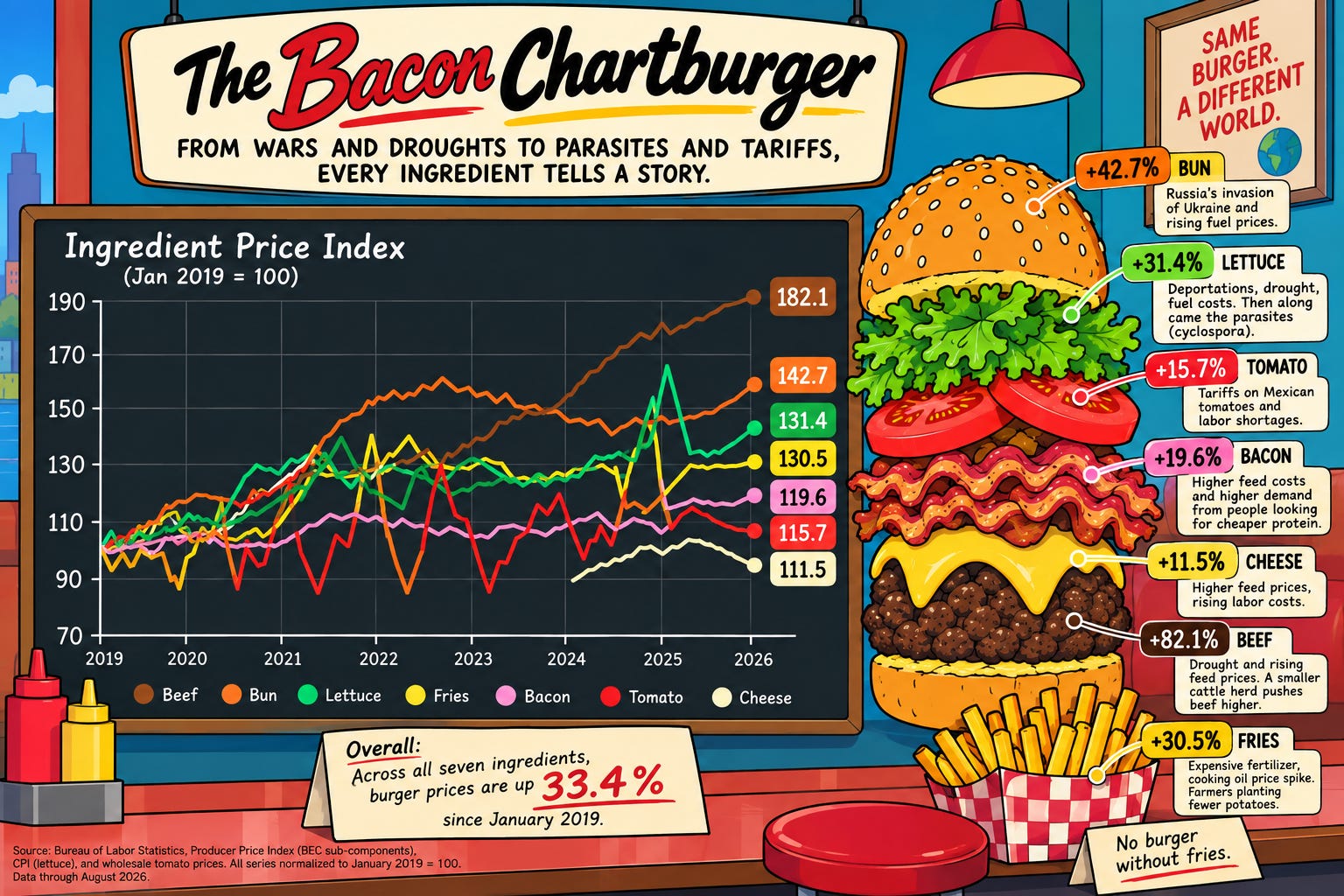
Stacey ran her own mini-CPI, collecting data on a representative basket of goods and services. In her case, they represent a bacon cheeseburger, which is 33.4% more expensive than before the pandemic. Beef is up 82%, bacon 19.6%, and she’s from Idaho, so she’s obsessed with potatoes, which are up 30.5%.
Every ingredient tells part of the economic story: drought, war, fertilizer, tariffs, labor, supply chains.
The world economy, apparently, fits between two buns. If you prefer a tortilla wrap instead, we’ve got you covered:
Justin’s Chart: What Are Canadians Actually Mad About?
My take: I think there’s a story that too few Americans understand just how deep the rupture is between the United States and Canada. So I dug deep into some unusual, but informative data, crunching the numbers on hundreds of comments from one of our recent Canada videos. Some say this is not a scientific survey, but I think it tells an important story about — feelings. There’s that word again.
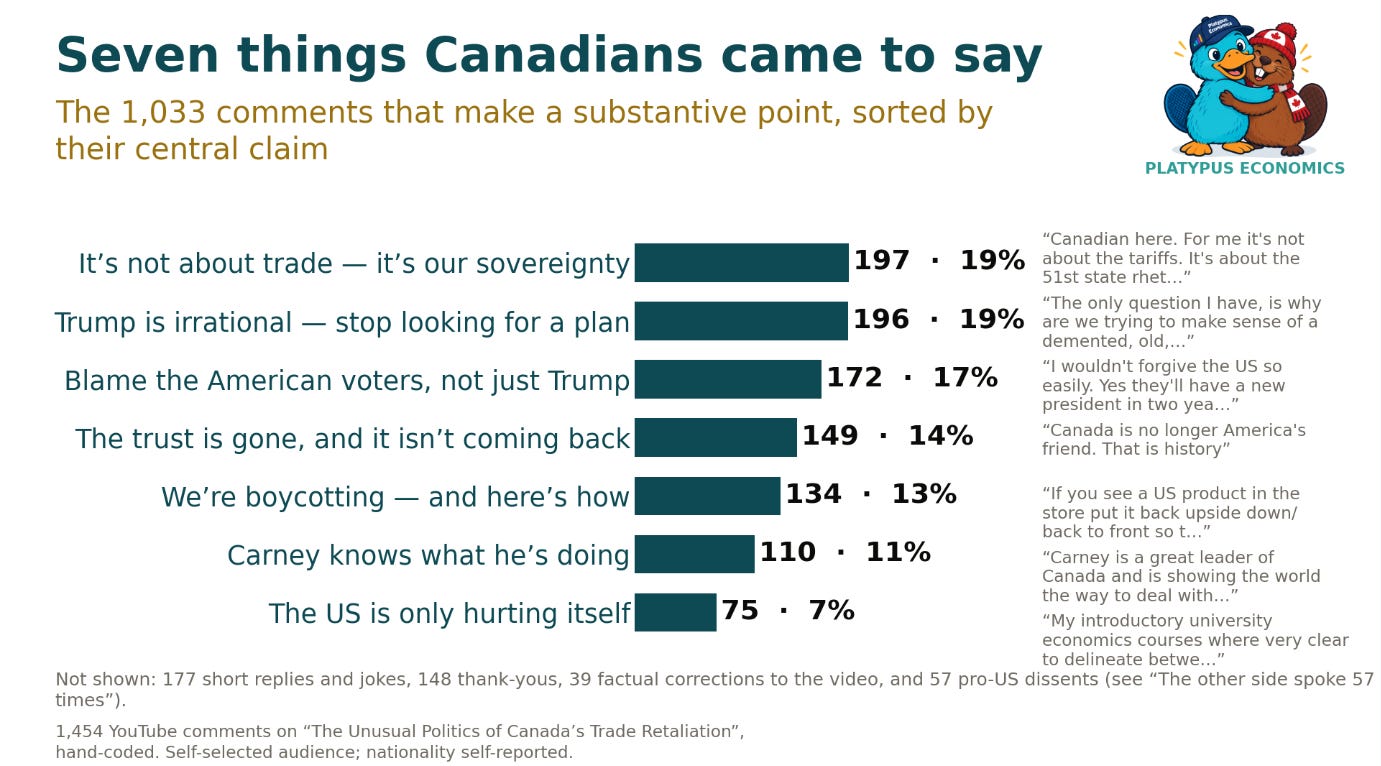
Actually, my feelings here are much bigger than one whole chart. I brought a whole deck of slides. (Yes, I’m pandering to the lovely Canadians reading this.) You can download the whole deck right here, and it’s chock full of interesting (albeit barely scientific) insights.
The key point: In this one sample, people weren’t just talking about tariffs. They were talking about sovereignty, lost trust, boycotts, travel, and shopping habits. Which brought us back to Stacey’s point.
Feelings don’t just describe the economy.
They change what people do.

I chose Stacey's chart as it hits close to my heart (burgers once a month, like clockwork, and they have gone UP!) but I love Canadians too, and understand that they are angry, and rightly so, not just at Trump and his sycophants, but at all of us for doing so little to stop him.
Our best neighbor, our closest ally, and this is what we do? Every emergency, they've been here for us, and to let this monster destroy our relationship so quickly and for nothing is enraging.
I applaud our Canadian friends and neighbors for cutting us off completely. I hate it, but agree completely.