


A couple weeks ago, Andrew Kolvet—a spokesperson for Turning Point USA—posted the following on X:
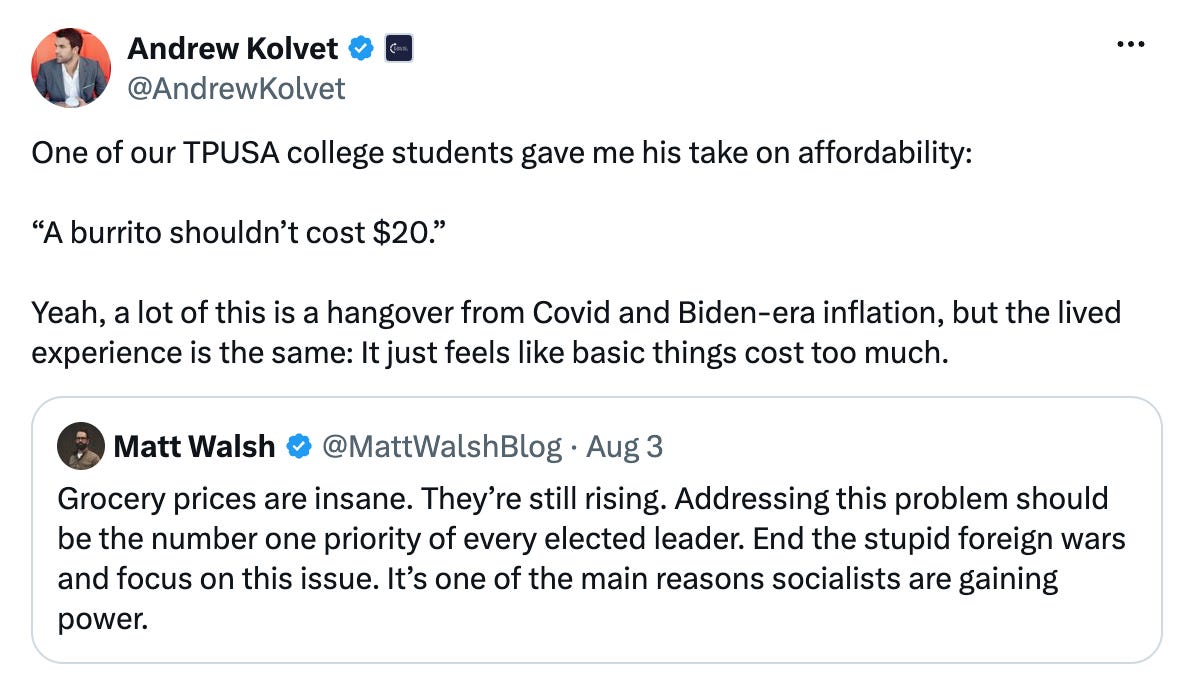
The claim was simple: A burrito shouldn’t cost $20.
And that kicked off the burrito discourse among MAGA Republicans. Some agreed completely: Life’s too expensive. America has an affordability crisis. For others, the response was: Eat ramen. Get roommates. Work harder.
A faction that won an election by telling voters America had become unaffordable was now arguing about whether it’s polite to say a burrito costs too much. So naturally, I decided to write a column for the New York Times about it. (Here’s a gift link.)
My job on Substack is to give you the extra stuffed, double-wrapped version. This is the kind of burrito that needs a second tortilla just to hold in all the juicy economic goodness.
Let’s start by setting the scene. Here’s what we know about the national mood:
Back in April, a record 55% of Americans reported that their finances are getting worse.
As of July, 95% of Americans believe there’s an affordability crisis.
And two-thirds of Americans now say groceries are unaffordable.
In other words: Folks are worried about affordability, and the national media talks of an affordability crisis. And yet, the broad economic data says that the amount of stuff that regular people can afford has been rising for years.
My job is to explain how both of those things can be true.
Toast (the company that owns the ordering systems, payments, and menu software behind a huge chunk of American restaurants) has a national burrito price monitor that pulls menu data from roughly 180,000 locations.
According to their latest estimate, the typical American restaurant burrito costs $13.67, and has risen 2.2% over the past year.
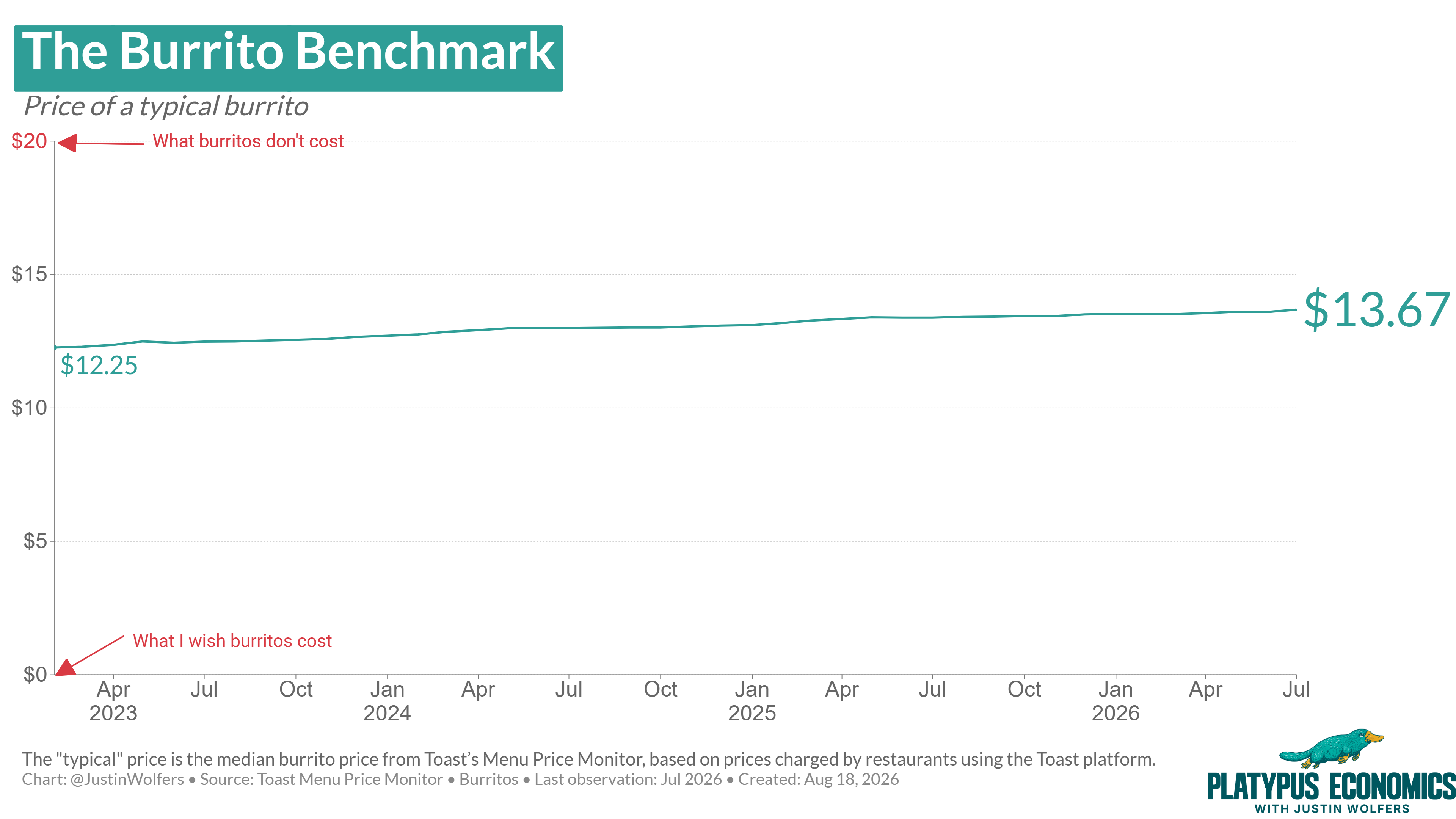
So yes, burritos are getting more expensive. But they’re not exactly skyrocketing.
And crucially, this data only tells us about prices, not affordability. Those two things are not the same.
How Economists Measure Affordability
Economists have a pretty straightforward definition of affordability—it’s what you can afford. We measure this by asking how much stuff your income can buy.
If prices double and your paycheck remains the same, you can afford half as much stuff as before. But if prices double and your paycheck doubles, your purchasing power (and thus affordability) remains the same—even though the numbers on everything are larger.
Let’s take this definition of affordability to the data to see what’s really happening.
With economic data, there are always choices. When it comes to affordability, those choices include: Should we look only at hourly wages, or also count benefits? Should we measure the average worker or the median worker? Do we ask workers what they make, or ask employers what they pay?
But when something’s true, it tends to show up no matter what you choose.
So I grabbed five different measures of real wages from official government statistics, and put them all on the same chart, with each one set equal to 100 at the start of 2022. (In each case, it’s the wage rate deflated by the consumer price index.)
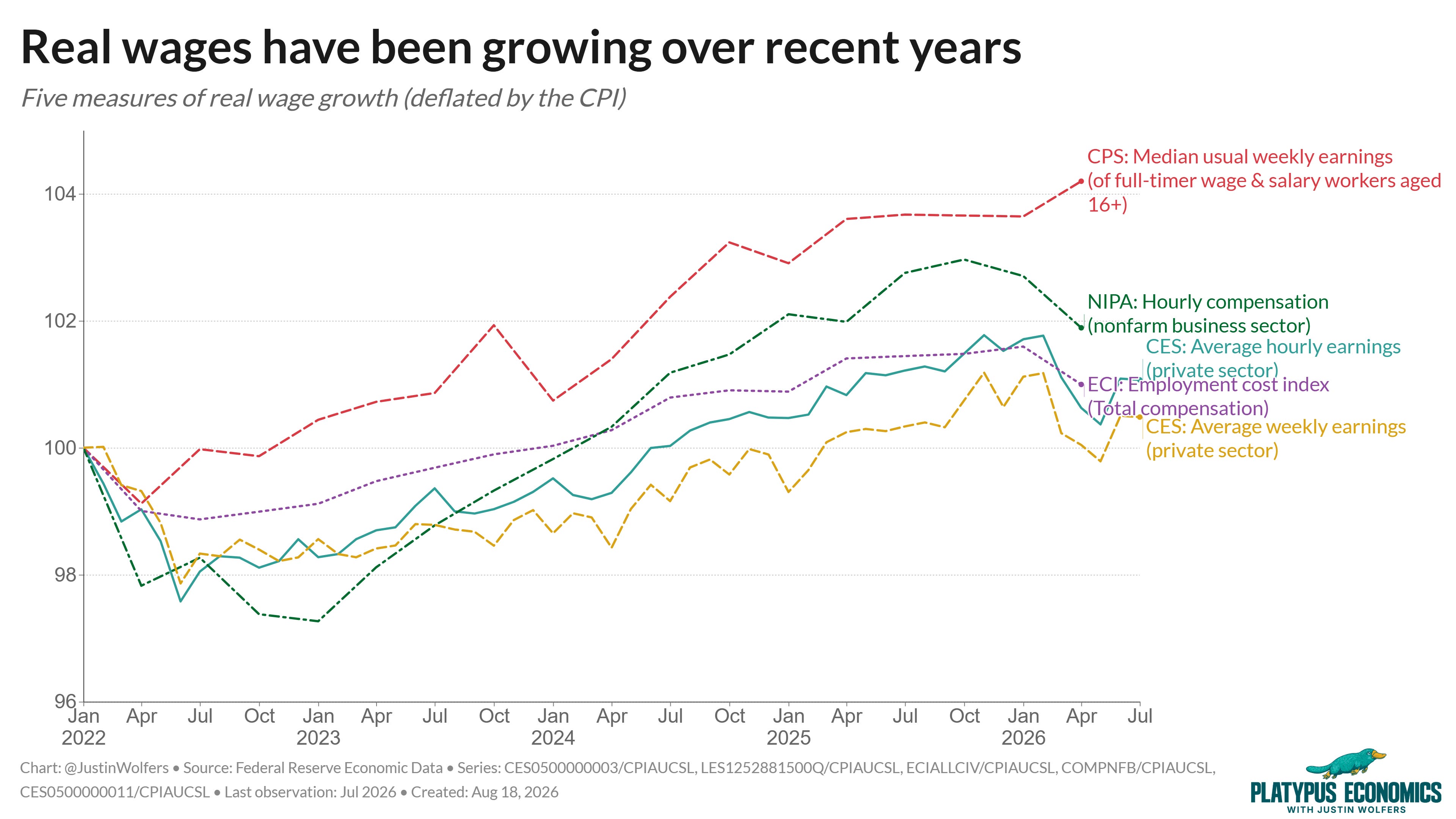
During the initial, post-pandemic burst of inflation, prices did jump ahead of wages. Workers lost purchasing power, and affordability declined.
But then, wages caught up. By early 2026 real pay was above where it began. That’s true across all five measures. Perhaps you were hoping for stronger real wage growth. I sure was. But is this shortfall really big enough to call a crisis?
Since averages can hide a lot, I also took a peek at the Atlanta Fed’s Wage Growth Tracker, which follows the same people for a year and tracks how their pay changes.
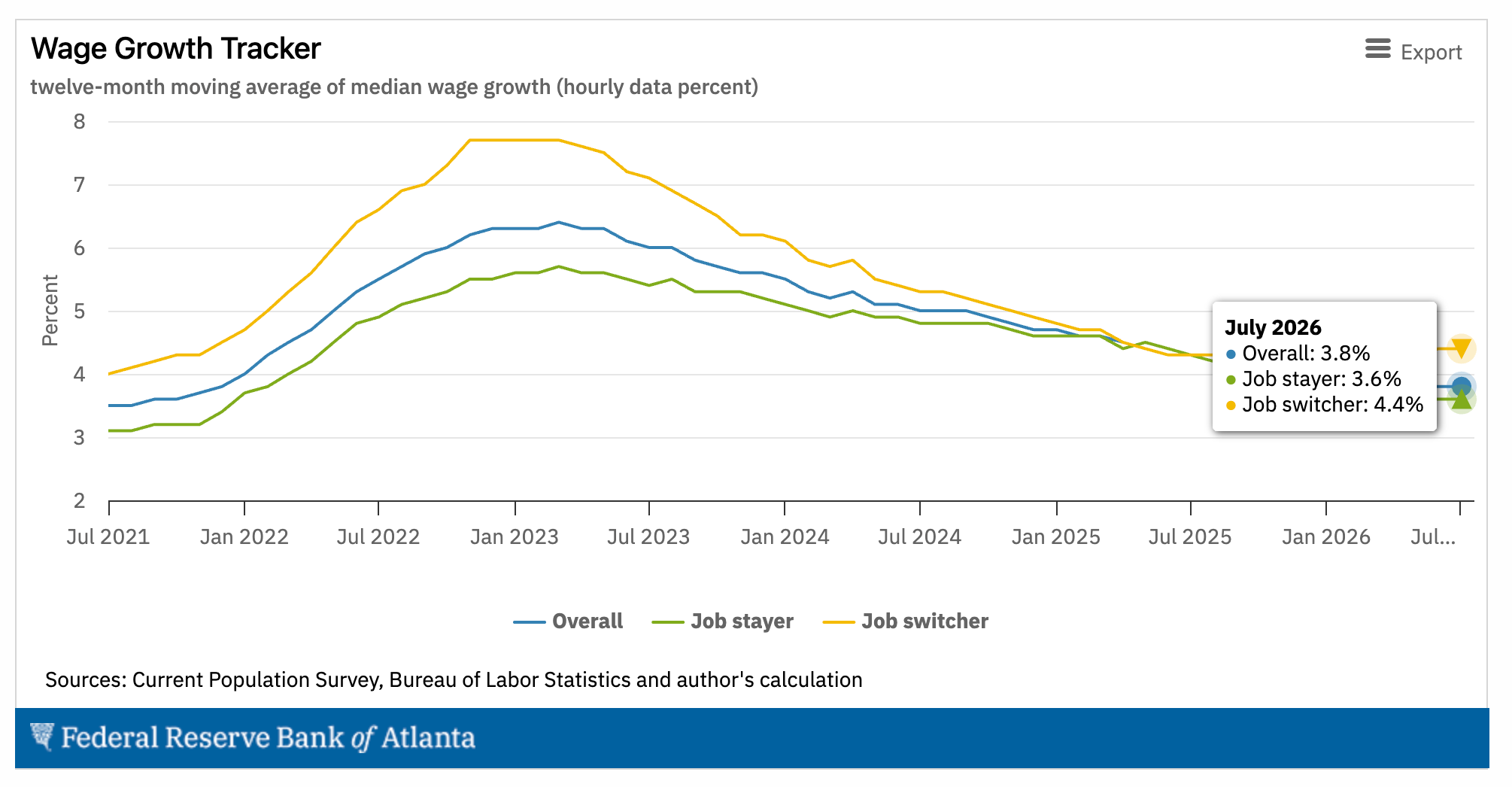
According to this tracker, the median rate of wage growth between July 2025 and July 2026 was 3.8%, while inflation was 3.4% over that same time period. This tells us that more than half of all workers received raises that beat inflation.
Why Feelings Don’t Match The Facts
Those are the facts. (Or rather, the statistics.) And as an economist, I’m inclined to believe them. But they clearly don’t match the national mood, and using statistics to explain to people that their feelings are wrong rarely works. (Believe me, I’ve tried.)
And that’s why I believe it’s also helpful to dive into the psychology of inflation. Let me start inside the mind I understand best: my own.
Last year, my university gave me a modest raise. Naturally, I decided this was a just reward for the fact that I had economist-ed extra hard. I’d taught my classes, gone to meetings, written the emails, and made at least one graph with far too many lines on it. (It’s the one above.)
I felt seen and valued; that raise was mine, and I earned it.
But then prices rose. And inflation ate away a lot of that gain. That part felt like theft.
Which brings us to the model of inflation many people carry around with them. Most of us don’t experience “the labor market”; we experience a boss.
And bosses—in the ordinary person’s model—don’t like raising wages.
Stefanie Stantcheva, a Harvard economist, has shown just how widespread this mental model is. She asked Americans what they thought happened when inflation rose, and 51% said: inflation will increase my employer’s profits, but that employer will not feel the need to increase my pay. Only 31% chose the economics-textbook story: companies compete for workers, and that competition pushes wages higher.
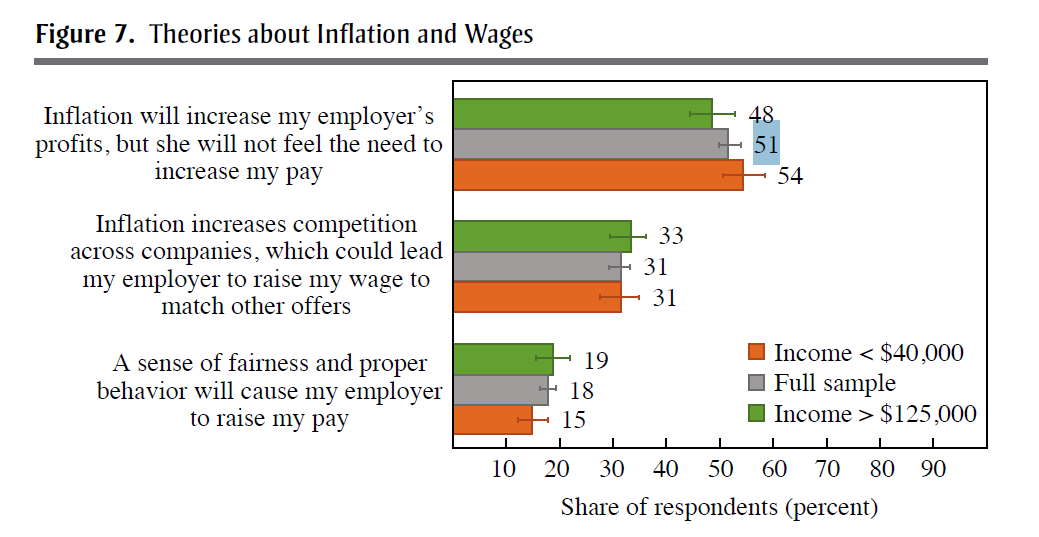
That textbook story has something important going for it: It describes an important truth. Employers do compete, workers get outside offers, and people can switch jobs. But the boss model feels more immediate—more intuitive. At least on first glance.
And if the boss model is your model, then inflation likely feels terrifying.
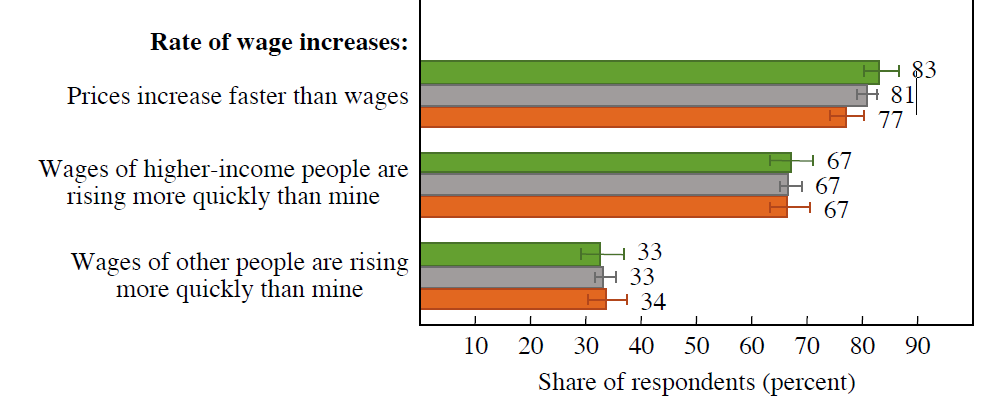
Stantcheva also found that 81% of respondents say prices rise faster than wages, and that folks usually credit a raise to their own job performance, not inflation.
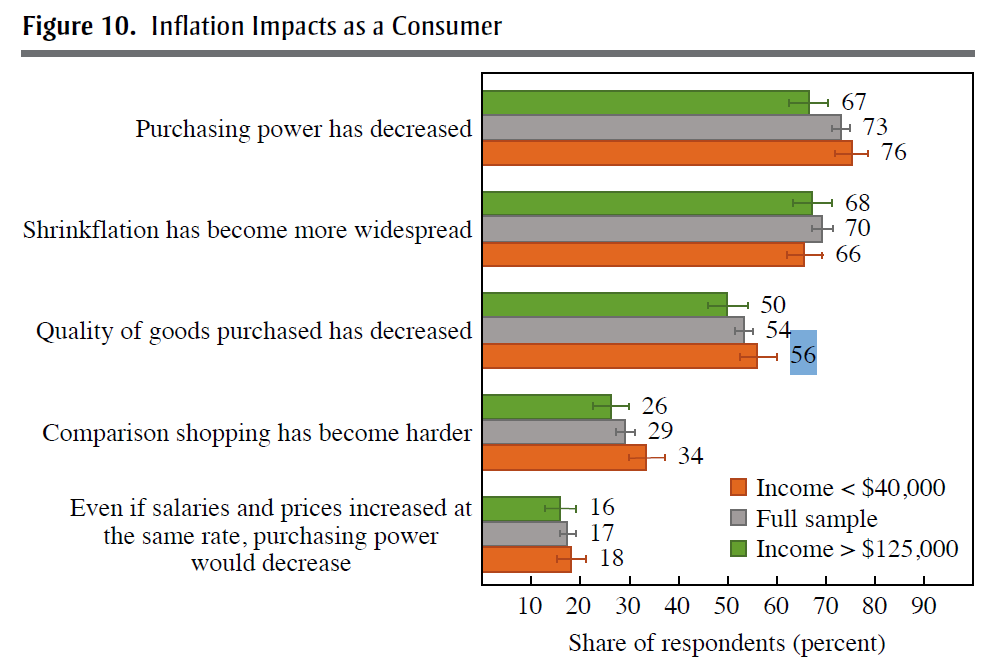
More concerning: this shapes real decisions, especially for lower-income families. 56% of lower-earning respondents said that inflation had led them to delay essential purchases.
Wages and Prices Travel Together
Stefanie Stantcheva’s surveys tell us a lot about how people think inflation works. But what about reality? How does it really work?
The data is clear: an inflation burst that raises prices typically leads to a roughly equal rise in wages. Real wages—the amount of stuff people can afford—is not shaped to any particularly large degree by inflation.
That’s easy for an economist to say. Hard for many folks to believe. So let’s explore the empirical evidence together.
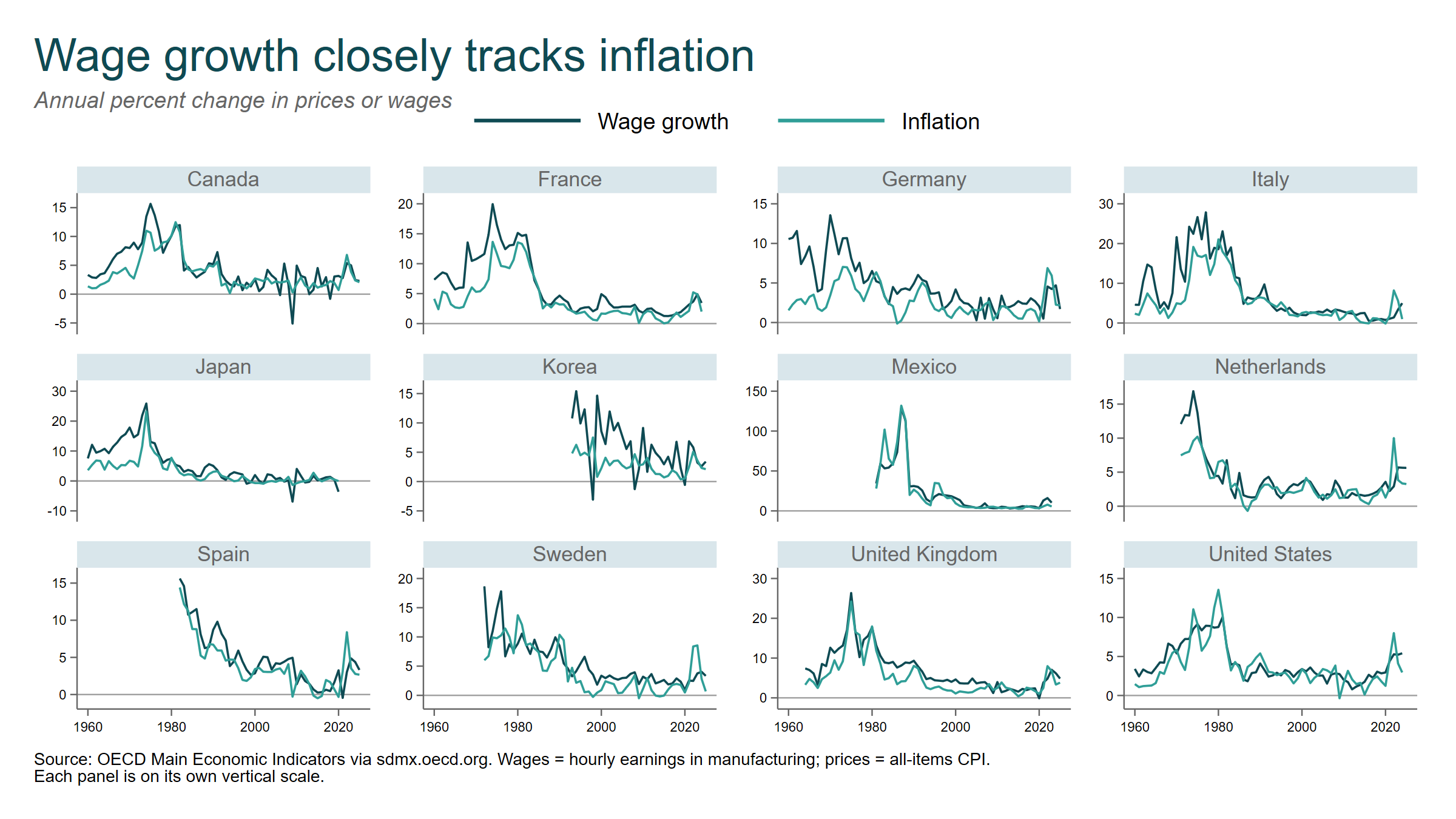
I pulled wage growth and price inflation for twelve large industrialized countries, going back more than sixty years. This gave me more than six hundred country-years of data.
And here’s the pattern:
Sometimes prices move first—businesses raise prices, and wages catch up as firms compete for workers.
Other times, wages move first—workers demand raises, and businesses pass some of those costs along in the form of higher prices.
But across countries and decades, price growth and wage growth move together remarkably closely. And the adjustment is pretty quick.
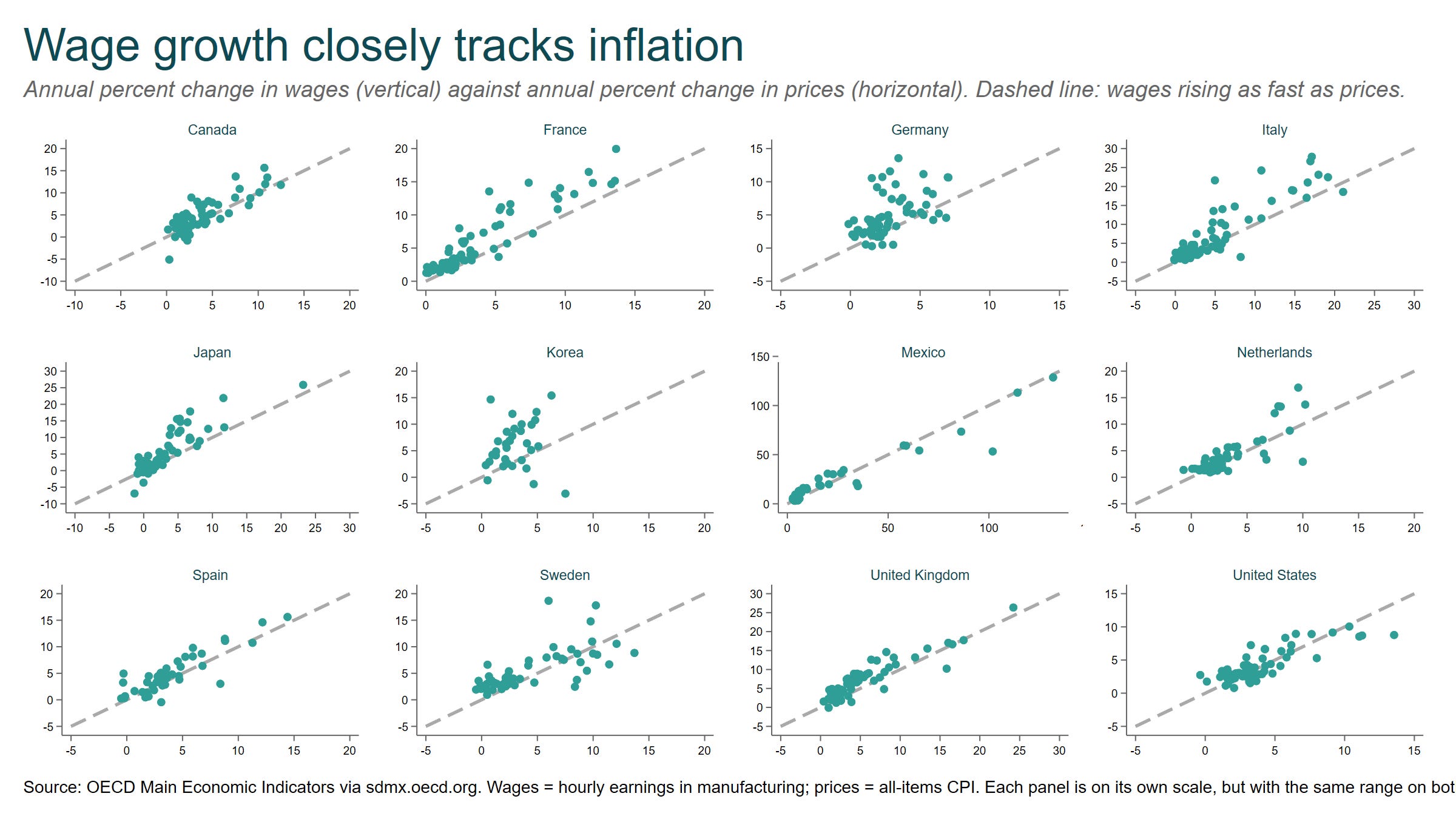
Remember, the popular perception is that prices rise and wages never catch up. If that were true, the data in a scatterplot of wage growth versus inflation (shown below) would lie along a horizontal line.
The economist’s model is that prices rise and wages keep up—and hence the data lie along the 45-degree line. Let me add one more wrinkle. In the full econ model, money wages tend to grow faster than prices over time—that is, real wages tend to grow—and hence the data should lie just above the 45-degree line.
Here are the scatterplots:
And yet…belief that an inflationary burst will not meaningfully undermine your purchasing power (for long) is at an all-time low.
Pessimism Hits a Record High
My colleagues who run the University of Michigan Survey of Consumers ask an incredibly revealing question: During the next year or two, do you expect that your income will go up more than prices, about the same, or less than prices? Even better, they’ve been asking this for decades.
The latest answer is a record: 71% of Americans say they expect prices to rise faster than their incomes. Only 8% say their income will rise faster than prices. (That’s despite the fact that more often than not, incomes have tended to rise faster than prices.)
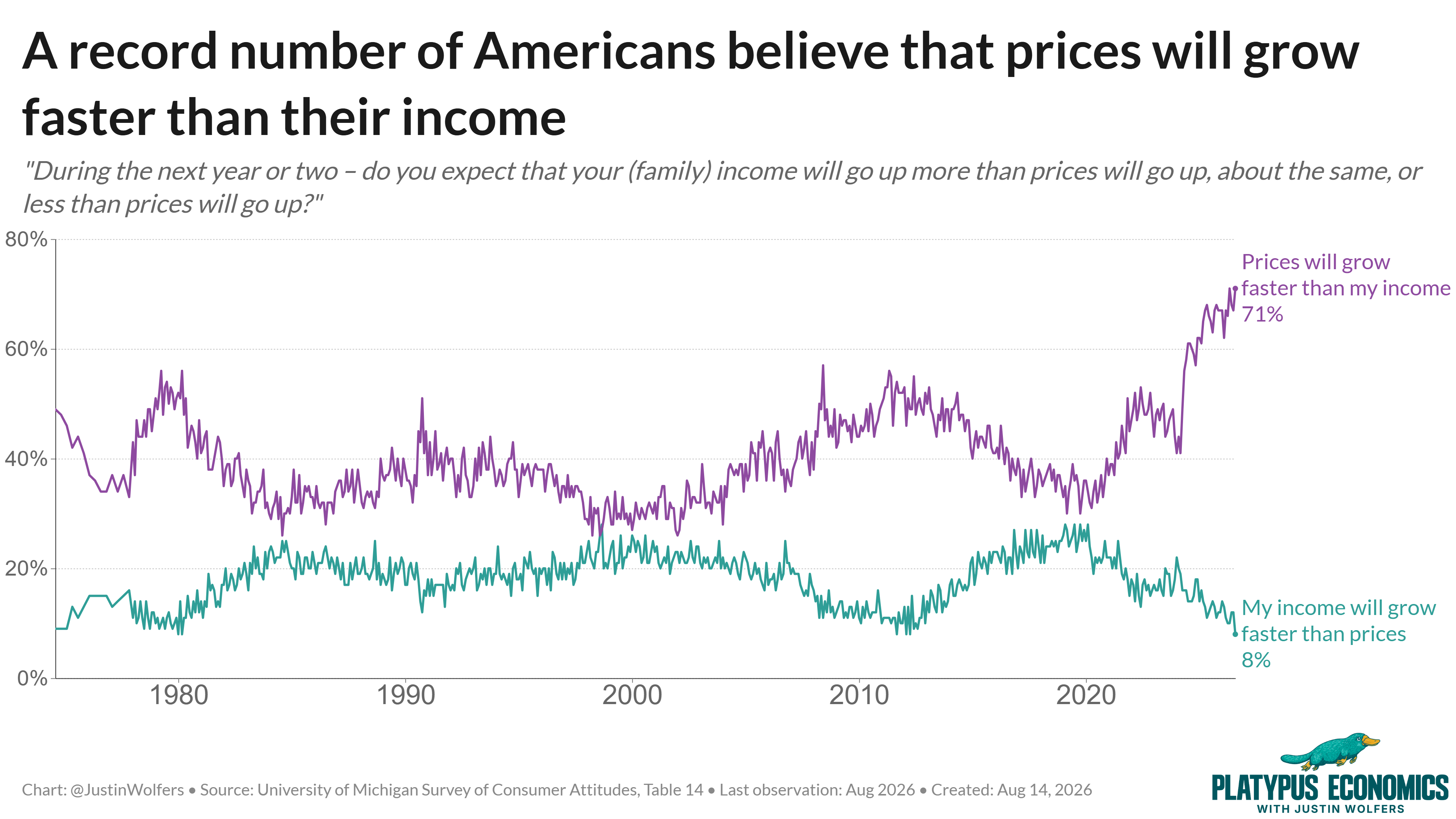
That’s the highest degree of pessimism ever recorded in over 50 years.
So, what’s going on?
To be honest, I’m not entirely sure. There’s a lot more to learn about all of this.
Could This Time Be Different?
Okay, the story that I’ve been telling so far is that inflation doesn’t much shape real wages because price rises are closely linked to wage rises.
But I need to add an asterisk next to this. It’s one that’s really relevant right now.
Sometimes inflation comes from a supply shock: a war disrupts oil, a drought destroys crops, or a tariff makes an imported input more expensive. When that happens, there’s less real stuff to go around and real wages often fall, because the country has become genuinely poorer.
We’ve seen several supply shocks over the past few years: Russia’s invasion of Ukraine disrupted food and energy markets. The war with Iran has disrupted oil flows and rattled energy prices once more. And then—of course—there are tariffs.

The burrito discussion is helpful because it reduces the economy to something you can wrap your hand around and taste. And it provides very real examples of economic policy choices.
You can see the aluminum foil wrapper, which is subject to a 50 percent tariff. The Mexican tomatoes inside have their own 17 percent tariff. The cheese and sour cream began on dairy farms, which are struggling with labor shortages exacerbated by immigration crackdowns. And I’d hold the lettuce for the moment—until food safety is improved.
A burrito isn’t the whole economy. But it is a little bundle of trade policy, immigration policy, food-safety policy, and cost-of-living policy, all wrapped together. And if your goal is to make dinner cheaper, adding fresh costs and fresh risks to the food system sure is a strange way to go about it.
One last thing for the nerdiest of my Platypals!
Today’s post includes a paid partnership with Stata, the software I use to crunch the numbers in my posts (and my research).
I used it here to calculate how wage growth has kept up with rising prices in the United States and 11 other countries. And if you’re really nerdy, you can use this worksheet to follow along! Or if you’re an economics or econometrics instructor, you might find this useful for class.
I think this is all correct, but I would add 2 points that I would like you to address in future columns. (1) I think the affordability crisis isn’t primarily about luxuries like burritos; it’s things that people need to have for a decent middle class lifestyle where prices have really skyrocketed: housing (especially in places with good job markets and schools), healthcare, education and childcare. (2) While wages per your data have generally kept up with inflation, they haven’t gotten ahead. Most importantly they haven’t kept up with increases in productivity, with a larger and larger share of national income going to capital rather than labor. This I think creates negative perceptions among workers, including feelings of being on an endless treadmill and never getting ahead, and also that the economy is rigged in favor of owners over workers (and my understanding is there’s a lot of data to support that belief).
Dr. J: As always, the breezy prose overlays a carefully documented and insightful exposition. Without gainsaying any of that, I'd like to propose that a small comment midway in has important impact: "Since averages can hide a lot,..." It is, after all, macroeconomics, and central tendencies are the order of the day. But I think there would be much to learn from the distribution of many of the factors you examine, that is, broken down by, say, income or gender or ethnicity. With the markedly skewed income distribution that we live with, those central tendencies are likely to be highly skewed as well. I wonder if similar curves by income level might tell us something about the difference between the data and what people perceive.