


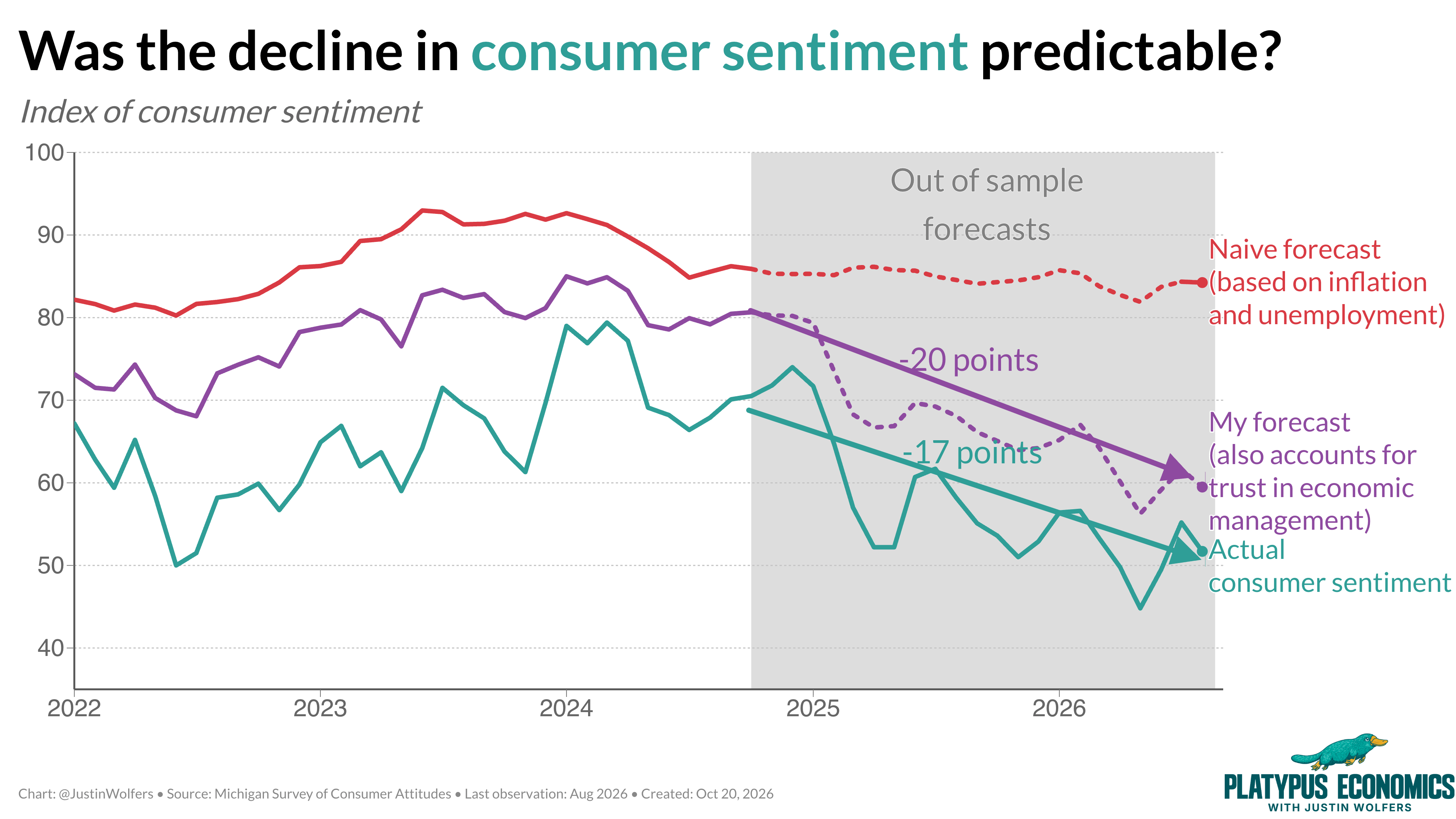
Americans feel about as gloomy about the economy as they did in 1980 — but in 1980, unemployment was nearly twice the rate it is now and inflation was running around 14%. Consumer sentiment should be around 82, but it’s been sitting near 52. The gap between our economic numbers and sentiment is a puzzle economists have been trying to figure out for a while. Earlier this week, I wrote about my own explanation.
I argued that the 30-point gap comes down to how little confidence people have in the government’s economic management.
You can catch up on that here:

Now it’s time for The Professor Is In, where I sit down with my producer Augusta Chapman to answer your questions. Think of it like office hours. The door’s open, come on in.
I have to be honest — I’m excited about this one. It’s not often I think I’ve cracked a case. Augusta came armed with your questions, some of which were meant to poke holes, and that’s great. In economics, poking holes in an argument is a sign of respect.
Which way does the causality run?
Augusta’s first question was about the source of the sentiment. She asked which way the causality runs here. Maybe people aren’t gloomy because they distrust the government. Maybe they’re just gloomy, and they blame whoever happens to be in charge.
These two stories make different predictions, and we can check them.
If Americans were simply in a bad mood, then their distrust of economic leadership should line up about equally well with all the different measures of economic sentiment. A general bad mood wouldn’t discriminate.
That isn’t what we see in the data. Questions that ask people to look into their economic future track their trust in leadership closely. Questions about a specific market (or the present moment) track it much less closely. “Is now a good time to buy a house?” is one of those questions, and people’s opinions swing widely, and in ways unrelated to their distrust of our economic leadership.
Look, I can’t be certain that I’ve nailed the correlation-versus-causation thing. That’s not the claim I’m trying to make. Let me be more modest. I’m saying: here’s a candidate explanation, it’s plausible, and it fits the key facts.
Put another way, consumer sentiment is falling short of economic fundamentals by exactly the amount you’d predict based on how little people trust leadership.
Is this puzzle worth solving?
Augusta’s next question: does this matter? If people say they’re miserable, but they keep spending and working, maybe sentiment just isn’t a useful measure.
There’s a serious tradition that echoes that skepticism. Many economists believe that you get closer to the truth if you watch what people do than listen to what they say. It’s called revealed preference: sticks and stones may break my bones, but words don’t hurt the economy.
I’m a teach-the-controversy guy, so here’s the other side.
There’s evidence that consumer sentiment helps forecast where the economy is headed. It’s not overwhelming, but it’s mostly believable. At the very least, sentiment carries information. How people feel about the future shapes what they do. The evidence linking how you feel about the economy to the choices you make is thinner than I’d like. The problem is that we rarely ask the same people what they think and then go on to watch what they do.
Keynes thought animal spirits were among the most important drivers of economic activity. If he were around today, I suspect he’d point you to the University of Michigan’s index of consumer sentiment.
Or forget measurement entirely. Say you run a business, and you expect economic policy over the next few years to be a mess. Do you build a factory now? Or do you wait, see what the mess looks like, and maybe build it in two years?
That’s a way sentiment matters, and it matters whether or not anyone actually measures it. It’s why presidents can matter for the economy. Once in a generation you get one who’s perceived as a chaos monkey. That can make it hard for businesses to plan.
More questions on sentiment
Other questions Augusta asked:
Is the hard economic data wrong, or just missing something?
Why should economists trust survey data at all?
Could other fields use an injection of economic methods?
Could this all be the phones?
Finally, why the post-2020 gloom?
The drop in trust in economic policy explains a lot of the past year and a half, but there was a gap before that. It opened up in 2020.
Lots of things broke that year in ways we still haven’t come to terms with. We see it in fertility statistics and national discourse. I see the echoes in the students I teach. I don’t think we’ve fully realized how much of our world was affected.
There’s also a boring possibility. My University of Michigan colleagues, the ones who collect these data, recently switched from telephone interviews to web interviews. That change mattered, especially when it came to questions about how people feel. We corrected for it in our analysis, but I think it’s an important change that might affect the numbers in some unexpected ways.
Whatever broke in 2020, the gap of the past year and a half has a more specific cause. People are looking at the future and don’t trust who’s steering. Until that changes, a lot of factories may stay on the drawing board.
Watch the full episode for the rest.