


President Trump claims that he’s secured $21 trillion in new investment to the U.S. since he took office for a second term. Sometimes he says it’s $18 trillion, sometimes $22 trillion.
Last week I wrote about those claims, which are false (and absurd). I also gave you a toolkit you can use to assess any of the giant numbers that politicians or businesspeople wave around.
You can catch up on that here:

Now it’s time for The Professor Is In, where my producer Augusta Chapman brings me questions from the audience. Think of it like office hours: my door is open, come on in.
And now for something completely different
The original post was about a ridiculous and false number. So Augusta and I didn’t spend too much of our conversation relitigating why it’s absurd. Instead, Augusta asked me about something else ridiculous.
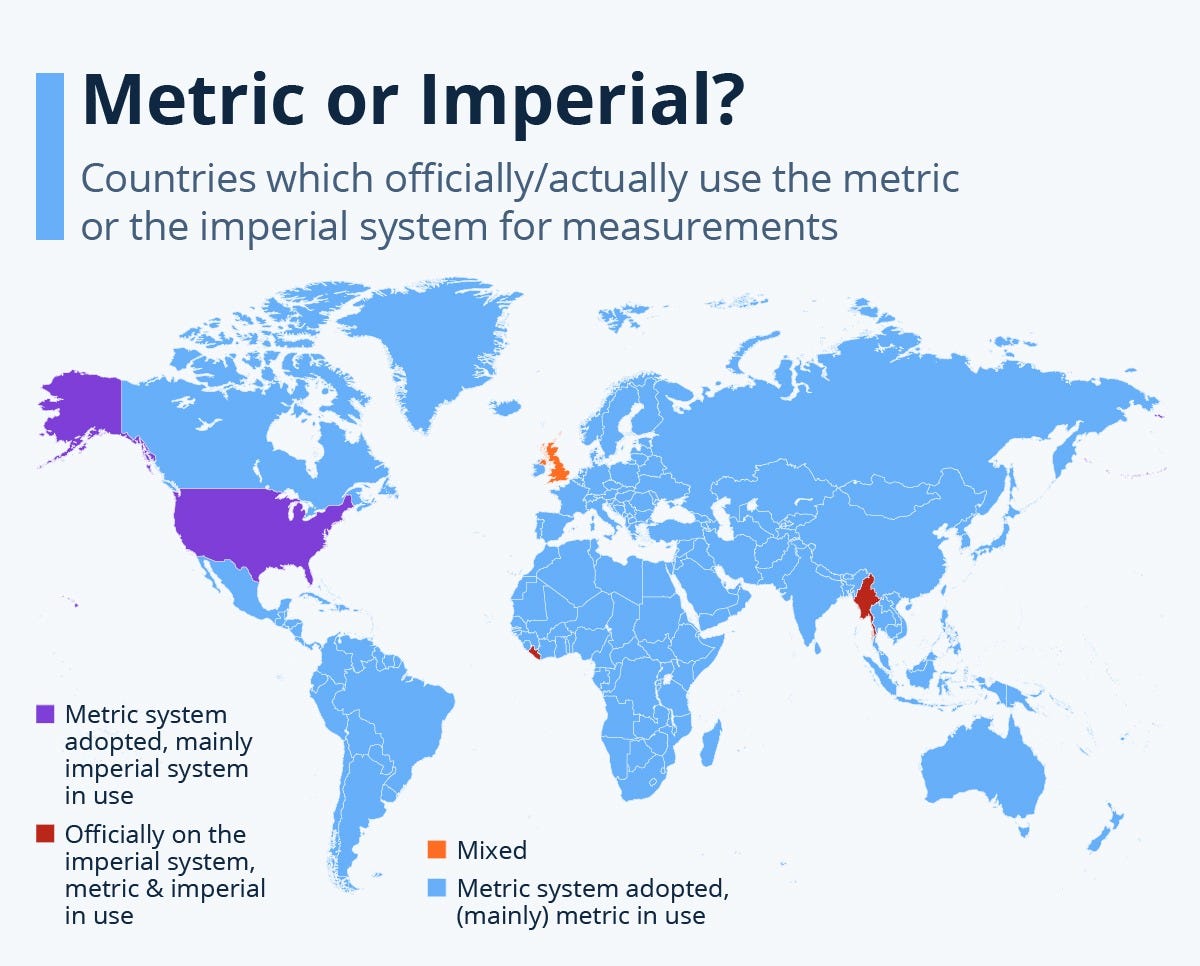
Why doesn’t America use the metric system?
I’ve wondered about this many times. As an Australian, I find the metric system obvious, smart, and sensible. It’s a bit insane that America doesn’t adhere to it. A conservative estimate is that 95% of the world’s population is on the metric system. That means that about 7.8 billion people on Earth all measure the size of their drill bits in millimeters, and we in America measure ours in eighths and sixteenths. The result is a lot of confusion and fewer drill bits available to us.
The metric system is a linguistic convention, just like every other system of measurement. Having a convention is extremely useful—if you use the same one as everyone else.
Staying off metric is a form of tariff
A tariff makes it harder for foreigners to do business with us, and harder for us to do business with them. In addition, a tariff raises revenue.
Refusing to adopt the world’s measurement standard is similar—it makes it harder for foreigners to do business with us, and harder for us to do business with them. But they differ because at least a tariff brings in revenue (at least when they’re imposed legally).
Of course, the absurd system in which there are 5,280 feet to the mile (rather than 1000 metres to the kilometer) could appeal to an anti-global trade president. If what you want is less engagement with the rest of the world, then you should make it harder for us to do business with that world. Using miles instead of kilometers does that.
America’s current system is a hybrid. It’s mostly our own thing (which owes a lot to the British imperial system) with a dash of metric thrown in here and there. If you go to a Walmart and start reading grocery packaging, you’ll see a mix of milliliters, liters, grams, kilograms, quarts, pounds, and pints.
Switching would be expensive and time-consuming. But it’s a one-off cost, and it would make life a lot easier. Think of how much easier global trade would be. Think too of the elementary school students, who wouldn’t need to remember there are a nice round 43,560 square feet to the acre.
How a system gets stuck
Bad standards are sticky. You know this if you’ve been part of an organization that’s switched up systems or software. People like to do things the way they’ve always done them.
Paul David wrote a famous paper about keyboards called “Clio and the Economics of QWERTY.” The story goes that the QWERTY keyboard—the kind I’m using to type this, and the one you almost certainly learned on—was designed to keep typewriter keys from jamming. There’s debate about this; some scholars say the design was shaped by telegraph operators transcribing Morse code. Whatever the origins, the layout was made for a machine that’s mostly been replaced.
There are other (potentially more efficient) layouts. One is called Dvorak, which was designed specifically for touch-typing and fast learning. It’s the metric system of keyboards, and almost no one uses it.
I learned to type on the machine my mum used, and she learned on what she had in school, and so on. Once a standard is entrenched, everyone wants the one that everyone else already has.
My metric policy proposal
I don’t want to sound like an old man shouting at kids on my lawn. But seriously, there are some solutions here. Technology can help us out with conversions online. My AI can speak metric, yours can speak imperial, and as long as we’re on the computer we’ll never have to confront America’s absurd measurement system in real space.
But I have another proposal for the physical world. The next time we’re in a recession and everyone is hunting for some shovel-ready projects, let’s go metric. Every road sign in America would need repainting. That’s a lot of jobs. Think of it as a Works Progress Administration for simplifying measurement.
Other questions Augusta put to me:
Trump claims $21 trillion in foreign investment. Why would we want that much foreign investment? Doesn’t that mean foreigners own a huge amount of America?
What do fax machines have to do with this?
Is Pluto a planet? (Answer: Pluto is a wonderful Disney character.)
Finally, should we have taken this $21 trillion claim seriously at all?
Look, this was the number we set out to test. The problem is that every part of this claim is absurd. We chose to analyze it anyway. Augusta thinks that was all right: it’s still the president of the United States, and when you have the expertise, you check. Showing our work helps people check for themselves.
I’m mostly convinced. If it isn’t obvious to everyone that something is nonsense, then my job as a teacher is to teach. But I’m still puzzling it over. Does teaching that nonsense is nonsense distract from our mission, or is that part of our mission?
These are puzzling times.
Watch the full episode for the rest.
I was told when I was ten years old, in the fifth grade, that we would be going metric. I am now 75. Aarrgh.
You've been in the States awhile, so when you ask this question, please don't take offense when I ask you:
Have you met us?