


Trump just hit Canada with a new set of 50% tariffs.
There’s a lot going on here. A lot. So let’s dig in.
This matters for American families because the President’s “retaliation” is higher tariffs — that is, higher taxes charged to Americans who buy stuff from Canada.
It matters for Canada. My rough insta-analysis says this is a much bigger deal than most of the President’s recent volleys in our on-again off-again trade war with our nearest neighbor.
And it matters for the rest of the world – and our relationship with the rest of the global economy – because the next round of the trade war is just around the corner.
My interpretation is that the President intends to send a message that resonates far beyond Canada. We’re on the cusp of the next round of the Trump trade war, and the President is trying to say: If you retaliate, expect further escalation and counter-retaliation.
Here’s a reminder about what to expect in the next round of this trade war:
Better Lawyers, Worse Economics: Inside Trump's Latest Tariff Strategy

If you’ve found it hard to keep track of Trump’s trade war, that’s not on you. It’s on him. Trade policy has turned into one of those horror-movie zombies. You think it’s dead. It sits up. Comes back even uglier. And keeps on coming back.
This tariff broke the Canada exception
So what actually happened?
Yesterday – July 20, 2026 – the White House posted three proclamations under Section 338 of the Tariff Act of 1930, plus a fact sheet pulling them together.
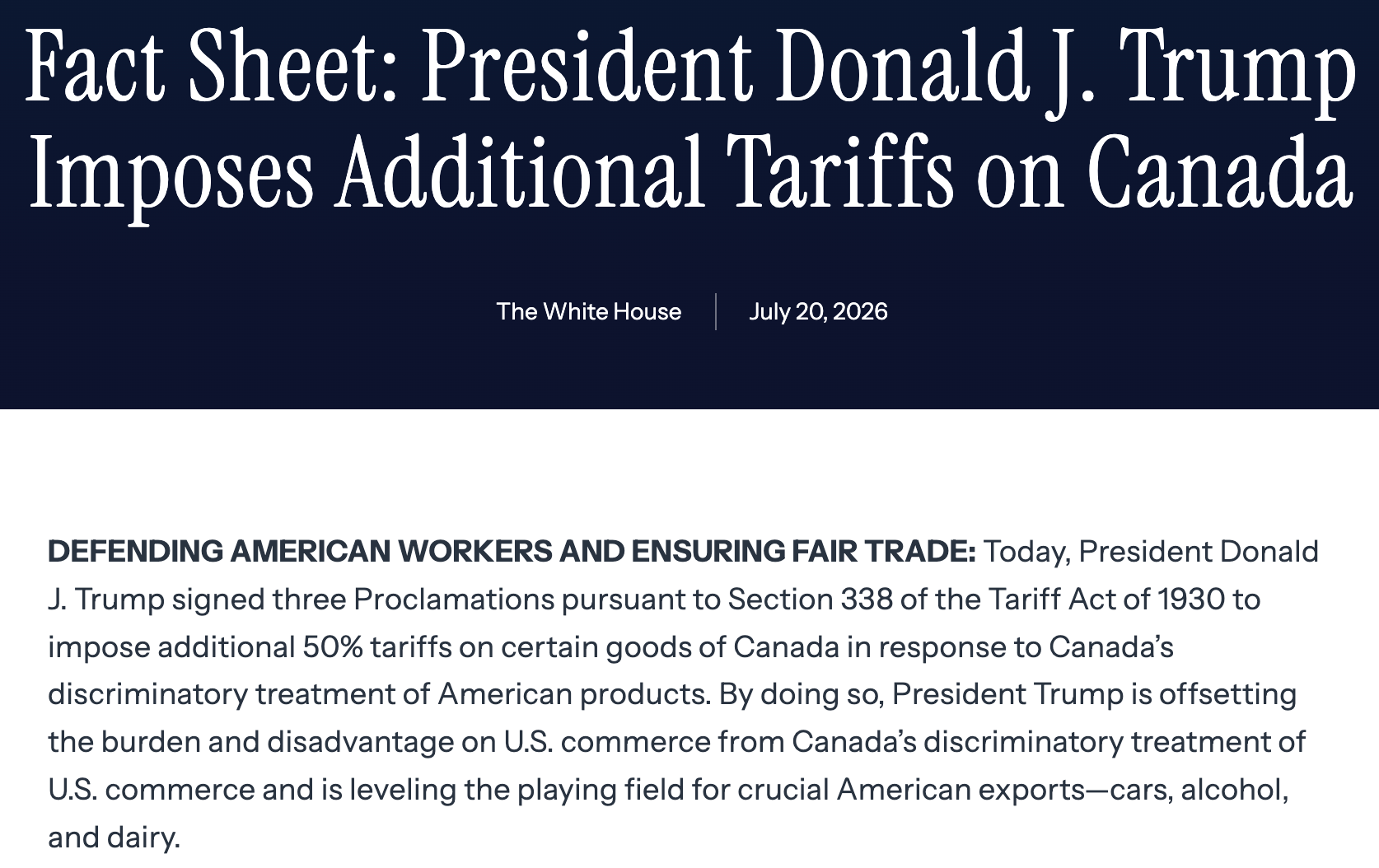
Each one slaps an extra 50% tariff on a list of Canadian goods, and these come into effect in a month’s time. The disputes are labeled motor vehicles, alcoholic beverages, and dairy. Those names refers to the President’s complaints, not to the tariffs involved.
There’s going to be a lot of ink spilled over these disputes.
Let me save you the time. There’s not much here, other than a desire to punch Canada, dressed up in a novel legal theory.
But this punch is different.
Here’s the important bit: The White House says these tariffs hit the covered goods whether or not they qualify under USMCA.

Let me put that in plain English. Even if a Canadian good ticks every box for preferential treatment under the North American Free Trade Agreement (which Trump renamed USMCA), this new tariff can still apply.
Why does that matter so much?
Well, for much of the tariff chaos earlier in Trump’s second term, USMCA compliance was the escape hatch.
Throughout 2025, the White House threw around tariff threats with reckless abandon, but it also quietly added an asterisk saying these wouldn’t apply to goods from Canada and Mexico that qualify under our existing USMCA free trade deal.
That turned out to be an important escape hatch, because almost all Canadian trade caught up in those earlier fights qualified. A Canadian Finance Department briefing said 97.5% of Canadian exports covered by those earlier tariffs were USMCA-compliant and thus came in duty-free. I have seen others suggest numbers closer to 90%. It’s hard to be precise, but it’s clear that this escape hatch effectively shielded most of Canadian industry from President Trump’s tempestuous tariffs.
Trump keeps renegotiating his own trade deal
Honestly, the history here is so absurd that the best thing I can do is just line the facts up and let them do the comedy.
First, Trump spends his first term telling everyone that NAFTA is a disaster.
Then he renegotiates it.
Then he announces the replacement (USMCA) like he’d discovered fire, invented trade, and personally rescued North America and created a deal they had (awkwardly, embarrassingly, noticeably) already been in for decades.
He held a signing ceremony. There were flags. Sharpies. People applauding.
In realty: Nothing much changed, except for the branding.

But in his second term, he hits Canada with tariffs anyway.
Then he adjusted them.
Then he carved out USMCA-compliant goods (effectively removing them).
Then he slapped sectoral tariffs on other stuff.
Then he kept telling everyone the trade agreements aren’t good enough.
And now, here we are again. Same President, reaching for a law from 1930 to tariff Canadian goods even when they qualify under the trade agreement that replaced the trade agreement he blew up in order to write this trade agreement.
The list is weird because the law is weird
Now let’s talk about the novel legal theory behind our new trade war with Canada. And I’m not a lawyer, so I’ll just sketch out the big details.
Remember, the constitution gives Congress, not the President, power over tariffs. So if the President is going to do something, he has to pretend that somewhere along the line Congress gave the White House this power. The courts have recently forced President Trump to actually pay attention to this, ruling many of his tariffs unconstitutional.
These new anti-Canada proclamations lean on Section 338 of the Tariff Act of 1930. Which was last used when Herbert Hoover was still in the building.
Section 338 lets the President slap on additional duties, up to 50%, if he finds another country discriminates against U.S. commerce or puts an unreasonable, unequal burden on it. And the law says the tariff should offset that burden or disadvantage. This seems to suggest there needs to be some proportionality to the response.
But a February 2026 brief from my friends at the Peterson Institute for International Economics called Section 338 an “untested retaliatory tool” and said it had never once been used to apply a tariff, even though people had threatened it over the years.
So yeah, this is weird. And that weird law is exactly why you get a weird list.
The three proclamations are officially the result of separate disputes over cars, booze and milk. But the goods actually getting hit? They’re not related to these disputes at all.

That’s because the title tells you the grievance, but not what is actually being tariffed in response. So you end up with a so-called motor-vehicles proclamation that reaches all sorts of things that are not motor vehicles: Wine. Cement. Hockey Sticks.
Tariff policy has discovered the junk drawer.
Small for America, real money for Canada
Okay, let’s do some arithmetic.
Now, this is day-one insta-analysis. I’m just trying to get the order of magnitude right.
In order to figure out how much of the economy is about to get whacked, I read up on the pages of goods that are to be tariffed, and paired them with official government data on US imports from Canada, by product.
My rough estimate is that these tariffs cover a bit more than $20 billion of Canadian goods sold into the United States. That’s maybe around 5% of what we import from Canada.
So for the United States, it’s a modest macro effect that will pack a more powerful punch in specific sub-sectors of the economy.
The cost to the typical American household lands at around $50 to $100 a year on average, depending on pass-through, substitution, and which firms use the tariff umbrella to jack up their own prices. Meaningful, but not gigantic.
But for Canada, this is a real hit.
Canada is a much more open economy than the United States, so trade really matters. And trade with its nearest neighbor matters a lot. When you impose an extra 50% tariff on something like 3% of a country’s exports (which adds up to nearly 1% of its entire GDP), businesses notice. Exporters notice. The people planning next year’s investments notice.
One more thing that expands the reach of these tariffs: Everyone in Canada will notice, including those who don’t make the specific products the United States targeted this time. The more far-reaching news here is that the President has shown that the list can change.
The USMCA shelter is no longer much of a shelter — that’s the escalation. Reliability, certainty, and a spirit of mutual cooperation are out the window.
Canada may be the warning shot
So why Canada? And why now?
It could be that the Administration is genuinely telling the truth that it’s worried about Canada’s cows, cars, and cocktails. I mean, it’s possible
The dairy dispute is probably the cleanest rationale, on its own terms. The U.S. has been complaining for years that the way Canada runs its dairy tariff-rate quotas under USMCA chokes off the market access America thought it negotiated. The US Trade Representative has actually taken this to a dispute panel. So that one did not spring out of nowhere.

The alcohol dispute is smaller and more provincial, and the motor-vehicles fight is tangled up with earlier rounds of tariff retaliation.
But if you step back from the legal labels and ask what the broader play is, I think the answer is far bigger than cows, cars, or cocktails.
My interpretation is that Canada may be the test case.
The White House fact sheet goes out of its way to point out that only China and Canada chose retaliation instead of negotiation. And I think you’ve got to hear that message alongside whatever’s coming next, including the administration’s broader push toward tougher customs enforcement and the expected wave of new tariff action around forced-labor issues.
To everybody else, the message is pretty simple: Don’t retaliate. Because if you do, the President is willing to reach for old powers, ignore new promises, and improvise from there.
And there’s something more broader, and more important: A deal is only a deal if today is a day the President feels like honoring it. Which means that it’s impossible for the United States to strike serious trade deals with anyone. For all of the President’s claims that he wants these agreements, no-one has done more to undermine that possibility.
Was this in supposed retaliation for the wildfire smoke? Which is bonkers in the first place. Frankly, I'd like to buy more stuff from Canada in protest. I'm stubborn that way.
To sum up, Trump doesn't know what the f**k he is doing in dealing with economic issues, tariff issues or any other issues for that matter. He is just a 34x convicted felon crime boss who happens to occupy the Oval Office at the moment - but not for long!