


Elon Musk just lost the most expensive bet in the history of American elections. He spent $474 million on these midterms — more than any donor has ever spent in a single cycle. Then his side lost, and it lost big.
You’ve probably heard a few different reactions to the Musk story. One is “Ha ha!” (maybe with a little finger point). Another might be “Phew.” Because maybe all that money can’t buy votes after all. Maybe our democracy is safe.
Both reactions miss the real story here.
I’ve spent the past day crunching numbers and making charts. And when I counted how many zeros were at the end of each number, that $474 million became small. It might just be a blip in Elon Musk’s week.
Here’s the short version. Tesla’s stock traded fairly flat during most of election day. So did SpaceX. Then the vote count began, the Blue Tsunami emerged, and almost immediately stock in both companies tanked. All told, the market value of Musk’s stakes in these two companies fell by more than $50 billion. Relative to the rest of the market — which rose! — his wealth took a hit of about $70 billion. And once you realize that much of this political risk was already priced in, it becomes clear that Musk’s wealth under a Democratic Congress might be a hundred — or hundreds — of billions of dollars lower than it would be under a Republican Congress.
Elon’s terrible, no good, very bad day
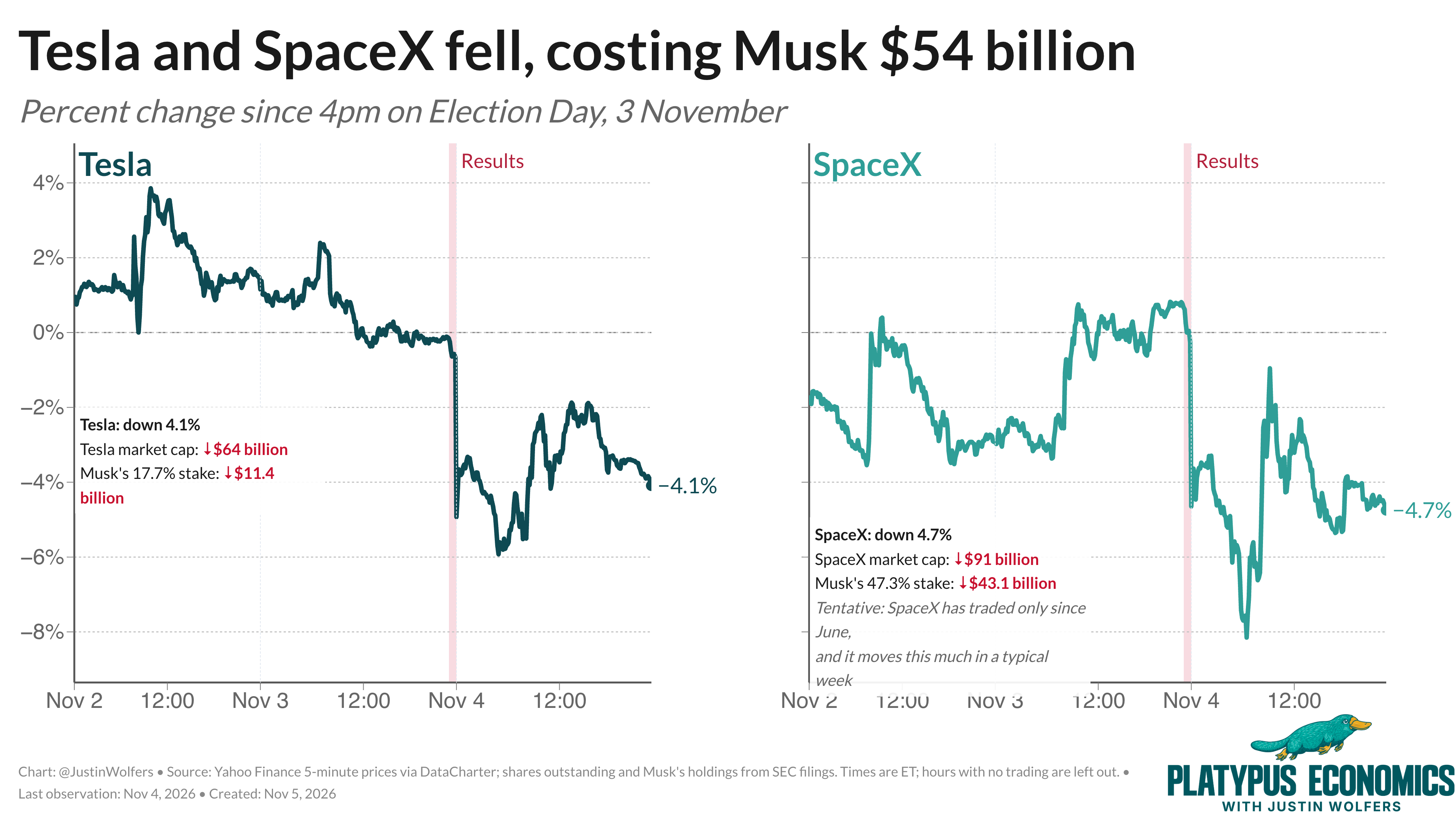
Eyeball the graph below, and you can see that news of the Blue Tsunami led Tesla’s stock price to fall by about 4%. SpaceX fell nearly 5%. Those moves came right as the results rolled in and a Democratic sweep came into view. That’s the reason we can be confident that this is causation, and not just correlation. After all, what else happened on Tuesday night that would lead the market to so dramatically re-evaluate Tesla and SpaceX?
Musk owns nearly one-fifth of Tesla and a bit less than half of SpaceX, and these companies are each worth hundreds of billions of dollars. Math it out, and these sharp declines knocked about $54 billion off Musk’s personal wealth.
That’s more than a hundred times what he spent on the entire election cycle.
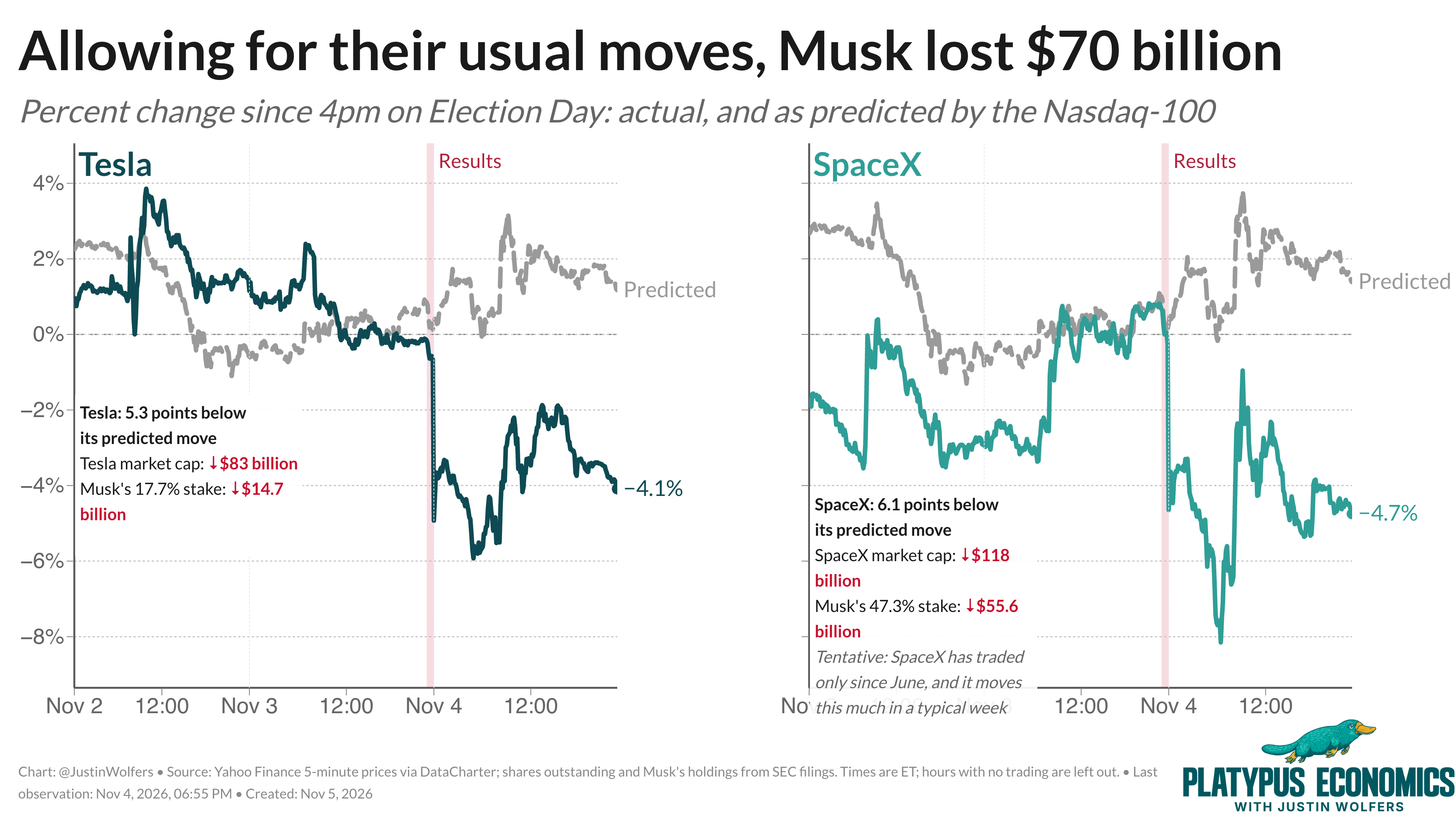
And that understates it. The broader market had a good day, and Tesla and SpaceX usually rise when the market rises. In finance, a stock’s unusual comovement to the market is called its beta. It measures how much you might have expected these stocks to have risen when the market rose.
Armed with our estimates of beta and the rise in the stock market, we can say that on a more typical day you might have expected Musk’s stakes to gain about 1.3%. Instead, they fell 4.6%. That gap between what the rising market predicted and what actually happened comes to roughly $70 billion of Musk’s wealth. Think of this as a different measure of what Musk lost — this time, one that accounts for a counterfactual that you might normally have expected whatever raised the rest of the market to have also helped Musk’s companies.
I want to be a bit careful about how robust this finding is. The Tesla result is solid — the size of the decline in its stock price is large relative to Tesla’s usual movements, and the timing fits the election story perfectly. It’s harder to know what to make of SpaceX. It has only traded since June and bounces around a lot. So it’s possible my estimate overstates Musk’s losses, just as it’s possible it might understate them.
You don’t need faux precision to see the point. The market went up, and Musk’s companies went down. The difference is tens of billions of dollars. That’s the key point here.
The bet was bigger than the surprise
I’ve understated things again.
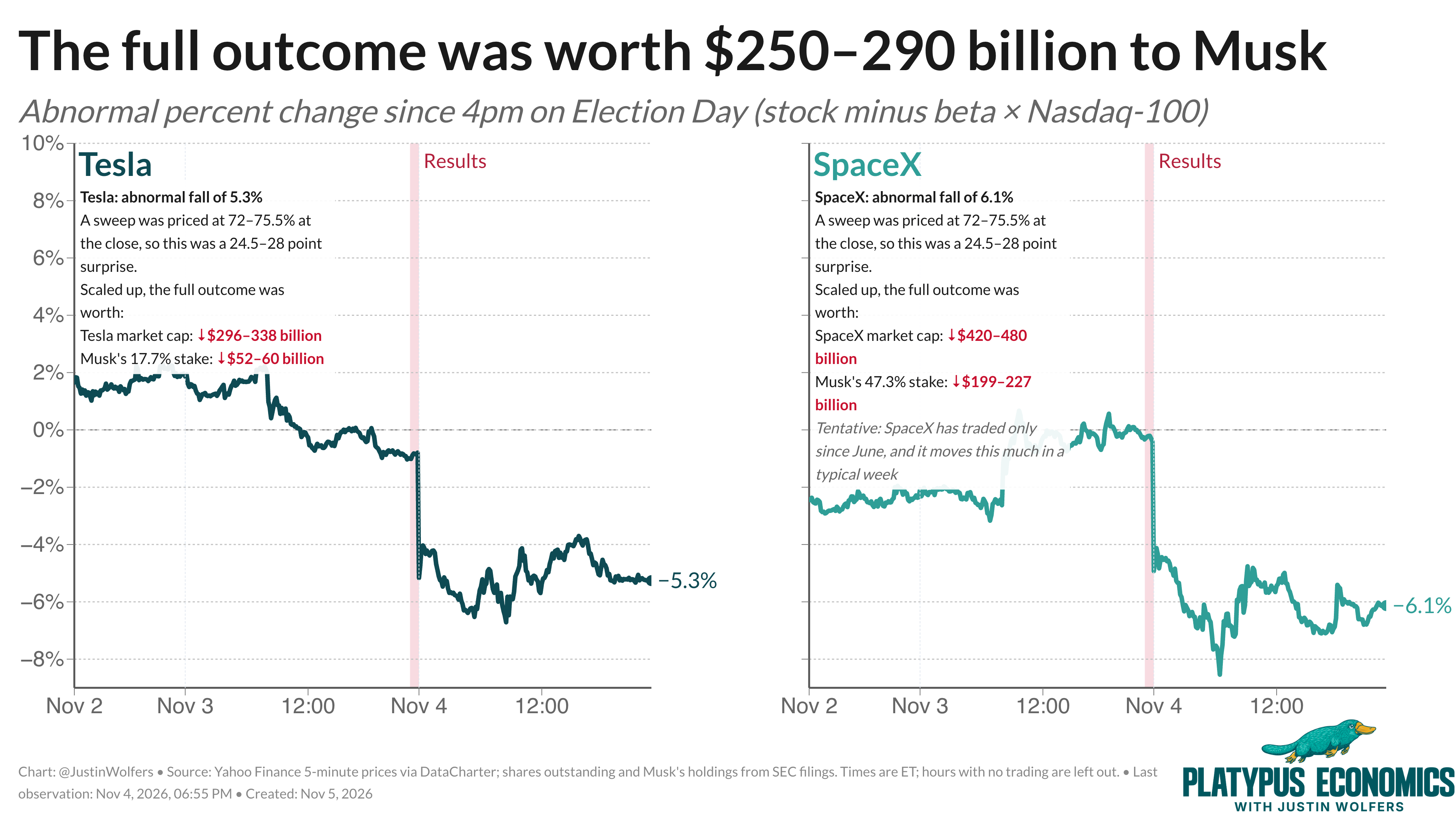
The $70 billion measures the surprise on election night. But markets look forward. At the Election Day close, before a vote was counted, prediction markets already put a Democratic sweep at about three in four. And the stock market also understood this. As such, three-quarters of the bad news for Tesla and SpaceX was already priced in, and election night just delivered the last quarter.
If the final 25 points of surprise cost Musk about $70 billion, the full swing from a sure Republican Congress to a sure Democratic sweep is worth about four times as much.
I’m not going to report four times $70 billion here because that overstates the precision of my estimates. Instead, I want to emphasize that this exercise says that Musk’s wealth is likely a hundred — or hundreds — of billions lower under a Democratic Congress than a Republican one.
(Nerd alert: This is the approach Erik Snowberg, Eric Zitzewitz and I used in our research on how elections — including midterms — move markets.)
So to put everything in the same units: Musk spent about $0.5 billion on the election, the surprise cost him tens of billions (my estimates are $50-70 billion), and the outcome itself changed his wealth by hundreds of billions.
These numbers are mind-numbingly large. Are they plausible? (Spoiler: Yes.)
Why one election matters so much to one man
Government matters a lot to Musk’s business. SpaceX depends on NASA and Pentagon contracts plus federal approvals. Starshield, the military version of Starlink, has already raised serious questions about whether one private billionaire should get to decide when a communications network works in the middle of war. I’ll tell you straight up: that keeps me up at night (and I don’t normally say that about satellites).
A Democratic Congress can’t cancel contracts with the wave of a wand. But it gets committee chairs, hearings, and subpoena power.
Tesla’s Robotaxi and Cybercab plans live or die by what safety regulators permit. A 100% tariff on Chinese electric vehicles currently keeps cheaper rivals off American lots. And a proposed Tesla-SpaceX merger now faces a Congress that can’t veto it but can bury it in delays, documents and headlines.
Musk is an extreme case, but the lesson is general. Government rules help decide who wins and who loses across the economy, and small changes in those rules can move billions of dollars.
Money helps, but not the way Elon spent it
So did Musk’s money fail? Money can help politicians win, but buying an election is harder.
More than $200 million of Musk-backed money went into attempting to elect Ken Paxton in Texas. James Talarico won that election by 12 points.
Does that prove that Musk’s money didn’t make a difference, and hence our democracy is safe? I don’t think so, and a bit more arithmetic makes the case.
Suppose that, in an effort to be conservative about how much money matters in politics, we assume that a political donation can change one voter’s mind for $1,000. By that math, Elon’s $200 million changes about 200,000 Texan minds. In a state as large as Texas, that’s enough to move the margin by about 4 percentage points. That’s a real effect, but it’s swamped by a 12-point loss.
Paxton was a terrible candidate. Texas is enormous. That makes it a terrible place to try to buy a Senate seat. So the argument so far is not that money doesn’t matter, but that Musk’s money didn’t matter because it was so poorly targeted.
What if he had spent his money in a more sophisticated way, with an eye to keeping Republican control over the Senate? If he had invested his money instead in helping Republicans hold Alaska, Mississippi, Maine, Kansas, Iowa, and South Carolina he really could have made a difference. Here, he would have needed to flip only 124,000 voters. At a price of $1,000 per voter, a mere $124 million could have changed six Senate seats, and with them, control of the Senate.
Look, that example is a little bit contrived. It assumes that a prospective political investor would know exactly where to put their money. But the underlying logic is robust: Spending enough to buy control of the Senate likely costs hundreds of millions, or maybe a handful of billions. And for an ultra-wealthy entrepreneur whose business is tightly linked to government rules — like Musk — the benefit is tens of billions, and possibly hundreds of billions.
Our democratic infrastructure is not built for these concentrations of wealth
In 1972, the economist Gordon Tullock asked a provocative question. If government decisions are worth so much, why is there so little money in politics?1
Most people look at $474 million and see far too much money in politics. I happen to agree. But Tullock was making the point that, for individuals with a lot on the line, it may be rational to spend even more.
By my math, it almost certainly makes sense for a politically connected near-trillionaire to spend the hundreds of millions or possibly billions that it would take to buy an election. You can tweak any of my (overly simplistic) assumptions in important ways. But the difference between the benefits of buying the Senate you want (hundreds of billions), and the costs of the campaign spending required (hundreds of millions), is so large that this logic is hard to escape.
Buying an election appears to be a profitable investment. And this holds true even for the world’s largest and most expensive elections.
When Tullock first proposed his puzzle in 1972, the idea of one man spending $474 million dollars on a midterm would have sounded absurd. Yet here we are. Where might we find ourselves in another few decades?
This time, the bet didn’t pay. But the next billionaire may bet more, and may bet in more targeted and sophisticated ways. The billionaire after that might discover that it’s still profitable to bet ten times more. If you think money in politics is a problem today, just wait.
And what does this mean for our democracy? For most of American history, millions of small donors could collectively outspend the mega-rich. But today’s extremes of wealth, the close links between their businesses and our government, and lax campaign spending laws mean that’s no longer true.
It’s our democracy. For now. It’s also up to us to defend it. The simple economics we’ve just worked out predicts that we really need to do something soon. Because if you think one man donating $474 million in one election cycle is a problem, my bet is that you ain’t seen nothin’ yet.
The original work is paywalled online, but you can read about what’s now called “Tullock’s Puzzle” in a 2003 economics paper that takes up the same question. Why would you want to read a famous economics paper? I don’t know. You read this piece, after all.
Dear Professor Wolfers. Excellent content and sober analysis. As the Democratic leadership is pondering next steps, the Roberts court’s decision on Citizens United is screaming for reversal, as your article addresses, or perhaps implies. The “independent” judiciary has demonstrated in the past that they are not above stating positions on matters beyond judicial review and will be swayed by public opinion. Thank you for your tremendous work.
Interesting to see how your analysis plays out JW. It may take a bit, but I think the market will continue to be unkind to him (and everybody apparently … we’re in correction territory)