


My dear stepfather had a particular theory of economics. Our family debates would sometimes turn to a complex question: what should we do about poverty? He’d come back with a deceptively simple answer. We should give people money.
If poverty is a lack of money, then giving people money helps.
My stepfather was a historian, and his answer was a bit of a tautology. It was also very deep. If we give people money, they have more money (yes, I studied for a PhD in order to learn that). But how we accomplish that — and if we even should — is a hotly contested feature of American political debate.
The Census Bureau just released the latest poverty statistics, and in their way they put his theory to the test. The official poverty rate fell to 10.2% in 2025, a historic low. A broader measure, which counts a wider range of resources and expenses, came in at 13.1%. It was basically unchanged from last year.
This is a mixed bag, like poverty numbers often are. You can take either of those measures and see the sheer scale of people in America whose needs aren’t being met. It’s astonishing that a country as rich as ours still has tens of millions of people struggling to get by. But there’s good news too, and plenty of it.
The great success story
Let me start with the good news, which is also very old news.
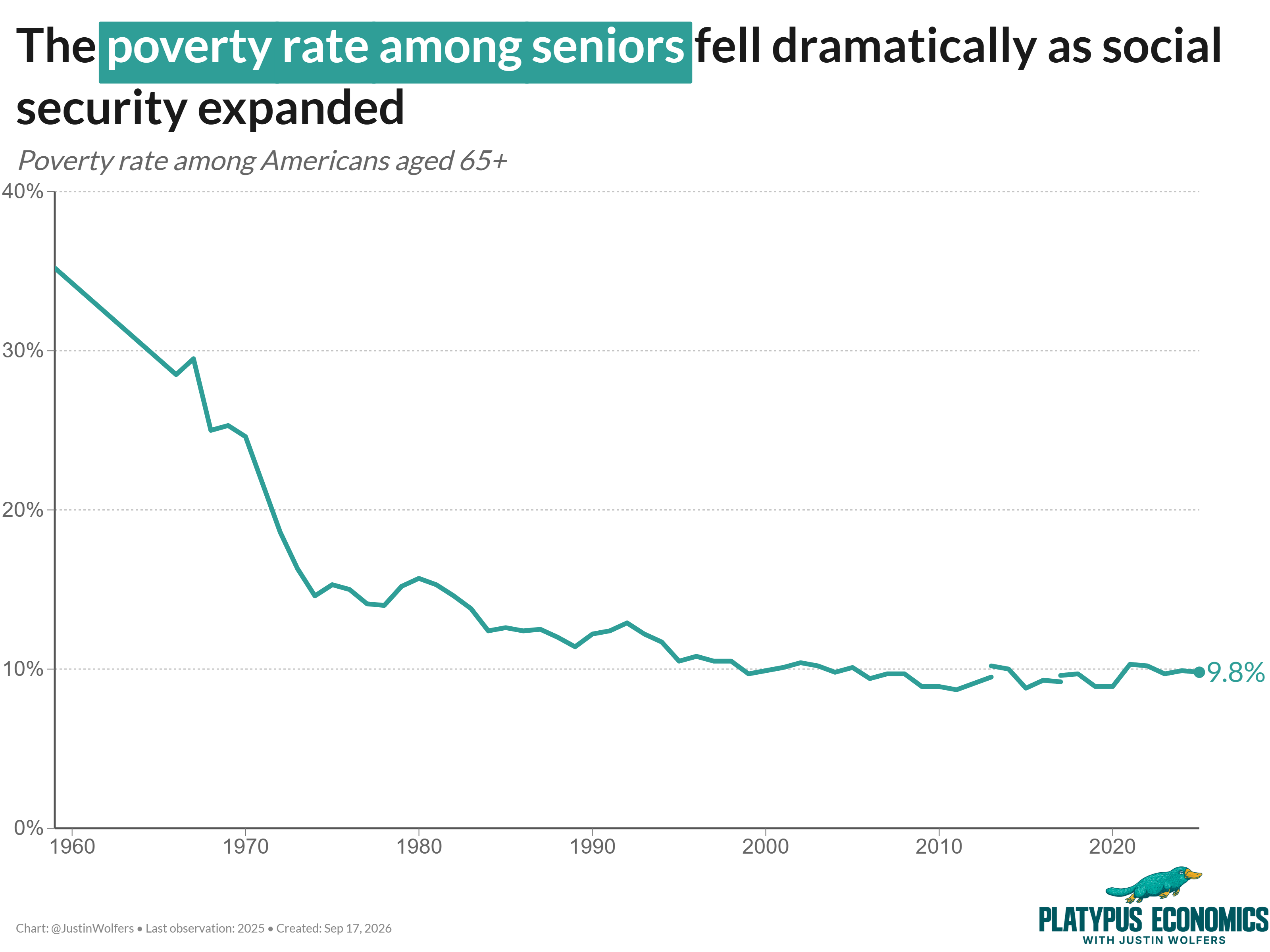
When poverty was first measured, we discovered that it was incredibly high amongst seniors. It’s obvious when you think about it. You’re retired, so you have no income. And having no income is how we define poverty.
Then came Social Security and its expansions, and poverty among older Americans fell by an absolutely gargantuan amount. It remains the largest anti-poverty program we have.
(An aside: politicians sometimes design a program to pay just a bit more than the poverty line. They’re not necessarily trying to fool you. Often they’ve simply asked the experts how much people need, and the experts pointed to the poverty line.)
That’s held, by the way. Poverty amongst older Americans remains low, and that’s a very good thing.
How we got here
First, a little history. There are two main measures of American poverty: the official number, and something called the Supplemental Poverty Measure, or SPM.
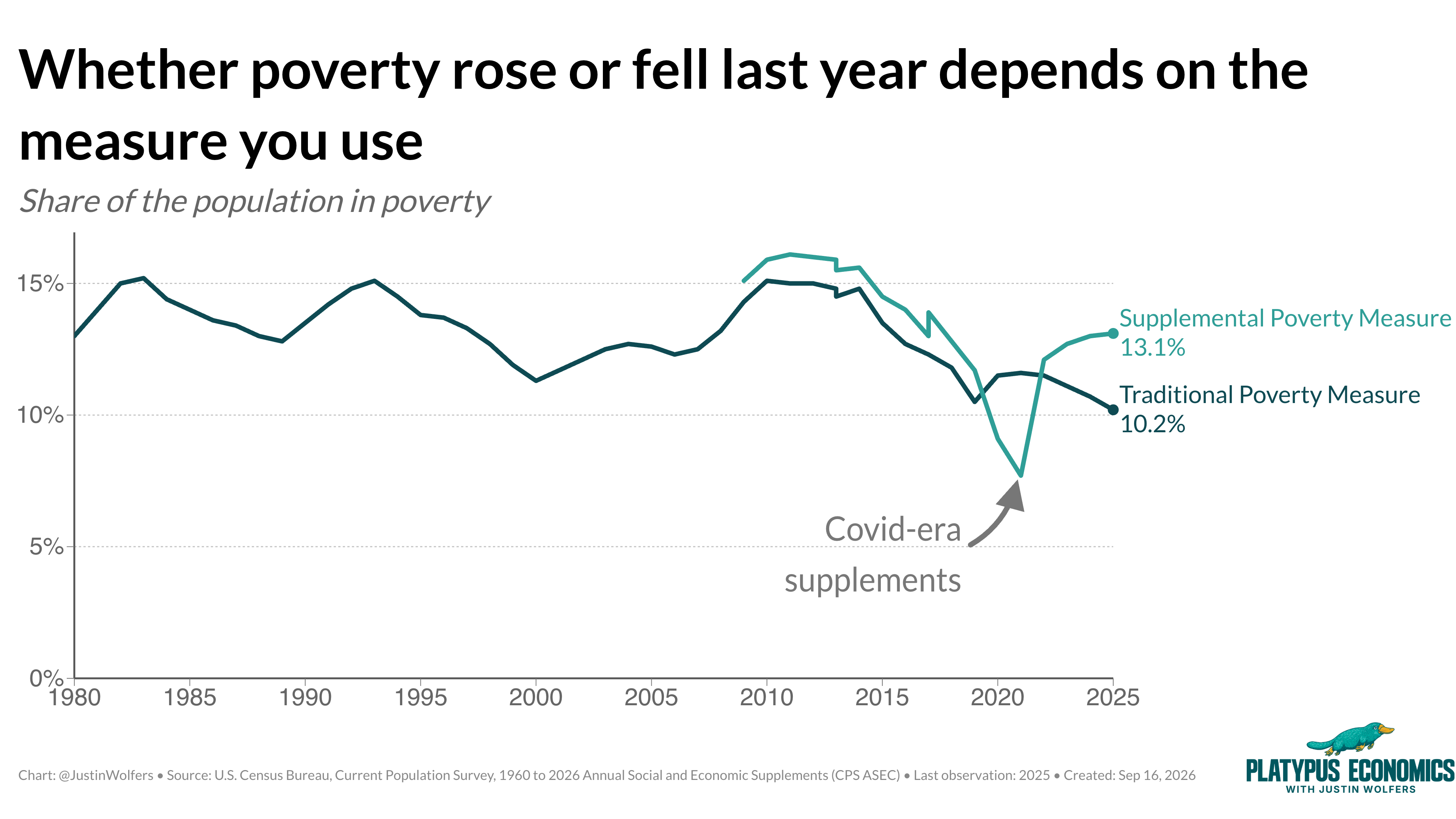
Why are there two measures? Well, start from the simple recognition that measuring poverty is hard. If you said to me, “How many Americans are 6’0?”, I’d just go out with a ruler and measure how tall people were. I’m a very literal person. If you ask me how many people are in poverty, I’m going to ask you a bunch of questions instead.
Questions like: How should we measure households vs individuals? In a very rich country — like the U.S. — is an income of $20,000 poverty, or is it actually a reasonable standard of living? Should we measure this differently for me in Michigan and my friends in New York? The cost of living is different in those two places. But maybe living in New York is a luxury good, and so it should be counted differently.
And then also: what do we mean by income? Should food assistance count as income? It’s not money. You can’t use it for everything, but you can use it for food, which matters a lot. Should we do this pre-tax or post-tax? The complexities multiply.
You have to decide on something
The first poverty measure dates back to the 1960s. Mollie Orshansky, an economist at the Social Security Administration, took the cost of a healthy diet for a family and tripled it, because families then spent about a third of their income on food. We’ve adjusted that line for inflation ever since, and that’s about all we’ve done with it. It counts pre-tax cash. The only resources that count as income are money income.
Which means it can’t see a food stamp, a tax credit, or a medical bill.
The Supplemental Poverty Measure fixes that. It was designed by a panel of poverty experts who all took turns yelling at each other until they finally agreed on something. Instead of obsessing about what counts as income, it focuses on the resources available to a family, and so it counts SNAP, tax credits, and housing help, among other things. It subtracts taxes, work expenses, and out-of-pocket medical costs. And it adjusts for the fact that living in Brooklyn costs more than living in Ann Arbor.
Almost everyone who studies poverty thinks it makes a lot more sense. And it lets you do something very useful.
Ballad of column B
This Supplemental Poverty Measure lets you treat everyone as a line in a spreadsheet.
We’re all lines in a spreadsheet. You’re a line in a spreadsheet, your friends and neighbors are lines in spreadsheets. Or perhaps you’re a column. When I tuck my kids in at night, I say: Good night, column C. Good night, column D. (Columns A and B are Betsey and me.)
Once everyone’s in the spreadsheet, you can mess around, change some of the cells in the spreadsheet, and see what happens.
Delete Social Security, and 28.8 million more Americans would have been poor in 2025. Delete the earned income tax credit, and about 4 million more would have been. Now subtract what people pay out of pocket for medical care. Medical expenses pushed 7.7 million people into poverty in 2025.
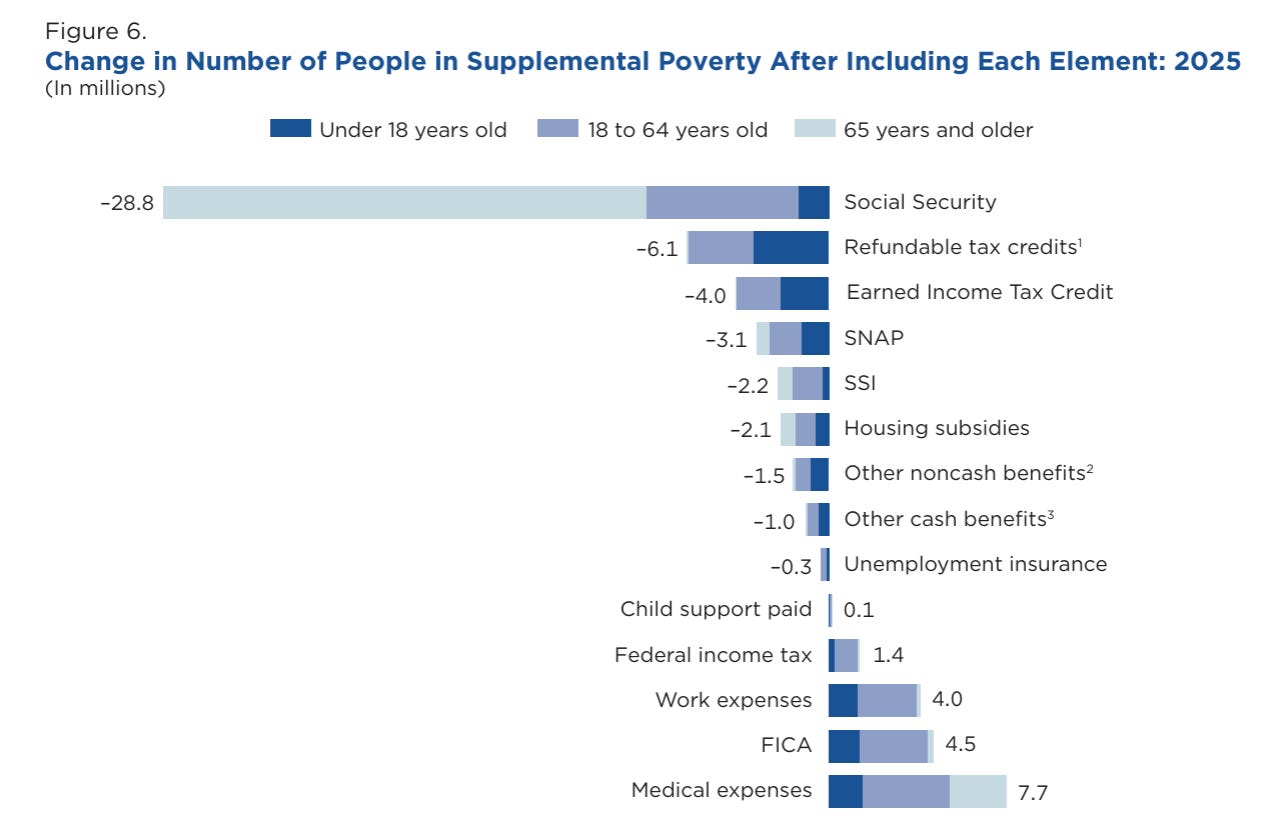
That’s close to my stepfather’s theory, just with more numbers on it. Give people money — or other useful resources that play a role money often plays — and they have more money. Take money away, and they have less.
What the spreadsheet can’t show you is the deeper story of why. This person’s income fell because they got divorced. That person left the workforce because of an industrial accident, and they can never work again. Those are different stories, and they matter here because: 1. they’re human and they’re important; and 2. they might change the help you want to offer.
First, who do you help?
Poverty is concentrated. The group most at risk is, overwhelmingly, single mothers. Single-parent families have higher poverty rates than two-parent families, for the obvious reason that there’s only one earner.
Poverty rates are higher for Black and Hispanic Americans than for white Americans or Asian Americans. But don’t conclude from this that poverty is mainly a story about minorities. The majority of Americans in poverty are white.
A rough rule of thumb: if you can get a full-time job and hold it for the full year, you are very unlikely to be below the poverty line. If you can find work 30 weeks a year but not 50, it’s much harder to get your annual income high above that threshold.
So how does anyone end up falling into poverty? Usually through a shock.
Divorce. Sudden single parenthood. Becoming a widow or widower. Losing a job. Becoming disabled. Anything that knocks you out of your usual ability to work and get by.
How do you do this, again?
Now, what works? This is hotly contested, so let me caricature the American debate first and then try to be more helpful.
The old battle line on the right was that handouts create a culture of dependence. People used to argue that teenage girls got pregnant so they could enjoy the incredible riches the welfare state showers on single mothers. If you’ve seen the struggles of actual single mothers, you might find that pretty unlikely. But the claim was that what people really needed was opportunity and a shove to go out and find work.
Roughly, the European and Scandinavian approach is to give people resources. The American approach is to give people work opportunities.
Here’s where it gets challenging. A lot of government programs say: if you’re poor, we’ll help you. And if you rise into the lower middle class, we’ll cut off your help. So there’s a range of incomes where every extra dollar you earn costs you a big chunk of benefits. You work and get a bit more money from your boss in one hand, but the government takes back its assistance from the other, and you don’t end up much better off.
Economists call that a high effective marginal tax rate. The rest of us can call it a poverty trap.
That means the highest effective tax rates in America often aren’t paid by millionaires. They’re paid by working-class families who lose a chunk of government help for every extra dollar they earn.
The earned income tax credit is meant to reduce that implicit tax. So if you believe, as so much tax-cut rhetoric insists, that low taxes are what give people the incentive to work, you should be pushing even harder for those credits.
How to decide who gets what
There’s an even more uncomfortable question under all of this.
American politics often draws a line between the deserving poor and the undeserving poor. We want to help the first group and not the second. And we carry around very coarse caricatures of who’s who.
The deserving poor: the single mom trying to get by, looking after her kid and applying for jobs every week. You’ve seen her in movies and heard about her in (many, many) speeches. The undeserving poor: the bum on the street begging for spare change who never bothers applying for a job.
If those caricatures sound to you like they might involve racist tropes, that was well-spotted.
Those ideas — about deservingness, productivity, and poverty — really shape how we offer help. In my home country, Australia, we give low-income people money. In the United States, we give them food stamps, which is money you can only spend on food. The idea is either that the taxpayer knows what you need better than you do, or that the taxpayer will pay for your groceries but not your cigarettes. Either way, a judgment about who deserves what is built into the design.
A gentler version of the question is: who can we expect to work, and who can’t we? Even that gets very hard, very fast. Say someone struggles with alcoholism, and every time they’re sober they apply for a reasonable number of jobs. Are they able to work? That depends on many of your judgements, including if you think of alcoholism as a disease and what you think their personal responsibility for their condition is. Now think about something like depression. Or bipolar disorder. Or a traumatic brain injury. Your legs might work, but can you?
Our disability programs draw the line with paperwork: you sit down with someone and document a known disability. But the moment you talk to real people, it becomes really, really hard. I hope we bring both a brain and a heart to these questions. I can’t tell you where to land.
An easy case: Children.
A six-year-old does not deserve to be in poverty. Ever. I’m happy to make that as a pure ethical statement (perhaps not the bravest one in the world).
This week’s report says official child poverty hit a record low of 13.4%. That’s good news. Still, it’s more than one in eight American kids.
Kids are one of the biggest groups in poverty for a simple reason: every single-parent household, by definition, involves children.
And here’s the policy problem. Those kids live with parents whom many voters see as the undeserving poor. Kids don’t have their own incomes, so it’s almost impossible to help a kid without also helping a parent. (Schools are the exception. Better schools help the kid, not the parent.)
We did move the needle on this somewhat recently. During the pandemic, a huge rise in income support — including in particular an expanded child tax credit — sent money to households with kids. By the supplemental measure, child poverty dropped sharply. When the credit expired, child poverty went right back up. Giving people money — this time in the form of a tax credit — worked.
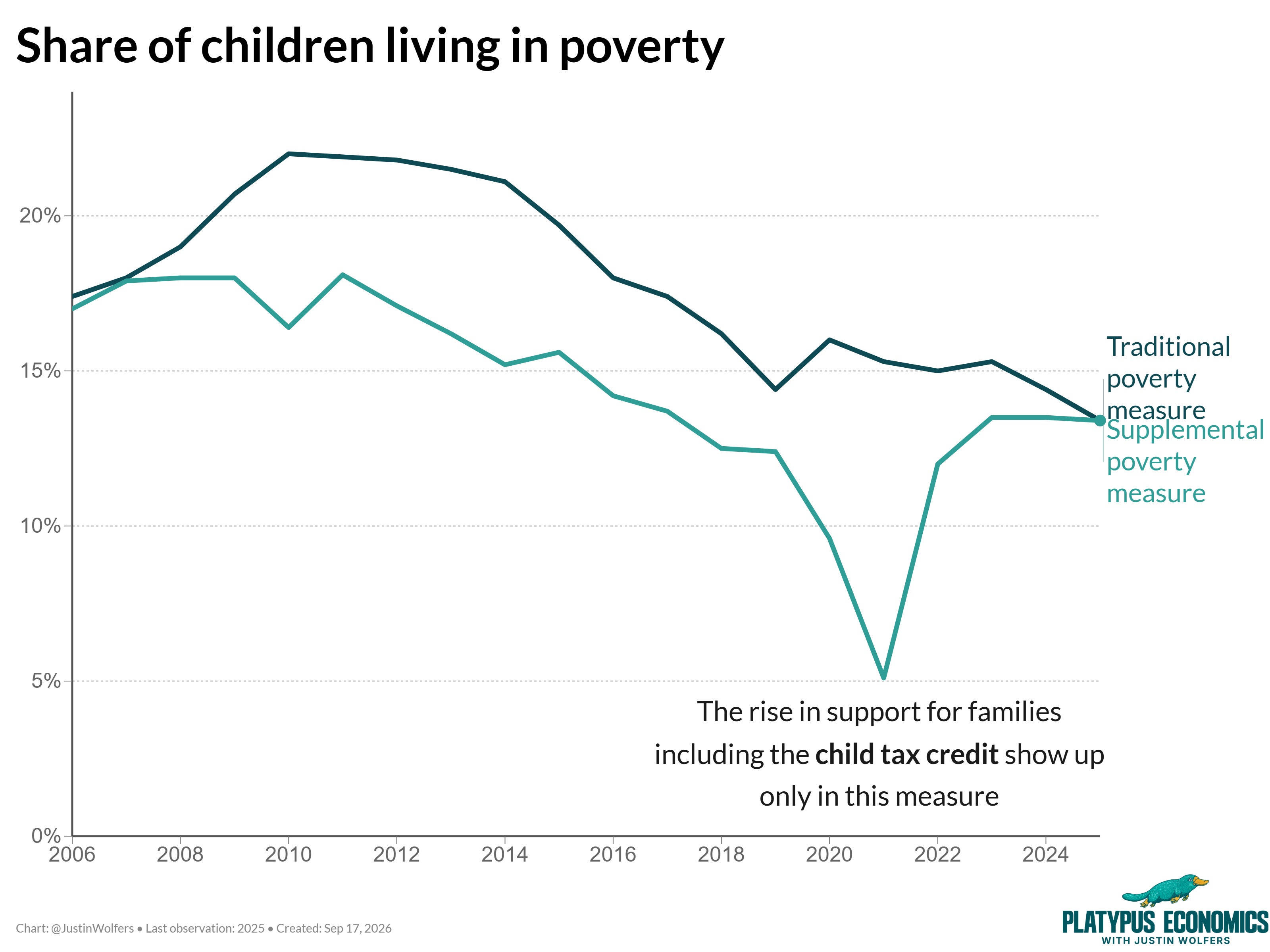
The official measure missed it entirely, because a tax credit isn’t money income. But that’s a defect of the measure, not the policy. Those were children who really had more material resources, over that period of time.
So what did we learn?
There was a brief window when we had the political will to do something about kids in poverty. When we did it, it helped.
When we gave seniors money, senior poverty collapsed. When we gave families with kids money, child poverty fell. When we stopped, it came right back.
Next year’s numbers will show what happens when you take food assistance away from millions of people. Only the supplemental measure will be able to see it, since the official one can’t see SNAP at all.
I suspect my stepfather’s position can be applied here too.
Give people money, and they have more money. Take it away, and they have less.