


The average food stamp recipient receives about $188 a month, or roughly six dollars a day.
Six dollars a day. That’s milk. That’s cereal. That’s eggs, rice, peanut butter. It’s the thing that lets a parent say yes to fruit this week instead of no.
Hold that number in your head, because over the past year, Congress passed one of the largest cuts to food assistance in a generation. And what’s happened since is bigger, broader, and harsher than most people realize.
This is one of the biggest economic stories in the country right now. It touches millions of people. And somehow, almost nobody’s talking about it.
What’s SNAP and who uses it
SNAP stands for the Supplemental Nutrition Assistance Program. Many folks still call it food stamps, even though the benefits are now delivered electronically on something like a debit card. It’s the country’s main program for helping low-income families buy groceries.
And that last word matters. Groceries. Not restaurant meals, or fancy extras.
At six bucks a day, this isn’t enough to live on, but it’s enough to help. It helps when the paycheck runs out before the month does. It helps when the power bill lands the same week the car needs a repair, the kid gets sick, and hours get cut.
Something’s often got to give — and for millions of families, SNAP makes sure that something isn’t dinner.

So who does the program help? Children account for nearly 40% of SNAP recipients, and about a fifth are over 60. Half of all households getting SNAP benefits include either an older adult or someone with a disability. There’s also workers stuck in low-paying jobs, and single parents trying to keep a household running on wages that just don’t stretch.
How we got SNAP cuts
In July 2025, Congress passed Trump’s big budget law, the One Big Beautiful Bill Act. Tucked inside it were very large cuts to SNAP.
But why go after food assistance?
Well, the bill was doing something else at the same time: handing out large tax cuts, especially to wealthy households. And to get the whole thing through the Senate, Congress used a legislative process called reconciliation — the fast track that lets a simple majority pass a budget bill without needing 60 votes.
Here’s why that matters. Reconciliation is a budget process, so the arithmetic has to work. If you want to put more money in some people’s pockets through tax cuts, and you want the bill to stay inside the budget targets, you’ve got to take money out of someone else’s pockets.
That someone else was — in part — families on food stamps.

The Congressional Budget Office (Congress’s own nonpartisan scorekeeper) estimated the food-stamp changes would cut federal spending by hundreds of billions of dollars over ten years. Which makes it one of the biggest ways this bill made room for everything else it wanted to do.
And the shape of it is ugly. Rich households got tax cuts. Poorer households got their food aid slashed — and their health care, too.1 Put the pieces together, and it’s the largest redistribution from poor to rich in a single piece of legislation in American history
What the law actually changed
Let’s start with how the old system worked.
For decades, the deal was this: the federal government paid for food-stamp benefits, while states ran the program — the paperwork, the offices, all of it. That split mattered, because when times got tough and more families needed help, states didn’t have to scrape together the money themselves. Washington — which has far more flexibility when it comes to borrowing money — paid the grocery bill.
The new law changed that, in two ways.
First, it changed who can get cut off directly. Before this law, there was already a strict rule for many adults: if you were between the ages of 18 and 54 without dependents, and couldn’t prove you were putting in enough hours, you could only get food stamps for three months out of every three years. Pretty restrictive, but aimed only at folks you might think have a good chance of getting by on their own.
The new law took that rule and stretched it. The restrictions now cover more older adults, all the way up to 64, as well as some caregivers and parents of older children. It also made it harder for states to ease up on the rules when jobs get scarce. So more people can now be knocked off food stamps after just three months — with the calendar, rather than their need, determining whether they qualify.
But the second change may matter even more. Washington cut in half the share it pays states to administer the program. And states now have to pay part of the benefit costs themselves, with the size of that bill depending on their payment error rate.
Picture yourself running a state food-stamp agency. Now you’re no longer just trying to get help to eligible families, but also trying to dodge a future bill from Washington. That changes how your agency behaves. It means you’ll start to require more paperwork. More verification. It means more caution, and more delay. Basically: make it harder for families to get help without officially making it harder to get help.

If you’ve ever dealt with one of these systems, you know exactly what that means on the ground. More letters you can’t decode. More time on hold. More trips to the office. More chances to blow a deadline, lose a document, or just give up. A system that was already a hassle — and honestly, kind of humiliating — just got worse.
The payment error rate (which this new formula depends on) officially includes both overpayments and underpayments. But there’s a hole in the logic, and this one boils my blood: If a family gets wrongly denied altogether, or wrongly booted off the program, that doesn’t show up in the error rate.
So the system dings a state for paying the wrong amount — but not for making it too difficult for eligible people to get through the door in the first place.
That’s a recipe for a much harsher system.
What’s happened since
Here I want to bring in the Center on Budget and Policy Priorities — one of the sharpest, most careful think tanks in Washington on this stuff. And I say careful deliberately: these are people who footnote their footnotes.
They’ve been tracking food-stamp enrollment month by month, and their number is stark. Between July 2025, when the law passed, and March 2026, more than 4 million people lost food assistance. Four million people, each losing roughly six dollars a day toward groceries.
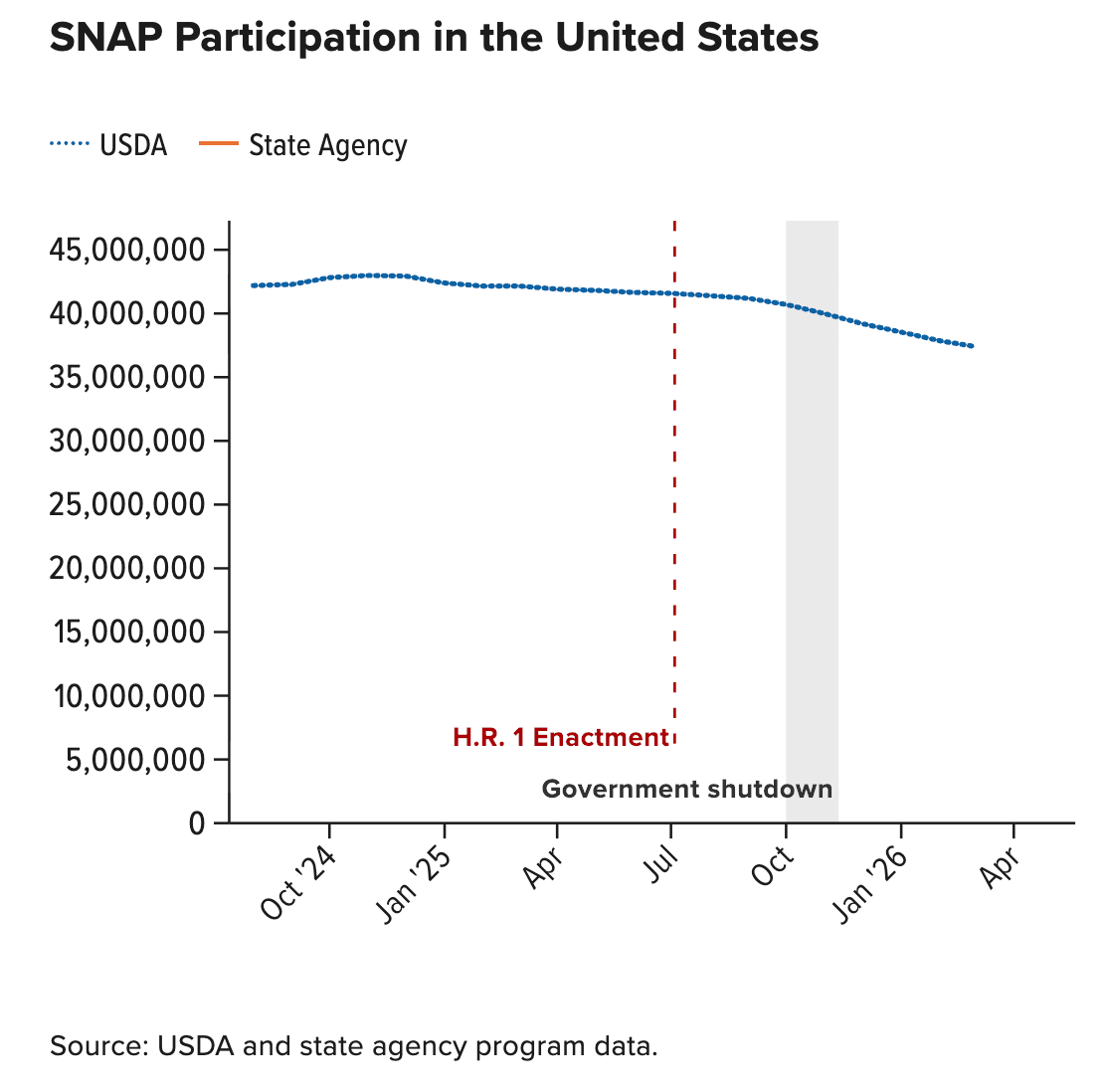
The official forecast already expected the program to shrink. But the actual drop was bigger, and landed sooner, than the government’s own budget scorekeepers had penciled in.
Now, you might be wondering: maybe fewer people needed help?
Fair question. But the evidence says no. Unemployment was roughly flat over this stretch, and the survey data show that trouble affording food stayed high. In 2025, nearly one in four adults reported not being able to reliably afford enough food. Among working-age adults living with kids, it was closer to one in three.
So the need for help didn’t disappear. Just the help itself.
And — perhaps the most important part — the people losing help were broader than advertised. Even if you liked the original pitch for this law, even if you genuinely thought tighter rules on a narrow group of adults was good policy, that’s not what the evidence shows.
The clearest example is kids. In the states where we can actually see the child data, about 1 million fewer children were getting food stamps by spring 2026 than before the law passed. Extrapolate carefully to the rest of the country, and the number is likely well north of 1.5 million.
That is a huge number.
And nobody stood up on the floor of Congress and said, “our goal here is to take food off the table for a million and a half children.” That was never the pitch. But it’s what’s happening.
Yes, this was a budget cut. But it was also a redesign of the whole machine that delivers the help. A system that used to be about getting food to eligible families is now under a lot more pressure to screen, to doubt, to delay, and to deny.
We shouldn’t be surprised when a lot more people get hurt than the politicians ever owned up to.
The enduring lesson
When politicians cut a program, you shouldn’t just ask how much money they saved. You should also ask: who lost what.
In this case, rich households got tax cuts. While millions of poorer households lost a modest – but essential – food benefit worth about six dollars a day.
In Washington, six dollars a day may sound like a rounding error. But in a kitchen where the milk is running low and the month isn’t over yet, it’s a whole lot more than that.
The health-care cuts deserve their own post. But today, I’m sticking to food.
Don't scroll past this excellent piece because you are not on SNAP. More people MUST understand the reconciliation process and why the terrible Big Bad Bill that Republicans jammed through took money from millions of Americans for many important programs to help billionaires avoid or reduce taxes. Thank you Prof. Wolfers!
The Food Research and Action Center posted this today:
Report Reveals More Schools Adopting Community Eligibility
to Address Child Hunger, SNAP Cuts Threaten Gains
WASHINGTON, July 22, 2026 – During the 2025–2026 school year, a record 55,362 schools offered breakfast and lunch to all their students through the Community Eligibility Provision (CEP), according to a new report released today by the Food Research & Action Center (FRAC).
The Community Eligibility: The Key to Hunger-Free Schools, School Year 2025–2026 report looks at participation in CEP, a federal option that allows high-need schools and school districts to offer breakfast and lunch to all students at no charge. This year’s findings show 27.6 million children attended a CEP school, 386,019 more than the previous year.
“More schools are demonstrating that offering healthy school meals to every student at no charge is a game changer for children, families, and schools,” said Crystal FitzSimons, president of FRAC. “Healthy School Meals for All reduces hunger; supports health, academic achievement, and attendance; removes the stigma often associated with free or reduced-price school meals; eases the pressure on families’ household budgets at a time when many are struggling to afford basic needs; reduces administrative work; and eliminates school meal debt, allowing schools to focus on serving healthy and appealing meals. Congress must make it easier for eligible schools to participate in CEP.”
Despite CEP’s benefits, barriers, particularly inadequate federal reimbursement, prevent many eligible schools from adopting CEP. These challenges will only intensify as a result of the 2025 budget reconciliation law (H.R. 1), which enacted severe and unprecedented cuts to the Supplemental Nutrition Assistance Program (SNAP).
Schools directly certify children who participate in SNAP for free school meals, which helps determine whether a school qualifies for CEP and how much federal reimbursement it receives. As SNAP participation drops dramatically due to the cuts, and fewer children are directly certified, schools may lose eligibility for CEP or find that it is no longer financially viable to participate.
“Without congressional action to reverse the SNAP cuts, children will lose critical food benefits that help families keep hunger at bay, and the progress we have made on Healthy School Meals for All could unravel,” said FitzSimons.
FRAC urges Congress to reverse H.R. 1’s cuts to SNAP by passing the Restoring Food Security for American Families and Farmers Act of 2025 , or addressing them in funding bills or other legislative vehicles that are moving forward. Looking ahead, Congress must pass a national Healthy School Meals for All policy to ensure no child faces hunger during the school day.
Read the full report and search FRAC’s online database to find CEP-eligible and CEP-adopting schools in your state and local community.
###
The Food Research & Action Center (FRAC) improves the nutrition, health, and well-being of people struggling against poverty-related hunger in the United States through advocacy, partnerships, and by advancing bold and equitable policy solutions. To learn more, visit FRAC.org and follow us on X (formerly Twitter), Facebook, Instagram, Threads, and Bluesky.