


The bond market has been all over the front pages this week. That’s rarely a good thing. Let me take the temperature down: this is not a market panic, a bond rout, or a crisis. Still, it matters, and it’s worth understanding. The bond market helps set the price of borrowing throughout the economy, and so it shapes your mortgage bill, your car payment, and your minimum credit card payment.
And sometimes what happens in the bond market doesn’t stay in the bond market.
What’s going on?
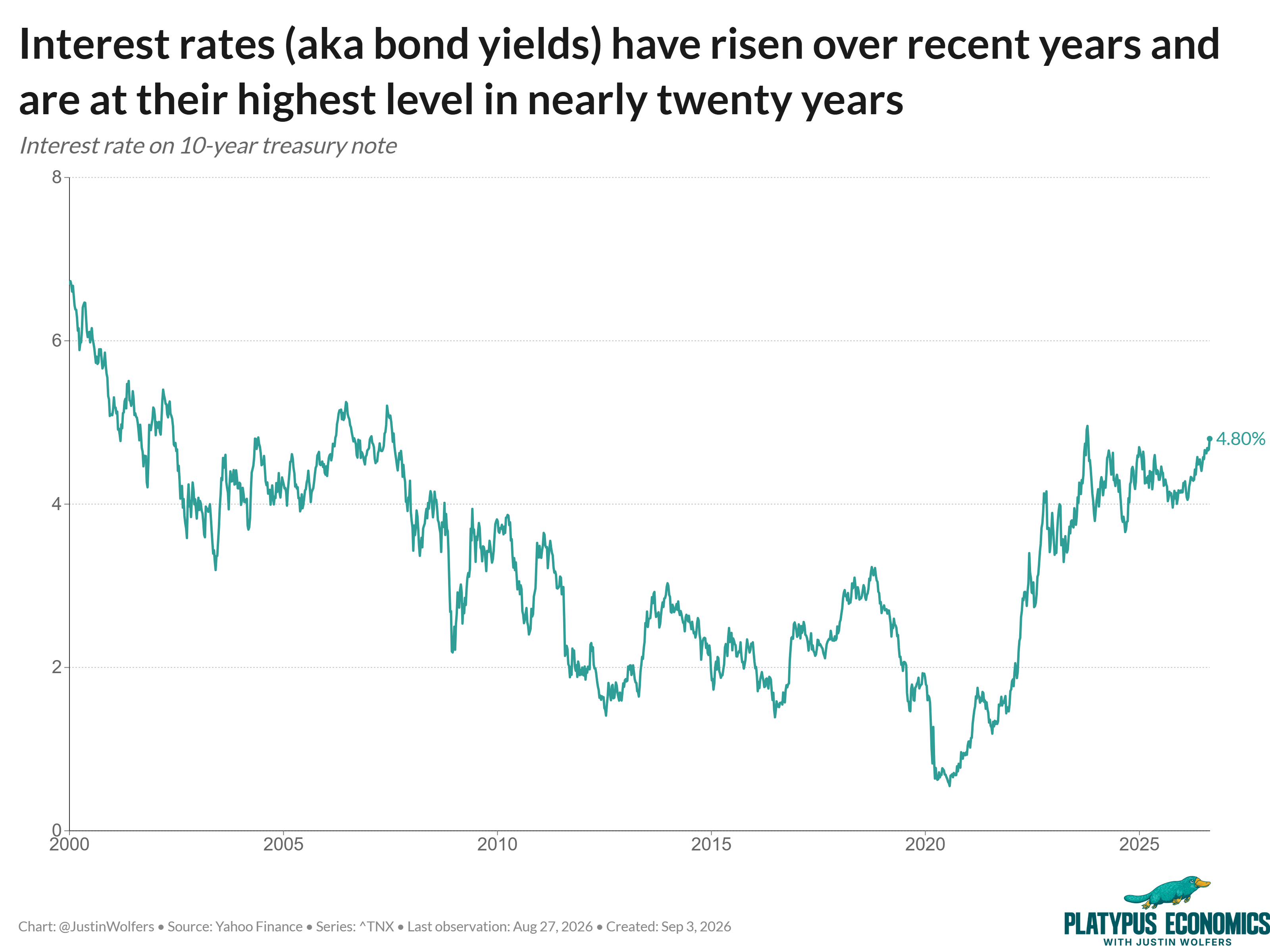
The interest rate that the government borrows at is sometimes called the bond yield. And that interest rate has been rising. It’s been rising over recent years, recent months, and recent days. So there isn’t really just one conversation about the bond market right now, there’s several, and it depends on which time horizon you’re focusing on.
Zooming in on the past few months and weeks:
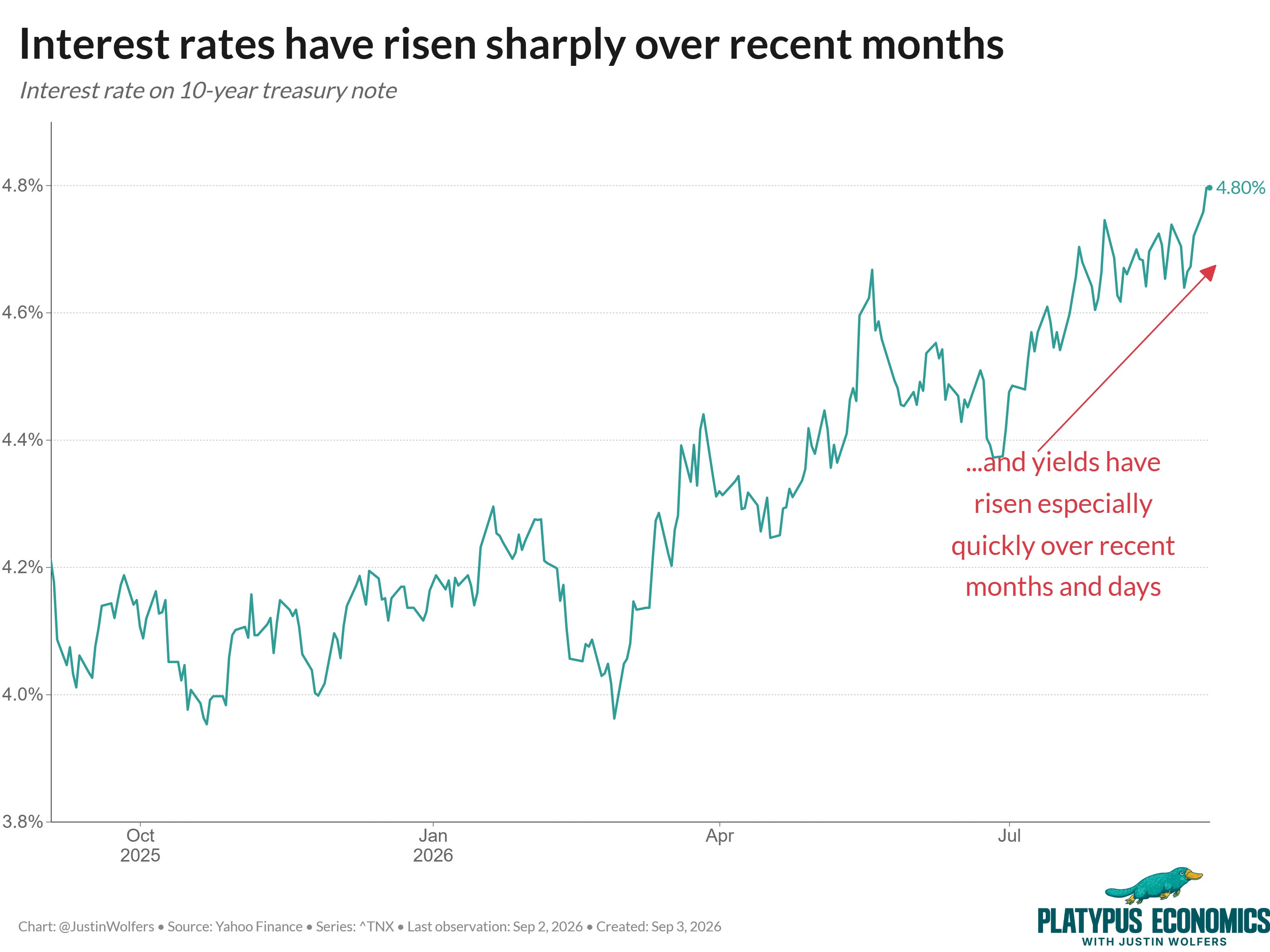
As always, we’re going to skip past the day-to-day, and focus on the medium- and longer-run movements.
Why are bond yields rising?
Let’s skip the complicated explanation. Start with the market for apples instead of bonds. If lots of people wake up and want to buy more apples, we call this an increase in demand. The price of apples rises.
Interest rates work pretty much the same way, but with slightly different language. Instead of apple buyers, we have folks who want loans. Instead of apple farmers, we have lenders, which might include your 401(k). And the bond market equivalent of the price tag on an apple is the interest rate.
What’s happened In the bond market is simply that the demand for loans has risen, which has driven up the interest rate.
Where is this all coming from?
There are three (relatively) separate forces that have increased the demand for loans..
First: the AI build-out. This isn’t the future-of-work story, just the concrete rooms full of computers. That’s a huge undertaking that costs billions, and a lot of it is borrowed. Goldman Sachs recently estimated that $500 billion of debt has gone out for AI. And that’s just in 2026.
Next: the U.S. government. It’s running a deficit of about 6% of GDP, the biggest in the post-war period outside a war or a recession. Plus, there are fresh tax cuts on the books, so there’s less coming in. The government deficit isn’t exactly new. But what is new is the visible lack of political will to even begin to fix this.
There was a time when numbers like these produced belt-tightening, and a lot of people in Washington muttering about the budget. That is simply not happening. Washington will care when the voters care, and right now the voters are distracted by — waves hands around — …all this. The bond market has long known the deficit is large, but now it’s figuring out that’s on track to continue for years.
The third factor is a bit harder to pin down. It’s… the future.
If you’re lending money to someone for thirty years, you’re also asking yourself what the world looks like in year four, year eleven, and year twenty-nine. You might even ask yourself: if I loan this money out in a few years time, will I get even better interest rates? Which means your vision of the future has a big effect on these interest rates.
The U.S. is at war. The four-to-six-week “conflict” in Iran is at its six-month point, the hot war is back on, and nobody sees an easy way out. I know we’re not really at war with Canada, but gee, it feels a little weird. Our friends in Europe feel very queasy about the things that have been said about Greenland. Ukraine and Russia grind on.
History is boring until all of a sudden it’s not. There’s a reason the English phrase “may you live in interesting times” is ironic. History tends to turn right around pivot points like this one.
I don’t know what will happen next. But it isn’t hard to imagine a world in which the U.S. wants a much bigger military, and in which other countries build much bigger militaries because they no longer feel they can count on ours. Militaries are very, very expensive. Expensive things get borrowed for.
And don’t forget: the U.S. isn’t necessarily looking trustworthy these days. For years, the government published data that was honest. The Census Bureau is under threat right now. The Bureau of Labor Statistics has been under threat. The president has put the Federal Reserve on watch. I wrote about this recently, here:

A decade ago I had enormous faith in a few basic tenants about the United States: That we would (continue to) have institutional stability, functioning markets, a democracy, and therefore a government you could always rely on to repay. Nobody feels quite so certain now.
The United States has always been able to borrow at a discount, because it was the safest place on earth to park your money. But if you’re going to carry some risk anyway, you might as well lend to a company instead. That safety discount is starting to erode.
Now: notice what words I haven’t used.
I haven’t called this a crisis. I didn’t urge you to the edge of your seat.
Because right now, there isn’t a crisis happening. The bond market is doing what it’s built to do: lots of people want loans, so loans cost more. There’s nothing disorderly here. Nothing that says a crisis arrives Tuesday.
Here’s what I am worried about.
Each of those three factors makes trouble more likely down the track. That’s a different sentence from “trouble is coming,” and I’d like to keep them apart.
Start with the data centers. I am not telling you AI is overbuilt. That’s a hard thing to know and I don’t claim to have the answer. But what I am saying is that it’s possible. What if we didn’t need all of this? What if those companies can’t repay?
If you hit troubled times and can’t repay your mortgage, the economy shrugs and moves on. If somebody who borrowed hundreds of billions can’t repay, that’s a different animal — and the trouble goes far beyond the borrower.
The key question is: who lent the money? Spread thinly across many actors, a bad outcome is survivable. Concentrated in one corner of Wall Street, all standing on the same bet, and you start to see a domino effect. That’s what we saw in 2008.
And in 2008, what stopped the fall was the federal government stepping in to hold the economy up. Go back to factor two: we’re already borrowing groundbreaking amounts of money. Would Washington have the room to do it again?
One more thing, and this one’s a judgment, not a number. I think it’s simply a fact that this is the least technocratically competent administration of my lifetime — the weakest set of economists I’ve ever seen on the inside combined with the least qualified cabinet. And they’re not even bringing their A-game because they seem to be much more interested in impressing the president than in making real change.
Every morning I wake up grateful nothing has gone too badly wrong yet. What I worry about is whether we’d have the competence to get out of it if it did.
I've usually already read other sources and gleaned the points from them, so I read your posts less for information than for the cherry on top of the sundae: clarity. That is, you have a knack for taking colorless, technocratic reports on economic issues and making them colorful and engaging. As a result, your analyses are what stick in my head and cause me to feel that I 'get' it. Thanks!
I’m so grateful for your thoughtful, clear and timely explanations of what the hell is happening. As soon as your Substack alert pops up, I drop whatever I’m doing (even if it’s Wordle!!) and read and think and understand more. Thanks for keeping us informed!