


In 1937, Stalin’s Soviet Union ran a census. The results came back politically inconvenient — too many people were missing, largely because of the famine. That didn’t square with the story of ever-expanding Soviet greatness. So the government suppressed the report. And then it shot the men who ran it.
Why am I opening an economics piece with Soviet history from roughly 90 years ago? Well, suppressing a completed finding for political purposes — as Stalin did — is an explicit violation of the rules that govern America’s official statistics. Or it was, until three weeks ago. Then something changed. Under the new rules put forth by the Trump administration, that kind of suppression is fine.
Venezuela gives us a more modern version. The economic crisis there was so severe that, in 2021, the State Department estimated a third of the population lacked regular access to good food. As that crisis deepened, Maduro’s government simply stopped publishing inflation statistics. Prices kept rising, families kept struggling, people stayed hungry — but the government stopped measuring it and stopped admitting it. Three weeks ago, I would have told you that the American government couldn’t suppress economic data like this. But under the new rules that the administration just put forward, the White House can direct its political operatives to kill uncomfortable numbers.
Or take Brazil under Bolsonaro, who found a subtler variation. During COVID, the government moved its daily data release until after the evening news, then pulled cumulative deaths and cases from public view. Nobody had to falsify anything. The numbers just got harder to find. Three weeks ago the United States had a policy that protected the free flow of scientific information and barred political meddling in how Census Bureau findings are presented. Today, it doesn’t.
To be clear: I’m not (yet) saying that our government is cooking the statistical books. Instead, I’m saying that it took the necessary steps to make that legal, and possible. In recent weeks, the Trump administration quietly rewrote the rules that kept political interference out of our economic statistics. And almost nobody noticed. This rewrite explicitly made it possible for the Stalin-Maduro-Bolsanaro playbook to be used in the United States. It doesn’t apply to all statistics, but it does apply to everything published by the Census Bureau and the Bureau of Economic Analysis.
You might remember that a few weeks ago I spent some time showing you the problems with a recent Census Bureau report — unsigned, un-authored, no methods, and claiming that 24,000 non-citizens had fraudulently voted in the 2020 election.

I showed you why that report was statistical nonsense. Today I’m going to show you something worse. Just after that report came out, the Commerce Department scrapped its ban on political interference in science.
This happened very quietly
On August 19, the Commerce Department posted a new directive called “Scientific Integrity” — note the scare quotes. It’s DAO 216-23, whatever that means. They posted this directive very quietly. There was no press release, no announcement, and no press conference. For the first time in his life, Howard Lutnick was quiet. The new version just appeared online.
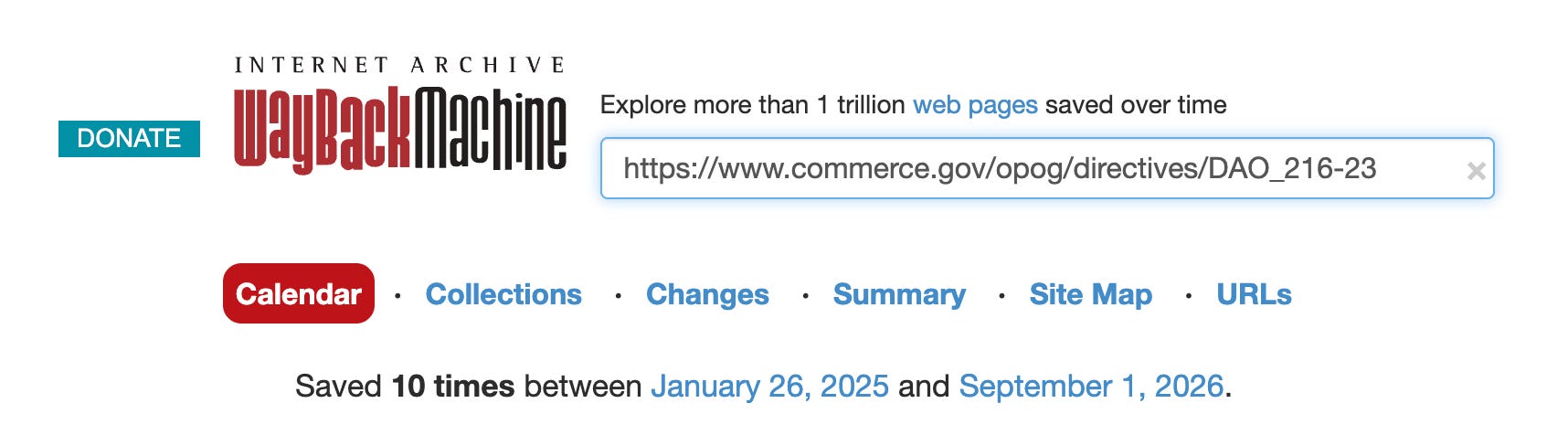
To analyze the changes, I actually had to go to the Wayback Machine to find the prior version of this policy, because it had been wiped from the Commerce website. There’s something pretty bleak about a country’s rules about scientific integrity surviving only because a volunteer internet archive grabbed a copy.
You hopefully can tell I think this is a big deal. And the government’s secrecy about it mostly succeeded. As far as I can tell, the only mainstream reporter who caught it was NPR’s Hansi Lo Wang, who found the change and reported that former Census officials were alarmed. Well, I’m alarmed too.
Commerce matters because Commerce contains the Census Bureau and the Bureau of Economic Analysis. The Census Bureau tells us who lives in America, where they live, what they earn, whether poverty is rising, which communities need schools and hospitals, and how congressional representation gets divvied up. The Bureau of Economic Analysis gives us GDP, consumer spending, household income, business investment—the basic scorecard for how the economy is doing.
Fortunately, not all of America’s numbers come out of Commerce. The Bureau of Labor Statistics produces the jobs and inflation and unemployment numbers we talk about all the time, and that sits over in the Labor Department. So it’s not affected by all this nonsense. Or at least not yet.
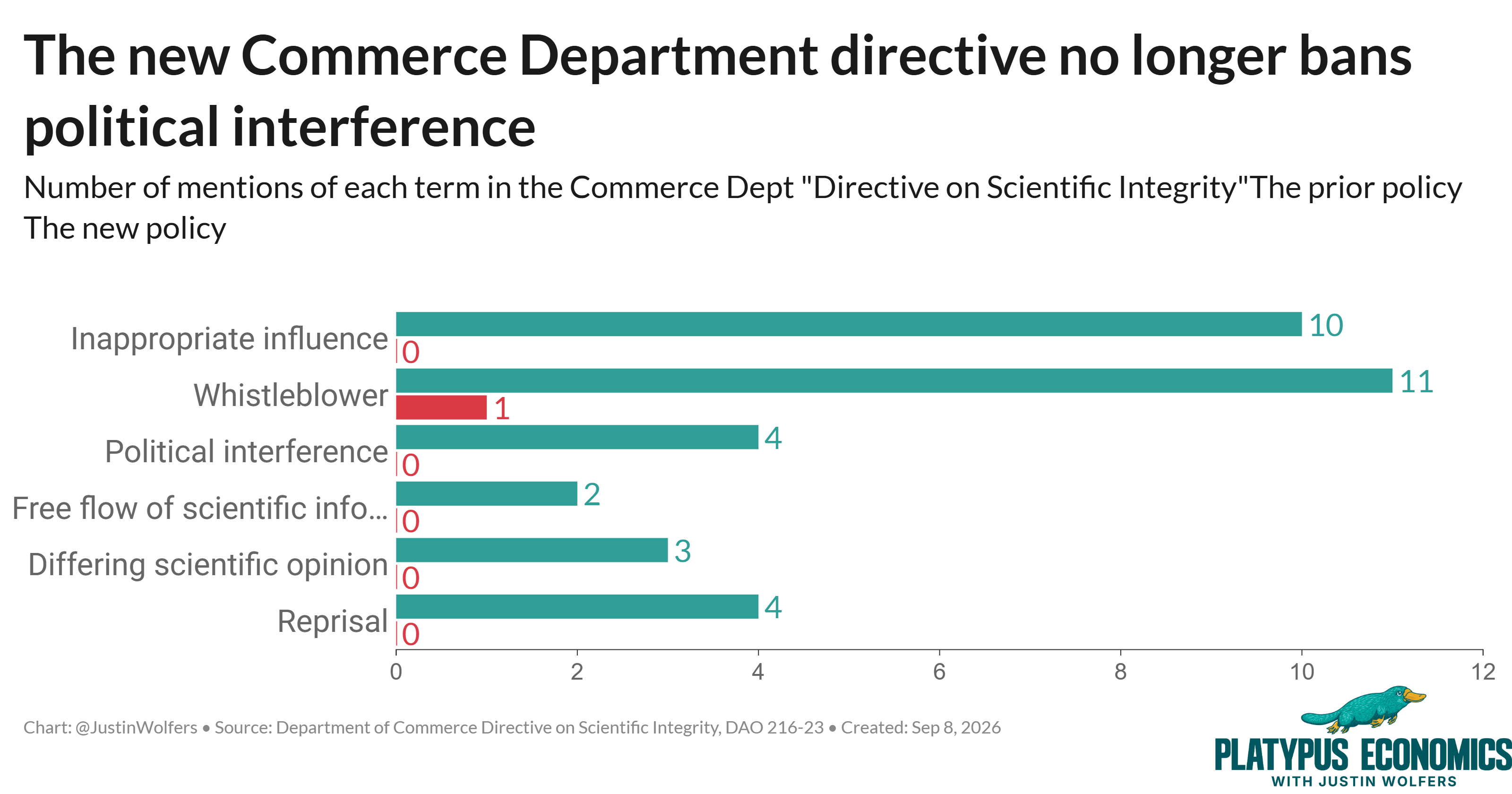
Ten mentions → no mentions
I put the old January 2025 policy up next to the August 2026 replacement and counted the phrases that do the work of protecting government scientists from political pressure.
The term “inappropriate influence” got 10 mentions in the old directive. Each of those mentions was trying to figure out how we can avoid it. Inappropriate influence gets zero mentions in the new directive. No longer is this something to be avoided.

“Political interference” gets four mentions in the old scheme. Again, the policy was about trying to avoid political interference. Now that term gets zero mentions. Political interference was outlawed. Now it’s not.
“Reprisal,” “differing scientific opinion,” “free flow of scientific information.” All those phrases are gone — along with their protections.
This isn’t a word game. The old policy, the 2025 one, was defining scientific integrity and giving us the rules needed to protect it. Scientific integrity needs honesty and objectivity.
The new policy keeps honesty. Keeps objectivity. Adds transparency and peer review— fine, good. And it deletes “protection from inappropriate influence,” along with every rule that made that principle real.
Apparently influence that is “inappropriate” is now appropriate.
Steel-manning the new approach
Let me build the best argument I can for the government’s new policy direction.
A government scientist who fabricates data is a serious problem. If someone makes up evidence, falsifies a result, or plagiarizes, they should be investigated and disciplined. The new directive takes that seriously. It defines fabrication, falsification, and plagiarism. It sets deadlines for investigations, requires corrections, and allows punishments up to termination. On rogue scientists, it genuinely breaks new ground.
But there are two ways government science gets corrupted. A rogue scientist can cook the books. Or a rogue politician can order the scientist to cook them.
The new rules go hard after the first and say nothing about the second.
Under these rules, a political appointee can tell expert statisticians which questions to investigate, steer them toward the data that gives a preferred answer, pick friendly reviewers, bury a report, rewrite the headline, strip out the uncertainty, and stamp the seal of the U.S. government on that document. That gives a savvy political operative plenty of ways to turn statistics into propaganda.
The previous policy — correctly!!!! — treated all of that as a scientific integrity problem. It prohibited political interference in the funding, design, proposal, conduct, review, evaluation, reporting, and use of science. It said findings could not be suppressed, delayed, or altered for political purposes. It said Department officials—including public affairs officers—could not alter scientific findings, direct scientists to alter them, or demand a presentation that compromised their objectivity. And it required the clearance process to forbid censorship, unreasonable delay, and suppression of results that could legally be shared. It encouraged scientists to talk to reporters directly rather than through political flunkies, and it gave them a formal way to put a differing scientific opinion in writing.
We’ve already seen the new regime at work. That Census voting report was opaque, unsigned, politically explosive, and mostly wrong. Yet it went out with the Census Bureau’s name and logo on it. It was prepared by partisan operatives rather than by statisticians. I told you at the time why that was wrong — but every part of the process that led the Census Bureau to be forced to publish propaganda is now permissible.
That report was patient zero.
Reporting your boss to your boss’s boss, who is also your boss
Here’s the part that decides whether any of the remaining rules mean anything.
The old policy required someone be employed full-time to make sure none of this went wrong. That person was a full-time career “Scientific Integrity Official.” That’s a senior post, held by someone who stays across administrations, whose job is to protect the evidence and the people producing it. The role required serious scientific credentials and political independence, because you can’t do the job without them. That person could gather information, review complaints, oversee corrections, coordinate with lawyers, and report on whether Commerce was actually protecting scientific integrity.
The whole design put distance between political power and the person judging whether political power had leaned on the numbers.
The new system closes that distance. The Scientific Integrity Officer now needs only to be, quote, “a senior department employee.” No career requirement. No scientific credentials. No political independence. The job of judging whether a finding met the department’s standards can now go to a partisan operative who knows exactly what the President wants and nothing at all about statistics.
That officer reports to the Deputy Secretary of Commerce. If nobody is appointed, the Deputy Secretary or their designee does the job.
The current Deputy Secretary is a bloke by the name of Paul Dabbar. He’s a political appointee. He serves Howard Lutnick. Lutnick serves the President.
So imagine a career statistician at Census. She’s worked there for twelve years, and she’s good at her job. Takes it seriously. New management comes in, and she’s worried they don’t take her commitment to the truth as seriously as she does. She feels like they’re political. One day, management tells her to drop the error rate from the summary of a document she’s working on. That obscures important information from her findings. Of course, she objects.
Under the old rules, she would have written this down, put it on the record, and sent it to an independent official with credentials. Now, her complaint travels up a political chain of demand.
It’s like reporting your boss to your boss’s boss, who is also your boss, and who hired your boss specifically to get the answer you’re complaining about being forced to produce.
This isn’t a Commerce quirk, either. The President’s executive order tells agencies to put scientific integrity enforcement under, quote, “a senior appointee.” That’s code for “one of our people.” Commerce is just following orders. It’s now “our people” over expertise.
The missing report
There’s one more change, and it’s about making all of this harder for you and me to see.
The old policy required Commerce to publish an annual scientific integrity report: how many complaints were filed, how many investigations happened, how many appeals were pending, where the resource gaps were, and what the department did about it, including summaries of closed cases. You could read it and judge for yourself whether these folks were telling you the truth.
The new policy requires operating units to send confidential semi-annual reports to the Scientific Integrity Officer.
The old rule was: tell the public when scientific integrity breaks down and show what we did about it. The new rule is: send a confidential memo upstairs twice a year. It is not a reduction in paperwork. It is a reduction, indeed elimination, of transparency and accountability. Now political hacks can force government statisticians to concoct propaganda day in and day out, and the broader public never gets to see the report that says it’s happening.
And, unfortunately, the Census Bureau doesn’t have its own stronger system waiting underneath. It has a scientific integrity page promising professional standards and quality, integrity, and credibility—all lovely words—with no detailed ban on political influence, no independent integrity official, no public complaint system, and no right for a statistician to put dissent on the record. These new Commerce Department rules are the Census Bureau’s rules.
One guardrail still standing, with an asterisk
Now for the good news. Sort of.
In 2018, Congress passed the Foundations for Evidence-Based Policymaking Act, which requires federal statistical agencies to be independent and trustworthy, and the Office of Management and Budget issued binding regulations under it—5 CFR Part 1321. People mostly just call it Trust Regulation.
It applies to both the Census Bureau and the Bureau of Economic Analysis. It says their statistics must be impartial and free from undue influence. It gives those agencies authority over their own methods and release schedules. And it bars the Commerce Department from editing statistical releases except in a few narrow cases. That may well be the foundation for future lawsuits.
Here’s the asterisk. A rule only matters if the people inside the administration enforce it. And we can only be confident they’re enforcing it if people outside the government can see when they don’t.
This new policy just deleted the report that would have shown us.
What we’re losing
I know this feels like it’s in the weeds. At one level, I’m telling you that a few sentences were quietly removed from a departmental directive that almost no American will ever read.
But I know my platypals are smarter than that. That we all instinctively understand the value of truth. That stats beat propaganda. And a new rule allowing propaganda doesn’t just appear for no reason.
A government that distorts the record on inflation does not make prices fall. Redefining poverty does not make anyone less poor. Mismeasuring growth does not make a single family richer. Reality doesn’t read rosy government propaganda—and if you can’t see reality, you can’t fix it.
We lose the ability to check the government’s story about the country. We lose the career experts who were supposed to be protected when they objected. We lose the annual accounting that would have told us it happened.
And we lose it the way these things always go: quietly, in a document nobody announced, that only survived because a volunteer archive took a screenshot.
If this post wouldn’t get me to upgrade my subscription, nothing would. Because I now want to be able to comment, dismally: all of this nonsense that Wolters reports is consistent with the stupid and intellectually bankrupt notion of the unitary executive. Under the SCOTUS ratified unitary executive theory, the lowest of statisticians has to satisfy the will of the chief executive. These were grown men, and one woman, who decided in favor of such nonsensical “original intent.“ didn’t they talk to their children or grandchildren before sanctifying such meretricious glop?
Thanks for informing us about this "under the dark of night" degradation of government reporting.