


Earlier this week, I wrote about the G7’s big announcement that they’re going to release 100 million barrels of oil from emergency stockpiles. President Trump touted this as a concession from Europe that will bring down oil prices. Dig deeper, and the reality appears to be that it's just an agreement to deliver on an agreement announced seven months ago, at the beginning of the war in Iran.
You can catch up here:
Now it’s time for The Professor Is In, where I sit down and answer questions from the audience. Think of it like office hours, where my producer Augusta asks me about things you want to know.
Augusta opened with a big question. At the scale of the oil crisis we’re dealing with, is there anything meaningful governments can do? Or does it all come down to ending the war?
I answered with the most obvious thing first. Sometimes, one has to do that. This one is so obvious it sounds boring. But it’s also worth saying, and then maybe saying again.
Not invading other countries is a really good way to avoid these kinds of problems.
Give peace a chance (economically)
Here’s the simplest economic theory of war.
Say Augusta and I are about to get into a fight. We yell and shout and call each other bad names and say things we can’t take back. Essentially, we wreck our friendship. And then, at the end of all that, I say: You’re right. I was wrong on Tuesday. I’m sorry.
Economics says there’s a better way. I think about what I know, forecast where we’ll end up, and jump there. I say: Augusta, let’s not fight. I’m sorry about Tuesday. I was wrong.
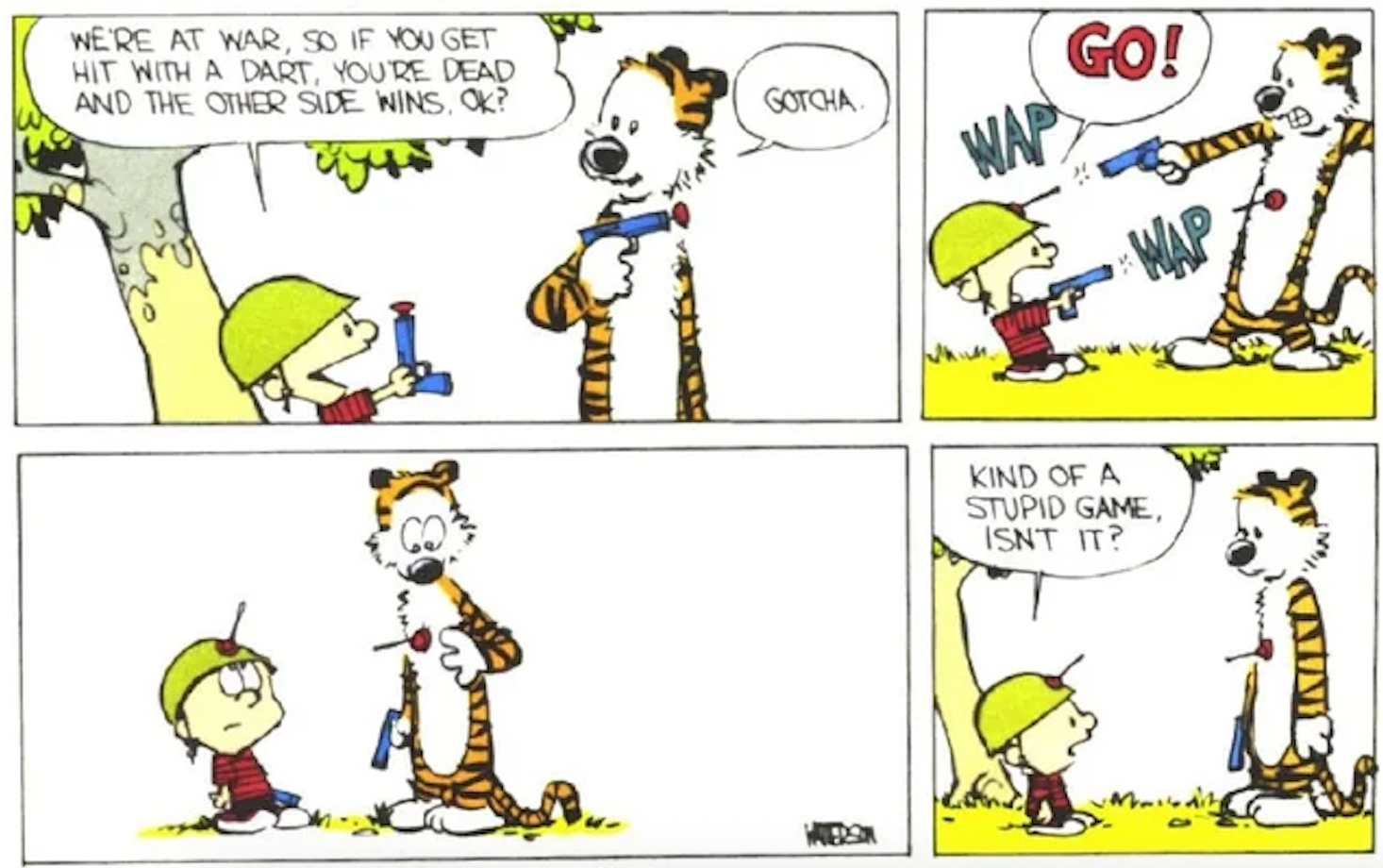
To prove I went to graduate school, I’ll tell you the fancy name for this. It’s called efficient bargaining. If Augusta and I are going to have a big donnybrook along the path to getting to our outcome — in which I apologize — then why don’t we just skip to the apology? The fight is pointless and costly and hurts both of us. Starting at the end avoids those costs. You can see why we call it efficient: Same outcome; less pain along the way.
This same logic applies to many forms of conflict. Think about labor strikes. There, workers refuse to turn up to work, demanding a better deal. The factory shuts, so the boss loses valuable output, but she also doesn't pay the workers while they're striking, and families go hungry. At the end of all that pain, one or both sides will make some concessions. Maybe it’ll be a pay rise, but not as large as workers hoped, or maybe it’ll be new workplace rules. Both sides are better off if the bosses just say: I realize you can do a lot of damage. And the workers say: If I don’t work, I won’t make money, and that will hurt me. And so they can both bargain knowing that, and jump straight to where they would have landed after the strike.
You still need to know the outcome
Augusta had a follow-up question. Doesn’t this theory of conflict imply you know who’s going to win? Isn’t the conflict part a step in getting to the outcome?
Yes. If each side can see the other’s military power, strategic assets, and willingness to persist when everything seems pointless, then both sides make their forecasts based on the same info, and if they’re smart that’ll lead them to the same forecast of the eventual outcome. When this happens, peace talks are easy.
But when the other side can’t see your strength, it’s possible they’ll lowball you. And then the only way to get to an outcome commensurate with your strength is to show them that you do in fact have some power. In a military setting, that might involve an invasion, even though an invasion hurts both sides.
In my class, we cover these issues during the week on information asymmetry. It’s an economic theory that explains how war might not be the dumbest thing in the world.
I still think it is. The costs being borne by folks in both the United States and the Middle East — and indeed, the rest of the world — are both terrible, and avoidable.
And I don’t think information is our problem now. Iran holds the Strait of Hormuz, and it has shown some leverage. Americans understand that some concessions will eventually have to be made. Maybe the president won’t admit it and maybe politics will get in the way. It might take us ten years to get there.
Let’s not waste those ten years.
Pretending to release oil doesn’t do anything
Back to oil. After the OPEC shocks of the 1970s, rich countries formed the International Energy Agency so they’d all hold emergency stockpiles (rather than everyone hoping someone else would). These emergency stockpiles are a tool for dealing with a temporary disruption. In March, when the Iran war was framed as a temporary four-to six-week disruption, relying on those stocks looked sensible (if small). Re-announcing the same barrels in October — which is really what the president just did — doesn’t actually change anything.
The longer-term fix is reducing our exposure to these shocks. My family has a very cool blue minivan — perfect if you want to look like a dad driving to soccer — and it runs on gasoline. We just got a second car, and it runs on electricity. As a result of that we’re less exposed. “Reducing dependence on foreign oil” used to be a campaign slogan on both sides, but it’s gone out of fashion lately. Even if politicians aren’t pushing it, individual families and businesses can make their own plans to reduce their vulnerability to oil disruptions.
More on the G7 (and some tangents)
Other questions Augusta brought:
Who is coming out ahead here? Oil producers? Anyone?
Would it be good policy for every American worker to own stocks (like the Australian retirement model)?
Does investment like that create a fight between the young and the old?
How do you even pronounce communiqué? (Answer: My thesis advisor was Olivier Blanchard, who is French, and so there’s exactly one word I can say in a convincing French accent. It’s “Blanchard.”)
Finally, is this promise worth anything?
The communiqué also had countries pledge to avoid energy export restrictions. Does that hold up?
Yes… and no. It’s a promise, but it’s a promise not to do the dumbest thing in the world. When I hired Augusta, I didn’t make her sign a contract promising not to do the dumbest thing in the world. Some promises are self-enforcing.
For our allies, a U.S. pledge like that has some value. That’s because we are liable to do things that might hurt both Americans and foreigners. For the United States, extracting a pledge from our allies not to do the dumbest thing in the world isn’t so necessary. Our allies are sophisticated. So we don’t get much out of this.
All told, this G7 “oil thing” is a press release that looks like a deal. If it helped the president not do the dumbest thing in the world, then I guess I should be happy.
The bigger lesson here isn’t that. It’s that if you can jump to the final outcome, then jump.
Watch the full episode for the rest.
Doing the dumbest things in the world seems to be a feature not a bug with this administration.
Funny, informative, wide-ranging, serious and fart sounds---you're the best! Plus---Calvin and Hobbes! Justin, I thought the French word you would have heard most often from your French dissertation advisor would have been NON! (And---anyway---as almost anyone who has studied French could tell you---no non-native speaker will ever be able to learn to speak it well enough to satisfy the French.) Completely off-topic, Augusta, I am intrigued by your fish plates and would dearly like to know more about them. Please?