



Another week, another huge pile of economic news. That means it’s time for Off The Clock, where I sit down with North America’s favorite economics journalist Stacey Vanek Smith to sort through what’s happened in the economy. Think of it as two mates having a beer at the end of the week and doing what mates do: breaking down trends in the economy. We’ll sort through what’s noise to find the nuggets of what mattered.
Here are the issues Stacey and I thought were worth a deeper dive:
Anthropic’s initial public offering. The AI company debuted on Thursday after the largest IPO in history—it raised $81 billion right off the bat at a valuation of $1.5 trillion. Stacey’s question, which is a good one: how can anything be worth $1.5 trillion?
I’ve talked before here about how the human mind struggles with numbers like trillions (and billions!). It just becomes difficult to understand scale when that many zeros are involved. So we did some back-of-the-envelope math (do people even have envelopes to do math on anymore?).
Based on Stacey’s assumptions, AI permanently raises the level of U.S. productivity by 50%. That means an extra $15 trillion a year. If we value that stream like a bond that pays 5% interest, that flow of extra income is worth about $300 trillion. If you scale that up to the world—the productivity boom wouldn’t just be in the U.S.—you get to a number I’ve always wanted to use on Platypus. We’re now at roughly a quadrillion dollars.
Under those projections, Anthropic only needs to capture about 0.15% of the value AI creates in order to justify its price. That doesn’t mean it’s a buy. It just means the valuation isn’t absurd on its face.
Are we in a bubble? Can you tell when you’re in a bubble? What do you even do? These were Stacey’s good questions, and the answer is that it’s really hard to know. If it were easy, then everyone would just sell, and the crash would happen right now. Quick, check: Has it happened yet?
There’s another problem: You may believe there’s a bubble, and you may be correct, but you can still be wrong on timing—and the market can often stay wrong longer than individuals can stay solvent.
If people aren’t buying because of fundamentals, but instead because the stock always goes up, then we get to another kind of problem. This is the so-called “greater fool” theory of investing (and of bubbles): if people are buying stock at high prices today because they figure some greater fool will pay more for it in a year’s time, then yes, that smells like a bubble.
Have you heard of the turkey problem? I hadn’t. Stacey brought me this, and it’s from Nassim Taleb’s The Black Swan. He, in turn, is adapting a parable from Bertrand Russell. In the lead-up to Thanksgiving, a turkey has overwhelming evidence that humans are wonderful. It gets fed every day, it gets a warm shelter, and it gets to relax. Confidence peaks the day before Thanksgiving.
Economists have a version of this called the peso problem. Most days, a currency wobbles a little. Then, one day, it collapses. The distribution of these events has what are called “fat tails,” meaning extreme outcomes happen far more often than a bell curve suggests. Watch a turkey for 100 days, stop the day before Thanksgiving, and you’ll conclude it has a pretty good life. Past performance is no guarantee of future results.
And speaking of expectations, everything broke these past two weeks. Apple, Microsoft Outlook, banks, and of course all those grounded flights. So we talked about trust. Stacey called it a trust tax, while I think of it as the price of uncertainty. If you start flying everywhere a day early because you’re afraid things will fail, the cost of that adds up fast.
Trust is the lubricant of commerce (and of life). Without trust, life can become riddled with concerns that the other person is out to get you. Often you’ll be right. Stacey pointed to a 2008 study by Luigi Guiso, Paola Sapienza and Luigi Zingales, which found that people who don’t trust others are less likely to buy into the stock market. If you don’t trust people, you certainly don’t want to trust your money to a CEO you’ll never meet.
Chart Versus Chart
My favorite part of any week is when Stacey and I try to best each other in the competition that is charts. It’s the comp lit major versus the econ PhD. Stacey is the defending champion, having taken well over 50% of the votes last time. Don’t forget to vote below!
You’ll see we both have similar things on our mind: Stocks. Prices. Market valuations. And what it all spells out for our economic future. This week’s competition yielded furrowed brows all around.
Stacey’s Chart: The Turkey Problem
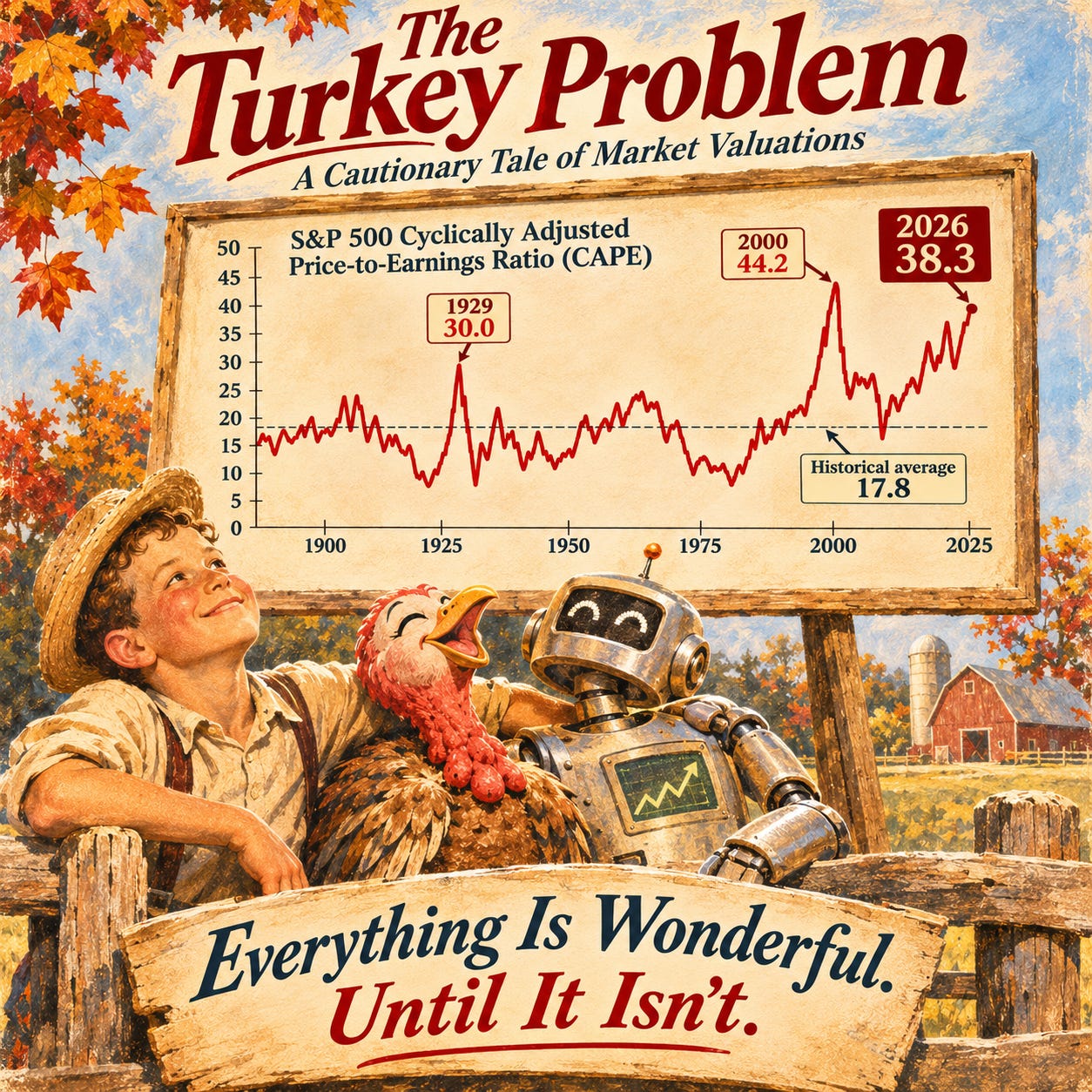
Robert Shiller’s CAPE is a sophisticated price-to-earnings ratio. It compares stock prices to the 10-year average of corporate earnings. His index has been this high only twice before: 30.0 in 1929 and 44.2 in 2000. Today it’s 38.3, against a historical average of 17.8. (Stacey also brought a turkey, a farm boy and a robot to help interpret this chart.) Two big peaks pointed to the end of two big bubbles. But I wonder, is this any more convincing than two coin flips both coming up heads?
A high CAPE either means the market is a bit crazy or that it expects earnings to grow. That little boy could be a vegetarian, and then the turkey problem becomes a turkey opportunity.
Justin’s Chart: Stonks Stonking
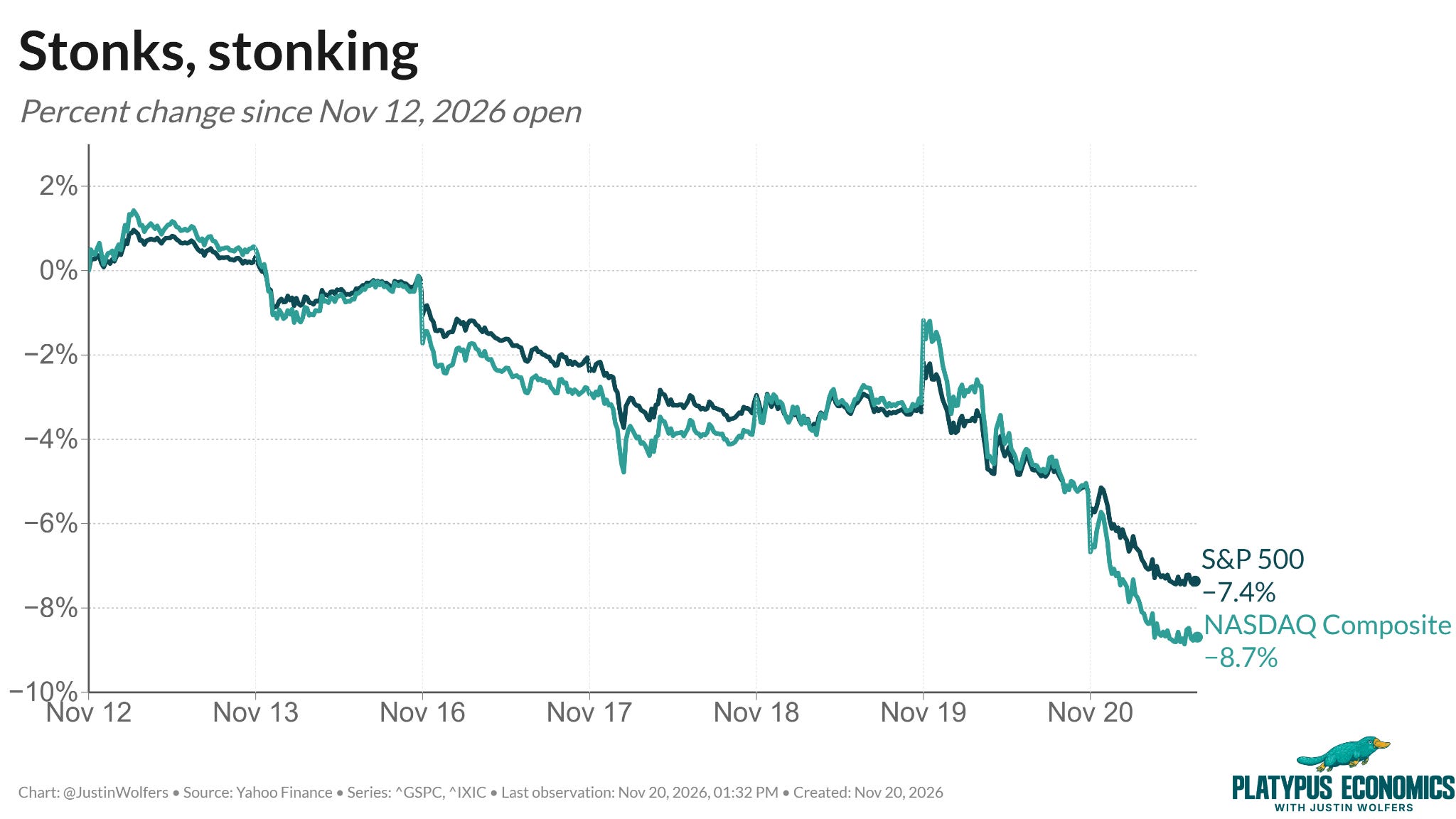
Since the S&P opened on November 12th, it’s fallen 7.4%. The NASDAQ is down 8.7%. It’s larger than Nvidia and Anthropic—we’re looking at a broad decline. Why? And why should you care? A stock is a bet on the future, so a drop of this size is the market saying it feels shakier about the future.
Both of our charts are about the same thing: how much faith we put in our future.
The turkey had faith, too. So… Happy Thanksgiving.
And one for the comments: does anyone remember the orange-moped ice cream delivery guys from the dot-com boom? I promised a reader would be able to name them.
Time for a Bare Naked Ladies remake:
“If I had a quadrillion dollars,
(If I had a quadrillion dollars,)
Well, I’d pay off Western democracies‘ national debts!
And if I had a quadrillion dollars,
(If I had a quadrillion dollars,)
I’d provide universal basic income for all the AI job losses…”
ok, needs work.
Love your postings! I learn so much. Sadly, I have never studied economics but now realize I would have loved learning it especially from a professor like you.