


Last week, the Census Bureau released the latest poverty numbers. So, we dug into what poverty is, how it’s measured, who’s in poverty, and what causes it. You can catch up here:

Now, it’s time for The Professor Is In, where I sit down to answer your questions about this topic. My producer Augusta joined me for the conversation.
Four kids, two poverty lines, one family
Augusta started with a deceptively simple question: what does your income have to be to count as poor in America?
It depends on who “you” are. Are you an individual, or do you represent a household with multiple people — maybe a married couple, maybe with a child (or three). A family of four doesn’t need four times what one person needs. They rent one apartment. They buy the massive Costco cereal boxes.
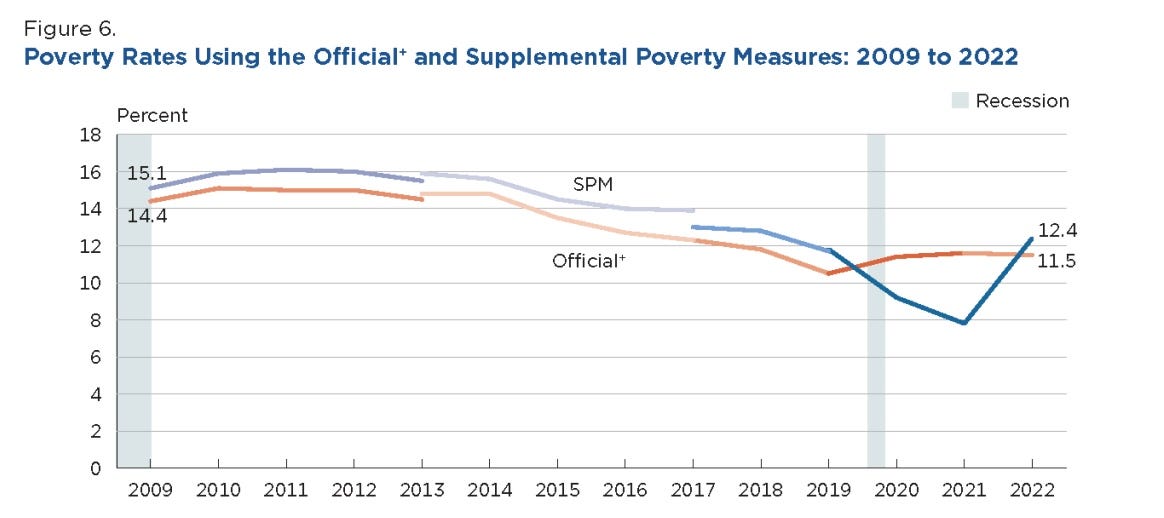
For a family of two adults and two kids, the official annual poverty line is $32,649. I don’t know how typical that family is. Most Americans are typically atypical.
That line, the poverty line, is what Mollie Orshansky built at the Social Security Administration back in the 1960s. She started with the cost of a bare-bones food budget, and then tripled it, because at that time, the typical family spent about a third of its income on food. (While we’re here: shout out to female economists. Orshansky is part of the untold story of women in economics.)
There’s also a second line, one that’s been updated for the 21st century. It’s the Supplemental Poverty Measure, and it puts the threshold for that same family at $41,701. That’s assuming that they rent, which is the kind of thing that additional measure was designed to think about.
FCSUti (not a typo, not a bank)
Where does that new poverty number come from? The Supplemental Measure came out of a 1995 National Academy panel. It’s what happens when you put a room full of nerds together and ask them about the thing they’ve spent their whole lives thinking about. They fought hard for their positions. The only thing they could all agree on was that the old way was wrong.
And then, once that part was mostly over, they designed a new system.
Look at what typical Americans, the ones in the middle, actually spend on the essentials. Get ready for an acronym you’re going to love: FCSUti. That’s not word salad: it’s an acronym for Food, Clothing, Shelter, and Utilities, plus telephone and internet. Leave out vacations and entertainment, or anything that feels like it moves you beyond “getting by.” Apply an adjustment factor, and that’s the line.
The “ti” is the interesting part. In 1963, if you’d said internet access was the price of citizenship in the modern age, you’d have been treated like a crazy person (because the internet hadn’t been invented yet). Today, try buying a train ticket, finding work, or applying for government assistance without going online. You’ll quickly find it’s essential.
So this measure tracks a baseline for getting by in two ways the old one doesn’t. It tracks what the essentials cost. And it tracks how much of them the typical American buys. Not being “poor” now means being able to afford roughly the food, clothing, shelter, utilities, phone, and internet that the typical American has.
Here, “typical” is a judgment. As Augusta and I discuss, calling something poverty is inherently subjective, and it comes with a lot of baggage. I can put these numbers in a very complicated spreadsheet. But that’s still based on a judgment.
Is New York City a luxury?
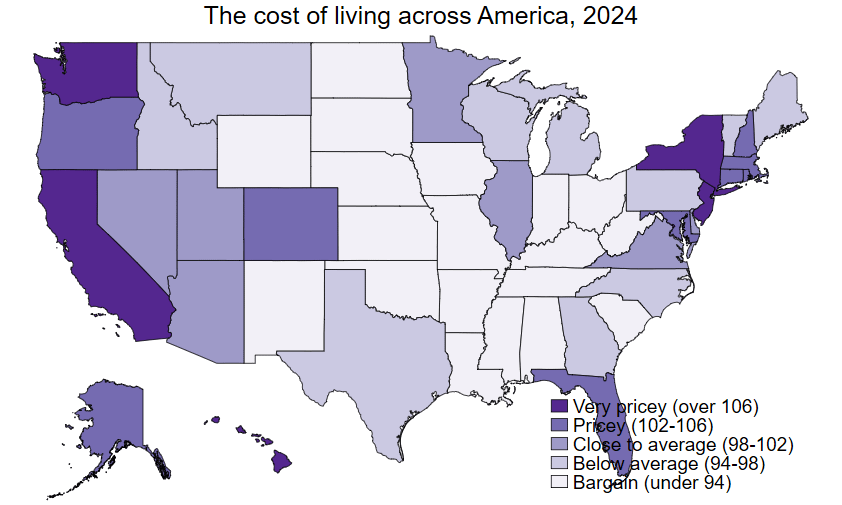
The Supplemental Measure makes one more judgment: it adjusts for where you live. The old line said you need the same amount whether you’re in Brooklyn, where Augusta lives, or Ann Arbor, where I do.
It adjusts for differences across areas in the cost of renting a two-bedroom apartment. In the video we also explore a broader measure of differences in the cost of living called “regional price parities.” That measure says that if I moved from Michigan to New York, the fourth most expensive state, it would be like adding a 12% tax on everything in my life.
Here’s where reasonable people disagree. Is living in New York City part of the cost of being alive? Or is it a luxury good? Do people really need access to Broadway, the opera, and arguably the greatest city in the world? And, if we decide that’s a luxury, what about the people who were born there? How should we think about the quarter of New York City residents in poverty in 2024?
Should we just give people money?
Imagine that tomorrow, the government sends every household a check for $32,000. You can go get a job and earn more, but that’s your floor. By definition, you’ve eliminated official poverty. (You might send a bit more to bigger families.)
That’s a lot of redistribution, and redistribution is often a leaky bucket. The taxes that pay for it can shrink the pie a little. But my guess is fewer people would be hungry, the streets would be safer, and we’d have more social solidarity.
So why hasn’t it happened? Some American voters don’t want it. People like the money they have. They like taxing other people, not themselves.
AI makes the question new again. Suppose computers take all of our jobs, or we each get offered work at two pennies an hour above subsistence. We live lives of grinding misery while OpenAI gets infinitely rich as the only productive force in the economy. Well, that sounds bad. The simple policy answer is to take enough from AI to make sure everyone can get by.
My partner, Betsey Stevenson, frames it differently. The AI companies wrote a few lines of code. The rest of us created all the world’s knowledge that those models consumed. They never paid for it, because they “forgot” to ask. On this view, UBI isn’t redistribution at all. It’s payment for an essential input.
I’m not fully on board. But I’m open. Why not?
Watch the full episode for the rest.
One last thing for the nerdiest of my Platypals!
Today’s post includes a paid partnership with Stata, the software I use to crunch the numbers in my posts (and my research).
I used it here to calculate the cost of living in America in 2024. And if you’re really nerdy, you can use this worksheet to follow along! Or if you’re an economics or econometrics instructor, you might find this useful for class.
So apparently healthcare, insurance, and transportation are nonessentials?
It sounds like the 25th percentile would be a good proxy. It would be computed by region and by household size. It's quick and dirty.