


I recently gave a keynote speech at Stanford’s Initiative for Financial Decision-Making. I wrote about it yesterday, here:

After my talk, Annamaria Lusardi and Michael Boskin asked me some questions, then took some from the audience. This was a room full of economists who teach personal finance, so it was a great place to argue for a topic I care about.
Economics isn’t just a subject. It’s a toolkit. If you understand how to use those tools, they can improve your whole life.
You can save money by learning
Michael Boskin asked me how to drive home the broadly important concepts of economics. So I got to turn it around on him. My first teaching job was at Stanford in the business school. I was 27 and scared, and I’d see this intimidating bloke on campus who had a death stare and asked hard, penetrating questions. That bloke was Michael!
The business school was a good education for a young professor. Freshmen tend to write down what you say because you’re the teacher. PhDs write down what you say because they want to be you when they grow up. MBA students — well, they think those who can, do, and those who can’t, teach.
So I taught them differently. I always led with the payoff. “Here’s why what I’m going to show you is important.” Then I’d teach. At the end of class, I’d come back to the beginning and say: look how much you just saved because you learned this.
I do the same thing in Econ 101. It’s harder, but it’s worth it. And if you’re a teacher — and we all are, whether we have the job title or not — you can do the same thing.
Dating lessons from economists
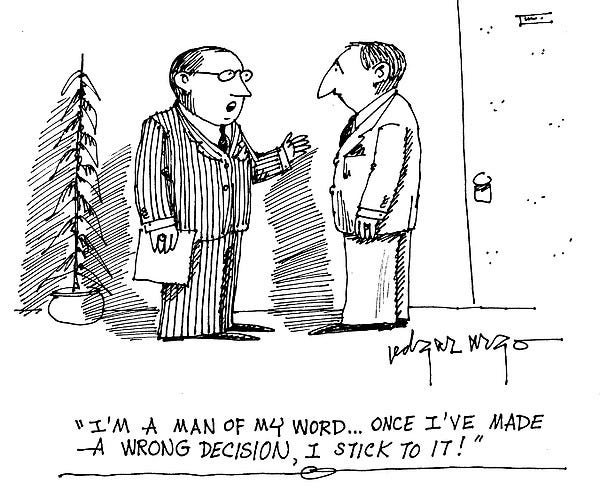
When I teach the sunk-cost fallacy, I give this example: we all have a friend in a long-term relationship with a guy who’s a bum. Or maybe he’s not the problem, and she’s just not the right match. But they stay together. When you ask why, they say “Well, I’ve put so much into this. I just want to see if I can make it work.”
That is the sunk-cost fallacy in action. That time isn’t coming back, no matter what happens next. The only question that matters is whether the future looks better together or apart. If you’re partnered with Mr. or Ms. Wrong, you’re only making yourself — and them! — miserable by sticking it out. Once a student works through that logic, I can tell them honestly: I’ve just saved you three years in a bad relationship.
In human terms, that’s a massive payoff. The folks in that room at Stanford are in a great position to do that work. They’re teaching personal finance, so every mistake they talk a student out of is literally measured in dollars.
Economics beyond the textbook
Michael then drilled down into a great example: options and futures. He teaches them, but not because he thinks all his students are going to end up derivatives traders. They have a broader application. By learning them, students learn about optionality — the practice of keeping your options open until you’re more sure of the best move. That idea matters in life. How should we take these ideas beyond finance?
I’m of the generation of economists that came up after Gary Becker. Becker taught us that there are a small number of economic principles that can be applied relentlessly across many domains of human behavior. So I teach that to my students. I give them a small number of principles, and then the rest of the semester I describe as going to the gym. You know the basics, and now you’re getting stronger. As you apply the same ideas to new topics, you’re building your intellectual muscles.
Once you embrace this idea, you start to see the power of economic logic in places you’ve never seen it before. When I was a student, I was taught comparative advantage as the theory of international trade. One country is good at one thing, another’s good at another, let’s specialize and sell each other our best stuff back and forth.
That’s not wrong. It’s just too small. Comparative advantage is the theory of how to assign tasks efficiently. The logic that says people in the United States should design the iPhone and folks in China should manufacture it, also shapes who does what in a household. My better half, Betsey Stevenson, is a public finance economist. I am not. I know what a consumption Euler equation is. She knows which bank our money is in… and that’s comparative advantage at work.
So I don’t teach personal finance modules in Econ 101. Every time I teach a principle, I show three different sets of implications: financial, personal, and policy. Three ways you can use economics, all for the price of one idea.
That does make the job harder for everyone who teaches this stuff. I told Michael I wasn’t sure whether I should thank him or be annoyed at him for the lessons I learned teaching at Stanford GSB all those years ago.
But here’s the thing about the sunk-cost fallacy. It doesn’t care what you’ve sunk into other ideas. Neither do any of the other tools. They’re just there, waiting to be picked up and used. Teach the principles well and your students can spot bad relationships on their own. Then they can figure out what to invest in next. That can be in their portfolios, in their careers, and yes, even in their love lives.
Watch the full talk for more.