


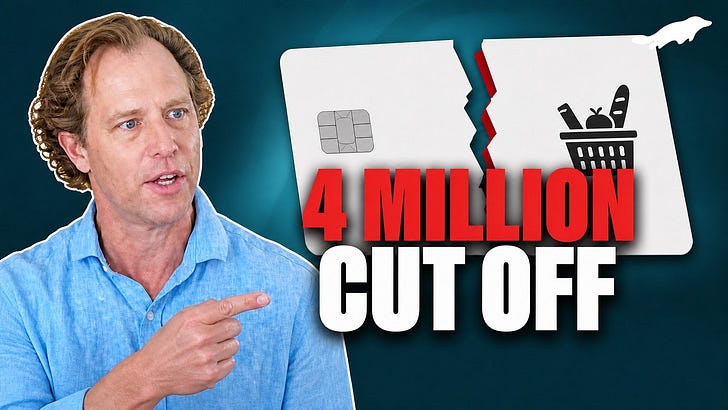
In this latest episode of The Professor Is In, I respond to subscriber comments and answer questions based on my earlier episode on the SNAP cuts that have led more than 4 million Americans to lose food assistance.
I start by walking through why administrative burdens do so much damage: when it’s harder to apply, appeal, or submit paperwork, the people who fall off are often the ones who need help the most. We can see this in the data — more than 1.5 million of those dropped have been children, even though they were never the intended targets.
I also dig deeper into the new rules for state governments. While a strong argument can be made for pushing states to lower their payment error rates, the fact that they’re not penalized for wrongful denials means that states are increasingly incentivized to simply boot folks off. And because states must run balanced budgets, shifting SNAP costs to them breaks the program’s role as an automatic stabilizer — in the next recession, when more people need food assistance, spending will fall exactly when it should rise.
The $6-a-day benefit may mean groceries for a neighbor, a kid at your child’s school, or a friend going through a divorce whose income just cratered. I believe that if more Americans understood who’s losing help and why, they might feel differently about these changes.
Excellent dive into SNAP, thanks Justin! Shout out to your daughter from this geriatric long time food banker.
I appreciate your observations about farming SNAP out to the states (pun possibly intended) and the unequal/inequitable patchwork that results. Note we DO NOT do that with Social Security and Medicare - somehow the federal government manages to run those programs across all states.. we manage to collect federal taxes centrally as well... stipulated that those systems aren't perfect, just emphasizing that there's no mystical advantage to 50 states running a national program in their own way, subject to widely varying state resources and abilities to run & fund 50 management systems instead (almost seems like asking for inefficiencies and duplicative bureaucracies?)
On a personal level, I appreciate your editorial comment in the last couple minutes. If only we could more widely speak like and be spoken to as adults, as you do in these videos: here's what's really happening, in detail; let's walk through causes and effects; now, are we happy with these realities? Put on our thinking caps AND do a little heart check... are we proud of our work (our shared national policy & procedural outcomes) or do we want to advocate for change?
This is how/why your Substack is valuable to me - not just reinforcing my feelings or assumptions; rather, providing analysis and setting the questions that arise within that
What would Steve Irwin do?