


Earlier this week I joined Fergus Macphee on The Trump Report to talk about the U.S.-Canada trade war. We talked about how Canadians are getting caught in the middle of a negotiation between President Trump… and President Trump.
A little history: The United States has had a free trade agreement with Canada since 1989. That U.S.-Canada Free Trade Agreement gave way to the North American Free Trade Agreement (NAFTA) when Mexico joined the club in 1994.
Then the first President Trump came to office calling NAFTA a disaster. He renegotiated it and replaced it with the United States–Mexico–Canada Agreement, or USMCA to its friends. The new deal was signed in 2018 and took effect in 2020. It’s basically NAFTA with a new title.
President Trump called that agreement:
“the largest, fairest, most balanced, and modern trade agreement ever achieved. There’s never been anything like it.”
That agreement passed the U.S. Congress, the Canadian Parliament, and the Mexican Senate, and was signed by the leaders of all three countries. It’s the law of the land in all three countries.
But here we are again. And my head hurts.
Talks collapsed and the trade war started
The second President Trump thought the deal that the first President Trump negotiated was terrible. He was unsparing in his criticism, saying:
“I would rather not have the agreement… We do better as a country if we don’t have an agreement.”

So earlier this year Trump demanded a new deal, and threatened large tariffs if he didn’t get his way. Talks began, then collapsed, and President Trump imposed tariffs of 50 percent (that’s high!) on a weird-looking list of Canadian exports, including hockey sticks.
There are two ways to see these tariffs. (Warning: Two-handed economist in the house.) On the one hand, these tariffs apply only to a relatively narrow slice of goods — around $20 billion worth of Canadian exports. That’s only about 4 percent of Canada’s exports, so not really that big of a deal. On the other hand, these tariffs apply to goods that should be tariff-free under the existing trade agreement. Previously these goods had been exempt from an array of Trump’s tariffs. This new move suggests a willingness to significantly broaden the trade war.
More here:
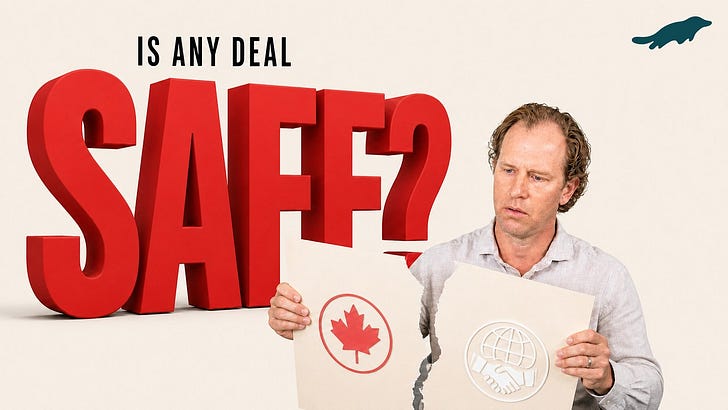
It’s retaliation all the way down
We recorded this podcast before retaliation gave way to retaliation for retaliation, then retaliation for retaliating against retaliation. So, a quick update: We’re in a retaliation cycle.
We’ve seen this movie before. In 2025, Trump got the United States into a tariff escalation cycle with China, and tariffs rose and were countered and counters were countered, and after a bit the United States was imposing a 145 percent tariff, while China was at 125 percent. Both numbers are untenable — high enough you might as well call it an embargo — and a month later, both sides agreed to mostly back down.
We may see this play out again with Canada — escalate until economic pain generates political pain, strike a “deal,” declare victory, and hopefully get back to where we began.
Reminder: We started with a free trade agreement with Canada negotiated by Trump.
The real costs come in the longer run
In our economics textbooks, the case against tariffs is usually that they impose immediate costs, usually on domestic consumers and companies that use imported inputs.
But Trump has found a way to make tariffs even more damaging to Americans: by making them unpredictable. He has oscillated — at seemingly random moments — between treating Canada as a friend and an enemy. He never even pauses at frenemy.
Eventually the United States may discover that it already has a trade deal with Canada. Maybe we’ll rebrand it (again!) and declare victory. But the history of ripping up past deals really matters. It is now understood that whatever is written down is only binding until the president decides it isn’t.
Canadian Prime Minister Mark Carney has noticed, saying that “America has changed,” and its “signature was written in pencil.” I noticed too, and wrote about it recently:

The problem is that this sort of on-again off-again relationship prevents either side from making long-term investments in their shared future. Even if we get back to trading with Canada, we’ll get less investment, less integration, and fewer of the gains that trade usually brings.
Should Canada retaliate?
We know what happened next: When Trump imposed tariffs, Canada retaliated.
I don’t think this is in Canada’s best interest.
The intuitive argument for retaliation says that Trump’s tariffs on Canada hurt Canadians, and so Canada should retaliate with tariffs on the United States that hurt Americans. A credible threat of retaliation might also deter future tariffs.
But that misses half the story.
The other half is that Trump’s tariffs also hurt Americans, and so the same logic says that Carney’s tariffs also hurt Canadians. That’s the argument for not retaliating.
This point was more vividly made by Joan Robinson, who was possibly the greatest economist never to win a Nobel. She wrote that answering foreign tariffs with tariffs of your own makes no sense: “it would be just as sensible to drop rocks into our harbours because other nations have rocky coasts.” (She credited William Beveridge with the metaphor.) The point is that tariffs make it harder and more expensive for ships full of goods to reach your ports. And who wants less efficient ports? Other countries’ inefficient ports are no reason to ruin your own.
This reality also makes Canadian threats less credible. The argument I hear most often from my Canadian friends is that they don’t want to be bullied. But if tariffs require hurting your own people as a necessary side effect of inflicting pain on foreigners, then a war of economic attrition rewards the leader most indifferent to the pain they inflict on their constituents.
I’m not sure that’s Mark Carney’s strong suit. And Canadians shouldn’t want it to be.
Can we (please) do this the easy way?
A good leader’s job is to make it easy for the other side to say yes.
Trump is doing the opposite. His childish taunts — that Canada is the 51st state, that its prime minister is really “Governor Carney,” that “Canada is nasty,” that its leaders are “clowns” who should “fall in line,” that Lake Ontario should become “Lake America,” and on and on — have stirred such anger among Canadians that Carney now has less room to give Trump what he wants.
Point is, Trump’s taunts unleashed a political force that all but forced Carney to retaliate. He has made it harder for Canada’s leaders to make concessions to the United States.
This is how you turn an easy deal into a hard one.
And we’re all paying for it.
I don’t know Justin. I understand wanting cooperation for the sake of all of the people from both countries, but cooperation requires both sides to be capable of seeing the other side and then want to give a little to ensure a cooperative success. I’m not seeing Mr Trump as being experienced in that regard. So then isn’t standing firm really the best option for Canada? Mr Trump is likely to dismantle any “deal” he makes the next time he needs to change the subject from Epstein, the war, the economy etc.
In one sense, this is Trump's modus operandi, repeated ad nauseum. In another sense, it's different.
Carney walked away because Trump demanded veto power over future Canadian trade deals.
In essence, Trump wanted to make Canada a satellite of the US, a quasi 51st state. This is consistent with beligerance directed at Venezuela, Greenland, and Cuba. His self-image is that of a global emperor; Palpatine, so to speak; with drastic implications for the global economy.