


When the Trump administration pushed out their tariffs, there was a laundry list of great things they were going to achieve. Today, I’m asking: did those tariffs do what the administration promised? I’m an economics professor, so I’m approaching this like a report card.
President Trump’s tariffs were supposed to do a lot of things. Give America leverage over foreign governments. Shrink the trade deficit. Bring factories home. Make America safer from China. And pay for child care, tax cuts, farmer relief, and tariff dividend checks. Maybe replace the income tax. Or cure toe fungus.
So today, for report card day: Five promises, which we’ll put to five empirical tests, and deliver five grades on.
Here’s the rule I’m using. I’m not grading these tariffs against what I would have done, or against what economists think trade policy should look like. I’m grading them against what the administration itself said the tariffs would deliver.
So: pencils down. Let’s see how the administration’s tariff policy scores on its own test.
Test One: Leverage for Getting Better Deals
Promise one was the tariffs were going to give America leverage over foreign governments. This was an argument that came in two parts. One hinges on fairness, the other on strength.
The fairness claim was that foreign governments were ripping America off with tariffs, subsidies, regulations, currency policies, all of it. The second part of the argument came down to power. America has the world’s biggest consumer market, everyone wants in, so we use that to force other countries to the table.
There’s a few problems with the fairness side. First: the world we actually lived in — at least before the trade war — wasn’t the world the President described. The world actually involves very little protectionism. The arguments for free trade had mostly won the day in most countries.
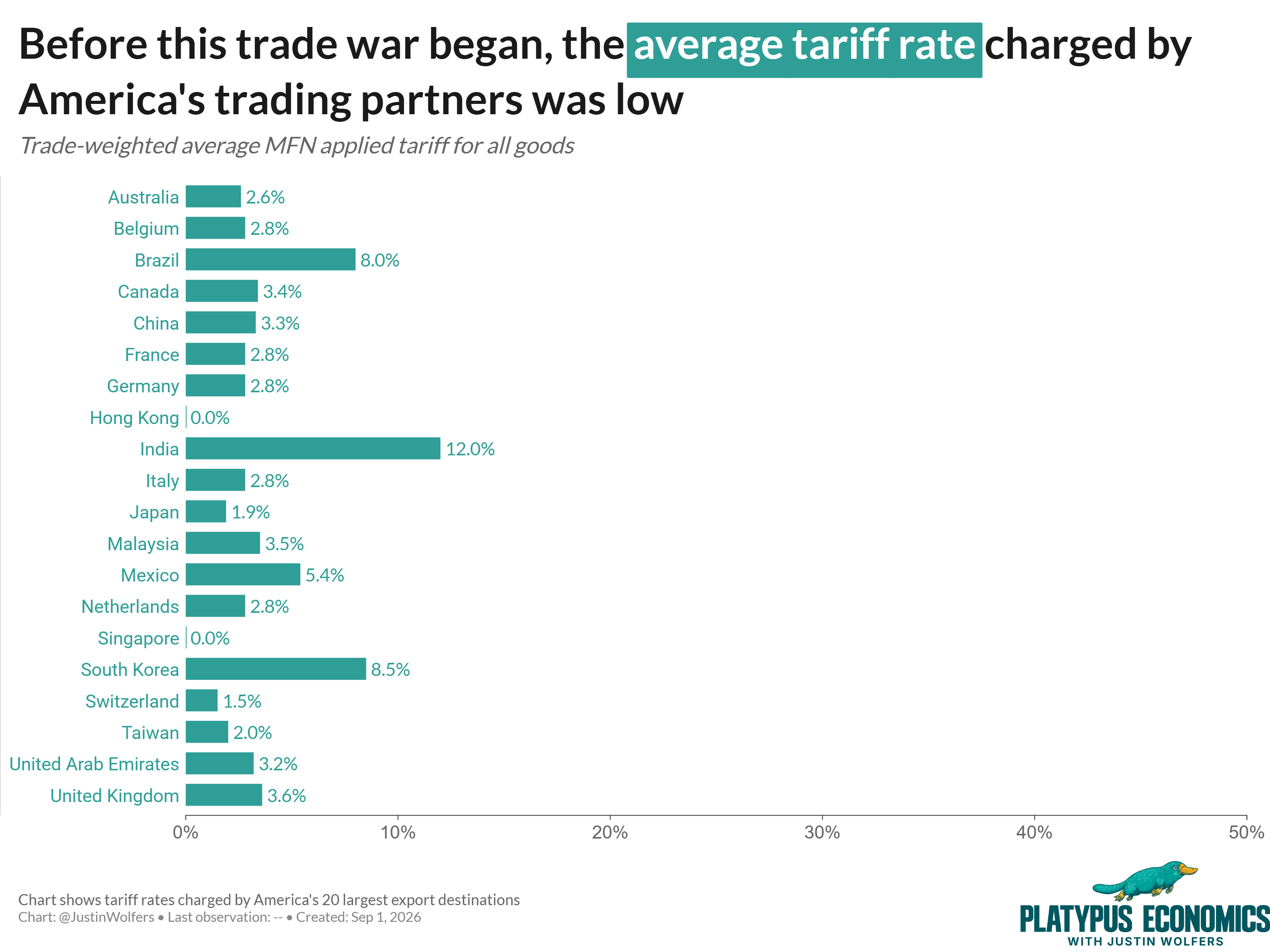
Canada and Mexico traded with America under USMCA, the free trade agreement Trump himself negotiated in his first term, and most goods crossed those borders duty-free. South Korea had KORUS, and most American manufactured exports already entered Korea tariff-free. The average tariff on American goods was around 3% in the European Union and around 3% in China. Most other rich countries sat in the same neighborhood. A few poor countries ran bigger tariffs, but they’re not large markets for us, so not really a big deal.
So there were tariffs — just very, very low ones. Why weren’t those numbers zero, rather than two or three percent? Because that’s not how trade deals work. When it comes to negotiating trade, two leaders sit down and eliminate tariffs across most of the economy. But they leave aside a handful of politically radioactive sectors — think dairy, rice, sugar, sometimes steel. Those are the sectors where a politician who mishandles them loses their job. So you forgive your counterpart their political weaknesses, and they help you with yours. The result is the attainable trade deal rather than the perfect one: tariffs broadly at zero, hand your counterpart a few political wins, and trade (mostly) freely.
That’s the world America had. The claim that we faced vast tariff walls across the developed world isn’t true, and hasn’t been for decades. It may have been partly true in the President’s youth… But that was a while ago.
Now for the power half. Did the tariffs get America better deals?
There have been many announcements about this — but they don’t amount to much.
Take South Korea. The administration celebrated a new deal opening Korea to American cars and manufactured goods. Except that our trade agreement, KORUS, had already given most American manufactured exports tariff-free entry years ago. So the new arrangement leaves a 15% U.S. tariff on Korean goods and claims credit for market access American manufacturers already had.
Or take the much-touted arrangement with the European Union, which isn’t a deal at all. It’s a framework: a promise to make future promises. The document is written almost entirely in the future tense — “intends,” “will work,” “seeks.” It’s the trade equivalent of “we should really get coffee sometime.”
Still the administration claims to have signed real deals — reciprocal trade agreements — with ten countries: Argentina, Bangladesh, Cambodia, Ecuador, El Salvador, Guatemala, Indonesia, Jordan, Malaysia, and Taiwan. Say that whole list out loud and it sounds impressive. Add up their share of American goods exports and you get about 6%. And the agreements cover only some products and only some barriers, so the share of exports actually affected is far smaller than that.
Oh… but it gets worse. It’s not clear that any of these agreements are actually in effect. Most were struck in response to tariffs imposed under emergency powers, and those tariffs were subsequently ruled unconstitutional. A USTR report from February lists all or nearly all of these as agreements that “have been negotiated, but have not yet entered into force.” So the count might be closer to zero.
Who isn’t represented in that count? The folks we actually trade heavily with: Mexico, Canada, the UK, China, Japan, and Germany, plus (as discussed above) the EU and Korea. This list of counties shows up elsewhere: It’s the list where American access has been restricted, or may soon be, in retaliation. China took tariffs on American exports as high as 125% in April 2025, and while the peak came down, a 10% additional tariff on U.S. goods runs through November 2026. That’s alongside targeted tariffs on American farm and energy products. American goods exports to China fell 26% in 2025. Sales elsewhere rose, but they didn’t replace that market.
The Canadian government retaliated too, and Canadian consumers started quietly protesting in their own way: trips to the U.S. fell sharply, as did their imports. Turns out the surest way to lose a Canadian’s business is to keep calling their country the 51st state.
Grading Leverage: Threats, retaliation, a few small commitments that may not be in force. No serious net gain for American exporters. That’s an F.
Test Two: Reducing the Trade Deficit
The White House called the trade deficit a national emergency. Not just the total trade deficit either: Peter Navarro argued for actions to reduce every bilateral deficit. This would require persuading the rest of the world to want exactly as much American stuff as America wants of theirs. Bold.
In 2024, America bought $1.212 trillion more in goods from the world than it sold. In 2025, the first full year of the tariff program, the goods deficit rose to a record of about $1.24 trillion. Tariffs apply directly to goods, and the goods deficit got worse.
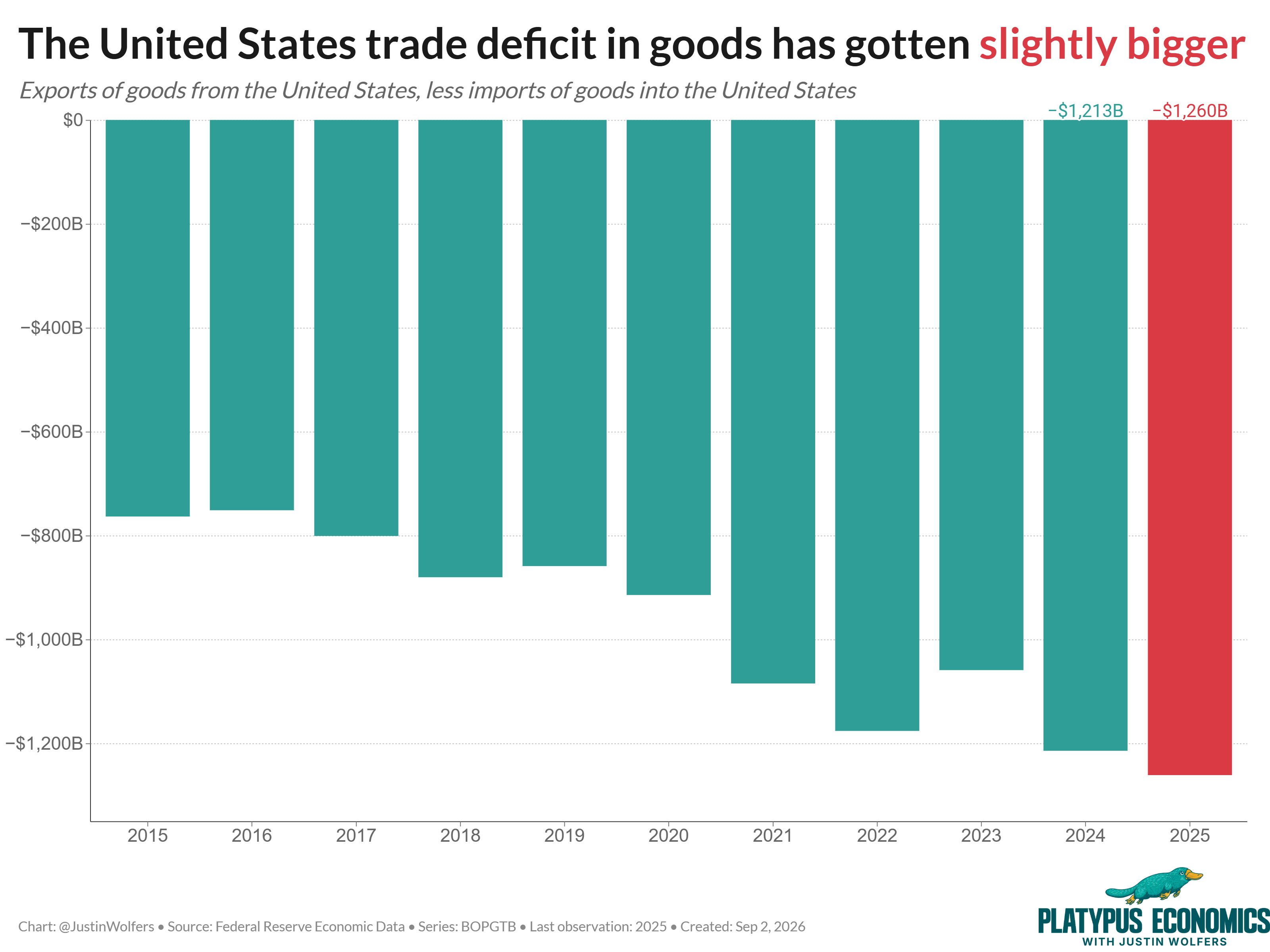
The first half of 2026 does look better — roughly $550 billion, which annualizes to something a bit north of a trillion. That’s an improvement… and a trillion-dollar deficit.
And, as you may have heard, America is a service-focused economy. We sell a lot of that — finance, software, travel, consulting, entertainment, education. The total deficit — including services, this time — was about $904 billion in 2024 and about $902 billion in 2025. If those sound like they’re pretty much the same number, that’s because they are.
A good professor asks his students to show their work, so let’s look to China. America’s goods deficit with China fell by about $94 billion in 2025. That’s good news — until you notice the goods deficit with Southeast Asia rose by about $100 billion over the same stretch. We just changed the labels on the boxes. Imports left China and reappeared in Vietnam, Malaysia, Thailand, and Indonesia. Some of that is real supply chain relocation. Some of it is Chinese firms shipping through third countries. Either way, Americans kept buying.
Grade the Trade Deficit: Bigger in 2025, maybe smaller in 2026, still enormous. Another F.
I’d add that a deficit is an accounting total, not an economic scorecard. The whole here premise is flawed. It’s not at all clear that a better grade on this score would mean a better life for Americans.
Test Three: An Industrial Revival
This is the big one, folks. The one the administration talks about at every opportunity. They said they were going to bring back factories. Big boofy blokes with steel-toed boots bringing home the bacon.
And yet: Manufacturing employment is lower than when Trump returned to office. By July 2026, America had about 62,000 fewer manufacturing jobs than in January 2025. That’s a small number, coming in at roughly half a percent. It’s not a collapse. But we ran an extraordinary trade war to rescue this one sector, and the sector kept shrinking while the rest of the economy added jobs.
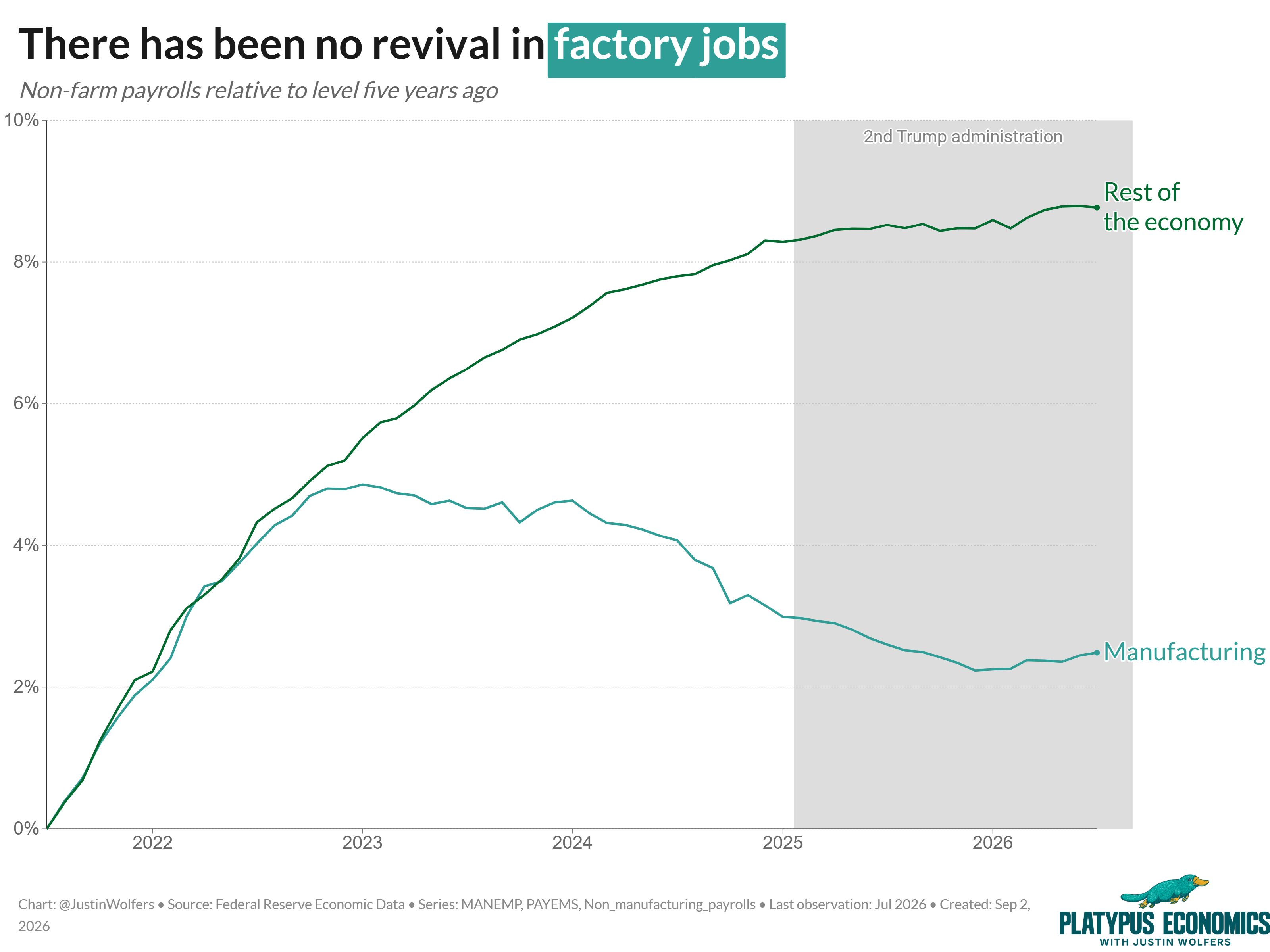
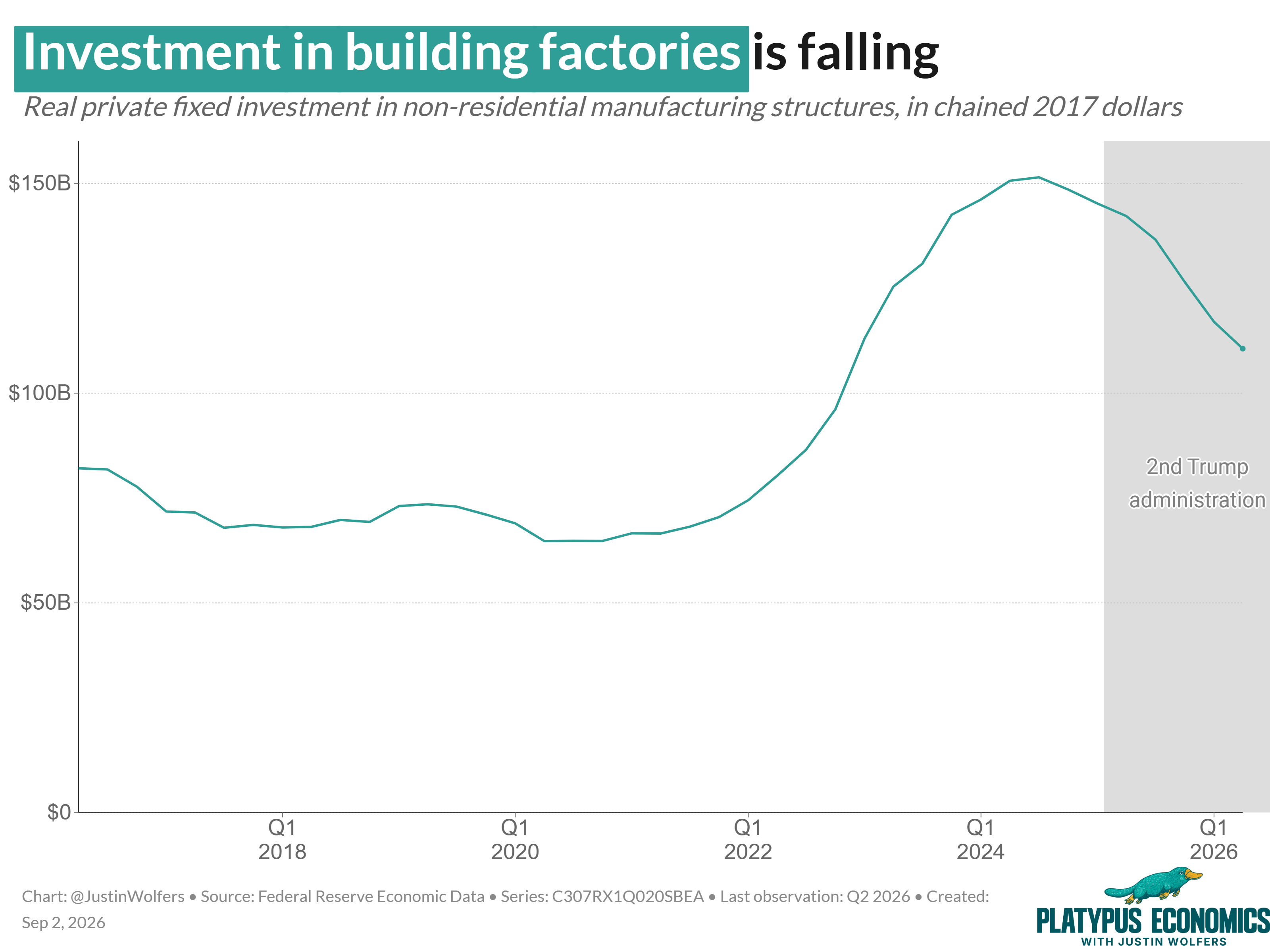
Manufacturing output has risen modestly this year, and factory capacity remains loose. American factories are not running flat out, because tariffs did not unleash a wave of new demand for what they make. Factory construction says the same thing: the manufacturing construction boom of the early 2020s was driven by semiconductor investment and industrial policy passed before Trump returned, it peaked in 2024, and it has fallen since. The tariffs arrived after the boom started and during its slowdown.
This is one where the details really deserve a first-hand account. The Dallas Fed put a beautifully simple question to 271 Texas firms: what net impact do you expect higher tariffs to have on your business this year?
59% said negative.
4% said positive.
17% said no impact.
20% didn’t know.
Fifty-nine over four is roughly fifteen — fifteen manufacturers expecting harm for every one expecting help.
And among the firms expecting harm, 55% said they would pass costs to customers. 44% said they would absorb costs as lower profits. Notably, 29% would look for domestic suppliers — that’s something the policy was actually going for, and it’s a positive. 27% would just shift the timing of their imports.
Just 5% planned to move production to the United States.
The Fed’s national small business survey finds the same pattern: 13% of firms using foreign inputs switched to domestic suppliers, and just 3% moved production to America.
There’s a reason nobody’s pouring concrete: if a tariff is on Monday and off on Tuesday, you don’t build a plant around it. The tariff can flip several more times before the concrete has dried.
Grading the Industrial Revival: Some domestic sourcing, fewer factory jobs, no revival. A clear F.
Test Four: National Security
I don’t want it to seem like I’m going through this report on the premise that there’s no point going after these goals. There is a real trade policy case for targeting strategic risks. America does need secure access to rare earths, magnets, chips, medicines, and specialized metals.
The trouble is that most of this trade war wasn’t targeted at all. And where it was targeted, it backfired.
Rare earths are misnamed — they aren’t especially rare. The scarcity comes in who processes them. China does a lot of that processing, and they do it for the entire world. That means they turn raw material into magnets. Those magnets go into cars, aircraft, electronics, and military equipment. Before the trade war, China supplied around 70% of the rare earth compounds and metals America imported.
Then things escalated, and China restricted exports of critical rare earths and magnets. The White House’s own economic report says those restrictions caused factory shutdowns, including in the U.S. China has since used export controls on gallium, germanium, graphite, and antimony too. No, those aren’t words I made up to sound like a scientist (please don’t ever think that I am a scientist). But those critical minerals matter for semiconductors, batteries, weapons, and advanced manufacturing.
Here’s the part that keeps me up. The dependence was always there. But a dependence only becomes a vulnerability once your adversary discovers it — and this trade war sent them looking. They found it. Now they know exactly where to press, and they’ve shown that they’re willing.
The administration has announced domestic mining and magnet projects, and those may help reduce these vulnerabilities. They also have nothing to do with the tariffs. And don’t get me started on the Strait of Hormuz and the rest of what we import from that part of the world.
Grading National Security: The vulnerability was revealed, not reduced. F.
Test Five: Tariffs Raise Revenue
Here’s a partial list of what the President promised that tariff revenue would fund. Child care. Tax cuts. No tax on tips. No tax on overtime. No tax on Social Security. Tax benefits for American cars. Farmer relief. Tariff dividend checks — remember those? Mine never arrived. Debt reduction. And the end of the income tax.
Tariffs are taxes, and taxes do two things: they change behavior, and they raise revenue.
This program certainly changed behavior. Families paid higher prices, businesses paid higher input costs, and supply chains reorganized themselves around dodging the tariff.
The revenue is the strange part. Customs duties rose from $77 billion in fiscal 2024 to $195 billion in fiscal 2025 — an increase of about $118 billion. Much of that increase came from tariffs imposed under the International Emergency Economic Powers Act, and the Supreme Court struck those down earlier this year. By mid-August, roughly $100 billion had already been refunded.
These refunds don’t work like they do at a store. When I paid more for olive oil at Costco because of a tariff, the refund didn’t come to me. It went to the importer of record. Yes: that’s the company on the customs paperwork. So… Costco. The family at the checkout paid while the big importer got the check.
More is likely coming. The Section 122 replacement tariffs — a temporary 10% tariff meant for a balance of payments crisis — were struck down at trial because there was no balance of payments crisis, and that’s on appeal. The newer Section 301 tariffs, the ones you’re paying right now, rest on the premise that we’re punishing other countries for their use of forced labor. Which countries? Apparently all of them. That’s a pretext, and everyone involved knows it.
Why the parade of odd legal theories? Because the Constitution gives the tariff power to Congress. Congress has occasionally lent narrow slices of it to the White House, but nobody ever intended it as something a president waves around at will — and this administration has consistently declined to go ask Congress for it. The courts occasionally suggest we look at the Constitution, and it’s unclear whether the administration will gather much revenue here at all.
Of course, if the administration passed these tariffs as laws, they wouldn’t have any of these problems. The revenue problems are the direct result of the President refusing to involve Congress in his trade war.
Grade Revenue: Americans got the distortion, and much of the money is being handed back to importers rather than kept by the Treasury. F.
Final Grade: Time to Call the Parents
Let me put the report card up one last time.
Leverage: threats and retaliation, no serious net gain. The deficit: worse in 2025, smaller in 2026, still enormous. Factories: a little domestic sourcing, no revival. Security: China found the choke point. Revenue: Americans paid, importers got refunded.
These failures look different from one another, but they share a root, and it’s an idea about what trade is.
Trade is cooperation. A farmer gets a customer. A factory gets a component. A family gets a product. An American business gets a buyer abroad.
The trade war threw sand in all of it. It disrupted export markets. It disrupted supply chains. It disrupted investment. It disrupted relationships with allies. Then it added uncertainty and stirred.
A stronger America has more customers, more suppliers, more trusted partners, and more capacity to make the things it needs. This trade war has delivered fewer of every one of them.
Five promises. Five tests. Five fails.
And this is grading the President on his own stated goals. As I’ve said before, those goals are themselves questionable:
In a word - NO! And trump has NO goals, like he has NO cards, NO brain, NO morals, scruples, sanity. Only the toadies who lay at his $#!t soaked shoes and his reckless feckless "aides" refuse to admit or do anything about this cruelty and recklessness. Nothing this evil being does achieves any goals other than to reinforce that he must go! Death before he makes more Destruction!
I learned something today … that what I already knew is backed up by numbers:
Trump is a fraud.
Thanks Teach!