


Treasury Secretary Scott Bessent just announced an “economic D-Day” against Iran.
And I got an immediate, serious case of déjà vu.
The big idea — of using economic isolation to effect regime change — isn’t new. We tried it in Cuba. In fact, we’ve been trying it for more than six decades. The idea was to overthrow Fidel Castro. Except he lived to a ripe old age and handed over the reins of power to his brother Raúl, who then handed power to his handpicked successor, Miguel Díaz-Canel, who remains Cuba’s president and Communist Party leader. The sanctions, like the regime, are still with us.
It’s remarkable how much of the current moment looks like a barely edited rerun.
It’s not just the idea of sanctions; it’s also the language. The administration’s talk of an “economic onslaught” closely echoes the private language of “economic warfare” used by officials in the Eisenhower and Kennedy administrations.
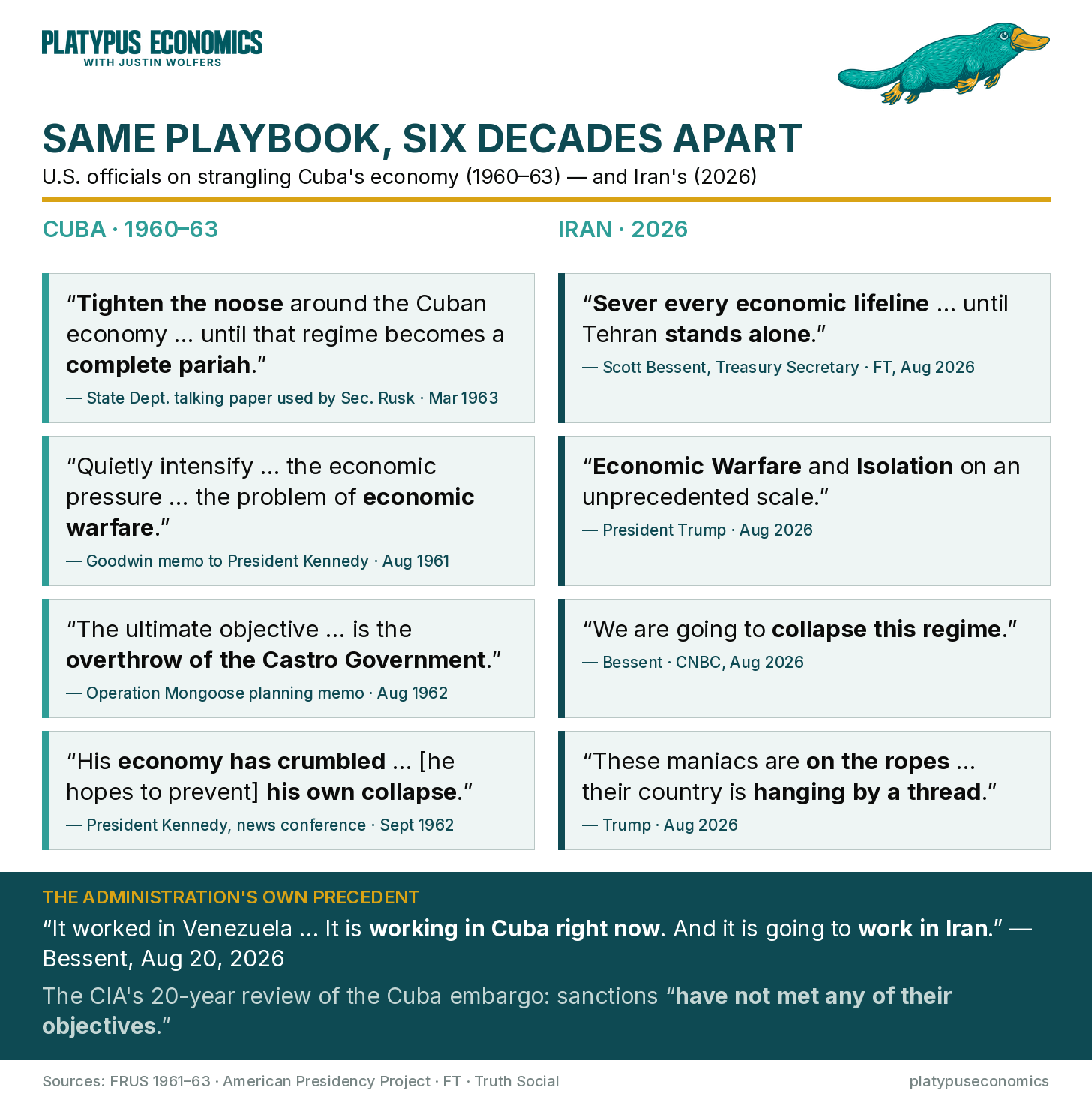
This is not a loose historical rhyme. It looks like the same playbook — six decades later.
What’s the big idea?
The United States has already imposed plenty of sanctions on Iran: on oil, banking, and shipping; on military figures, front companies, and the networks that have helped them evade the earlier sanctions.
But the latest move is different. There’s a clue in the name: “Operation Economic Outcast.” It’s a threat to everyone doing business with Iran.
The White House is asking the world to choose. The choice is business with Iran or access to the United States and the dollar-based financial system. The White House is hoping the world takes that threat seriously.
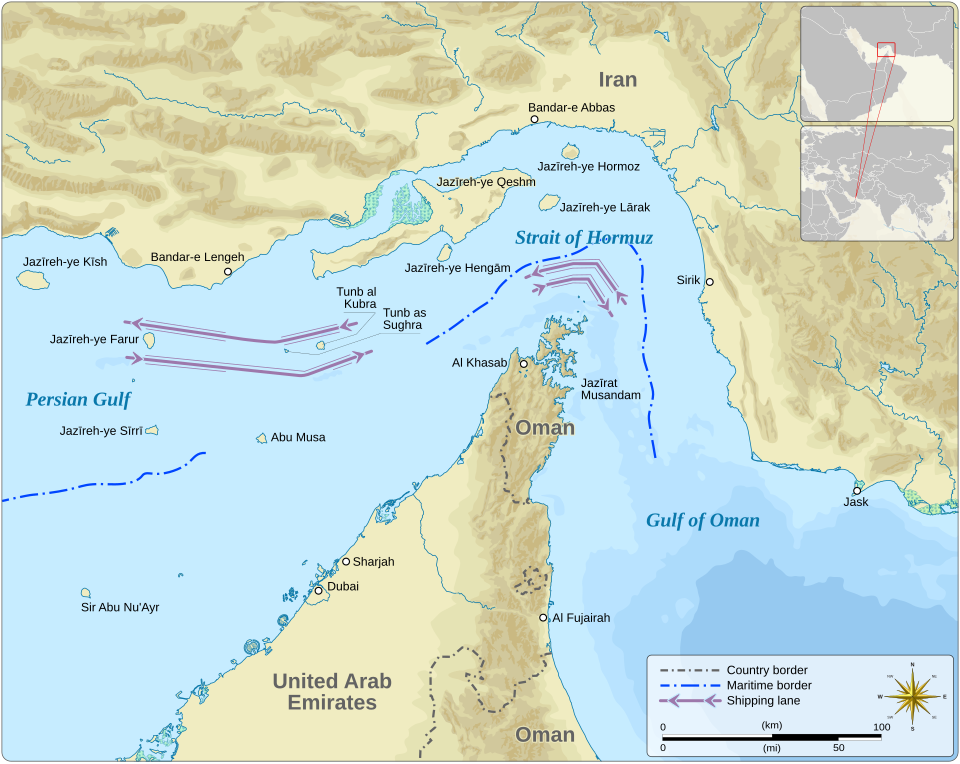
There’s a funny analogy here worth dwelling on. We’ve just learned (the hard way) what a chokepoint can do. Iran sits right next to the Strait of Hormuz — the narrow waterway connecting the Persian Gulf to the wider ocean. When that route gets threatened, oil prices rise, shipping gets harder, and the global economy slows.
In other words, Iran controls a piece of the physical plumbing that’s central to the whole world. It’s hard to move oil without access to Hormuz.
On the other side, the United States controls a lot of the world’s financial plumbing. It’s hard to move money without access to Wall Street. If you’re cut off from that, moving money itself becomes much harder — and a lot more expensive.
It’s hard to know what to make of “Operation Economic Outcast” because it’s mostly just an announcement that there will be future announcements.

Still, we can try to take Treasury at its word. The idea is to expand the domains in which the United States can use its power to prevent folks in other countries from engaging with Iran. Treasury will now work harder to prevent anyone from doing business with Iran in shipping, aviation, technology, gold, and digital assets.
That list gives away the intention: Make it painful for anyone who engages with Iran in any economic domain.
The trouble with weaponizing the plumbing
One lesson from the Strait of Hormuz: When a chokepoint becomes unreliable, people start finding ways around it. That means turning to other suppliers, building new pipelines, adding storage, using different ports, or taking longer routes. The whole geography of trade shifts.
And the same thing can happen in finance.
Every time America uses access to the dollar system as an ultimatum, other countries get one more reason to build alternatives: other currencies, new payment systems, and different banking relationships.
The dollar is still extraordinarily powerful. But the more idiosyncratic and unpredictable American policy becomes, the more valuable an alternative route starts to look.
Back to the future
The original sanctions strategy toward Cuba began with the same basic economic logic as today’s policy toward Iran.
Cuba’s main export was sugar. America wanted to deny Castro hard currency from sugar sales. Today, Iran’s main export is oil, and America wants to deny Iran hard currency from oil sales.
Both times, America has sought to prevent outside countries from filling its foe’s economic gaps in the hope that the resulting economic pain would produce political change.
In 1960, Lester Mallory, a senior State Department official, wrote that the way to alienate Cubans from Castro was through “economic dissatisfaction and hardship.” That meant denying Cuba money and supplies, reducing real wages, and bringing about “hunger, desperation and overthrow of government.”

The theory: starve a person long enough and they’ll turn on their leader. That assumes they won’t turn on the country doing the starving, and that’s a very big bet to make. Anyone who’s ever been hangry could have flagged the problem.
The Kennedy administration understood the danger. Richard Goodwin warned that America should be careful not to make Cuba look like the victim of U.S. aggression, as it would strengthen Castro’s hand and encourage Cubans to rally around the flag.
Unfortunately, that’s exactly what happened.
If you’ve ever been to Cuba, you might be familiar with the political story its citizens are taught: The country has economic problems, and the United States is trying to crush it.
That story leaves out a lot — Cuba’s government did enormous damage to its own economy. But the embargo gave Castro something real to point to, and provided an effective scapegoat for domestic problems.
The strategy works by creating real pain for real people
The Trump White House isn’t using Mallory’s language. Instead, it talks about illicit revenue, sanctions evasion, oil networks, and military procurement. But a country doesn’t have three separate economies for its military, its elites, and its ordinary families.
Foreign currency pays for imports; when it becomes scarce, it becomes harder to buy food and medicine, or the machinery and materials needed to keep factories running. And when you make it harder for a country to export, that pain moves through the whole economy.
Research on Iran finds that sanctions affect what families eat. Even exempt humanitarian goods (like medicine) get disrupted. That happens when banks and suppliers decide Iran-related transactions are simply too risky.
And the regime narrates that pain for citizens: America is attacking you. Your hardship is foreign aggression.
A recent study looked at nearly two million posts by more than a thousand Iranian political influencers during earlier sanctions episodes. It found that broad sanctions increased pro-government sentiment, including among some moderate opponents of the regime.
That’s influencer data, not a nationally representative poll. But it fits the Cuban lesson: You can make a country poorer for decades, but you don’t get to choose what its politics become.
The lesson from Cuba: It’s easy to create pain, harder to get regime change
Bessent recently said this approach “is working in Cuba right now.” But what actually happened in Cuba?
Yes, the embargo hurt Cuba. A 1982 CIA review judged it significantly damaging to Cuban growth and development in its early years, while finding that its effects diminished over time. Its broader conclusion was that U.S. and regional sanctions had “not met any of their objectives.”
Now we have more than four decades of history since that CIA assessment. And more than 60 years of pressure overall. There’s been plenty of economic pain, but not political transformation anywhere close to what Washington set out to achieve.

And the sanctions literature says Cuba is not some bizarre exception. A classic study by Gary Hufbauer, Jeffrey Schott, Kimberly Elliott, and Barbara Oegg is one of the more optimistic accounts of sanctions: It finds (at least partial) political success in roughly one-third of cases.
But success is much more likely when the demand is concrete and limited: release a hostage, reverse a specific policy, stop a particular transaction.
Regime change is an entirely different kind of demand.
Justin Wolfers, you are breath of fresh air. You make sense. You provide data. You consider what has happened in the past that might shed light on our current circumstances. I really appreciate the history lesson on Cuba. And you point out how we continue to disregard the plight of ordinary people. Ordinary people in Iran. Ordinary people in Cuba. And the rest of us ordinary Americans who will no doubt suffer the miserable consequences of our incompetent current regime. And, while it's totally unscientific, it just seems nuts to me that anyone would think that torturing ordinary people would have the effect of making them love their torturers. Thanks for a terrific post.
A (tangential?) personal reflection on the Cuban embargo... somewhere around here in a box of memorabilia I've got a page from a small town Ohio newspaper; the date is early 1963, a few months after the Cuban missile crisis. Kept in our family because it has a photo of our smiling faces as we congratulate our parish priest on his elevation to monsignor (small town, big news😊). Elsewhere on that crumbling, yellowed page of newsprint is a small item about the US embargo against Cuba and the anticipation that it would soon bring Castro and his regime to its knees. If there were politicians quoted in that article, I assume they're all long gone, as is Castro, as is the monsignor, as are some of my fam in the photo. Me & the embargo, we're hanging in there... maybe a little worse for the wear, a bit different than we looked in 1963. I like to believe I've gotten some good accomplished during my years since 1963. I can see (and so love!) my kids & grandkids living out the proof! The embargo tho...?