


Treasury Secretary Scott Bessent claims that America can grow its way out of the federal debt. This week, I ran the numbers on that. Spoiler: it’s not looking good.
You can catch up on that here:

Now, it’s time for The Professor Is In, where I sit down with my producer Augusta Chapman to answer audience questions. Think of it like office hours: my door’s open, come on in.
Augusta started with the topic on everyone’s mind right now. If AI delivers the productivity boom that its more fervent advocates are promising, does that change how we should think about the debt? Is there any evidence that productivity is growing—and how would we see that in the data?
We’re still waiting for AI’s productivity boom. Your returns on learning economics show up much faster: right now, you can get a subscription to Platypus Economics at 25% off. That’s $7.50 a month if you pay as you go, or under $6 a month if you decide on the annual plan. In addition to all our usual stuff —-which remains free-— you’ll also have access to:
An audio Econ 101 course made by me and my partner, Betsey Stevenson
Our subscribers-only weekly wrap-up newsletter, which includes a reader Q&A, behind-the-scenes content, and a special selection of Platypus puzzles
Ad-free videos
The ability to comment on all our Substack posts
On a personal note, Platypus exists to teach the world economics. Support from our readers means we can keep doing that. Thank you for being part of our community.
Click here to subscribe to Platypus Economics today.
First step: squint
The way we see this is, essentially, we squint. Start with incredibly noisy data, hold it up to the light, and turn it around and around and around until you convince yourself that this hard-to-see thing is definitely there. We actually have hints that Fed chair Kevin Warsh is doing exactly that.
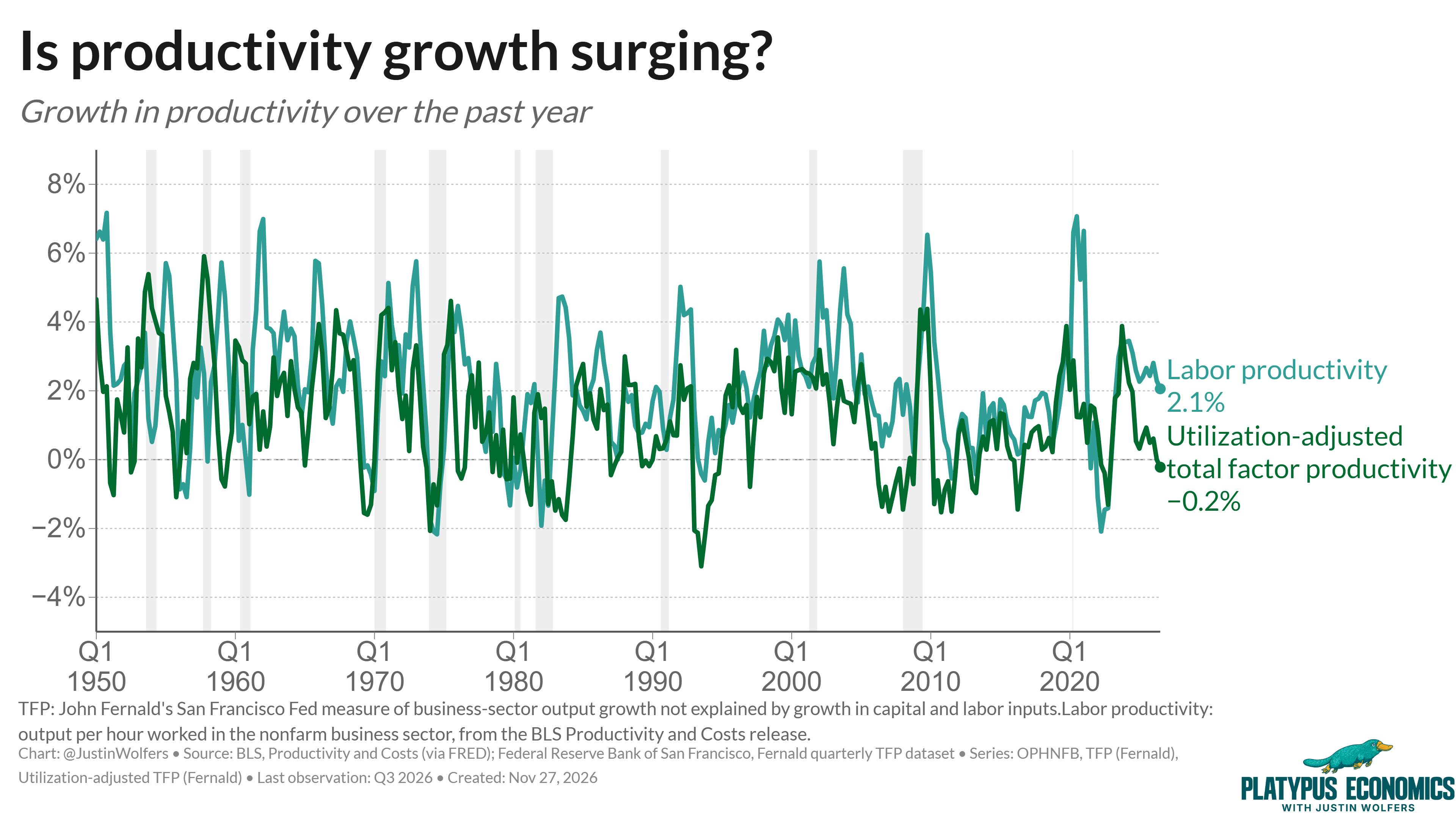
This may sound unscientific. We’re just torturing the data until it confesses! But when you have strong evidence, and strong priors, from other sources, you don’t want to ignore it. There is a good case that we’re living through a transformative moment. There’s also a good case that it’s yet to show up.
The problem with a transformative moment is that, even if it tells you productivity will grow, it doesn’t tell you when.
What other revolutions tell us
In 1987, economist Bob Solow observed that “you can see the computer age everywhere but in the productivity statistics.” Think back to that time: there had been people in offices called typists whose job was to go clickety-clack. Then, those jobs disappeared, to be replaced by machines running WordPerfect 5.
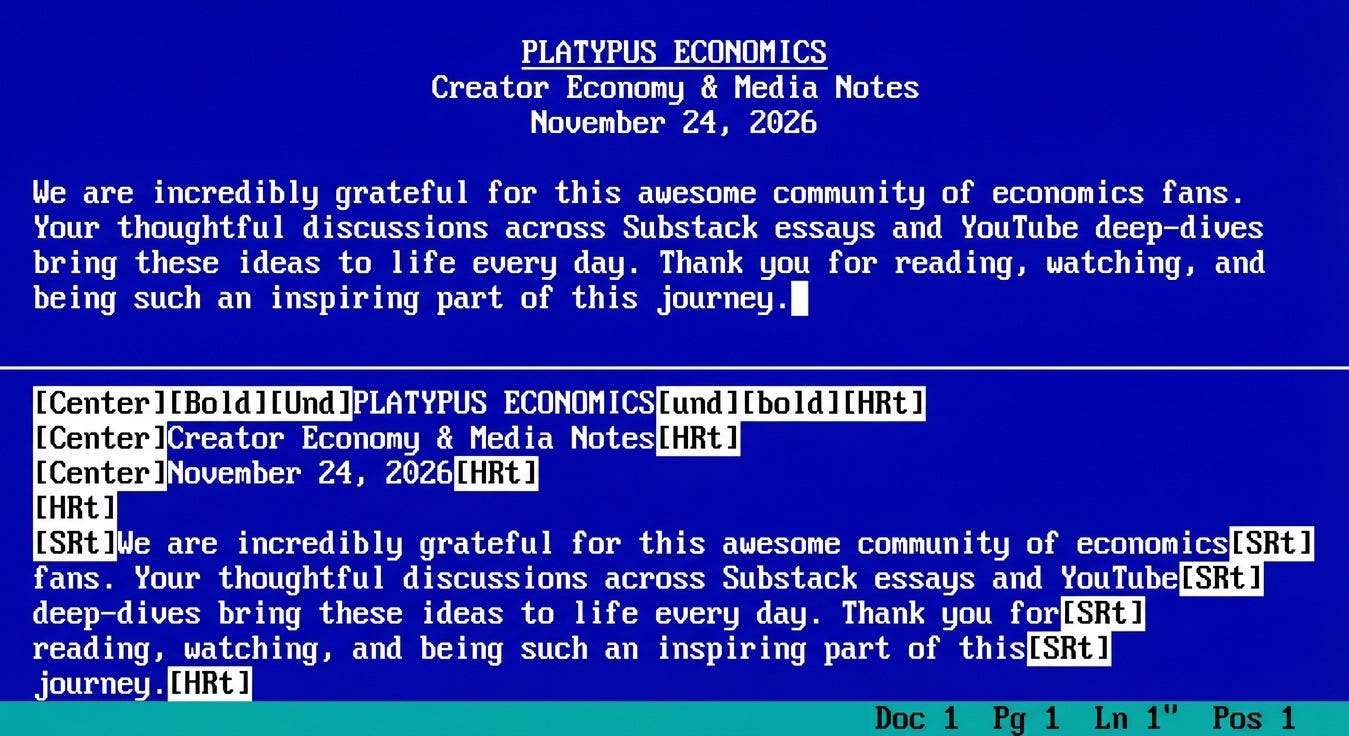
For years, the productivity data barely captured computers’ integration into the workforce. Then, it caught up. That’s a big part of what we now think of as the Clinton boom.
The lesson here is that new technology “pays off” once we reorganize work in deep, sometimes fundamental ways. The PC took twenty years to show up as generalized gains, while the Industrial Revolution took sixty. AI may move fast—but faster than decades is still years.
What optimism means here
My partner Betsey Stevenson is also an economist. She goes to a lot of AI conferences. They’re full of researchers, billionaires, and economists who study all this. When you ask a question like Augusta’s—will AI revolutionize the economy?—every hand will shoot up.
But then, you ask what that “revolution” means. Some technologists will say 10 percent growth for a full decade. Others say 50 percent a year. The economists are just as excited as the technologists, but to them, thrilling growth is a rise from 2 to 3 percent per year.
That would be an enormous leap. By the rule of 72, two percent growth doubles our material living standards every 36 years. Three percent would double them every 24 years! But that isn’t the six percent growth we’d need to make the debt sustainable. Even the most optimistic AI economists aren’t forecasting that.
Let me introduce some humility here. The technologists could be right, and the economists could be wrong. It’s possible that we understand the math of exponential growth better, and they understand AI better. So, I don’t rule out a boom. It’s just not likely. I’d bet a million dollars (at even money) that the U.S. doesn’t average six percent growth over this next decade. I haven’t cleared this bet with Betsey, and I don’t have a million dollars handy, but hey, I’m still up for it. I think.
Other questions Augusta put to me:
Why use the $32 trillion figure for the national debt instead of $40 trillion? (Answer: Because I’m not counting the federal government borrowing money from the federal government. If my left trouser pocket owes money to my right trouser pocket, I’m no deeper in debt.)
A reader in Denmark asks: Who’s actually paying America’s bill, and what are we getting for it?
How do tax cuts and inequality shape who carries the debt?
Finally: how’s the math feeling?
This week we tried to do something ambitious. We taught you an equation. It’s one I first learned in graduate school (there it’s called the debt-dynamics equation). Once you understand it, you can see how the Treasury Secretary is making claims that just don’t add up.
People tell me that the public can’t be brought along to understand debates like this. They say it’s too hard or too boring. But my Platypals tell me something different. You’re curious, ready to extend yourself, and hungry to better understand our world. You’re my ammunition against those doubters.
It may have been hard to keep up with the math, and it was also our first time trying it. Unless you all deliver pure hate in the comments, well, we might do another equation someday. Maybe.
Watch the full episode for the rest.
Today's show was so good (as always), what with the sale price and being a practical consumer, I jumped on the offer and subscribed! I was listening at breakfast and my husband was also captivated, and didn't make me listen through my headset. Being a retired children's librarian, who has struggled with math phobia brought on by timed multiplication tests in 1959, I am evidence that you two are waving a magic wand!! (Plus I've been suspicious that my understanding of economics might better than Scott Bessent's, and you confirmed that.). We might be listening to your economics class at breakfast from now on.... Thanks so much!
For Justin: for someone like me (age 77), my knowledge of calculus is minimal (my high school math teacher proudly told us that he failed out of the U.S. Naval Academy ...), the part of your math equation I simply could not follow is what the "delta sign" meant. So: use simpler math, if that's possible.