


America’s net government debt is now roughly $32 trillion. That’s a huge number, full stop—and it’s also huge in the context of our ability to pay it. Right now, the debt is about 100 percent of our GDP. That’s a lot.
Treasury Secretary Scott Bessent says that the United States can simply grow its way out of that debt. So today I want to ask: is that level of growth realistic?
The short answer: no.
The long answer: no, but the “why” is important. So today, I’m going to walk with you through the math here. Yes, math! Stick with me and we’ll have some fun. There isn’t going to be a test, and by the end, you’ll know about as much about America’s fiscal situation as any budget wonk in Washington.
Unlike the federal government, you want your budget to add up. We can help: right now, you can get a subscription to Platypus Economics at 25% off. That’s $7.50 a month if you pay as you go, or under $6 a month if you decide on the annual plan. Already you have free access to everything we write and do trying to explain the economy. A paid membership comes with some useful extras:
An audio Econ 101 course made by me and my partner, Betsey Stevenson
Our subscribers-only weekly newsletter, which includes a reader Q&A, behind-the-scenes content, and a special selection of Platypus puzzles
Access to ad-free videos
The ability to comment on all our Substack posts
On a sincere note, Platypus exists to teach the world economics. Support from you helps us deliver on that mission. Thank you for being part of our community.
Click here to subscribe to Platypus Economics today.
Debt is about ability to pay
Let’s say you owe the bank half a million dollars. That could be a life-altering debt. If you earn $50,000 a year, you may be in serious trouble. If you earn $5 million a year, that’s a different conversation entirely.
The debt is the same, but the income changes the whole picture.
America’s net government debt is around $32 trillion (you may have heard $40 trillion, but that counts money one part of the government owes another part, so I’m focusing on $32 trillion here). We need to think of that in the context of our ability to pay, which we measure using GDP, a measure of our collective annual income.
This, by the way, is why growth matters. As the economy grows and America produces more, our incomes rise, and the debt is smaller relative to our ability to pay. Debt becomes sustainable when debt-to-GDP stops rising. Notice, the line here is not about eliminating or paying down the debt; we’re just looking for it to stabilize relative to GDP.
Right now, net government debt is about 100 percent of GDP.
That’s a lot. But it’s also a gift. Remember that we’re doing math here. With debt roughly equal to GDP, the arithmetic gets particularly simple:
When we borrow an extra 1 percent of GDP, the debt-to-GDP ratio rises by one percentage point.
When interest rates rise by one point, the annual interest bill goes up by about one percentage point of GDP.
When the economy grows one point faster, the debt-to-GDP ratio falls by about one percentage point.
It’s that easy—just one for one.
The two-part deficit
The deficit is what we add to the balance of debt this year. In the fiscal year that ended in September, it was $2 trillion, which is about 6 percent of GDP. It consists of two pieces.
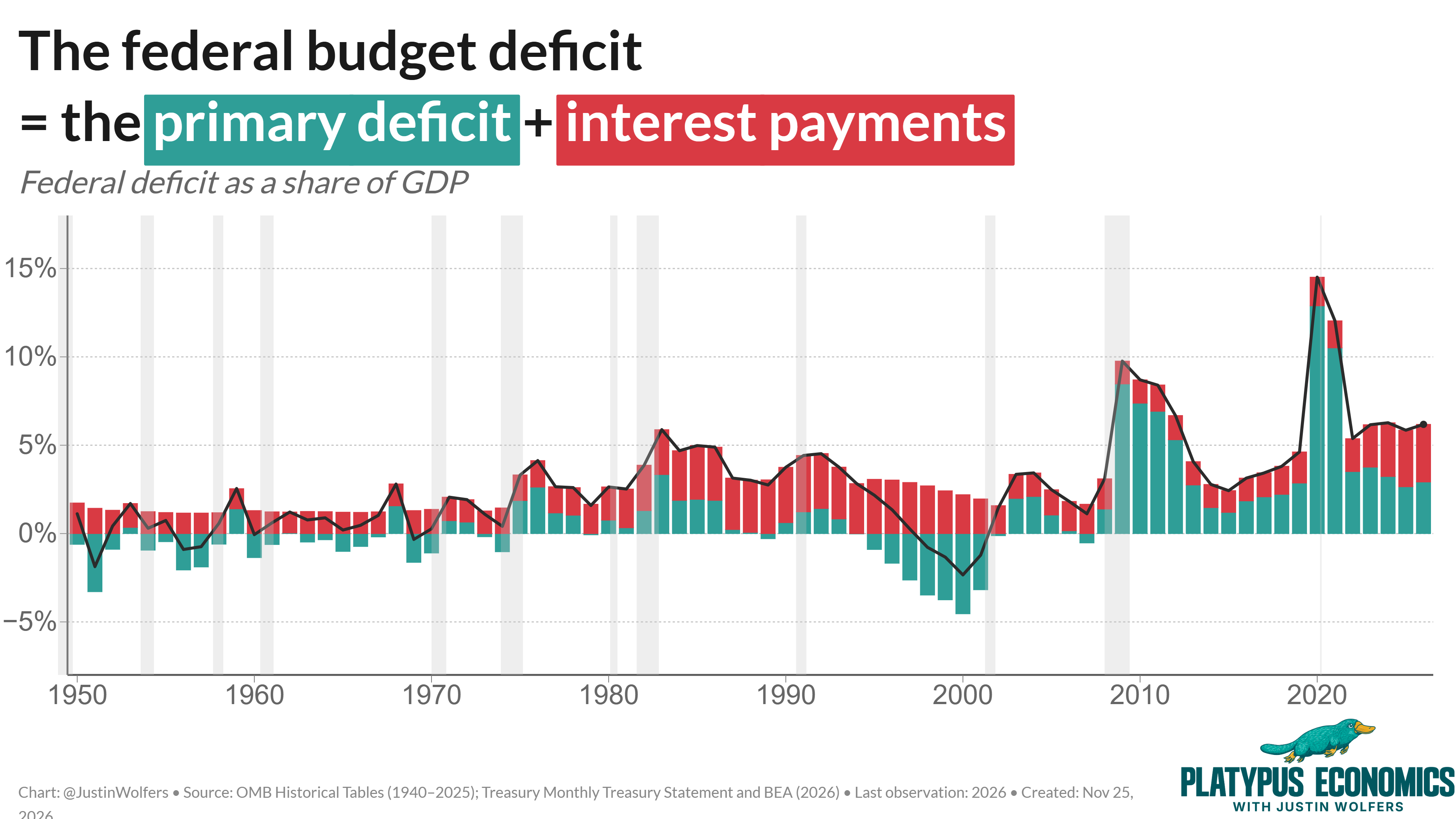
First: interest. This year it was a bit above $1 trillion. That’s roughly 3 percent of GDP.
Second: Spending not covered by taxes. That gap, between what government takes in and what it spends (not on interest), is called the primary deficit. This past year, the primary deficit also ran at a bit above 1 trillion. That is also roughly 3 percent of GDP.
Even if the U.S. paid no interest on any of our debt, the federal government would still be borrowing nearly three cents for every dollar of our national income.
If growth is supposed to fix that, it’ll have to be a lot of growth.
Building the debt equation
What makes the debt-to-GDP ratio rise? We’re going to answer this by building an equation.
I know: Math is hard. You read this newsletter for fun, not algebra. And all of this feels pretty abstract. Equally: I believe in you. I know you can lock in, and follow. I can’t build furniture, but I have built Ikea, and so we’re going to take an Ikea approach to building an equation that describes why the debt rises. We’re even going to have fun.
Stick with me through three simple steps that build one upon the other.
Step one: New borrowing (before interest). The primary deficit is the difference between government spending (not on interest), and revenue. Say we start the year with debt at 100 percent of GDP. If we run a primary deficit of 3 percent of GDP, then the year ends and we owe roughly 103 percent of GDP.
In math, we’ll call the debt ratio b, so its change is Δb and the primary deficit (as a share of GDP) is d. So:
Δb ≈ d
Step two: Interest on old debt. If debt is 100 percent of GDP, and the real interest rate is 3 percent, then the interest bill adds another 3 percent of GDP. The bigger the inherited debt, the more pain any given interest rate might cause. The term for that is the real interest rate, r, and we multiply it by the debt-to-GDP ratio, b, to get what it adds to the debt-to-GDP ratio:
Δb ≈ d + rb
Step three: Let’s consider economic growth. More GDP makes the denominator of debt-to-GDP bigger, which makes the ratio smaller. Our ability to pay rises 3 percent when real GDP rises by 3 percent. With debt equal to GDP, that’s pulling the ratio down by roughly 3 points. If growth is g:
Δb ≈ d + rb - gb
Combine those last two terms, and you get the equation:
Δb ≈ d + (r - g)b
Congratulations. You’ve done practical math. Economic math. Important math. Now let’s figure out what it says.
Running up the down escalator
I want to focus on the term r-g, which is the real interest rate minus the growth rate. It’s essentially an answer to the question: are our interest bills rising faster than our ability to pay them?
So how do we stabilize debt-to-GDP? We stop the debt ratio from rising! That is, we set Δb≤0 and rearrange our equation:
0 ≥ d + (r - g)b
With debt about equal to GDP, b is about one. So the whole thing comes down to:
g ≥ r + d
Translated into English: The economic growth rate, g, has to beat the real interest rate, r, by the size of the primary deficit, d. For America, that primary deficit is 3 percent of GDP.
It’s like we’re running up a down escalator. Interest is the speed of the stairs, flying by underneath you. Growth is your leg speed. But we keep borrowing 3 percent of GDP a year due to the primary deficit (that is, this year’s non-interest spending exceeds revenues). So just keeping pace with the stairs isn’t good enough. We have to win by three steps a year, every year, forever.
Let’s explore what this equation is telling us, in a bit more detail.
Plugging in America’s numbers
We know d, the primary deficit is 3 percent. What about r, the real interest rate? Inflation-indexed bonds are currently around a 3 percent real rate. Or you can think of the real rate as the long-term nominal bond yield (about 5 percent), less expected inflation (the Fed’s target is 2 percent), which also gets you to 3 percent.
For growth to beat that 3 percent real interest rate by another 3 points (due to the primary deficit), then real GDP has to grow by roughly 6 percent.
Secretary Bessent is technically right that growth can stabilize the debt. Technically right, but practically irrelevant. There’s basically no chance the U.S. economy will grow anywhere near the rate needed to stabilize the debt. Growth can’t save us.
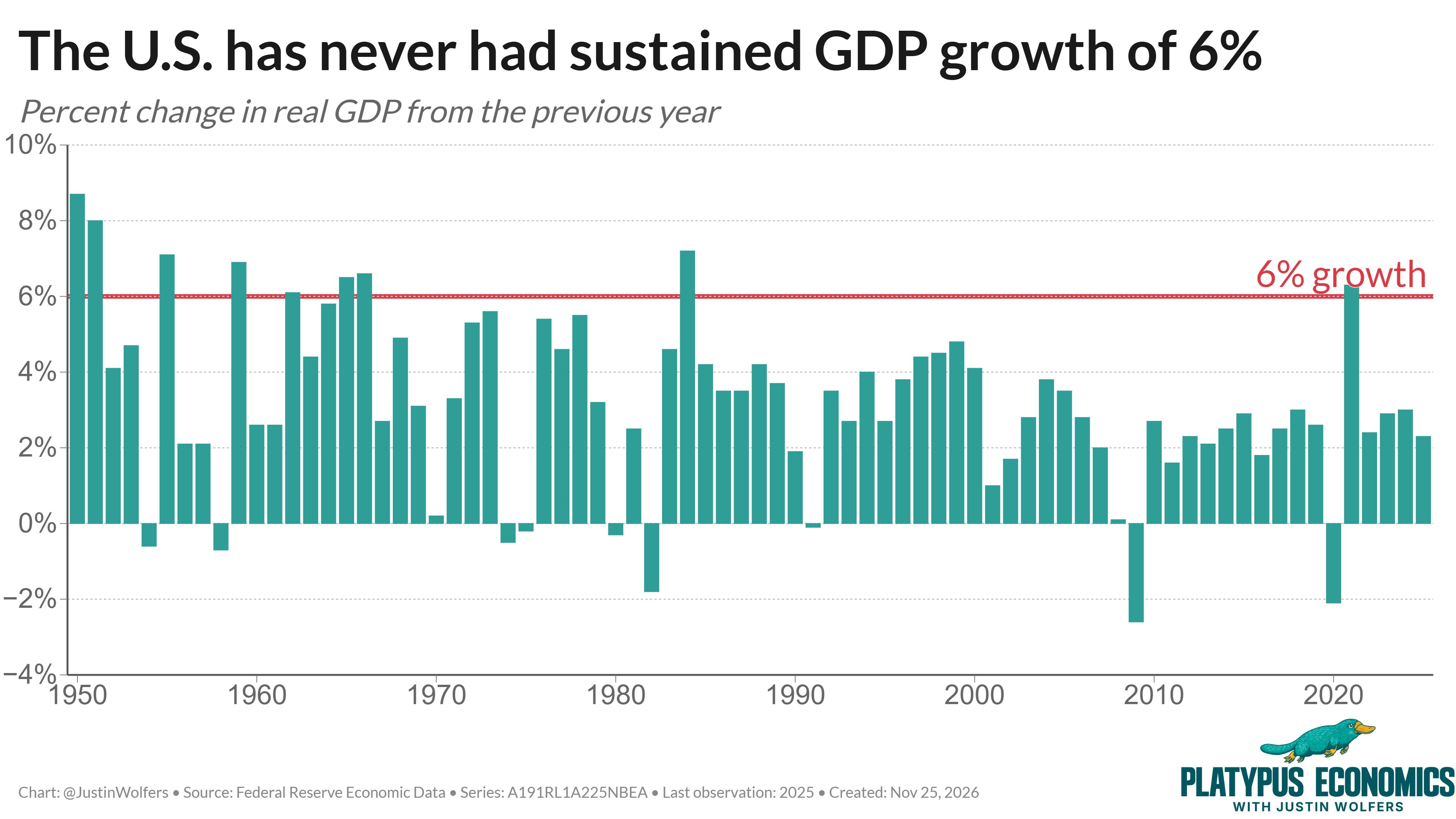
The U.S. has never sustained anything close to 6 percent real GDP growth for even just ten years. Even the best postwar decade we ever had didn’t exceed 4.5 percent—and that’s with serious cherry-picking. The 2000s averaged roughly 2 percent, the 2010s averaged about 2.4, and the 2020s are on track to hit that same level.
There are no credible economists on earth who think 6 percent sustained growth, over a period of years, is likely. They don’t see it at the Congressional Budget Office, or the Fed, or on Wall Street.
Scott Bessent himself has stated his goal is 3 percent economic growth. That would be terrific news (though we haven’t reached it yet), but our legs would still be falling short of the stairs. Bessent’s idea that we can outgrow our fiscal problems simply doesn’t math.
The stairs are starting to go faster
The U.S. government isn’t yet paying 5 percent on every dollar it owes. Lots of that money was borrowed at a time when rates were lower, in some cases much lower, and according to CBO, the average rate on that debt was around 3.4 percent in 2026.
But today’s borrowing comes with today’s interest rates, and a lot of old borrowing is about to come due. When that happens, the government usually borrows to pay again. About one-third of the government debt comes due within a year, and more than half comes due within three.
Today’s interest rates are going to become the rate environment pretty quickly.
This is why you see so many headlines about rising bond-market rates. When you owe a huge amount of money, like the federal government does, then a one-point rise in interest rates is… well, it’s also quite a lot of money.
This creates a feedback loop. The government borrows more and interest rates can rise. Higher rates make future borrowing more expensive, which in turn creates a bigger interest bill, which means bigger future deficits.
The U.S. has deep financial markets. We borrow in our own currency and have enormous economic capacity. This isn’t the stuff of an imminent crisis—but we’re also not on track for a solution. Bond markets are endlessly patient right up until they’re not.
Making the math add up
Next time a politician or economist claims America can simply grow its way out of debt, you now have the tools to fact check them. Yes, growth helps. No, the sorts of growth that are plausible aren’t going to be enough. Not by a long shot.
Something will have to change for this debt to stabilize. That conclusion is basically unavoidable. And that requires a serious argument about what to do. Should taxes rise? Should spending fall? Which taxes and which spending? What should happen to Social Security, Medicare and Medicaid, defense, and programs for kids?
Pretending that no choice is required is a choice—and it’s a bad one. It leaves the next Congress with even more debt and even harder choices.
Excellent work! Bessent should learn from this! Oh wait, he is simply saying what his big boss wants to hear. Works for the rich I guess. We regular taxpayers can just pay up or have the necessities of our social programs cut.
Professor, you're right. Math is fun and provides irrefutable proof that Bessent is either lying or ignorant of reality.
Either way the future looks bleak, mostly for the future generation We can only hope that the new Congress understands and takes action.
How do other countries that provide meaningful social programs avoid this issue? No country spends more on the military than the USA. What % reduction in military spending would be needed to reduce the annual deficit?