


This week, I joined Charlie Sykes on his podcast, To the Contrary. Charlie and I always go deep on the issues, and this week was no exception. He pushes me off my safe ground — economics — and towards values. But values matter, including to economists.
This time we got into a puzzle. Support for immigration seems to be rising in direct proportion to the brutality of the administration’s immigration crackdown.
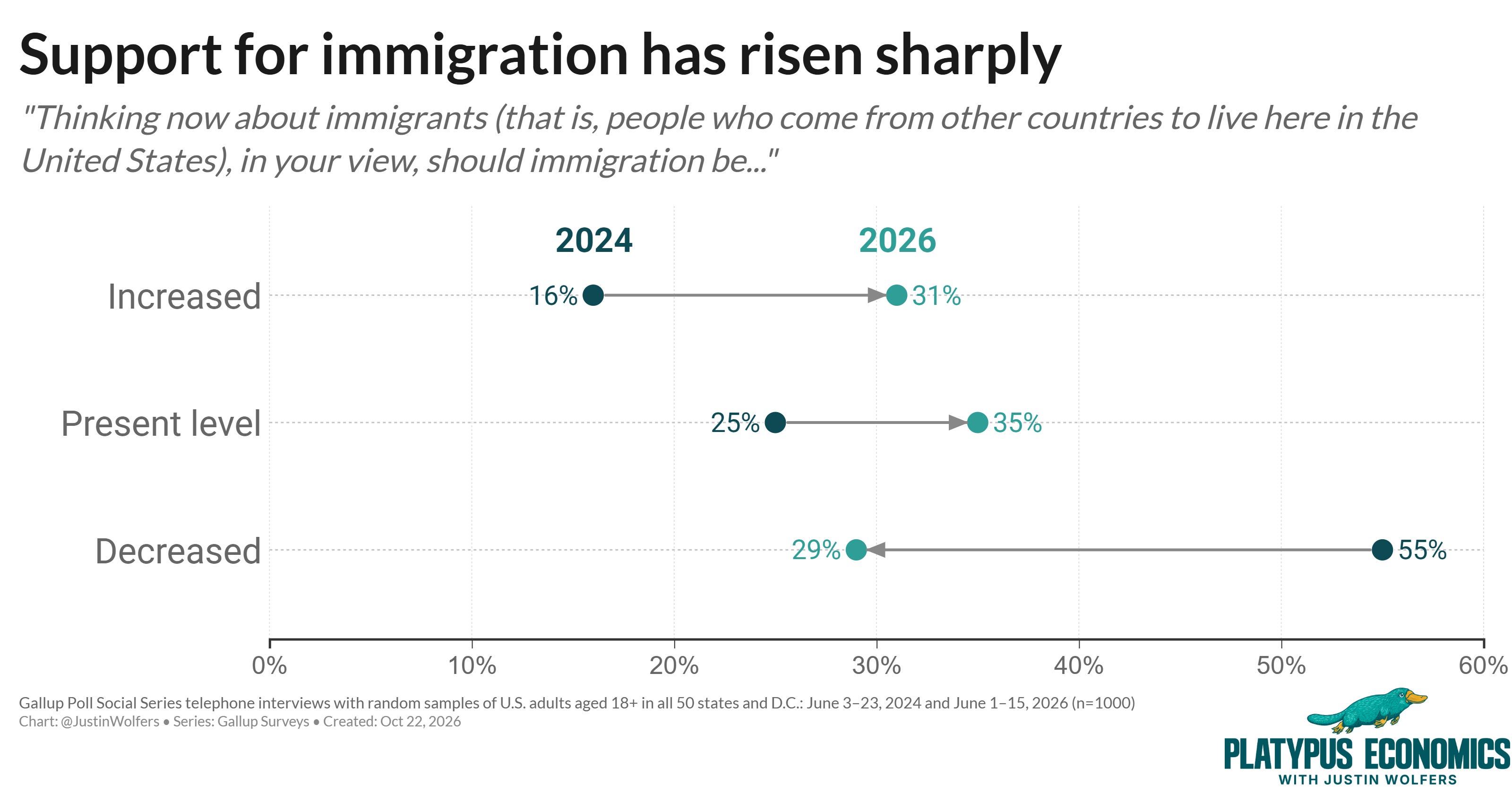
My explanation of this is simple. It’s easy to vilify a group in the abstract. Then the policy hits in real life, and your neighbor disappears. The people being hit might be from your church, they might be your kids’ teacher, or maybe they’re your grandfather’s caregiver.
Oh, you think to yourself. I didn’t mean that bloke.
We’ve seen this before. Not long ago, it wasn’t hard to whip up hysteria against gay men, lesbians, and the rest of the rainbow flag. There were whole elections built around it. Then every family discovered that it had a gay niece or cousin or neighbor, and those people turned out to be perfectly nice folks just trying to get on with their lives. The single best cure for vilifying a group is meeting someone in it.
Charlie and I also talked about how this immigration policy is a sharp turn for Republicans. Reagan liked to say that you can live in France and cannot become a Frenchman, but anyone can come to America and become an American. Both President Bush and his son, President Bush, took immigration seriously as a way to make the country richer, in every sense. This is an abrupt break.
Then there’s a word I’d like everyone to watch: “illegal.” Whenever I talk about the virtues of immigration, someone comes in and says, “No, Justin, you don’t get it. The problem is illegal immigration.” That position has a logic to it, and as someone who’s stood in the immigration queue myself, I have mixed feelings about people jumping it.
But let’s set the many nuances of that aside for a second. The administration is going after legal immigrants, too. It has revoked more than 300,000 visas. It has shut off legal immigration from many countries. It has been consistently capricious, and getting into the country is no longer any guarantee of being treated fairly.
It has made it very hard for students to get visas. And those who do come are scared to return home for the holidays in case they can’t get back in to complete their degrees. This is lunacy. Students from all over the world want to pay us $70,000 per year to sit in a lecture with 500 kids at the University of Michigan, and that money funds better classrooms, more financial aid for local students, and lots of excellent research. Plus, when those students return to their home countries, they return with a love for the United States, and an appreciation of our values.
Yet the administration’s answer is: we just don’t want them here.
I also confessed something to Charlie about my wardrobe. I don’t usually wear political t-shirts, but I had one specially made on this topic. It’s blue and it says “immigrant” on it.
It’s simple, and I like it, because when people are anti-immigrant, they’re not usually picturing blokes like me: white, moderately successful, nonthreatening. But I am representative. My immigrant friends do the same things I do. They wake up, go to work, raise their kids, and (if they’re citizens) they vote their conscience, just like you.
I hate that admitting I’m an immigrant has become subversive. The Somali immigrant the president singles out has no less dignity than I do.
You can tune in for our full conversation above.
My wife and I ove your columns and share with kids and friends often. Watch u on MSNOW oft too. You are the best.
But today's column on immigrants is your most important. Please distribute it eveywhere
Professor, the answer to the increase is all about white supremacy and the so called so called Christian ethos of America. For some reason this thinking seems to be passed from generation to generation.
I'm sad to say that there is some of this thinking here in Canada too, among older citizens. It manifests as complaints about providing social assistance to newly arrived people, not so much about their ethnicity or skillsets. A case in point is the recent Alberta referendum that had many less publicized questions about restricting and controlling immigration. There are similar issues wherever there is a white majority in the population. Brexit is another example.
All of this is in the face of the facts that you laid out, the taxes paid, the purchases made and talent brought to society.
I see this changing in the younger half of the population here in Canada. My kids, children of boomers grew up in a multicultural environment, went to multicultural schools and have a number of non white friends. I hate writing it this way, they are just friends.
So there is hope, at least here in Canada, which helps protect our core values of respecting others, while making a happier, productive and growing society.