


The American economy continues to surprise me—and, today, delight me.
The latest jobs numbers just dropped, and they’re a whole lot stronger than forecasters expected. New jobs from October plus upwards revisions from the prior two months combine to form a pretty healthy picture. Running a line through the past three months, we’re now adding an average of 137,000 jobs per month.
These jobs numbers come in on top of an already action-packed week. We had an enormous election Tuesday, results became clear on Wednesday, and then on Thursday, there was a huge market sell-off. Now it’s Friday, and we learn that the U.S. economy has been doing far better than anyone understood.
165,000 jobs and three questions
Every time there’s a new jobs number, I ask the same three questions. What does this number say on its own terms? How does it compare with what people expected? And how does it change our story?
On its own terms, 165,000 new jobs in October is downright strong. If the U.S. economy keeps doing that, we’re in for a pretty good ride.
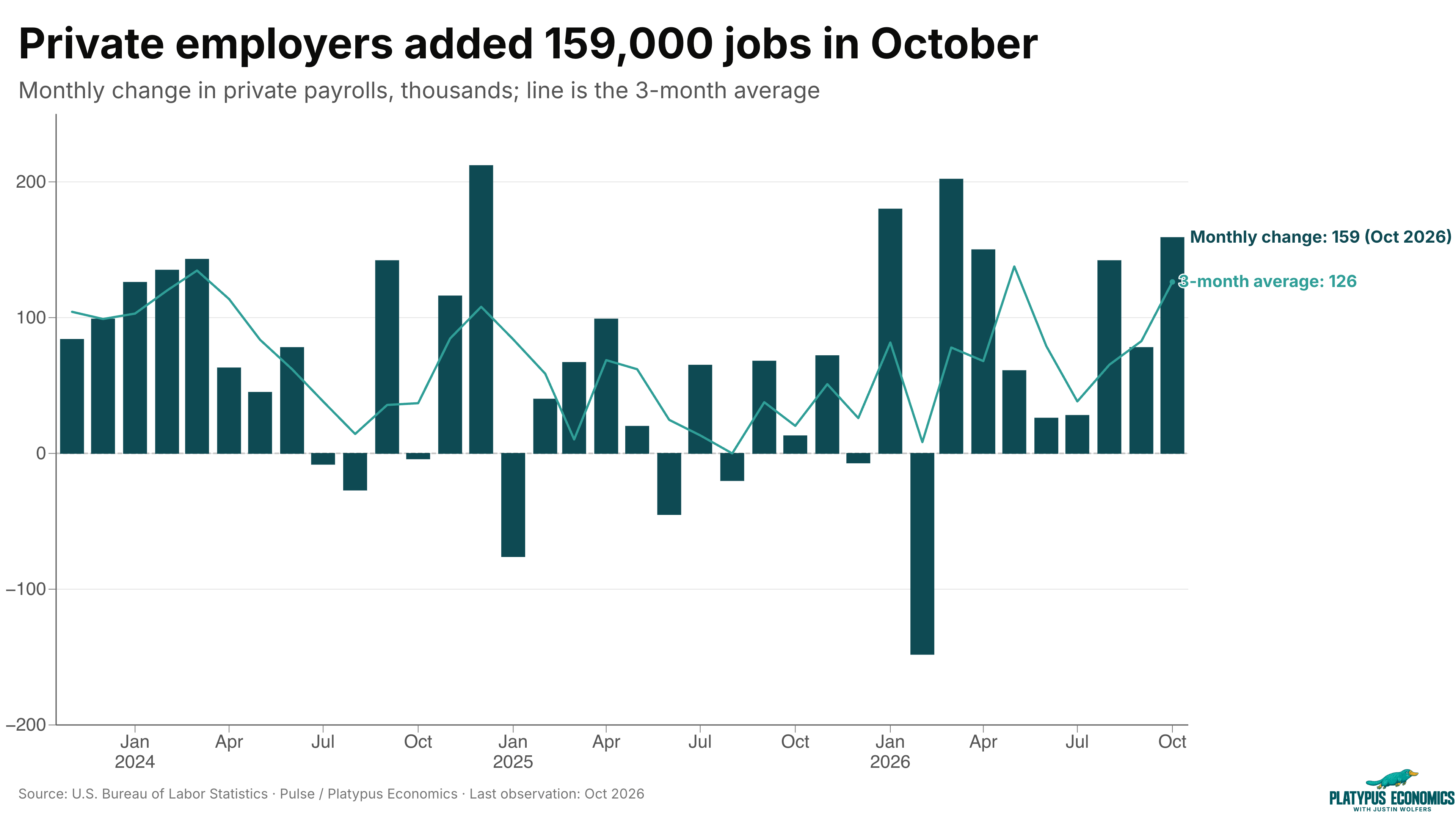
Relative to expectations, it’s a big win. Forecasters were braced for a meh month—predictions ran from 45,000 to 120,000. Even the most optimistic numbers were short.
The third question, how this changes our story, is the one that really matters. Through much of 2025, I thought that job growth was weak. It was. The first part of 2026 was hard to read, but now we are in the back half of the year with three pretty strong months in a row. Maybe it’s time to believe that the American economy is the little engine that could. Yes, job growth slowed, and yes, it got uncomfortable for a while. But we may be seeing the other side of it.
Upward revisions are good
This is the October jobs report, but a big part of the story isn’t the October numbers at all. Each jobs report includes revisions as the Bureau of Labor Statistics gets more clarity on what happened in August and September.
And I know it’s always uncomfortable to talk about revisions. Wouldn’t it be good if we could find out the truth right away? But more accurate data is better, and in this case, the revisions were very good news.
In August, the American economy created 53,000 more jobs than we’d previously thought. September got revised from 29,000 up to 60,000 jobs. When you combine that with the October data, we’ve got a couple of strong months in a row.
Fewer people means smaller numbers
This report showed an unemployment rate of 4.1%. That’s down from 4.2%. If jobs keep up this growth, unemployment will continue to fall. We’ve written about this before:

Some of you have longer memories, and so you may recall when the jobs report would put out growth numbers at 200,000 or 250,000. The key difference between then and now is immigration.
Back then, the U.S. was a growing country, because people were constantly moving here. The Trump administration has stopped immigration in its tracks. Without that population growth, there isn’t the need for as much job growth every month.
There’s another piece of the unemployment story. America keeps getting older, and so every month, a whole lot of people hit retirement age. That can confuse the data, and so to get a clearer picture, we can look at what’s called the prime-age employment rate. That’s the share of 25-to-54-year-olds who are employed. It’s been remarkably steady the past few years and is now at 80.7%, near its post-pandemic high.
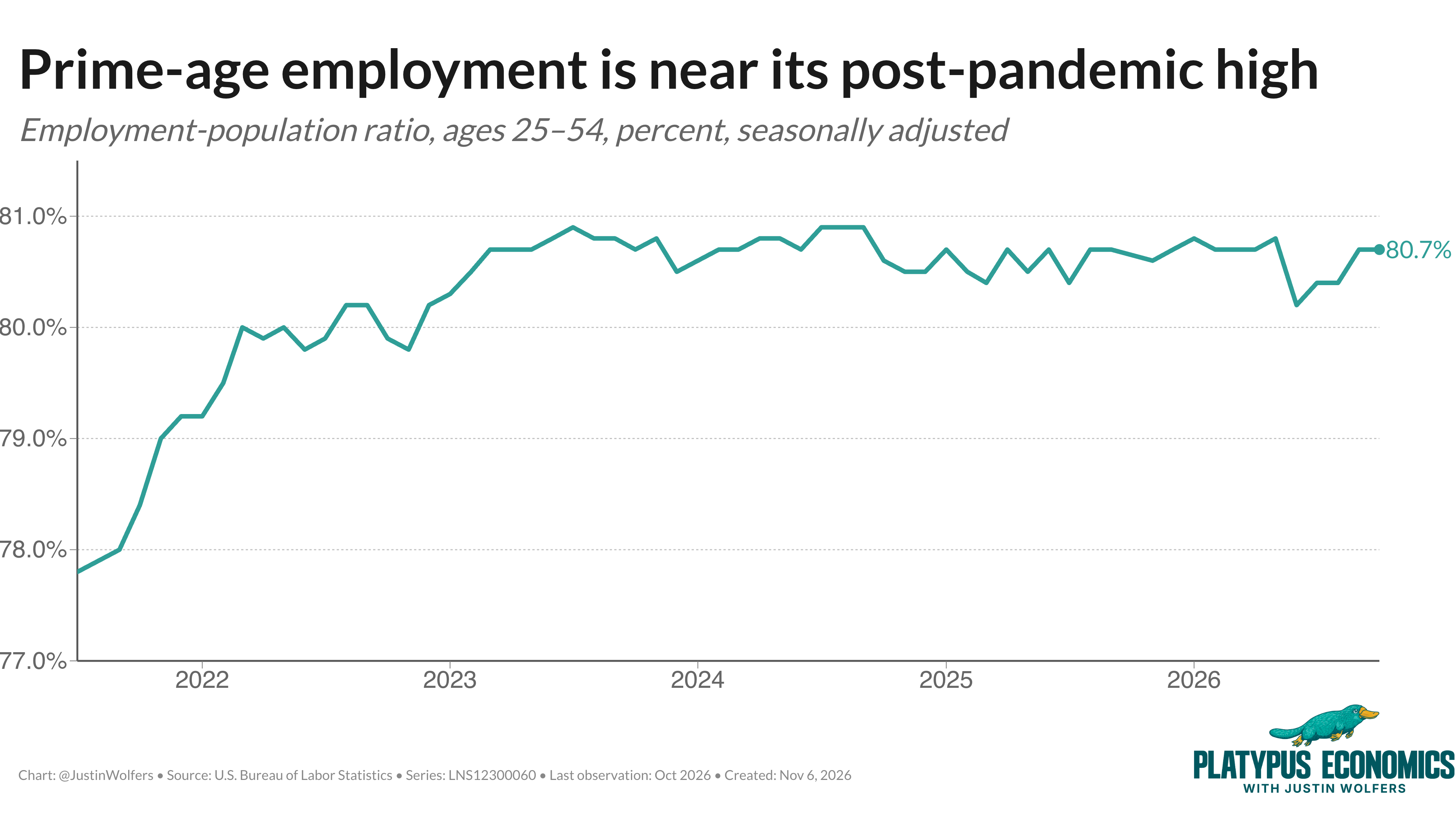
That means most people who want work can find it—though it’s not easy to secure those new jobs if you’re unemployed. We’re still in a low-hire, low-fire phase. If you’re without work, finding something new can be downright difficult.
Health care isn’t the entire story (for once)
For nearly two years, the little engine of our economy has been health care and social assistance. It’s up 1,044,000 jobs since January 2025. Over the same stretch, the rest of the economy is down 19,000 jobs.
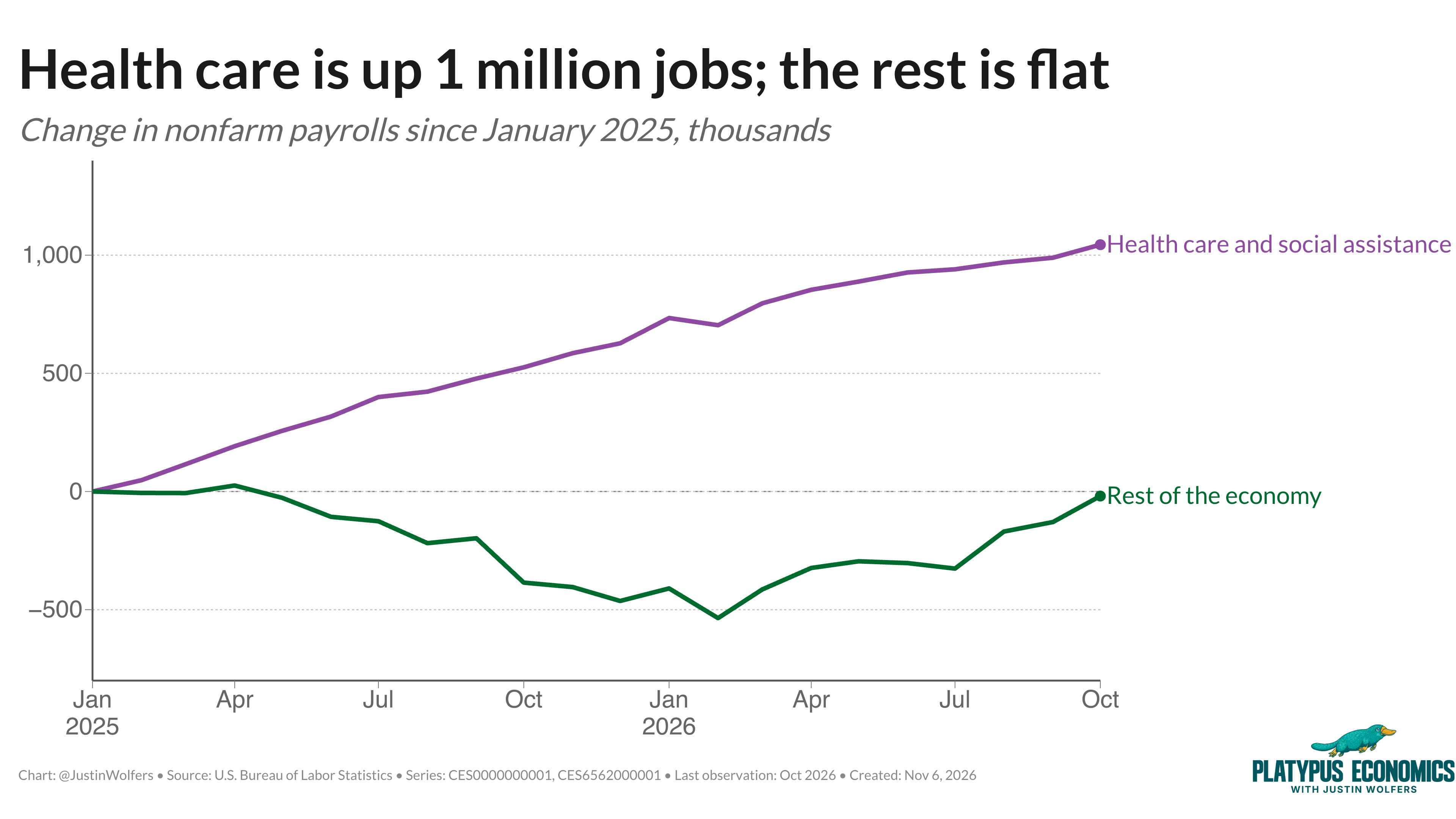
But look at the shape of that second line. The rest of the economy shed jobs through 2025 and hit bottom around the start of this year. Since then, it has added jobs at a rate roughly parallel with health care.
Health care is still an incredibly important story. But it’s no longer the whole story.
You see that in who’s getting hired. At one point, essentially all of the jobs created under the Trump administration had gone to women. That’s an interesting contrast to all the rhetoric about steel-toed boots and blokes carrying lunch pails.
Since January 2025, women have gained about 791,000 jobs. Men have gained 234,000. That means, of the total jobs added, about 77% have gone to women. However, men’s gains have picked up over the past few months as job growth has spread beyond health care.
This isn’t because employers strongly prefer women. Health care and social assistance are traditionally female-dominated industries, and so when they do most of the hiring, women get most of the jobs.
I try to resist talking about manufacturing, because all jobs matter. But it’s politically salient, so: factory employment is now back where it was when President Trump took office. It fell after the Liberation Day tariffs and bottomed out around when the Supreme Court struck them down. Since then it has climbed back. I’m not saying that’s cause and effect. But it’s worth noticing.
Wage growth gloom
Now a break from the sunshine. Wage growth has been falling for several years: over the past year, average hourly earnings rose 3.1%. Prices rose faster, and wages aren’t keeping up.
There are bright spots—wages grew 0.4% this month, a bit faster than the past few months. If you measure from January 2025, wages and prices have roughly moved in sync. Wages even edged ahead early on, before losing ground over the past year.
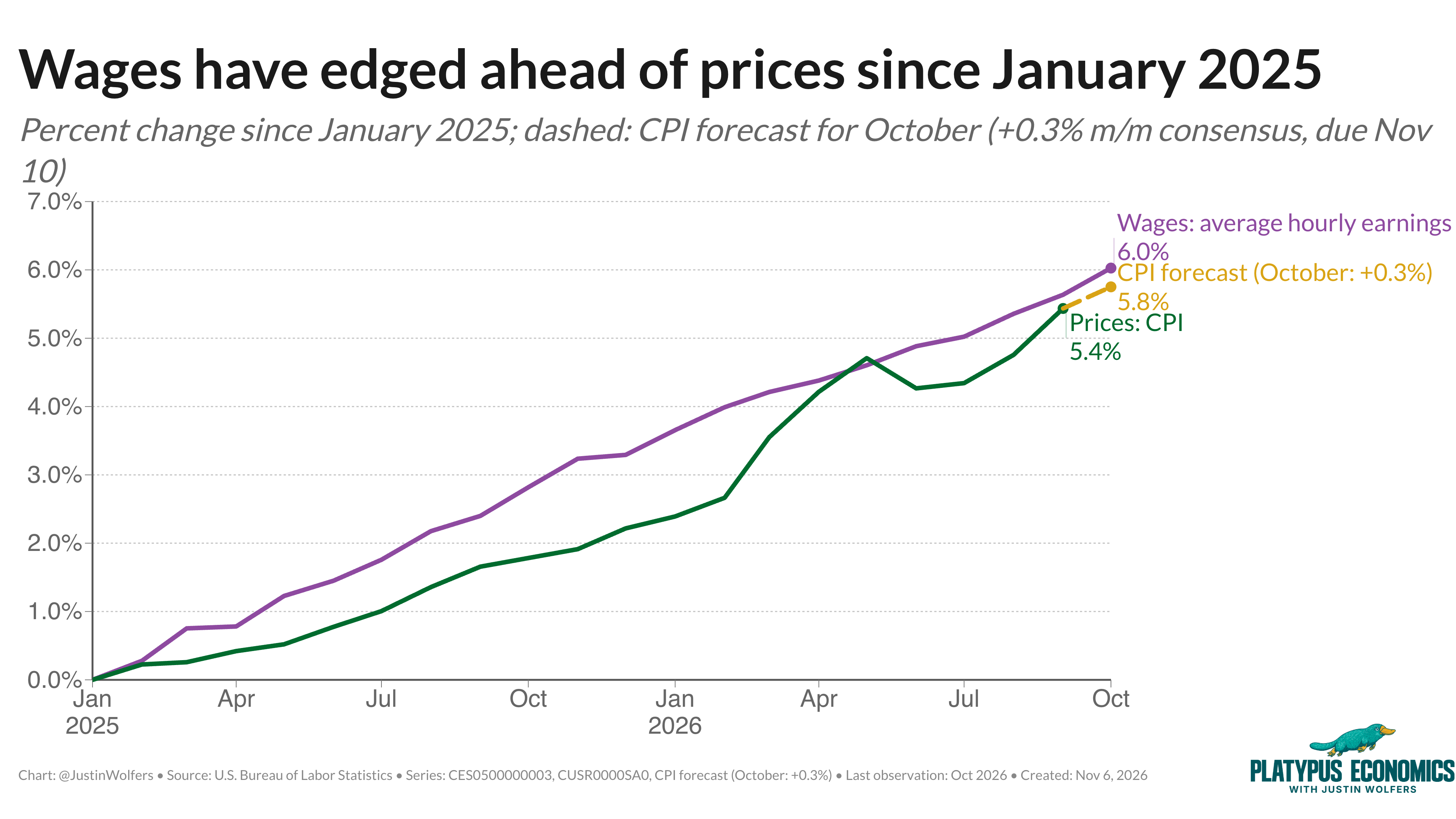
But that’s an average. It’s not your life. People who move jobs often get decent raises, while those who stay loyal, stick with their boss, and dig in at their company are now finding that the company might not return the loyalty. Raises have been weaker, and they haven’t kept up with inflation. Plus it’s a low-hire economy. The move that gets you ahead is now harder to make.
Who doesn’t like to talk about the Fed?
Inflation is the Fed’s big problem now. Unemployment is less so.
When inflation is a problem, it’s usually time to put your foot on the brake. In other words, expect the Fed to raise rates soon. Markets currently put the chance of that around 80% (and if financial markets keep going haywire, the Fed might slow down again).
There’s another jobs report before the next Fed meeting, which will have an effect on this too. Rates will likely go up, and now the question is just timing.
You’d never fake the data like this
A final note on this jobs report. Every month, someone asks whether these numbers are being jiggered. If you were going to rig them, this is the exact opposite of what you’d do. You wouldn’t publish a strong October three days after the midterms. And you wouldn’t revise the pre-election months up once the votes were counted.
I trust the numbers when they’re bad. I trust them when they’re good. Measuring the economy is hard, but the errors are the random, statistical kind you expect from a good, honest, serious statistical system.
Strong jobs numbers are good news, and I welcome them (even during a roller-coaster week). The gap between wage growth and inflation is less good. That’s the gap I’ll be watching.
This is 👀
US CONSUMER CREDIT ACTUAL 27.839B (FORECAST 13.8B, PREVIOUS 8.28B) $MACRO