


The Nobel Prize in Economics was announced this morning. It went to Robert Hall of Stanford and Michael Woodford of Columbia (also known as Bob and Mike). I’m on the road right now, but I couldn’t wait — I had to sit down and dig into this exciting news.
Nobel Prize Day is a day that economists celebrate. We take our field’s great thinkers and we celebrate the lives they’ve led, the impact they’ve had, and their extraordinary ways of coming up with new research, new ideas, new ways of understanding the economy. We haven’t sorted everything out yet as a field — we’ve got a long way to go — yet we should still celebrate progress along the way.
The prize was officially awarded for “microeconomic foundations of macroeconomic stabilisation.” Also, for those doing a very close read, it is formally called the Sveriges Riksbank Prize in Economic Sciences in Memory of Alfred Nobel. But nobody calls it that, except insufferable pedants.
How to decide what to buy
First, let me take you back to the ancient past. This is 60 years ago, when dinosaurs roamed the earth (okay, intellectual dinosaurs). Back in the day, macroeconomics was dominated by what we called large-scale macroeconometric models. The idea here was to stack up as much time-series data as you can — consumption, and investment, and wages, and inflation, and exchange rates, and imports and exports, and monetary policy, and fiscal policy — and throw it in the cauldron. There was some economic theory involved in all this, although it was pretty much like my approach to adding spices to my cooking. Why not add it and see if it helps?
The point was to try to understand the statistical relationship between all these things. When this series wiggles, what follows and how soon? These got really big and sometimes involved dozens of variables and even hundreds of equations. Lawrence Klein actually won a Nobel Prize for exactly this.
It’s a program based on statistical regularities. And the problem with statistical regularities is that they keep working until the day they don’t.
Let’s take an example here, but we’ll switch contexts to make the point. U.S. News & World Report publishes rankings of colleges and universities. To make those ranking, it tries to figure out various statistical clues that will be meaningful for students and parents. For years, one of those was the percentage of admitted students who actually attend the school. They measure that by looking at what proportion of applicants a school accepts who go on to enroll. That’s called the school’s yield, and it’s a pretty sensible way to go about measuring which schools students tend to pick.
But the moment you start measuring like that, universities start acting differently. They quickly figure out how to manipulate the rankings. Now, if you’re a university that’s pretty good, but not great, you stop admitting the very best students. You want to avoid admitting anyone who will turn you down and make your yield rate look worse. Now the yield rate tells you how much colleges reject strong students, instead of how much strong students reject pretty good colleges.
U.S. News & World Report was trying to figure out how the yield rate was related to university quality. The problem here is that, once you start relying on that statistic, then it’s vulnerable to manipulation in important ways. Then that relationship breaks down. Thankfully, they dropped this measure in 2004.
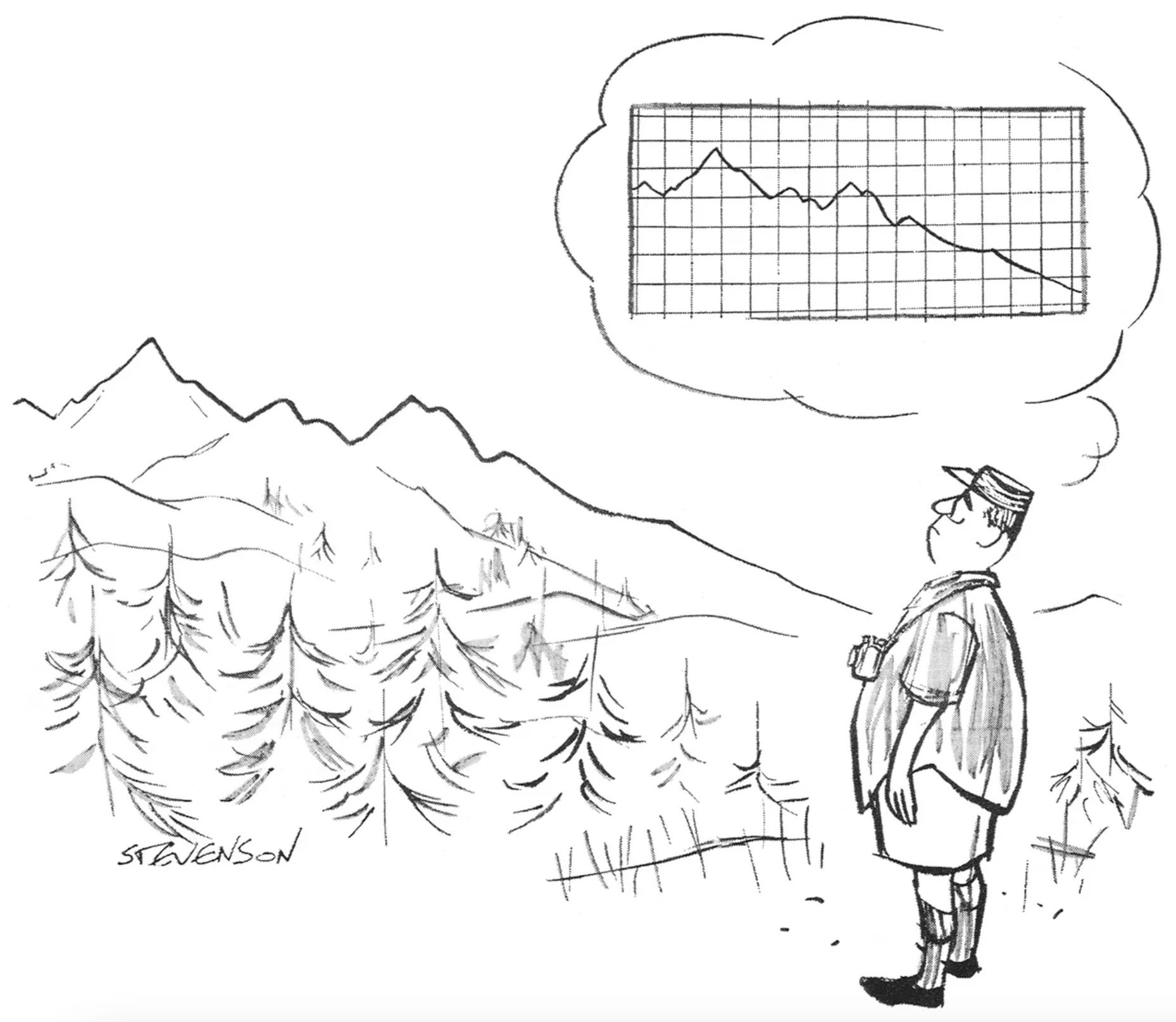
Another economist, Bob Lucas, won the 1995 Nobel for work that made exactly this point, but in the context of macroeconomics rather than picking colleges. This idea is often called the Lucas critique, in his honor. That critique essentially said: correlation ain’t causation. Sure, you can find correlations in the macro data from the past, but what’s to say they’ll be useful in the future? Change the rules, and people can change their behavior. To understand that, you need to understand how all those millions of people think as individuals. Lucas’s suggested that rather than combing through historical associations, macroeconomists should work to understand the more foundational drivers of human behavior.
Economists call this insight the microeconomic foundations of macroeconomics. It’s the research program that won today’s prize, and it’s the thing today’s laureates have in common.
The most successful failure in economics
Bob Hall’s most famous work is about consumption, which is an economics term for how much you and I — and other consumers — spend each month. And his approach was audacious.
Hall took consumption, or total spending in the economy. Then he tried to predict changes in it. And then he put all the different variables that you or I might be able to think of in order to explain those changes. And — this is the best part — he failed.
His most famous work is a failure. But it’s a constructive failure.
Hall essentially said, look at all this stuff you might think predicts changes spending over time. Notice how it doesn’t. That’s important, because we economists thought we understood this. In my first macro course as an undergraduate, I learned the Keynesian consumption function. The point of that function is to look at how much income there is in the economy, and then use it to predict exactly the level of consumption. Seems pretty straightforward.
Then Hall comes in and says that if you want to predict changes in consumption, the usual suspects — recent changes in income, past changes in consumption, and so on — don’t really explain it at all well. Crikey, what’s going on here?
What Hall was showing goes back to that statistical breakdown I showed you earlier. When people make decisions about what to buy, they’re not just thinking about what’s in their bank account today. They’re thinking about what comes next. In other words, people spend based on their own forecasts of the future. So what drives changes in consumption is changes in expectations.
If your forecast is smart (economists say “statistically efficient”), then you can’t predict how it’s going to change. If you could see that revised, improved forecast coming, well, you’d just make it now.
So follow that chain. Changes in spending follow changes in forecasts. Changes in forecasts are unpredictable. So changes in spending should be unpredictable, too.
That is exactly what Hall found. His failure to predict consumption was evidence that his model was right. To an economist, that’s magic.
A footnote here, since the field has kept going since this. Not everyone can spend more today based on learning that the economy will be stronger in the year 2056. Some people can’t get credit, others aren’t forward-looking, and there are those who simply check what’s in the bank. Economists call these households hand-to-mouth: this week’s income determines this week’s spending. Now we work with a more blended picture, where some households live hand-to-mouth and others plan ahead and respond strongly to expectations. There’s a rich and interesting program around all that, and it all starts with Hall.
When your local restaurant predicts inflation
Mike Woodford works in the same tradition, but he took on a bigger project. His goal was to put together all of the pieces of the economy, where each piece is itself built up from its microeconomic foundation. He’s the central figure in what’s called the three-equation New Keynesian synthesis.
That’s a lot of words. Let’s break them down. “Three equation” just means that we’re looking at three sets of issues. “Keynesian” means in the tradition of Keynes, who took seriously the idea that markets aren’t always perfectly adjusting, that people may not have full information, that prices and wages sometimes change slowly, and small mistakes add up to big effects that shape the whole economy. “New” means we take the Lucas critique seriously. We need to understand how each person thinks about their choices, and we can build our picture from that.
So what are our three issues here?
First: monetary policy. You may have heard of John Taylor and the Taylor rule. That rule tells central banks, like the Fed, how to respond to swings in inflation and the broader economy. When inflation is too high, raise rates. When the economy is struggling, lower them.
Second: inflation and how it works. Think about a local restaurant. It only changes prices occasionally. When owners do change prices, they’re thinking about whether ingredients will be more expensive, whether their landlord is going to raise rent, or whether it will it be hard to find good workers. That means prices might rise now if they expect costs to go up in the future. You can see how inflation today depends on what people expect inflation to be tomorrow. Add math, stir, and you’ve got yourself the New Keynesian Phillips curve.
Third: the rest of the economy. Back in the old days, we called the bit about how much spending is going on the IS curve. This part is built on Hall’s insight: when people decide how much to spend, they’re thinking about the future, interest rates, and the state of the economy. Hall gave us micro foundations for consumption; my old grad school teacher, Dale Jorgenson, did the same for investment.
The old models had dozens of equations. Woodford got it down to three core ideas which were each built on individual people and businesses making decisions. With these models, you can ask real questions. What if the Fed raised rates? What if it targeted inflation? Would people end up better off or worse off? Economists call that welfare economics, and these models make it possible.
The universal language of central banks
Hall’s view of consumption is now simply how we all think about consumption. The next generation added rigor, depth, new observations, and new data. But it’s all built on Hall’s forward-looking approach.
Woodford gave economists a common language for talking about the ups and downs of the business cycle. That’s the Fed, fiscal policy, and predicting a recession. Walk into any Fed building or central bank around the world and this will be the language they speak. Read the newspaper closely and you’ll see it there too.
This is also why central banks share so much about their plans. If households and businesses are forward-looking, then telling them what you’re up to changes what they expect. That change in expectations can actually move the economy. (Silent Kevin seems uninterested in using this tool.)
From research to classrooms, via textbooks
Beyond this Substack, I have another job: I’m the author of a (the?) leading undergraduate introductory economics textbook, together with my partner, Betsey Stevenson. And we made it our mission to translate the cutting-edge work done by these laureates in such a way that these insights can be taught to freshmen.
If you learn macroeconomics using the Stevenson and Wolfers text, you’ll learn about Hall’s approach to understanding consumption. If you’re teaching freshmen right now, you can point out that they’re learning the approach that just won the prize.
And we also have a chapter called “The Fed Model,” which is an Econ 101 version of Woodford’s synthesis.
There’s a bonus to this approach. Traditional macro can feel like watching an economy that’s somewhere out there. You’re not part of it. In this version, the version in which macro is built on microeconomic foundations, you’re a player. The theory of consumption is not just a theory of others, but also a story about how you might think about making the best spending choice you can make. Ditto for investment. Suddenly the study of macro is not about what’s “out there,” but rather folks like yourself, making important decisions.
Trying to boil this cutting-edge research down to its key intuitions was hard work. I first encountered the ideas of Hall and Woodford in graduate school, and quickly learned that when you’re trying to describe the decisions of forward-looking people, the math suddenly gets a whole lot trickier. Explaining it is a wonderful intellectual challenge that all of us who teach economics take up. The result is we can bring intro students into the work that won today’s Nobel.
On a personal note
I know Bob best here. He’s been a friend since I was just a baby economist, and he’s been a favorite of young economists his entire career. He approaches life and economics with tremendous tenacity. While many of his generation of economists rested on their laurels, Bob wanted to stay on the cutting edge. We worked together at Stanford and he’s been a part of the Brookings Panel on Economic Activity, which I used to help run. His students include Valerie Ramey, Pete Klenow, Marjorie Flavin, Hanno Lustig and Stijn Van Nieuwerburgh. And almost every macroeconomist of my generation would count him as a mentor and an inspiration.
Mike is no less beloved. His papers are more dense, more serious, even as he loves a laugh. You can read one of his papers, think you’ve got it, and then go back and read it three more times. He is the intellectual father of a generation of leading thinkers on monetary policy, including Gauti Eggertsson, Stephanie Schmitt-Grohé and Martín Uribe, Marc Giannoni, and my good mate Bruce Preston in Australia.
Bob and Mike were both graduate students at MIT, though 16 years apart. This was during an era when there was a lot of excitement about macroeconomics. They both had the great Bob Solow as a thesis advisor. In fact, Bob Hall’s thesis committee — Bob Solow, Peter Diamond, and Paul Samuelson — all won Nobels. Now Bob’s won one himself. Mike was also advised by Tim Kehoe, which is where you see the deep technical prowess and mathematics.
This prize is also a prize for a community. John Taylor and Guillermo Calvo, who worked on how sticky wages and prices work. Greg Mankiw, my friend and occasional co-author, a central figure in the New Keynesian economics. Another central figure there was David Romer at Berkeley, along with Christy Romer, and also Janet Yellen. Jordi Galí and Mark Gertler. My thesis advisor Olivier Blanchard, one of the truly great New Keynesian economists, has been there at every part of this revolution. Stan Fischer. Nobu Kiyotaki. Julio Rotemberg, who is no longer with us, and my colleague John Leahy, who we lost late last year. And there’s a whole Nobel waiting to be written about how and when and where firms adjust prices.
I’m happy today. I love celebrating when my field actually moves forward. I know that we have got so much work to do, but I also know there are excellent economists who wake up every day wanting to make the world better. They work hard, burning the midnight oil, and wake up the next day to train a new generation of students. They help people around them better by creating a research program that’s not about winning a funny-looking medal, but instead about making the world a better place.
Congratulations to Bob Hall and Mike Woodford for the 2026 Nobel Prize in Economics.
From education here is an example. They still rank schools based on the number of students enrolled in AP courses. Guess what? Now, everyone gets shoehorned into AP courses.