


Last year, the federal government spent $2 trillion more than it took in. That number is called the budget deficit, and it’s the difference between what’s coming in and what’s going out. In the fiscal year 2026, for every $5 the federal government collected, it spent $7.
Those numbers come from a recent Treasury Department report. This is the final report on the first full fiscal year of Trump’s second term. Today, I want to dig into what all this means for you, your government, and your economic future.
First, let’s define our terms
There’s the debt, and there’s the deficit. The debt is all the borrowing from previous years that’s built up over time. Think of it like Washington has a credit card; the debt is the balance, and the deficit is the charges from this year.
America’s current total debt is around $32 trillion. To put that in context, $32 trillion is roughly the amount the entire U.S. economy produces annually. So Washington owes folks roughly one year of our national income.
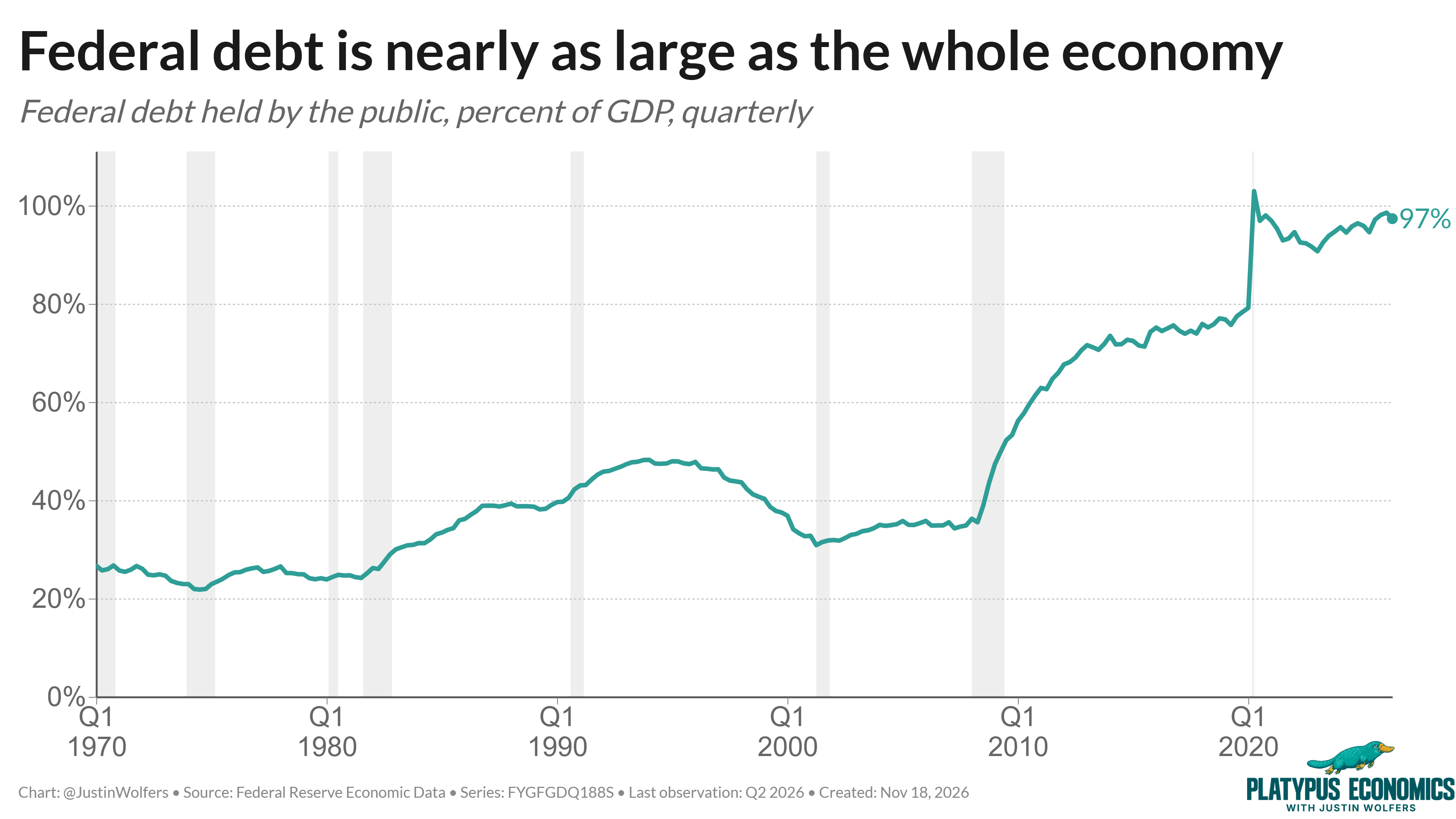
Now you might stop me and say wait, Justin, what about the $40 trillion number I’ve seen? Frankly, I think that number is too alarmist. It includes money that one part of the federal government owes another part. When I want to know how much money a person owes, I don’t usually count the debt that the left pocket of their trousers owes the right pocket.
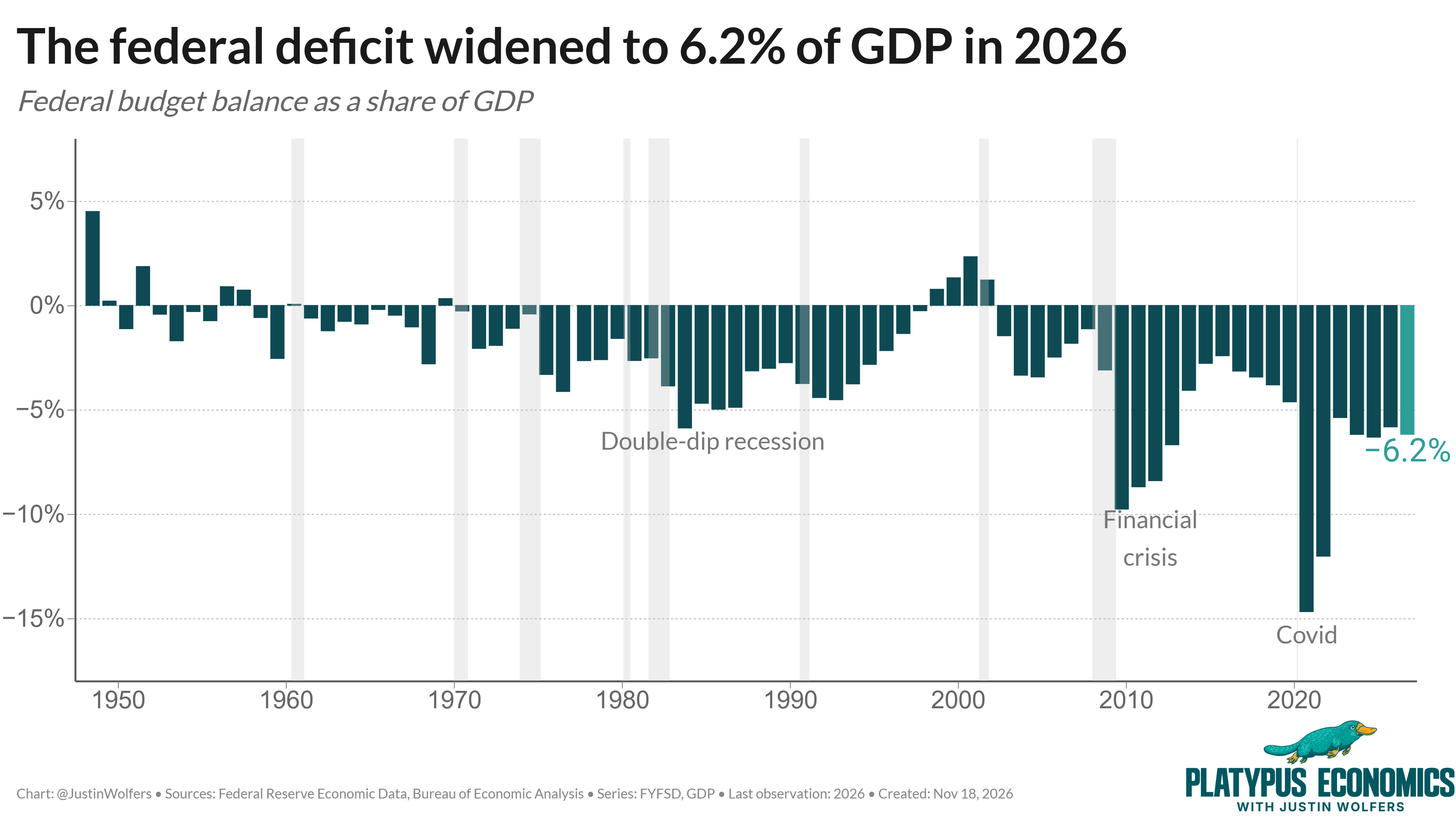
We didn’t rack up all that debt at once. In fact, we’ve run up deficits every year for a quarter of a century. This year, we added $2 trillion to the debt. That’s about 6.2% of GDP, on top of a pile that’s already the size of the economy.
Where’s the emergency?
Sometimes borrowing can be exactly the right choice—when a recession throws people out of work, when a pandemic shuts down businesses, or when a country goes to war. In all those cases, the government borrows to keep communities afloat.
A deficit of 6.2% of GDP is extraordinary for a normal economy. It’s the largest federal deficit in American history outside a war or a recession (and that’s adjusting for inflation and the size of the economy).
During World War II, America borrowed massively to build the ships and planes and tanks needed for an army that could defeat fascism. During the global financial crisis, millions of Americans lost their jobs and tax revenue collapsed, and America borrowed to stop that recession from turning into a depression. COVID-19 brought faster borrowing because hospitals were shuttered and people were out of work. And the recessions of the 1980s put unemployment in the double digits.
War, mass unemployment, financial collapse, and pandemic. These are the moments that bring this size of deficit.
Today, though? GDP is growing and unemployment is reasonable. So why all this borrowing?
Political inaction makes this a crisis
There are a few answers, and one is something that everyone saw coming. Americans are getting older. More people are retiring, Social Security and Medicare are growing, and the costs to pay for it all just keep rising. This year alone, Social Security, Medicare, and Medicaid spending rose by $217 billion. The nonpartisan budget wonks who keep track of these things expect those costs to keep going up.
This isn’t a crisis that came out of nowhere. There are few things as foreseeable as aging. The real fiscal issue here is that aging is colliding with political inaction. For decades Washington has promised benefits while also cutting taxes. The people in power push off the moment when the numbers need to add up.
Recently, Congress made the gap bigger. President Trump called the law the One Big Beautiful Bill, and it’s true that it was big. The OBBB extended and expanded tax cuts, reducing tax revenue during a period of already-large deficits. It also changed spending programs. The law added hundreds of billions to the deficit over the next decade.
How did the president plan to pay for this? Tariffs.
Or at least that’s what he said.
That scale never worked. Customs duties, including tariffs, brought in $173 billion this year. The deficit was $2 trillion. Tariffs are a bucket and the deficit is a swimming pool.
They’re also a leaky bucket, since the Supreme Court ruled that the Trump administration didn’t have the legal authority to impose most of its tariffs. The government ended up refunding roughly $130 billion that it had already collected. Since then, the White House has imposed other tariffs, and naturally they face new legal challenges. Nobody knows if the government gets to keep that money.
The final policy challenge to the deficit: immigration. Immigrants do all the things that make the economy larger and more functional. They (and I’m included in this) earn wages, pay payroll and income taxes, spend money, and help businesses expand. That matters even more in an aging country.
More workers help pay for retirees’ benefits, and they enlarge the economy that’s carrying the debt. Call that the many-hands-make-light-work theory of fiscal policy. We’ve chosen fewer hands. That makes it a heavier burden.
The fastest-moving piece: interest
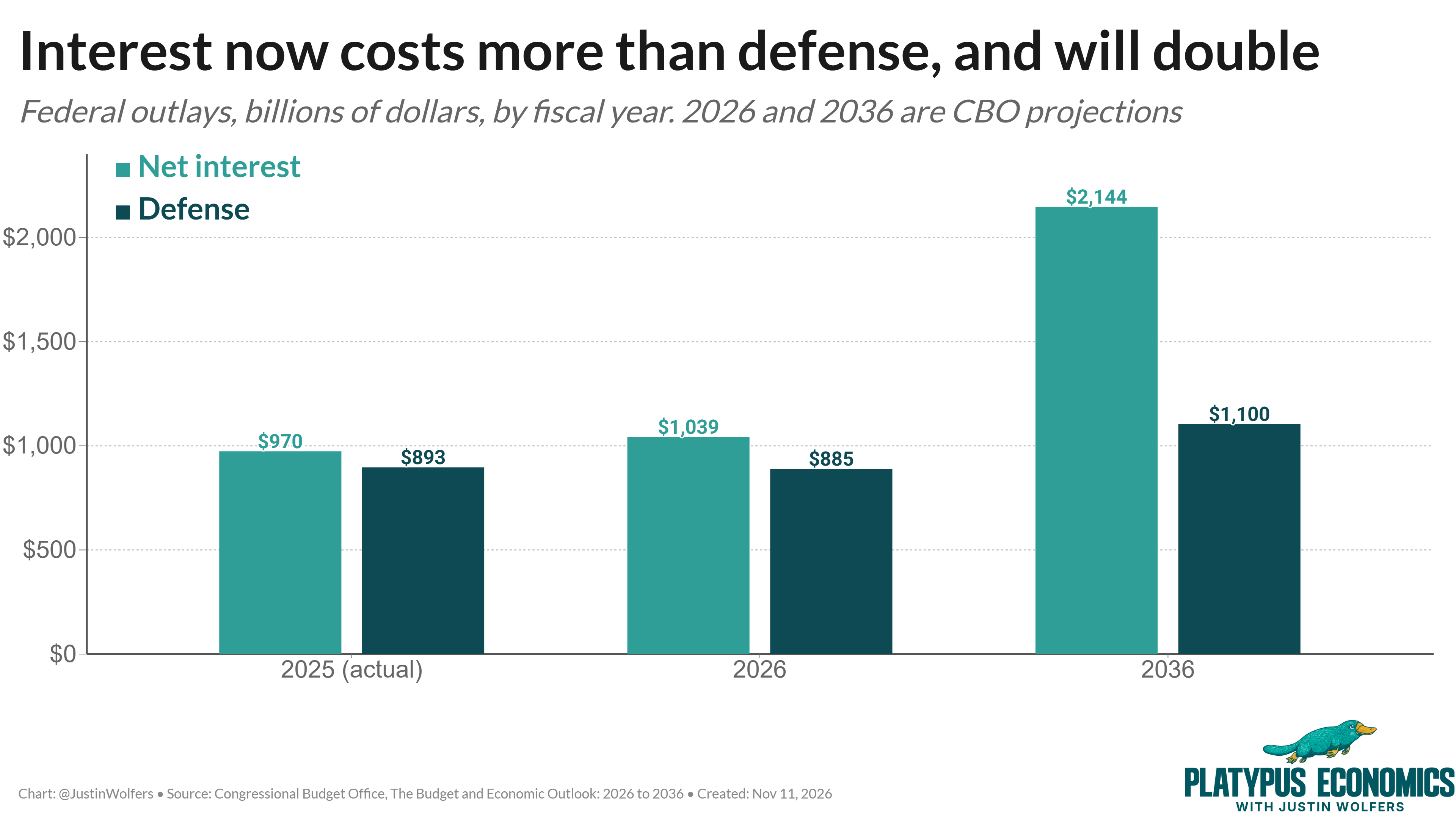
This year, the government spent $1.1 trillion on interest on the debt. That’s more than we spent in the same year on the military. At the same time, those interest costs are on track to roughly double within a decade.
Remember when I said the debt was like a credit card balance? Well, the government’s debt doesn’t carry a fixed rate of interest. The rates change.
If you’ve heard some financial news about bond yields, this is what people are talking about. Back in February, budget forecasters expected the 10-year Treasury yield to average 4.3% over the coming decade. By early October, the actual yield was closer to 5.2%. We’re paying about a percentage point more than anyone expected, even at the start of this year.
That’s a lot of money, and that rising interest isn’t caused by inflation. Here’s some arithmetic for you: rates are up about one percentage point, and we owe about $32 trillion. One percentage point of that is $320 billion. So we’re paying an extra $320 billion a year in interest. That’s about $1,000 for every American—and that’s just the extra interest due to higher bond yields!
I am simplifying a little bit here. Washington doesn’t pay that extra $320 billion all at once. The rate on old debt is locked in until those bonds mature; but maturity is coming at us fast. You might be familiar with how debt works, and so you hope that Treasury locked in long-term loans, back when rates were low. But that didn’t happen.
About a third of the government’s debt comes due within a year. More than half of it is due within three years.
We don’t repay all those cheap old loans when they’re due. Instead, we refinance… at today’s higher rates. That raises the interest bill, which further increases the deficit. That leads to more borrowing. Then we pay interest on that new borrowing.
That $320 billion in extra interest payments — which was due to that single percentage point rate rise — is about equal to what the federal government spends on transportation, natural resources and the environment, and community and regional development, combined.
Point is: when you owe a lot, small changes in interest have large financial consequences.
The (financial) company we keep
It’s difficult to compare the debt of countries, in part because different levels of government handle different things in different places. Economists add federal, state, and local governments together in something called the “general government deficit.” It’s broader than the numbers I’ve used so far, but for the United States, it’s mostly due to the federal government.
Our general government deficit, according to the latest IMF data, is at 8.5% of GDP. That is the largest in the G7. France is projected at 5.4%, and budget drama is practically a national pastime over there. Germany is at 4.3%, the U.K. at 3.8%, Italy at 2.9%, Canada at 2.5%, and Japan at 1.8%.
Which countries are above America on the global deficit table? I looked it up. Timor-Leste, Libya, Kiribati, Iraq, Brunei, the Maldives, Egypt, Bahrain, Ukraine, Grenada, Gabon, Bolivia, St. Vincent and the Grenadines, Algeria, St. Kitts and Nevis, Tunisia, and Malawi.
And then, under Malawi, is the United States.
There’s context to that list, too. Timor-Leste is drawing down a petroleum fund, while Ukraine is financing a war. Grenada is rebuilding after a hurricane. Some of those others are small or commodity-driven economies. Some have fragile institutions and severe fiscal stress.
What is our reason? We chose this, in good weather, on purpose, with an economy running close to normal.
Raise the 5 or lower the 7
Federal revenue falls short of what Washington spends on programs. That’s before we pay a dollar of interest.
America borrows to pay for today’s government, and then borrows again to pay interest on yesterday’s borrowing. So the debt keeps rising.
There are plenty of ways to respond. Raise more revenue. Slow the growth of spending. Reform retirement and healthcare programs. Claw back tax cuts for the rich. Do some of each. You could come up with your own plan, but every serious plan has to answer one question: how does it shrink the gap between tax revenue and spending?
For every $5 Washington takes in, it spends $7. If you’re not raising the five or lowering the seven, you are not solving the problem. And every year we wait, the interest rate on our balance goes up.
Raise more revenue. Slow the growth of spending. Reform retirement and healthcare programs. Claw back tax cuts for the rich. Do some of each.
Dear Professor Wolfers. Slowing the growth of spending might start with ending the war with Iran. Scaling back the tax cuts for the rich should be a no brainer. The tax rates from the Clinton Administration may be a baseline. Advancing these two programs would be a great start.
Trump is playing us for fools, running up debt and cashing out. Just like in his many failed businesses. This time though his republican enablers will be paying the price for years to come.