


I joined Charlie Sykes on his To the Contrary podcast this week. He started off strong by asking me to recount the time a fly flew down my throat live on CNN. I responded by turning it into a metaphor for Kevin Warsh’s approach to monetary policy.
Then we got to talking about Canada, and the jokes ran out.
Here’s the thing: when the president campaigned in 2024, he was bracingly honest about loving tariffs. He talked about China. He talked about other countries “ripping us off.” He never once connected that to Canada. Then one of the very first moves of the administration was steep tariffs on China, Mexico, and Canada. These were the “fentanyl tariffs,” which he imposed because of “the failure of Canada to do more” to stop producing fentanyl and shipping it over the border. Canada basically isn’t in the fentanyl game, so that was weird. Those tariffs were eventually scaled back and later ruled unlawful. But that wasn’t the end of it, because it was probably never really about fentanyl.
Since then it’s been a cycle of retaliation, then retaliating for retaliation, and retaliating for retaliating to retliating.
Let me offer the simplest way I know to think about whether any of this is good for America.
I live in Michigan. Michigan borders Canada. According to the administration’s logic, policy that makes it harder for goods to cross the Michigan–Canada border is good for Michigan. So why don’t we make it harder for goods to cross the Michigan–Ohio border? (Honestly, might be a good idea during The Game.) No-one thinks a tariff wall with Ohio would make Michiganders richer. Or Ohioans. The same logic applies going north.
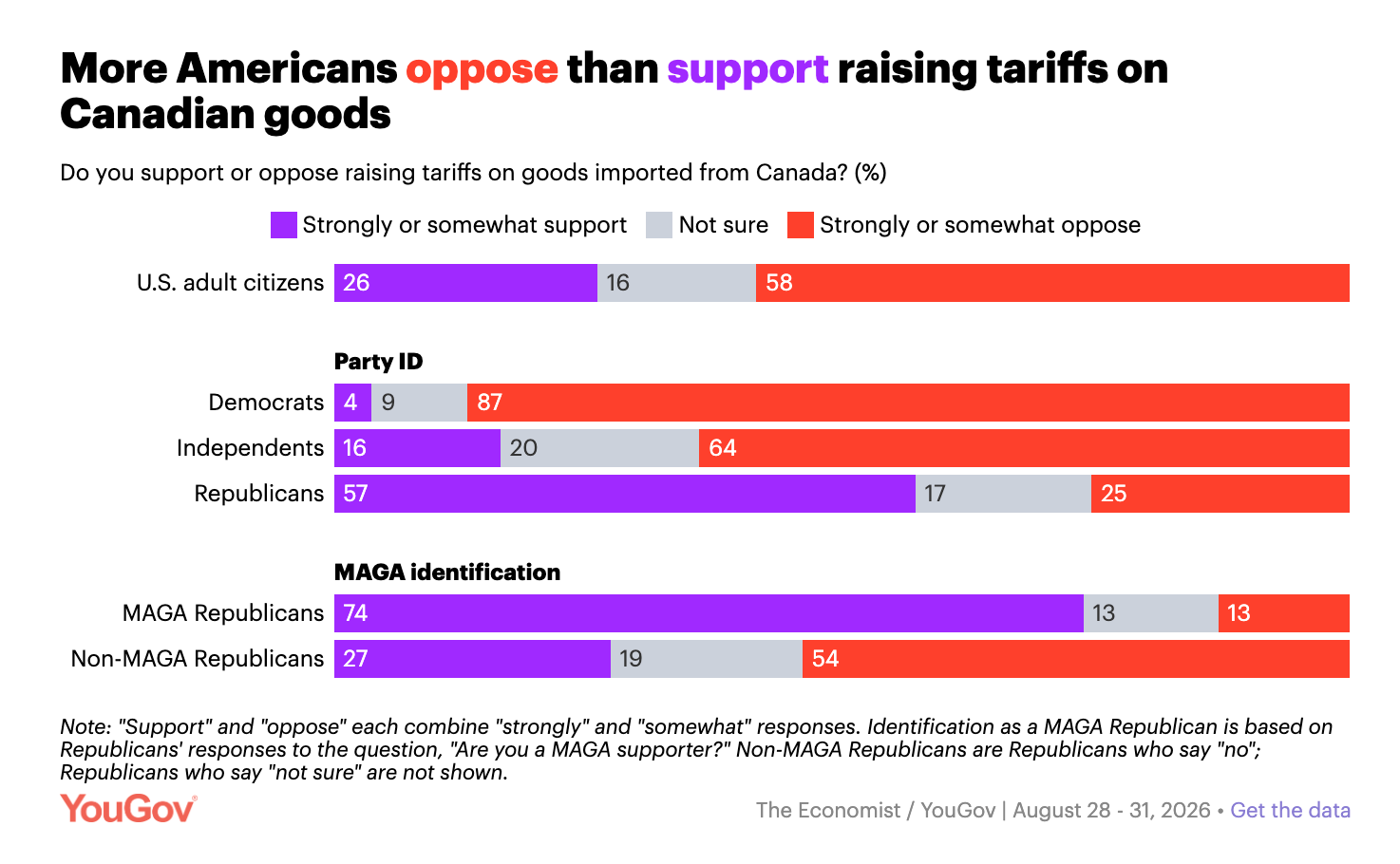
Americans know this. They like Canadians. They have no interest in tariffing them.
The deeper failure here isn’t really economic (well, okay, it’s a little bit economic). Mainly, it’s a failure of leadership. Your job as a leader — of a company, a community, or a country — is to work out what’s good for your people and then make it easy for others to say yes.
This administration has done the precise opposite. President Trump called Canada the 51st state and openly mused about using economic power to take it by force. He calls the prime minister “Governor Carney.” He has called Canadians nasty, and clowns, and told them to fall into line. And — keep in mind here, the president is laser-focused on the affordability crisis — there’s the “renaming” of Lake Ontario. My partner Betsey Stevenson named the moment beautifully:

Kids in the midwest learn to name the Great Lakes with the mnemonic HOMES, which stands for the Huron, Ontario, Michigan, Eyrie, and Superior. Swap out Lake Ontario for Lake America, and the only useful way to remember it is SHAME. Perhaps that’s right.
Any reasonable observer can see that this has stopped being a trade dispute. North of the border it’s about sovereignty and dignity, and the anger is difficult to overstate. Canadians are all in — they’re refusing American groceries, cancelling trips, and sending their students elsewhere.
Which puts Carney in a tricky spot. There’s an old economist line, originated by William Beveridge and popularized by Joan Robinson: if other countries have rocky harbors, should you put rocks in your harbor? A tariff is a rocky harbor. It makes it harder for goods to move in and out. Retaliation does hurt Canadians. But Trump has made it politically rocky for Carney to clear the way.
Trump can punch Canada, but only with tariffs that also punch Americans in the economic gut. Carney can punch Trump, but only by retaliating with tariffs that also punch Canadians in the gut. Winning this sort of game requires caring less about your own people’s pain than the other guy cares about his.
Meanwhile the more consequential thing may be Carney’s middle powers speech — the idea that countries other than the U.S. might start acting collectively in their own interest. It hasn’t yielded much yet. But if it rewires global trade around us, the president will have sold American exceptionalism remarkably cheaply.
We didn’t have rocks in that harbor. We put them there ourselves.
Wolfers is absolutely correct concerning the importance of the Census Bureau's veracity. Interesting how it takes a first generation Australian to raise a warning flag regarding our Constitution. How easy it has been recently for our young republic to forget, ignore?, fundamental values. Thank you, Mister Sykes, for this informative interaction. Would that we still had national media with a fundamental sense of morality.
Canada does have one possible non tariff response, it could charge higher fees on American associated traffic through the canal that bypasses Niagra Falls, but I suspect that it would have negatives similar to those of tariffs.