


I recently joined my pal Mary Harris on Slate’s What’s Next to talk about why interest rates are rising and whether that should worry you.
My answer is based on an idea that I first encountered in graduate school. The idea is called the “envelope theorem,” and I’ll admit that it took me years to fully grok. My classmates were a lot quicker, so what I lost in speed I made up for in enthusiasm. I now love this mathematical idea so much that I explain it whenever it might be remotely relevant. And I guess I did that to Mary.
Mary started by setting the scene. Kevin Warsh and the Fed recently raised rates — which will raise the cost of paying your credit card, your car loan and your mortgage. By her telling, this is an odd response to the reality Americans are already upset that the cost of living is so darn high.
I took Mary for a walk up a hill. Metaphorically. Let’s imagine the top of the hill is the best possible outcome. When you’re standing at or near the summit, a step to the left or the right barely changes your altitude. When you’re halfway up, every step is a big change.
The envelope theorem builds on this simple fact about hills: Climbing hills is important work, but when you’re near the top, small changes in where you stand don’t much matter. As long as you’re near the top of the hill, the fight about exactly where the summit is doesn’t matter quite so much.
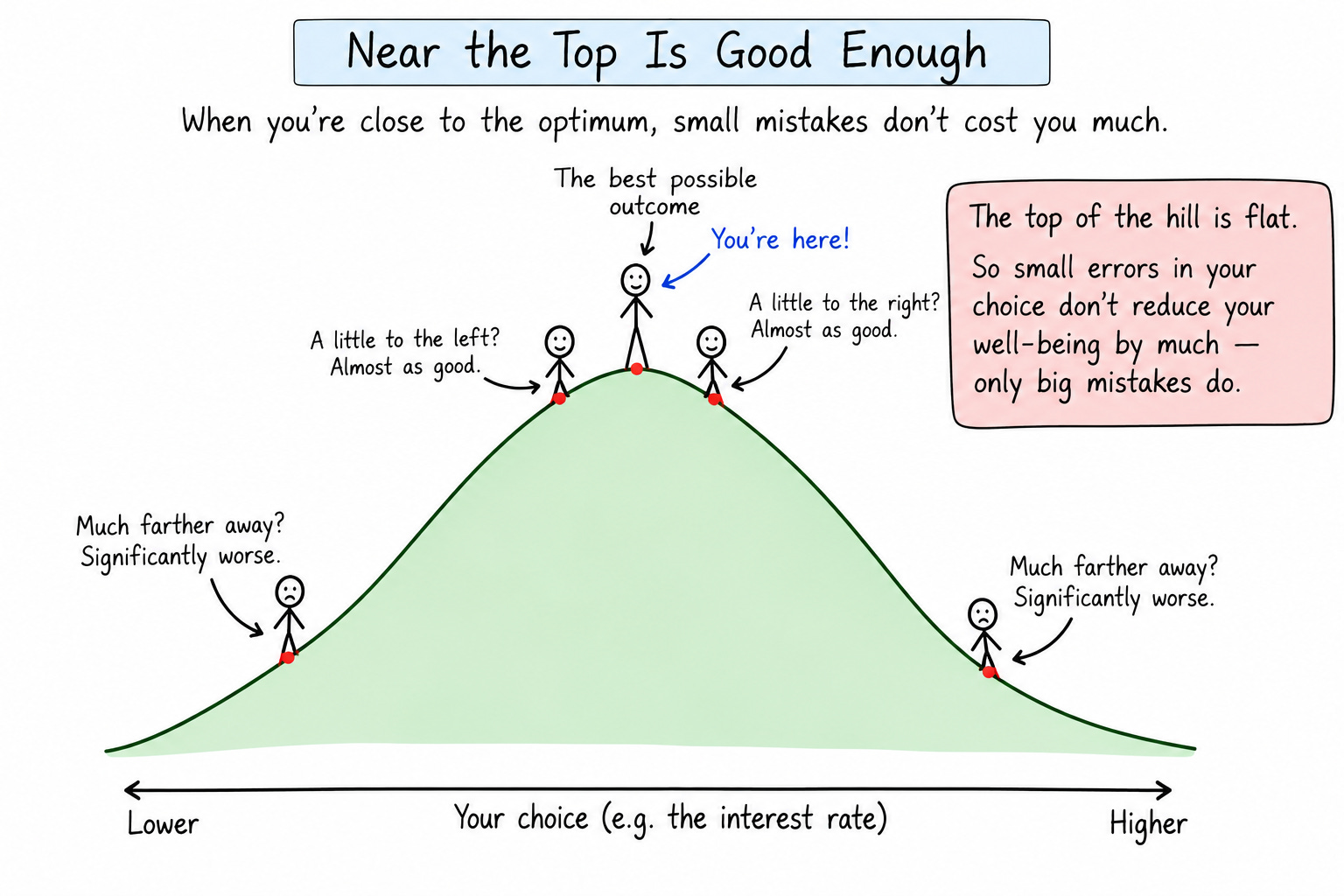
My best guess is that the optimal interest rate for our economy is somewhere between 3½ and 4½ percent. The Fed has us in that neighborhood, and it’s only looking to make the sorts of small changes that will keep us in the neighborhood. Fights about where in this nearly optimal range we are just don’t make that big of a difference.
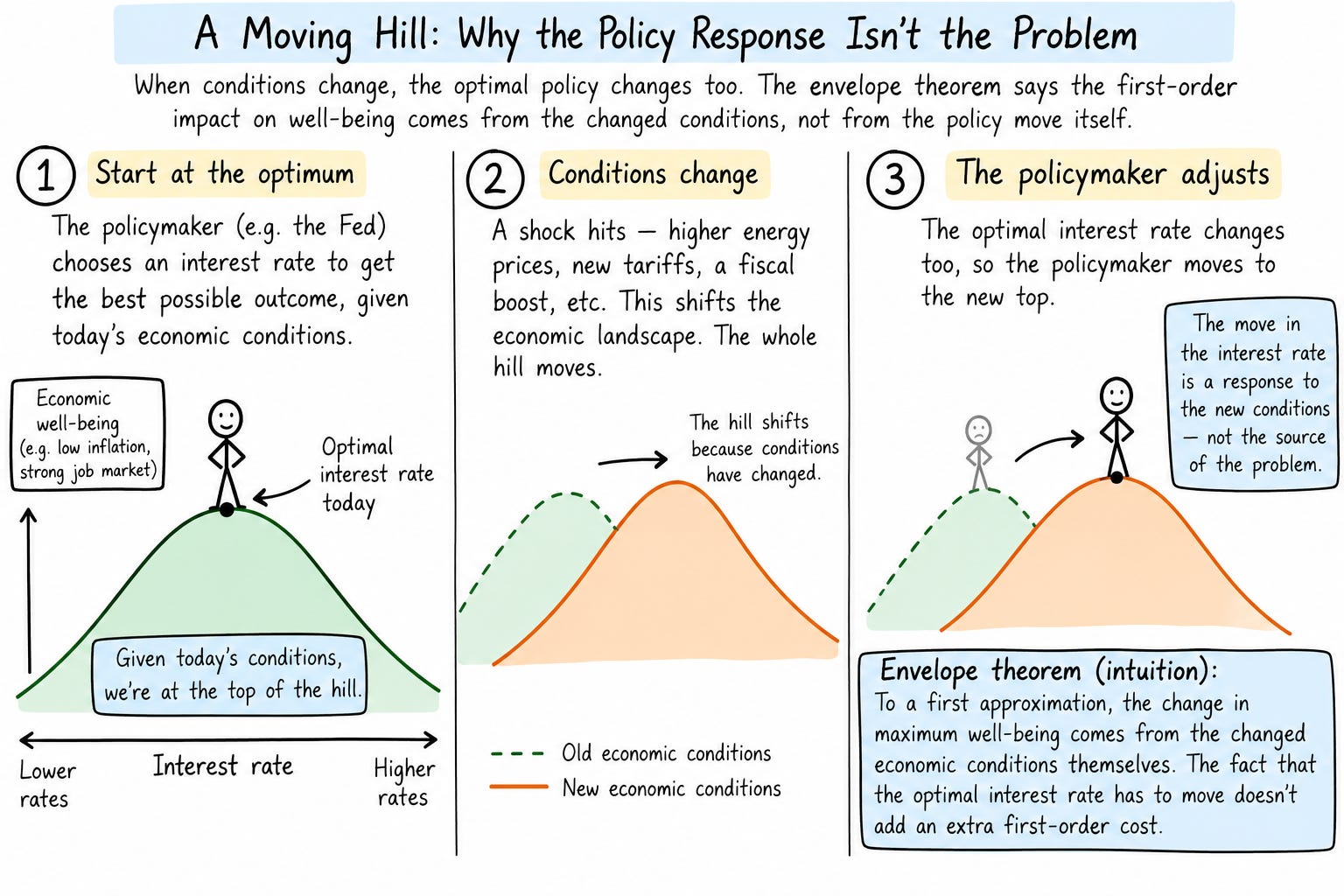
Likewise, when the state of the economy changes — and it’s always changing — people’s well-being doesn’t change much due to the Fed shifting from being near the top of the old hill to the top of the new hill. (The fact that economics conditions change does matter — that’s what moves us to a new hill. But the Fed’s response isn’t the problem.)
By contrast, there is a fight that really matters.
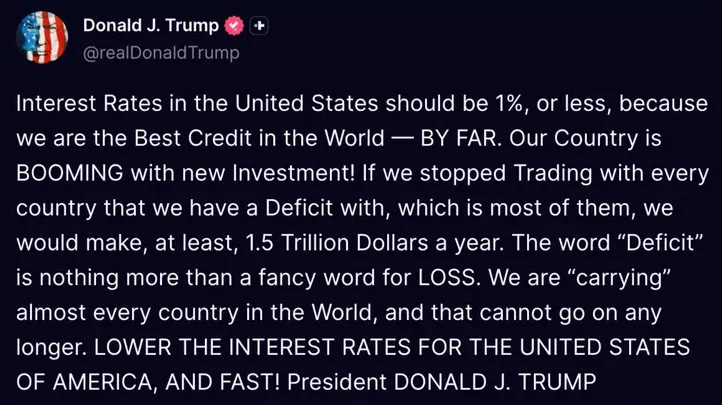
The president has suggested the Fed ought to cut interest rates to 1%. That’s a long way from the top of the hill. That mistake would be incredibly costly.
And that’s why I worked to refocus our discussion. It’s tempting to spend most of your time arguing about a quarter point here or there within the range of reasonable. Honestly, this just doesn’t matter that much.
The really important monetary policy issue is that interest rate decisions are roughly reasonable. In institutional terms, this means that rate decisions must be made by qualified Fed governors who will keep us near the top of the hill, rather than an idiosyncratic president whose political interests lead him away from the hill altogether.
Driving our economic car near the top of the hill
To be clear: I’m not saying the economy is perfect right now. Rather, I’m suggesting that our current interest rate settings make sense — are nearly optimal — given the economic shocks buffeting our economy.
The Fed has what’s called a dual mandate, which means that Congress tells it to care about two things. First: unemployment. Right now that’s a little over 4%, which is low by both international and historical standards. It’s also been pretty stable. The second part of the mandate is inflation. Right now, that’s at 3.4%, and it has been above the Fed’s target of 2% for five years.
So one part of the dual mandate — the unemployment bit — is basically okay, and the other — the inflation bit — isn’t. The Fed then needs to turn its attention to the bit that’s out of whack. That means it ought to lightly tap on our economic brakes to get inflation under control.
Keep in mind, Warsh says he hasn’t actually tapped the brakes yet. He thinks of his recent rate rises as simply taking his foot off the accelerator. Silent Kevin also insists he isn’t signaling an upcoming hike. No one believes him, of course. There will very likely be another rate hike by the end of the year.
And all of this is normal(ish)
Mary pointed out that we’ve spent more than a decade in the land of cheap money, so higher interest rates feel scary. That’s fair. Then she brought up Ghostbusters, where Dan Aykroyd complains about a 19% mortgage! Call that the Ghostbusters Era. The next era following, and from the mid-80s through 2007, inflation averaged around 2% and interest rates ran a few points above inflation. I think of this as the Normal Era. From 2008 through roughly 2022, things were weird, but a different weird. The economy got hit by two “once-in-a-century” shocks within 12 years, and so interest rates were forced to be nearly zero for over a decade.
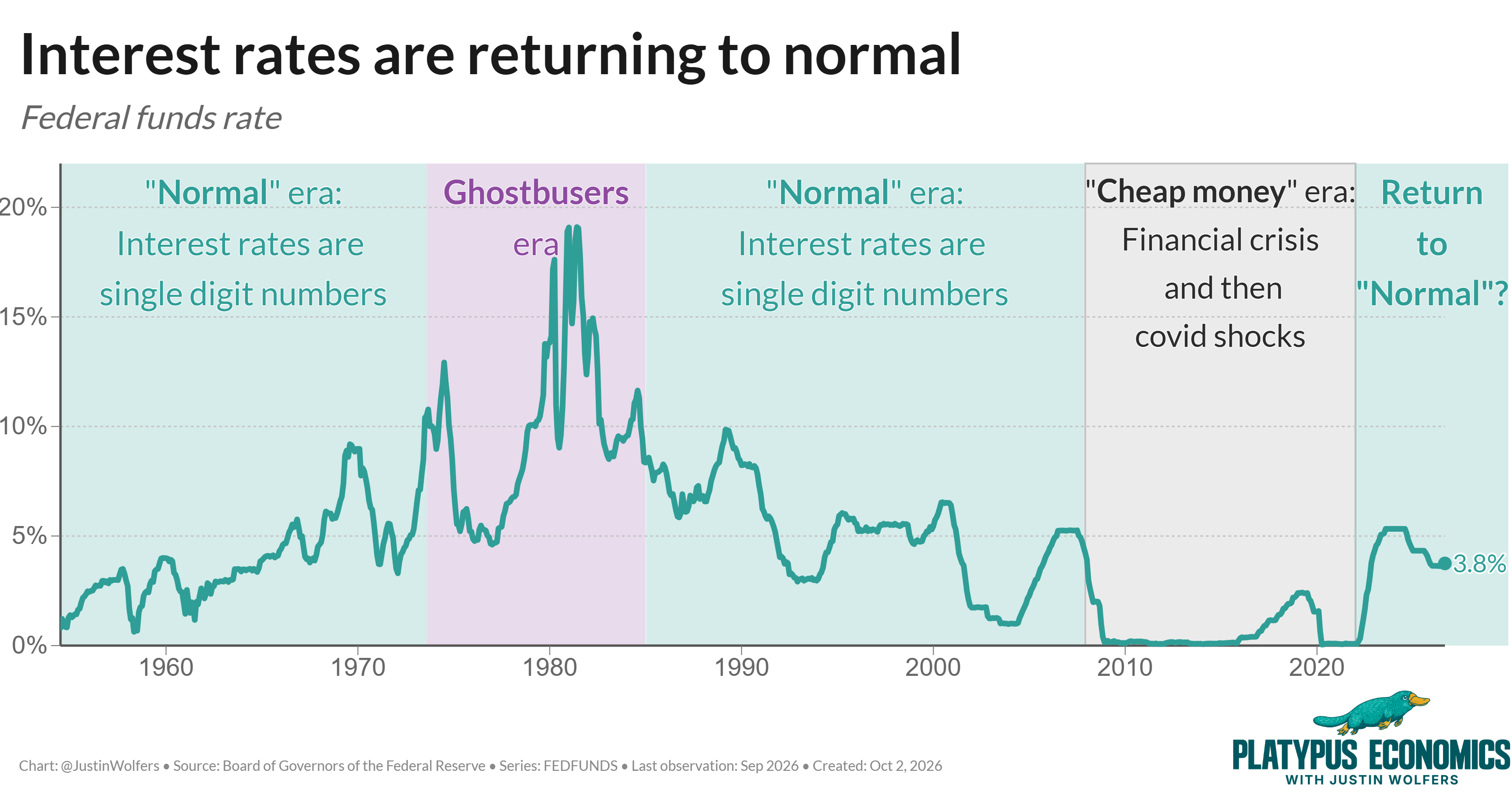
The point of this history is to remind you that higher rates are mostly a return to normal.
Could this round of hikes tip a weak economy into a recession? It’s possible. But Paul Volcker pushed rates into the high teens, and these moves are enormously less dramatic. A crash like the one in the early 1980s is very hard to see.
To be clear, the envelope theorem isn’t saying it’s okay that we have a tariff shock, a fiscal shock, and an energy shock. That’s not okay. It says that, given that we have them, the Fed is in the neighborhood of the best response to the lousy hand the president dealt us.
Now, aren’t you excited to tell your friends all about the envelope theorem?
✉️💌✉️💌✉️💌✉️💌✉️💌✉️💌✉️💌✉️💌✉️💌✉️💌✉️💌✉️💌✉️💌