


Last week I wrote about the Canadian retaliation against President Trump’s tariffs — the history of our trade relations, the 1965 Auto Pact, NAFTA, the fentanyl tariffs, and then the surprise 50% tariffs on hundreds of Canadian goods. I concluded that, while the economic hit to Canada is small, the damage to the oldest friendship America has is not.
You can catch up here:
Now it’s time for The Professor Is In, where I sit down to answer audience questions about this topic. My producer Augusta joined me for the conversation.
She opened with the easiest question in the world: what’s happened since we filmed?
Well, everything about US-Canadian relations got dumber.
Retaliation with extra cheese
Give the Canadians credit. Their response was measured. They hit back with tariffs on $20 billion worth of imports, which matches the American tariffs dollar-for-dollar. It’s crafted to spare Canadian consumers (where possible).
So of course, the American president answered the next day with his retaliation to the Canadian retaliation to the American retaliation to the Canadian retaliation to the president’s tariffs. Five Presidential proclamations in total.
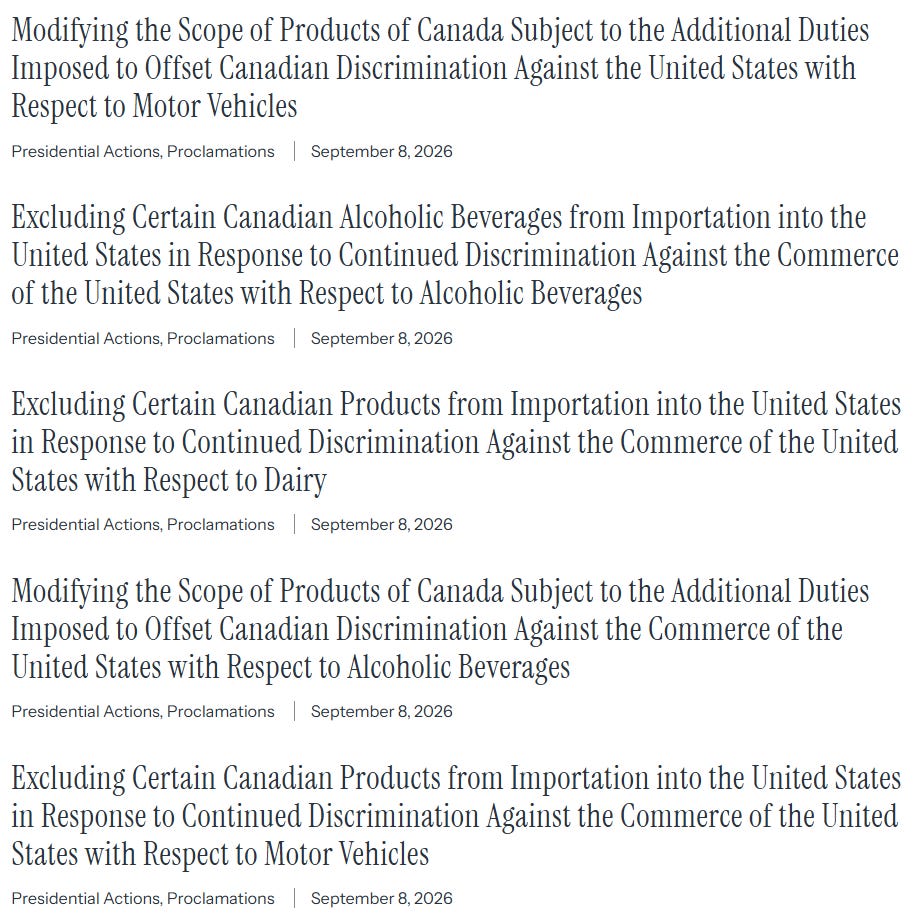
Notice who wasn’t involved: Congress. Also notice: the Constitution gives the power over tariffs to Congress. So, it isn’t at all clear how much of this survives contact with a court.
Also worth remembering through all of it that the governing law between our two countries is still a free trade agreement. If you’re American you call it the USMCA. If you’re Canadian you call it CUSMA, because for you Canada always comes first.
What number is bigger than fifty?
I asked Augusta to guess how high America’s retaliatory tariffs against Canada would go. She said fifty-one. I urged her to be ambitious. Fifty-two. I told her to dream like the president. Sixty.
Infinity.
We now have infinity percent tariffs on Canadian alcoholic beverages, dairy products and motor vehicle products.
I’m being lightly silly, and I’m also telling you the truth. He banned imports in those categories. An import ban is an infinity percent tariff — you can’t buy that thing for any amount of money. An American in the United States cannot buy Canadian dairy products for infinity dollars.
I say it that way because it highlights the absurdity.
Infinity is the number that punishes us, not them
A 10% tariff prices out the shoppers who could take it or leave it. That’s what a tariff does at the margin; it peels off the people who were basically indifferent anyway.
Raise the rate to infinity and you keep peeling. You price out the people who deeply wanted or needed that thing. The man who’s been drinking that specific whisky for thirty years. The plant that was built around that part.
Those people are… Americans. At infinity percent, the people you’re punishing are on your side of the border.
We only ever got to 145% with China. But if there’s one thing I’ve learned about this administration, it’s that we hate the Canadians. So of course, infinity. Why not infinity?
Other questions Augusta put to me:
Do consumer boycotts actually work — and does it matter that this one is aimed at a country rather than a company?
Whether the Canadian boycott is now costing America more than the formal tariffs are.
What Canadians mean by “elbows up,” and what an Australian does instead. (Answer: the Australian crawl, which you call freestyle, and which has cost the United States an enormous number of gold medals.)
Why your federal government is now buying its stationery from someone other than the cheapest supplier.
Should Canada go find some new friends?
If the United States is going to be a good friend and a close friend, then diversifying away from a good friend and a close friend makes no sense. You pay more to trade with people further away and get nothing for it.
But if you lack that confidence, the extra cost buys you something real: less exposure to American political risk.
The Canadian judgment is that there’s no certainty we revert to being a close friend anytime soon. I think that’s genuinely an open question — and because it’s open, there’s a risk, and moving away from risk is what you do with risks. Prime Minister Carney has been very clear that diversification is central to Canada’s economic future.
That will hurt the United States.
Watch the full episode for the rest.
When you have an “infinity tariff,” you have a black market. It will inevitably arise.