


A quick note: In the time I’ve been working on this, news has broken that Nvidia may be preparing to oust Jensen Huang as CEO. We’ll see what happens next, but based on what I’m seeing and hearing, this latest development makes the points below even more relevant.
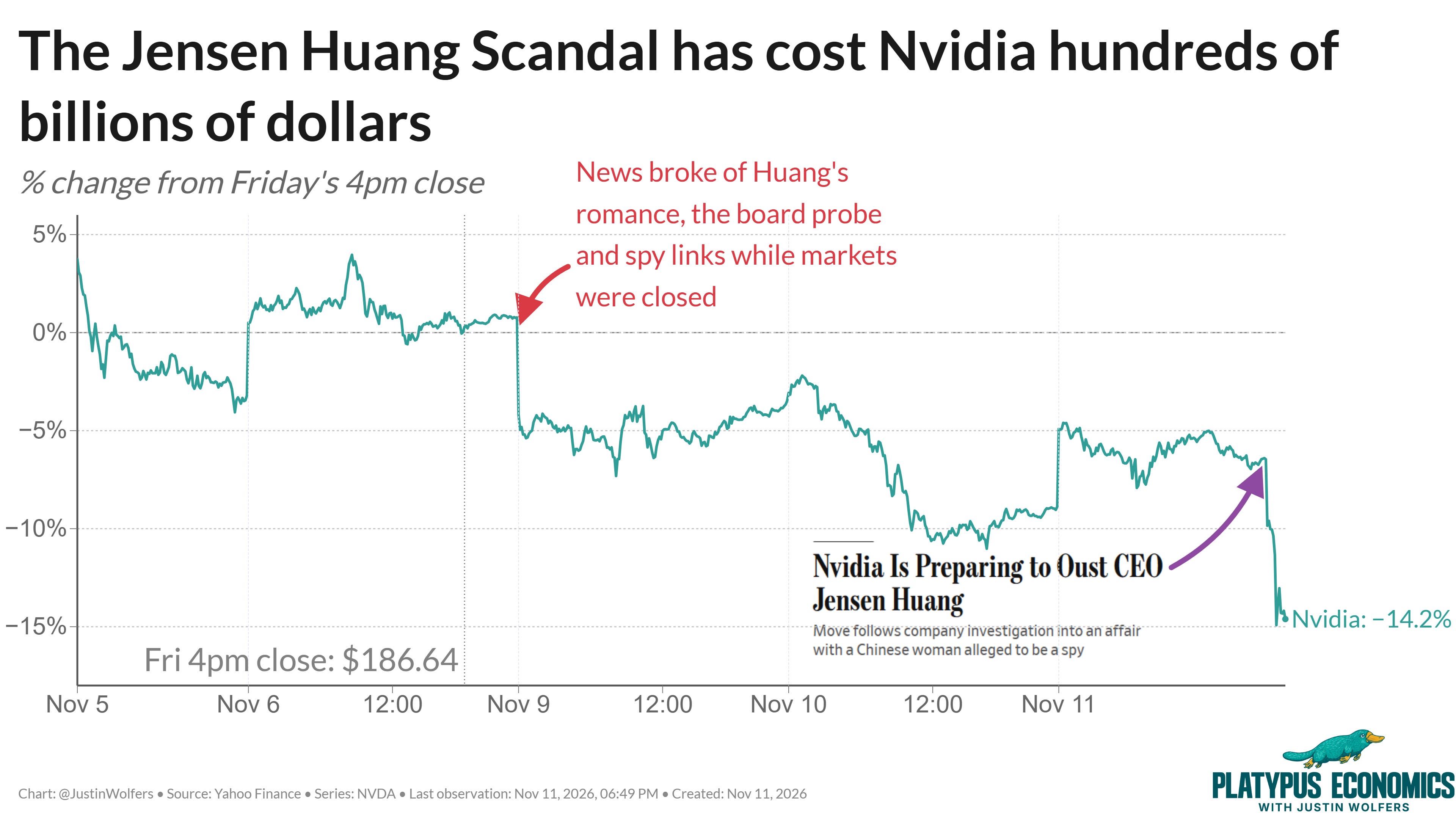
Over the weekend, the tech company Nvidia announced it was opening an independent investigation into reports that co-founder and CEO Jensen Huang had been targeted by a foreign intelligence effort. This effort reportedly came in the form of an extramarital relationship with a woman alleged to be a spy for the Chinese government. Huang has acknowledged the affair, and he’s said nothing about the espionage claims.
Meanwhile, Nvidia’s stock dropped. Last Friday, before the investigation, Nvidia closed at $186.64. On Monday, with the news now public, Nvidia closed at $178.67. That’s a fall of 4.3%. Measured against a rising market, the damage comes to about $300 billion. [Update: News that Huang may soon be fired led the stock to drop another 8%-10%! We might now be closer to $800 billion in damage.]
How does one man’s private life wipe out a stimulus-package-sized amount of wealth? And what does this tell us about the concentration of our economy?
How large is this disruption?
This is now a story that touches many things: a personal scandal, a national-security problem, and a corporate crisis. It’s also an economic story.
A share of Nvidia is a claim on the future profits of the company. Investors want the company to keep designing leading chips, secure production, and sell its products all around the world. That requires keeping customers happy and dealing with governments. A major scandal adds geopolitical and business risks to all of that.
It also raises awkward questions about succession. Nvidia is the second most valuable company in the world. Yet the succession plan seems to be everyone crossing their fingers and hoping Jensen is okay. That’s not a succession plan—it’s a horoscope.
Normally, most of us wouldn’t care if a company did bad succession planning. People running companies make mistakes, and that’s on them. But Nvidia is different. It’s a bottleneck supplier to the AI buildout.
All bets on AI require computing power. Microsoft, Amazon, Google, Meta, OpenAI, and thousands of other firms get that power from Nvidia. So the company’s fate is closely tied to its customers, and to its competitors. And it’s a tight web of customers. Last year, the top two accounted for more than one-third of its revenue.
At that scale, the possibility of future problems can have large financial effects. Investors now think the chance of fewer chips, slower growth, and weaker margins is slightly higher than it was Friday. When a company is this big, “slightly higher” risk can lead to huge changes in value.
The price of one weekend
Nvidia is a $4.5 trillion company. So we could say the loss here was 4.3% of $4.5 trillion, or about $192 billion. But that undercounts it. The better question is, where would Nvidia have closed on Monday if this news had never come out?
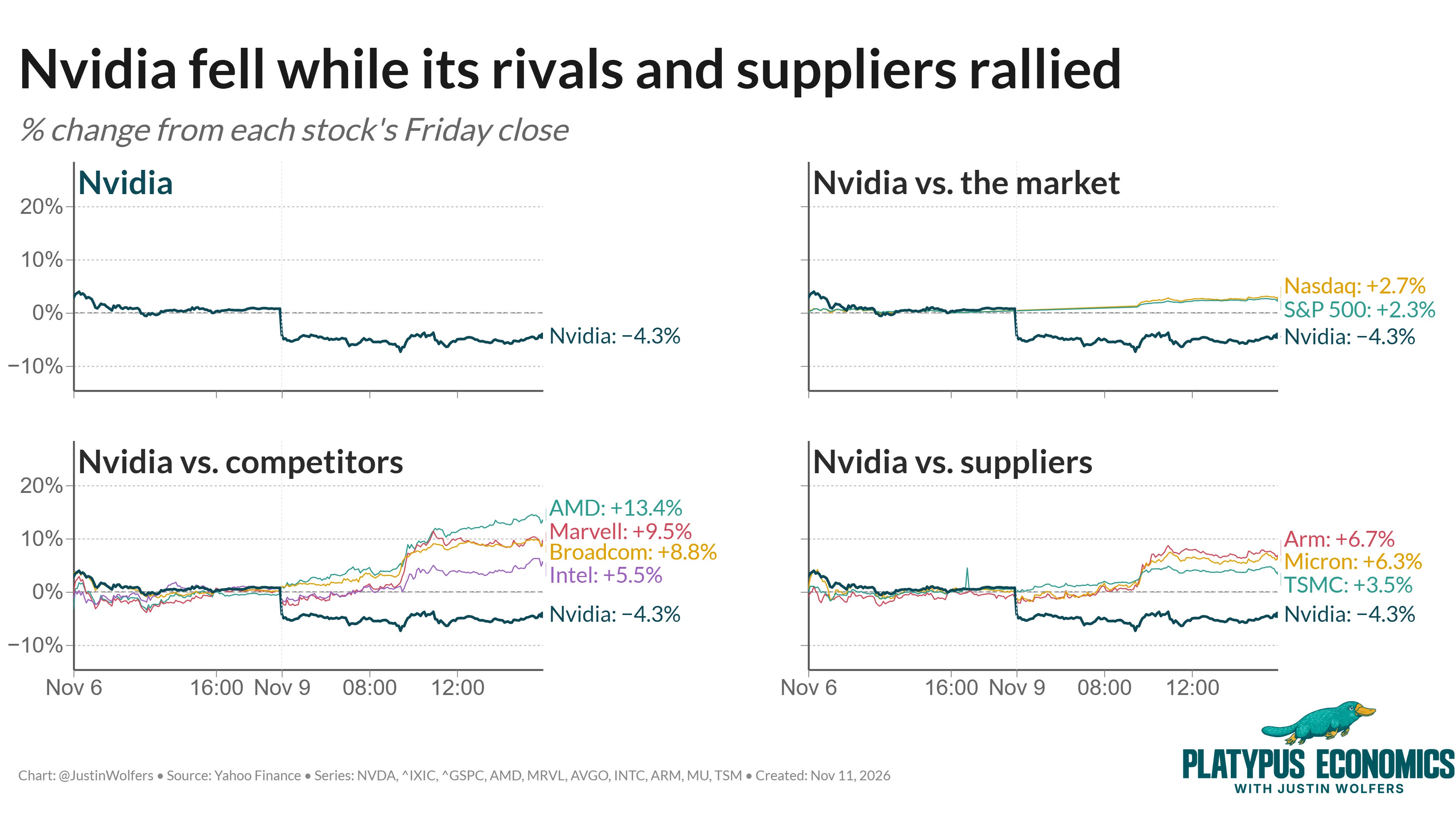
On Monday, the S&P 500 rose 2.3%, the Nasdaq rose a bit more, and stock in both Nvidia’s competitors and its suppliers rose. People were buying AI—they were just selling Nvidia.
From Friday’s close to Monday’s, Nvidia’s stock trailed the S&P 500 by 6.6 percentage points. 6.6% of $4.5 trillion is a loss of about $300 billion.
From the stock price to your account
Whose $300 billion was it that just vanished? Roughly four-fifths of U.S. stock is owned by Americans (as opposed to foreigners). So — as a rough guess — around $240 billion of that loss was borne by American households.
There are roughly 130 million households, which means that’s a loss of nearly $2,000 per household.
That’s big enough to have macroeconomic consequences.
Remember early COVID? We’re looking at a change in household wealth about the same size as the first round of COVID stimulus checks. The Nvidia dip is roughly as big as a medium-sized economic stimulus [add in Wednesday night’s drop, and you’ve got yourself a major economic stimulus]. But a stimulus adds to household wealth, and Nvidia’s troubles destroy it, so perhaps it should be called an anti-stimulus.
But Nvidia’s troubles also differ from those stimulus checks in another, quite important way. The effects are concentrated, plausibly on those who are best poised to deal with them. The top 1% own about half of all stocks, so they carry about half the loss.
Jensen owns about 3.5% of Nvidia, so this move cost him roughly $10 billion. [By the Wednesday, he had likely lost his job and perhaps another $20 billion in the value of his portfolio]. His wife has every reason to be mad.
There’s a lot here, but I want to focus on what this says about where power lies in our economy. It took an emergency law for Congress to move this much money. Jensen Huang’s personal choices — and the market’s response — erased a similar amount of money, over a scandal-filled weekend.
Tech concentration is market concentration
There’s another aspect to why this news matters so much for markets. Nvidia supplies the chips that power a tech ecosystem, and that tech ecosystem powers our stock market.
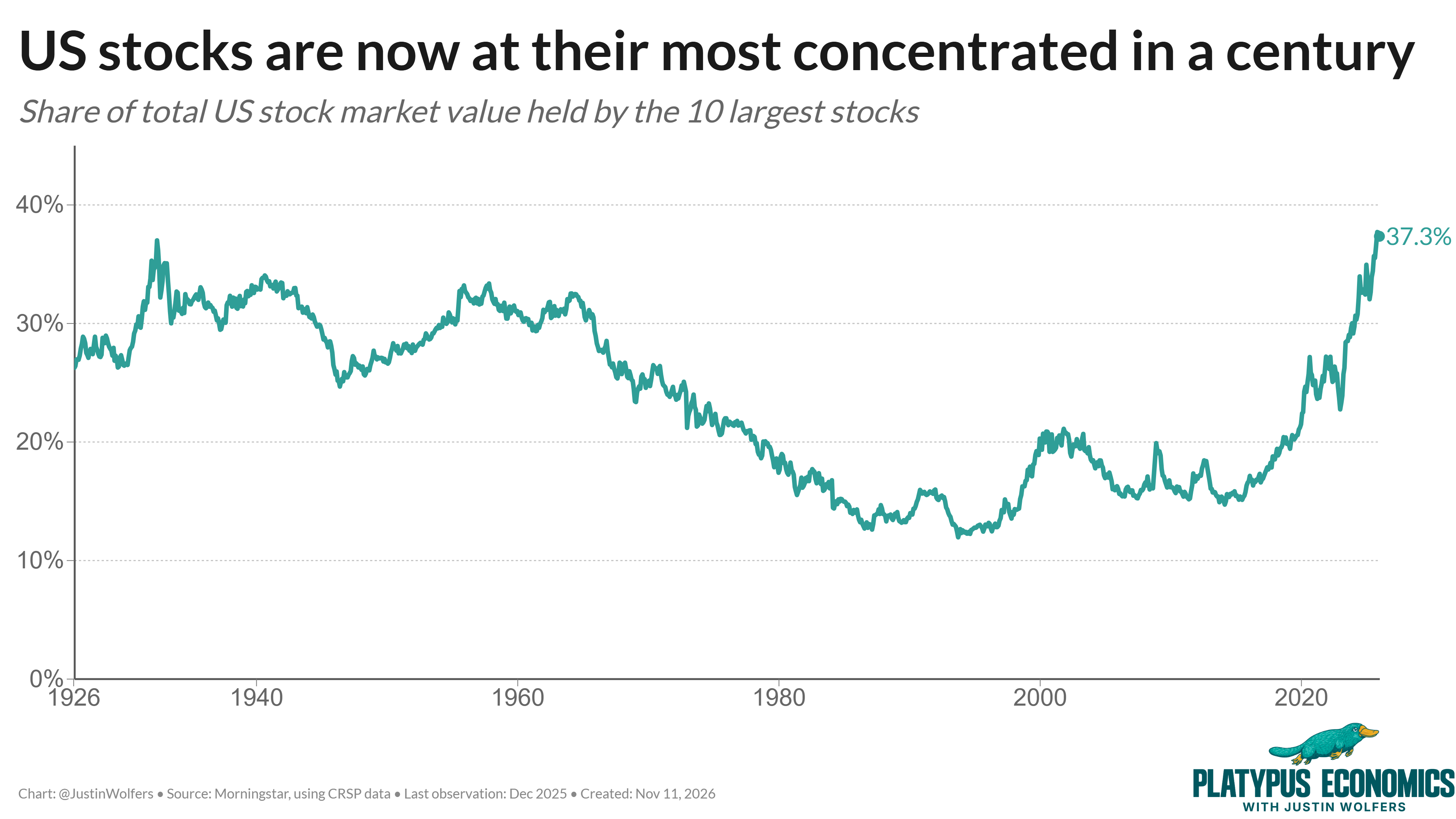
Today, the ten largest American companies make up more than 37% of the entire U.S. stock market. How unusual is this? Concentration hasn’t been this high at any point in the last century. Today’s concentration tops the prior high from 1932.
And the men running those companies could fit into a minivan, with room to spare. Satya Nadella’s Microsoft turns Nvidia chips into cloud services. Andy Jassy’s Amazon Web Services rents out computing power and builds alternatives. Sundar Pichai’s Google combines search, cloud, and AI models, and makes its own chips. Mark Zuckerberg decides how hard Meta pushes into AI and controls platforms billions of people use to communicate. Sam Altman runs a lab with a seemingly bottomless appetite for computing power. Elon Musk’s companies span AI, satellites, cars, social media, rockets, and defense infrastructure.
That’s just six men. With Huang making the chips, it’s seven. They know one another, rely on one another, compete, cooperate, and sometimes conspire. When the political stakes are high, they consolidate, and turn up to Washington together.
Washington has noticed, and things have gotten cozy. President Trump’s White House ballroom received generous donations from these folks—Apple and Nvidia each committed $25 million, Google $22 million, Microsoft $10 million, and Amazon and Meta, $5 million each. That’s according to a leaked donor list, and to be clear, it doesn’t prove a quid pro quo. But it is unsettling. And cringe.
This is everyone’s problem now
The success of these companies is tightly bound up with the decisions our government makes. They need export licenses and AI rules. They need antitrust decisions and government contracts and energy permits. Think about it for a moment, and you’ll quickly understand why we now see the titans of Silicon Valley in Washington more often than we see them launching new products.
This extraordinary level of concentration now means that one private person’s bad decisions, health events, or relationship issues can become a very public problem.
The people who paid for Nvidia’s bad weekend weren’t in Jensen Huang’s bedroom or boardroom or the White House ballroom. But their retirement accounts, jobs, and access to political speech are partially dependent on decisions made in rooms like those.
Nvidia, SpaceX, Meta, and X are private companies. But “private” describes who owns them. It no longer describes the consequences of their choices.