


On September 18, President Trump kicked CNN, MS NOW, and Politico out of the White House. He repeated the claim he’s made many times: that their reporting is fake news. The next day, their reporters’ badges were deactivated.
This is clearly a First Amendment issue. But it’s also an economics issue.
Today, I want to tell you some stories. These stories come from what economists call “natural experiments.” These stories will help us figure out what a free press actually does, using real examples. They’ll also help us understand what’ll happen if our press becomes less free.
So strap in for a tour of some of the evidence that economists have collected on how a free press shapes our society, our democracy, and yes, our economy.
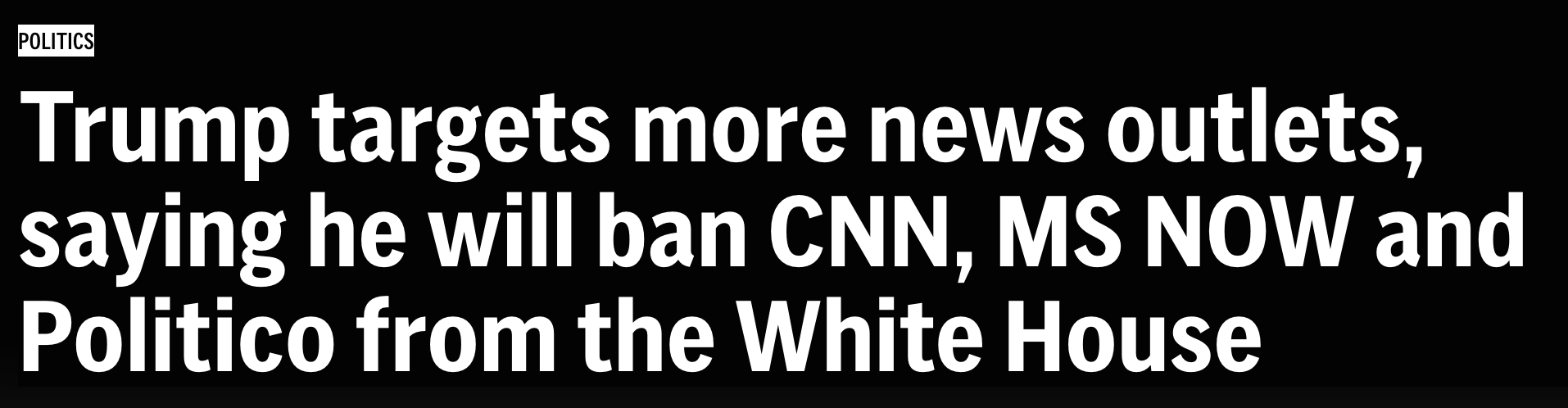
Presidents complaining about the press isn’t news. George Washington complained about how the papers treated him, but he had the good sense not to tweet about it.
This is different. The President is using the power of his office to decide who gets to watch him work, who gets to ask the questions, and who gets close enough to ask his staff what they’re thinking.
It’s also part of a growing list of attacks. The White House took control of the press pool. It restricted the Associated Press after a fight over language. President Trump has sued big news organizations. ABC settled one case. Paramount paid $16 million to settle another, just as it was awaiting federal approval for a multibillion-dollar merger. And Brendan Carr, Trump’s FCC chair, has reopened complaints against broadcasters, threatened their licenses over coverage, and pushed early scrutiny of ABC stations.
You could wave off any one of these as a coincidence. Put them together and it adds up to a systematic effort to take control of what used to be a free press.
I want to ask an economist’s question: How does a freer, more independent press affect the quality of government? And what happens when a president gets leverage over the media that’s supposed to report on him?
This is a hard question. Here’s why: Rich democracies usually have freer presses. They also tend to be less corrupt and better governed. But that doesn’t tell you much. Maybe a free press makes government work better. Maybe well-run countries are better able to afford a free press. Maybe courts, education, prosperity, democracy, and press freedom tend to come as a package. The problem here is that even if economies with higher incomes tend to have a freer press (and they do), correlation isn’t causation.
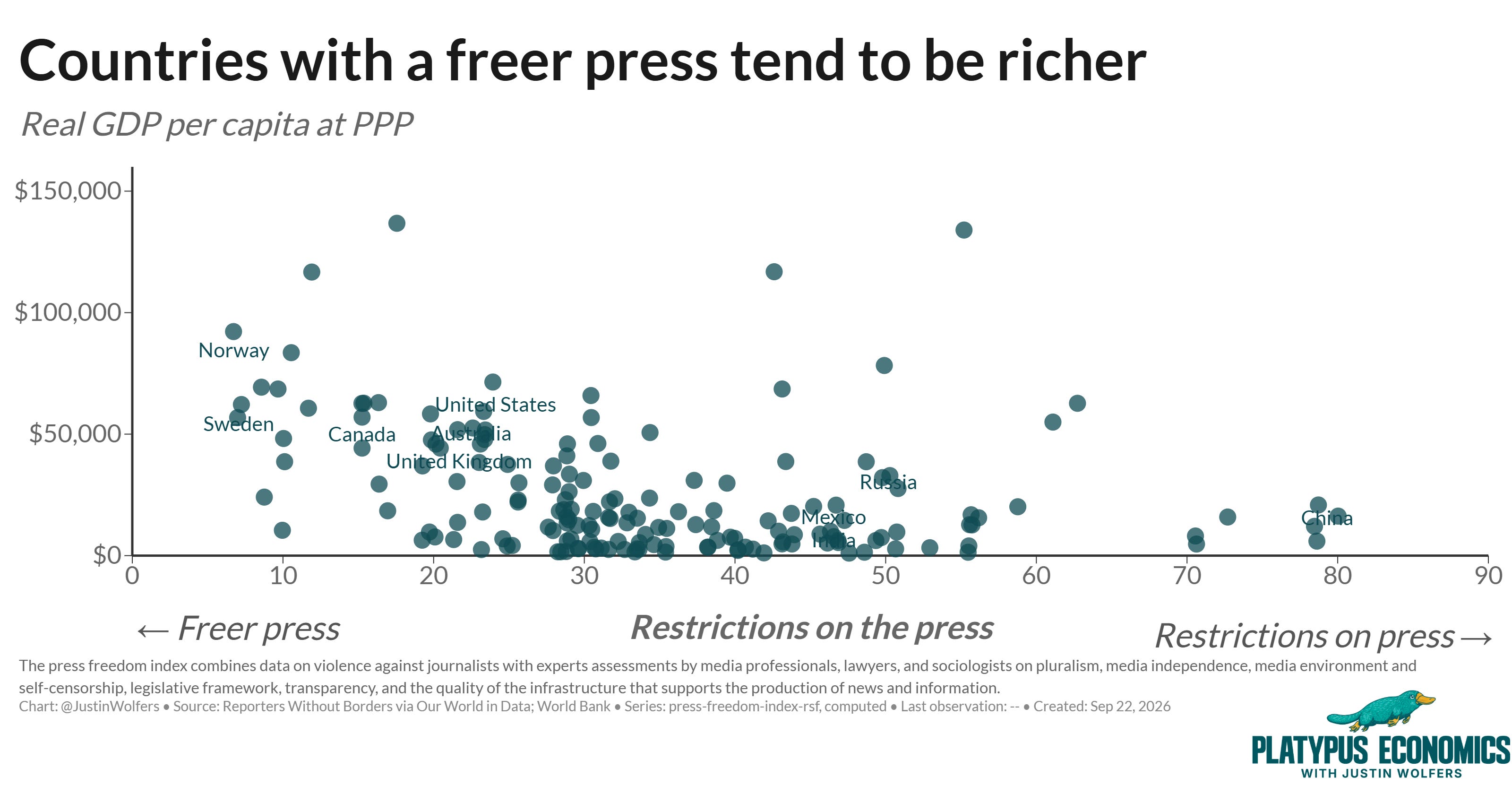
But the stories I want to focus on use natural experiments to isolate what restrictions on a free press actually do — their causal effect.
Story 1: A dictator’s shopping list
In the 1990s, Peru was supposed to be a democracy. In reality, it was a dictatorship. President Alberto Fujimori ruled the country for ten years with the help of his de facto chief of secret police, Vladimiro Montesinos. Montesinos bribed everyone. He bribed judges, he bribed military leaders, he bribed the business community. And he kept meticulous records of every payment he made. He even kept videotapes of the negotiations!
Those records turned out to be very useful for economists. John McMillan and Pablo Zoido went through them and worked out what the regime spent each month to buy off the institutions that were meant to hold it in check.
Buying a majority in Congress cost Montesinos around US$300,000 per month in bribes.
The judges cost about $250,000 a month.
The corrupt Peruvian regime was willing to pay over ten times more — more than $3 million — to control the media.
That price list is the best evidence I know for a simple idea: The people who most want to escape accountability know exactly where accountability comes from.
Story 2: More media = more help
Now let’s turn to the United States in the 1930s. Radio was spreading at the same time that the Roosevelt administration was handing out New Deal relief. Here’s the quirk that makes this a natural experiment: radio reception depends partly on the physical world, meaning terrain, ground conductivity, and how a signal travels. So some otherwise similar counties could hear political broadcasts more clearly than others.
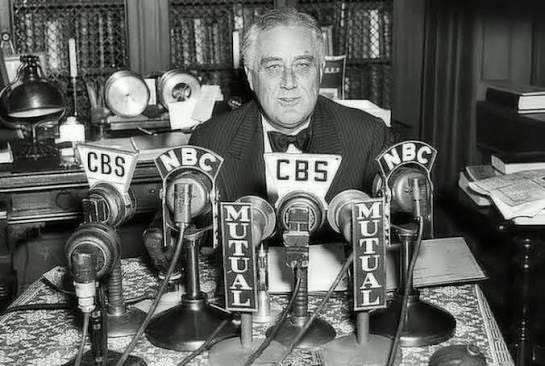
Economist David Strömberg analyzed this natural experiment. He found that counties that (due to quirks of geography) ended up with stronger radio signals got more federal New Deal relief. More media meant voters could follow what government was doing, and that gave government stronger reasons to pay attention to them.
There’s a modern version of the same story. Newspapers serve markets, members of Congress represent districts, and sometimes the two don’t line up. James Snyder and David Strömberg found that where local papers had less reason to cover a representative, voters knew less about that representative, and the representative did less. Less showing up at hearings. Less work on the committees that matter to local interests. Less fighting for the folks back home.
Story 3: Disaster stories matter
So does a freer press change what government actually does? To answer that, we’ll travel to India. Tim Besley and Robin Burgess, two economics professors at the London School of Economics, looked at droughts, floods, and food distribution across Indian states. Where local newspapers were stronger, state governments responded much more vigorously to crop failures and floods.
Here’s the mechanism: A drought hits a remote district. The state capital might be focused on something else. Local papers bring the crisis into the public conversation. Voters hear about it. Opposition politicians spot a failure they can attack. Officials know they’ll have to explain themselves.
Story 4: Exposing corruption
Now let’s move from governments failing to help to officials stealing from citizens.
Starting in 2003, Brazil’s federal government randomly picked municipalities for audits of federal money. Some audit results came out before an election, and some came out after. That’s the foundation for a great natural experiment.
Claudio Ferraz and Frederico Finan compared the two groups. Corrupt mayors who were exposed before the election were far less likely to be reelected, and the effect was much bigger where there was local radio, because radio was how the story reached voters.
Mexico shows something similar. When local radio and TV reported that politicians had misused public money, voters punished those politicians’ parties much more heavily.
Then there’s deterrence. Later research, by Eric Avis, Claudio Ferraz and Frederico Finan on Brazil’s audits found that when one municipality was audited, politicians in nearby municipalities with local media cut their own corruption. The press made the odds of getting caught feel real, so politicians behaved better.
Stories 5 and 6: What media capture buys
Russia shows why politicians care so much about all this. At the time researchers studied it, most Russians got their television from networks the government influenced. NTV was the one independent national channel, and how well you could receive it varied across the country. Where people could pick up NTV, support for the government party fell.
One channel telling a different story was enough to move votes. Now imagine what a government would pay to make sure that channel never reached you.
Hungary shows how that government pressure on the media works. Adam Szeidl and Ferenc Szűcs found that government-controlled firms sent more advertising money to politically connected outlets, and those outlets gave something valuable back: less coverage of corruption scandals. When one owner fell out with then-Prime Minister Viktor Orbán, his paper’s corruption coverage jumped. When another outlet changed editor and owner and became connected, its corruption coverage fell.
Story 7: American local news
The Cincinnati Post was one of Cincinnati’s two daily papers. On New Year’s Eve 2007, it published its last edition. That closing date had been set decades in advance — which made for a clean natural experiment.
Sam Schulhofer-Wohl and Miguel Garrido found that, in the Kentucky suburbs that relied most on the paper, fewer candidates ran for local office after the paper closed. Turnout fell. Incumbents were more likely to win.
Less media, less competition, and less reason for politicians to serve voters.
Then there’s the taxpayer’s bill. Pengjie Gao, Chang Lee, and Dermot Murphy studied local newspaper closures across the U.S. After a local paper closed — an increasingly familiar story — local governments had to pay higher interest rates on their debt. Lenders had less independent evidence that spending was disciplined and projects well run, so a less-watched government looked like a riskier borrower. Higher borrowing costs come straight out of the money cities and counties use for schools, roads, and water systems.
Adding up the costs
Trump’s America has different pressure points than those in Orbán’s Hungary or Fujimori’s Peru. Nobody is handing TV executives envelopes of cash. The levers are more respectable than that. Access. Licenses. Merger approvals.
But the direction is the same: A press that’s less free, less able to report, and under commercial and political pressure to go easy on the incumbent. The costs extend far beyond the newsroom. This perversion of our information environment imposes costs that you and I pay.
The ban on CNN, MS NOW, and Politico is now in court. A judge will decide the legal questions.
Meanwhile, the economic question has already been answered. A free press helps voters manage politicians. It makes corruption riskier. It keeps political competition alive. It lowers what taxpayers pay to borrow. And without it, we and our economy are weaker.
An interesting angle on the issue, JW. The bottom line is that the press is vital to democracy. Trying to muzzle it usually doesn’t end well for the muzzler.
Dear Professor Wolfers. Growing up, I was taught politics is sociology in action. Your report demonstrates that politics is also economics in practice. Thank you for your insightful articles.