


I have an op-ed in today’s New York Times on the cost of the war in Iran. While the Pentagon claims the conflict has cost taxpayers $25 billion, I reckon that it’s much much much more than that. Much more.
Not only has the Administration grotesquely under-estimated the cost of this war to the American people, the cost to the rest of the world may be larger still.
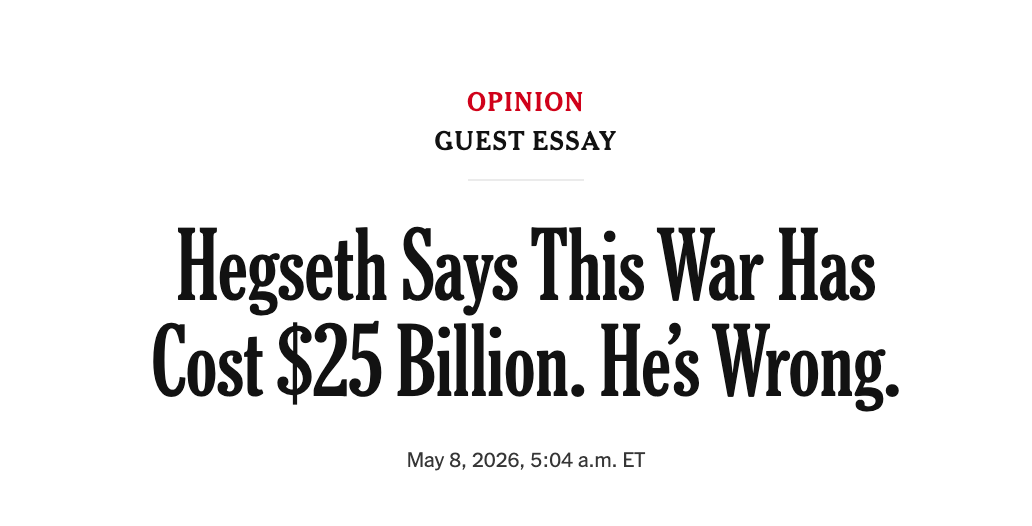
I encourage you to check out the full article here (that’s a gift link), but I thought I’d use this post to highlight a few of my key arguments and calculations.
The $25 billion price coming out of the Pentagon reflects the narrow accounting tab for Operation Epic Fury — the price of missiles already fired, warplanes flown (in some cases lost), and other equipment and gear used up. But to understand the full cost, we must compare the world we’re living in today to the one that was expected before the war began.
Oil is the obvious place to look first, and the picture’s not great:
Futures prices for oil at the end of 2026, 2027, and 2028 are all still sitting well above where they were before the start of the war.
There’s also a cost associated with the rise in geopolitical risk. A measure developed by Fed economists Dario Caldara and Matteo Iacoviello suggest that cost is roughly $200 billion, with a million fewer Americans working in a year’s time.
The war has also put the Fed in a sticky spot. Previously expected rate cuts are now unlikely, and and a rise in rates is back on the table:
If the Fed raises rates, it may succeed at beating back a war-fueled burst of inflation, but only by destroying hundreds of thousands of jobs and edging the economy closer to recession. A reasonable guesstimate — informed by the Fed’s own models — is that this will cost the economy about $200 billion.
When taking into account the full set of macroeconomic consequences, professional forecasters predict that the country’s economic growth over 2026 will be half a percentage point lower than what was previously expected. That might sound small, but once you pencil out the losses over time, but the consequences are large:
If it takes a couple of years for the economy to return to normal, that slower growth rate would mean around $400 billion in lost income.
And the biggest bill of all is still ahead of us. With Iran’s newly-revealed leverage over the global economy via the Strait of Hormuz, the U.S. will require more military spending to maintain its military supremacy. To get an idea of what this number may be, we can look to the White House:
Recently, the administration made a defense budget request of $1.5 trillion for fiscal 2027, a roughly 40 percent boost over this year. That’s a massive $600 billion increase, or roughly $4,000 per household.
Keep in mind — that’s just the cost for 2027. Defense budgets rarely go down, so the cost over the next decade may add up to trillions.
Ultimately, the recent past holds a lesson for where all this might end up. Major costs of the Iraq War (estimated at $3 trillion in total) showed up in the aftermath:
A huge share of [the Iraq War’s] expenses came after the conflict, including the expense of lifetime medical care and disability benefits for veterans, and the higher recruitment and retention costs that follow a bloody war — all compounded by a rising interest bill.
The costs I’ve estimated are inexact and surely clouded by the fog of war. But the best I can do is get the order of magnitude right. The conflict in Iran isn’t costing tens of billions — it’s costing hundreds of billions, and very possibly trillions.
And yes, I’ve only focused on the economic costs of this war. The human costs are very real. You know what they are, and you don’t need an economist to lecture you about them. I don’t want to suggest that there’s any important conceptual separation between economic and human costs — all costs matter. But my comparative advantage is economics, which is why I’m only focusing on that part of the story.
Anyway, read the Times piece. I wish I had written it as an exclusive for Platypus Economics, but — at least right now — the Times has a bigger audience, and it felt important to get these arguments out there.
Fun fact: This whole agenda began as a series of videos I put together in the pre-launch of Platypus Economics. Here’s my first estimate of the cost of war from way back in mid-March.
But Platypus is a special place because I can do here what I can’t do at the Times — really dig in and show you how I penciled out these numbers. Show you a bit of the back of the envelopes scattered across my desk. And so I’m planning to go deeper for y’all with a longer piece that I’ll send you early next week.
For now, I want to share with you something from the back catalogue — a piece I’m proud of, where I pulled together some basic threads on the economics of war — to predict that this war would be much more costly than the White House was telling us.
Follow you on your TV appearances - glad to subscribe to your useful succinct newsletter, and value your take on not just economics, but realistic opinion, knowledge of real life, not the fantasies of demented and dark faux kings who think they know everything, and actually know Nothing! Hope you get more air time (but also worry about media corruption by a few billionaires). Follow many former news people on SS. And YOU are a great asset for truth and integrity!
Love your analysis!