


The holidays are just around the corner. A new inflation report just dropped. If you live in my corner of the world, that means one thing: the Cost of Thanksgiving Discourse.
Are turkey prices up? How much do green beans cost? What’s cheaper now than last year, and what’s more expensive? Here’s my take: most of these headlines will miss the point. I care about the price of every meal, not just the price of this one.
There are lots of ways to spin this. Turkey prices are up 10%. Egg prices keep falling now that bird flu is over, which the current administration will certainly mention, failing to remember that eggs are not a Thanksgiving dish.
But the most expensive part of Thanksgiving isn’t on the dinner table. It’s how you get to the table.
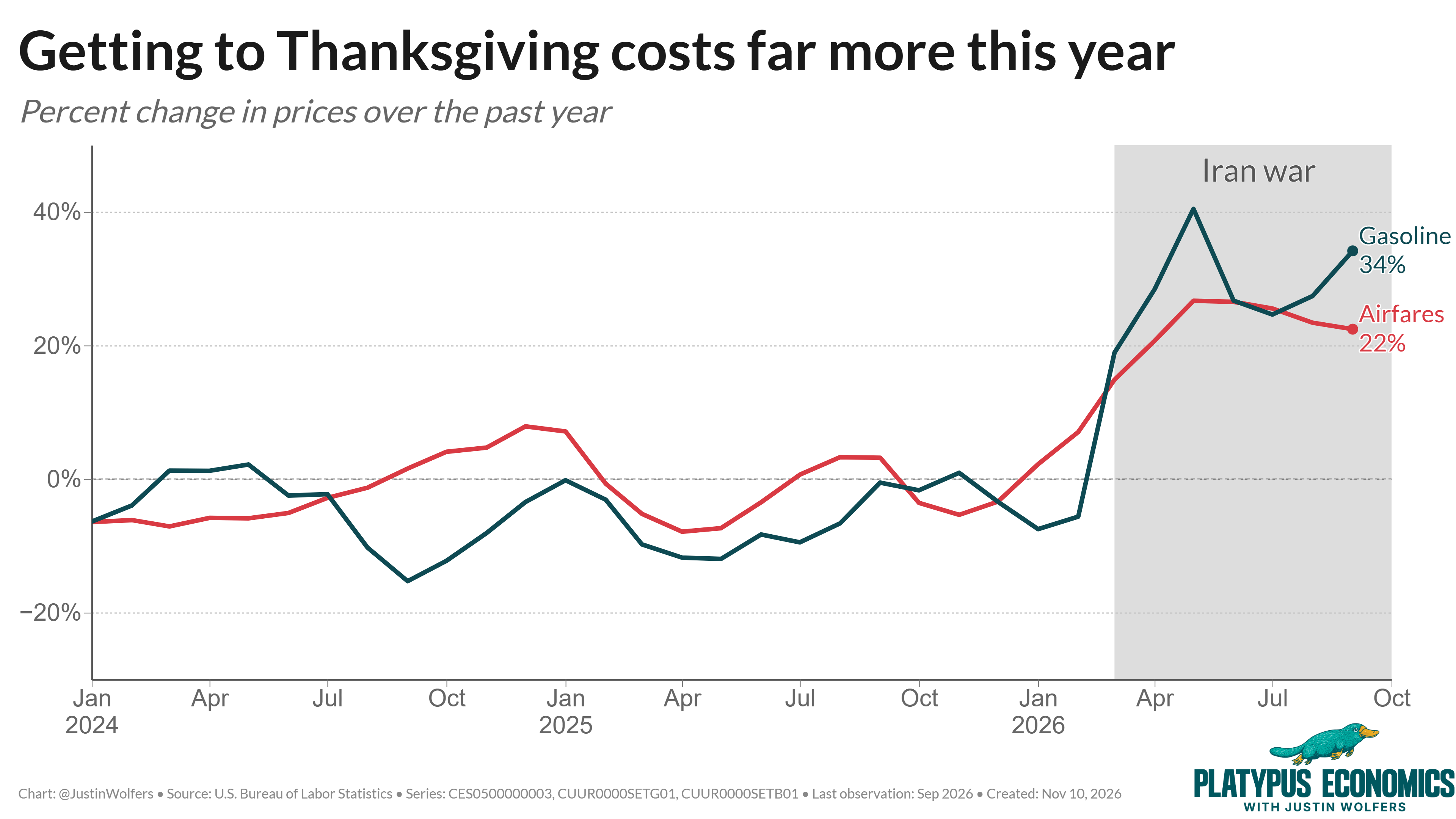
We’re hosting Thanksgiving this year, but usually, we’d go to DC, or Boston. We’d likely fly. And airfares are up about 22% over the past year.
Let’s say we drive instead. The price of gasoline is up 34%.
This is the effect of the war in Iran. The war caused the price of gasoline to spike because so much oil is on the wrong side of the Strait of Hormuz. As much as you might want it, you can’t get it over here.
The price of diesel is up too. That’s a slightly more complicated story, because even if we get the oil, it still needs to be refined. The world’s refining capacity isn’t great right now, in part because of bombing campaigns in the Russia-Ukraine war.
And for those of us in cold places, heating oil is about to become a big line in the budget. I’m in the Midwest, and my team is mostly in New York. This is the first expensive winter since the U.S. invaded Iran.
All of this stems from oil. Oil prices rise and other energy prices—gasoline, diesel, heating oil—rise with it. The good news is that if those prices stay high, and nothing else happens, that won’t lead to ongoing inflation, because inflation is the rate of change of prices. A reminder: Prices rise, and so does inflation. Then if prices stay high, that’s not inflation. That’s just high prices. That’s the story right now, and the high prices suck, but when you’re looking at inflation, this is what passes for good news.
Let’s take a step back
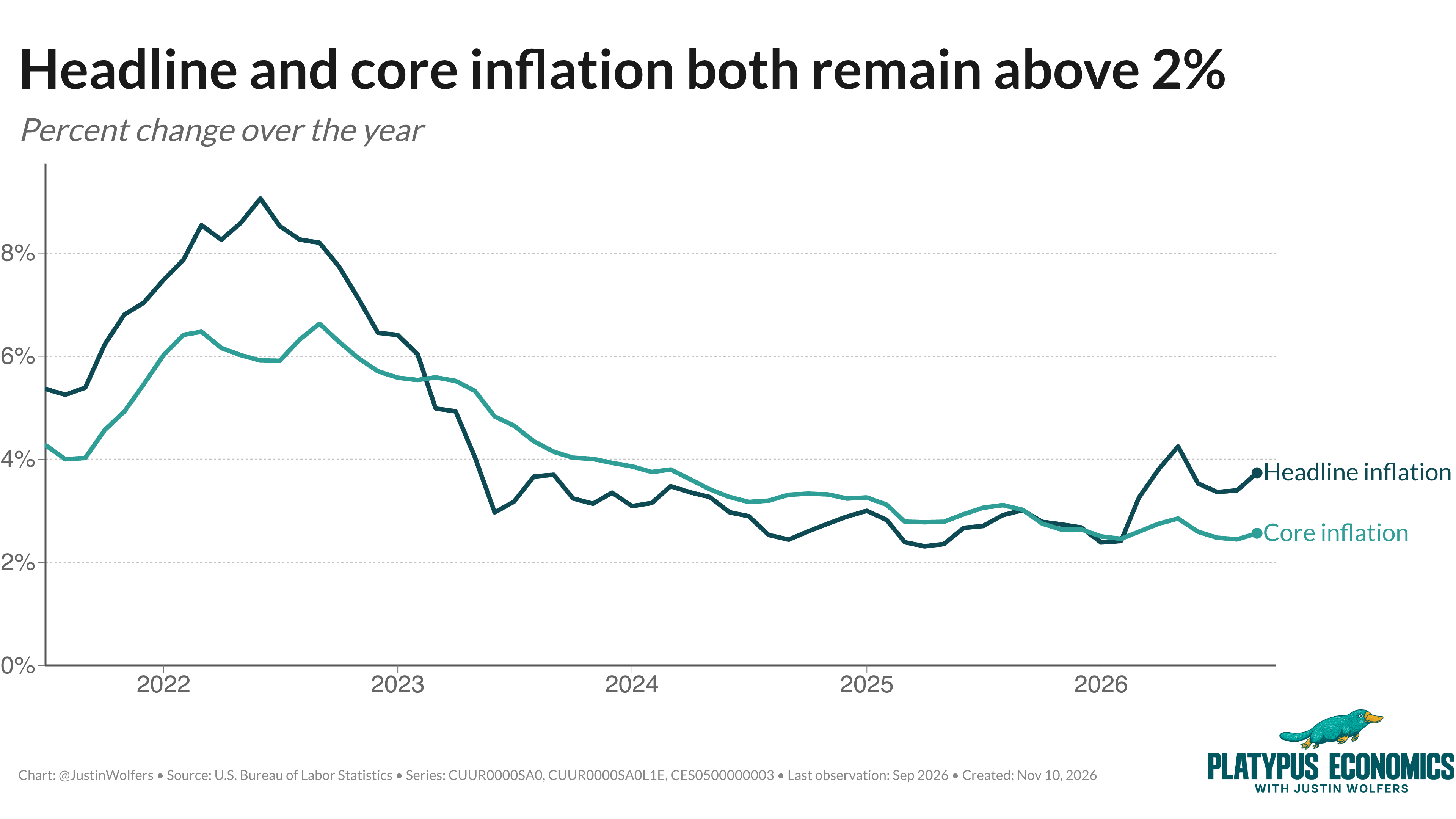
Inflation is hot across the board. Consumer prices rose about 4% over the past year, which is higher than Wall Street expected and well above the Fed’s 2% target. By the way, 4% includes some estimating on my part. That’s because the government was shut down last October and we’re missing a bit of data.
Core inflation, which strips out food and energy, has run at a 3.7% annualized pace over the past three months. That’s up from 1.6% the three months before. Now we’re beyond the gas pump. When you look back at tariffs, an energy shock, and COVID supply shocks, we haven’t been near 2% inflation for six years. At some point, that’ll start to build its own momentum.
The next stage of the usual analysis is then to try to strip out all the different “one off” factors, to try to find the One True Underlying Inflation Measure. Mike Konczal did an amazing job of summarizing where that gets you right now:


Wages aren’t keeping pace
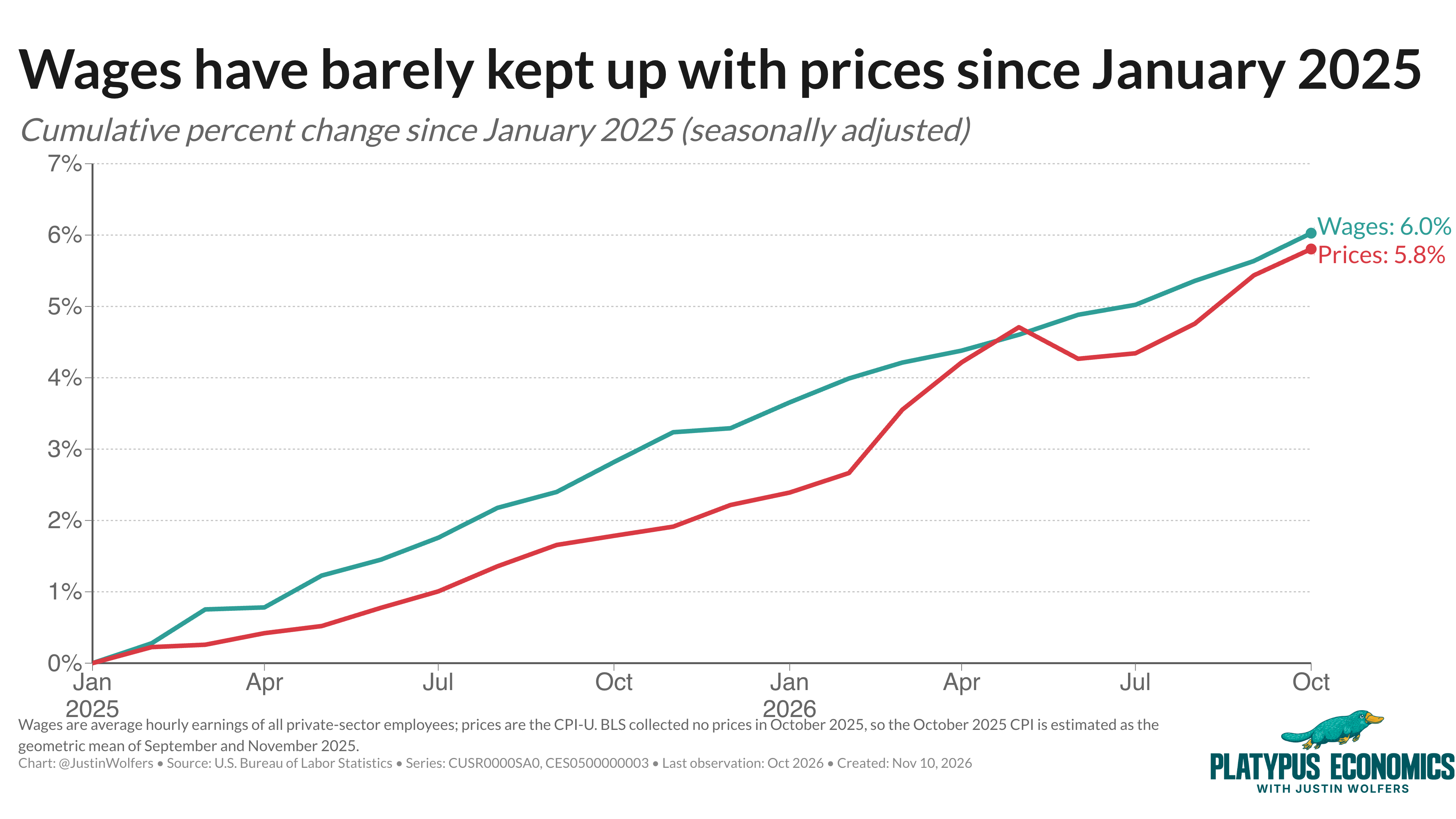
When we grow our economic pie, everyone’s slice should grow with it. The pie has been growing—we wrote about that here—but the average worker’s slice is getting smaller.
Over the past year, wages rose 3.1% and prices rose 4.0%. Real wages (what your pay actually buys you) fell 0.9%.
These are averages. That means that some people aren’t getting that 3.1% raise and the squeeze is getting worse for them.
The Fed’s next move
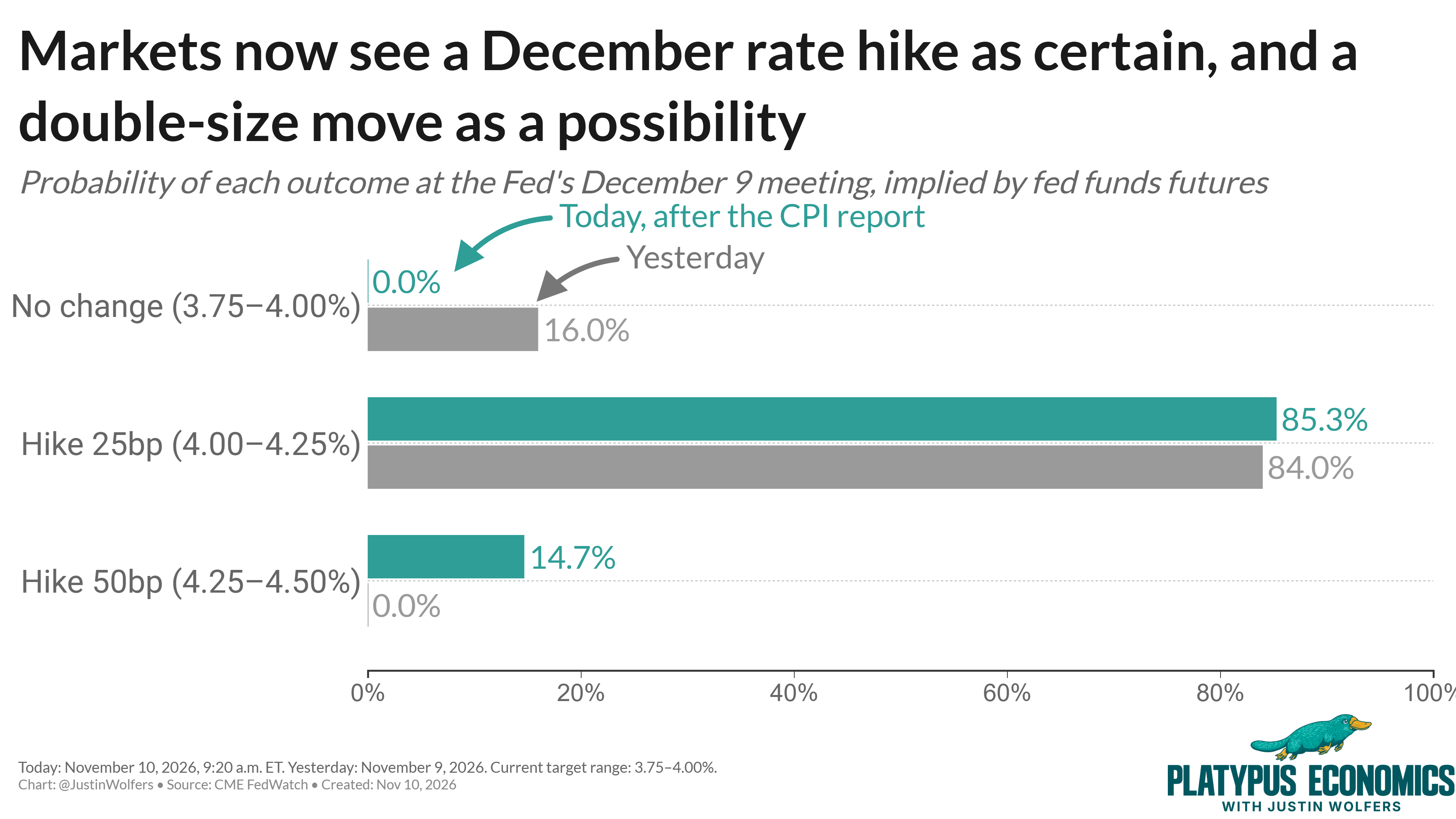
The Fed will almost certainly raise rates come December. Markets now price a hike as a sure thing, and they’re now saying there’s a 15% chance it’s half a percentage point, double the usual dose. Fed governor Chris Waller said hours before this part that a 0.3% core reading should put a half-point hike on the table. This came in at exactly 0.3%.
So, Thanksgiving will cost more this year. That’s mostly because getting there costs more, but also because pay isn’t keeping up, and inflation isn’t going away.
It’s a frustrating note going into the holidays. But it’s still a beautiful season, with much to be thankful for. I love the community we’re building here. I also look outside my window, and the air is crisp and the leaves are turning red and falling.
Is that why Americans call autumn “fall”?
Dear Professor Wolfers. Nice article. Conjecturing from your analysis, is it safe to project ending the Iran war will trigger multiple events that would reduce inflation and perhaps consumer pricing? If so, this should be the top item of the new Congress’ agenda, combined with an amendment to overrule Citizens’ United and the development of an equitable tax system. A good start, but not a final product.
Well, I will admit, our American name for autumn isn't as pretty, but "fall" definitely describes what happens to the leaves on many trees in our country, though here in southern Arizona, it usually describes just the temperatures this time of year! (We do have a few trees that change color, especially in the nearby mountains.) Most of our native trees, shrubs, cacti, and flowering plants have other ways to cope with cooler temps. Soon it'll be hygge time. We love Platypus Economics!