


Over the past five quarters, more than three-fifths of measured U.S. GDP growth has come from AI-related spending.
That’s a striking number. It’s even more striking when you remember that AI-related spending is only around 4–5% of the economy. A small slice has been doing a very large share of the measured lifting.
And that helps explain a puzzle a lot of folks have been wrestling with: how can headline GDP look decent while the broader economy still feels wobbly?
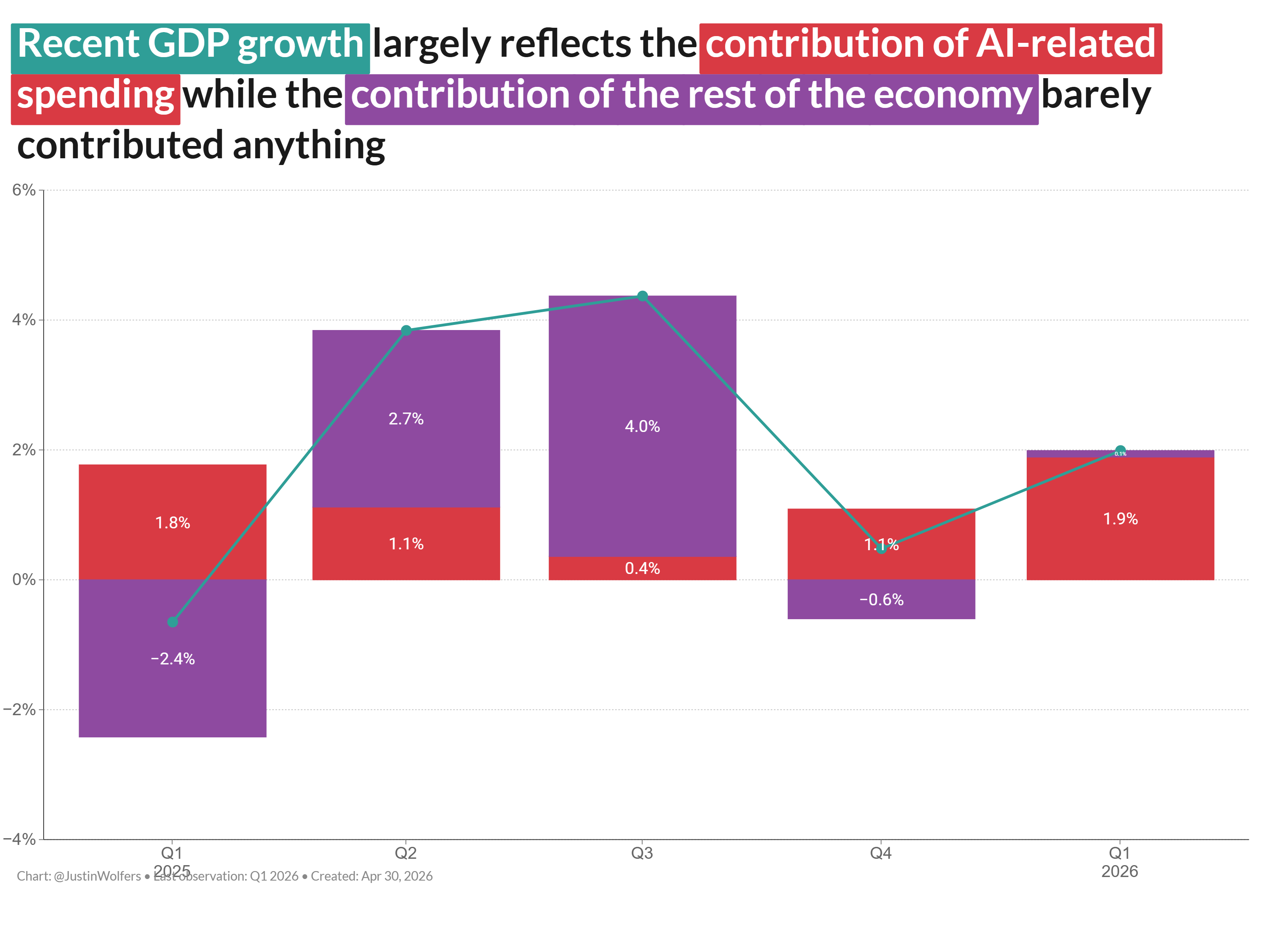
Let me be precise about what this chart shows.
This is an accounting decomposition of GDP growth. The bars show how much AI-related spending contributed to overall growth, and how much came from everything else. It is not showing two separate, self-contained economies. And this is not a clean counterfactual of what would have happened if the AI boom never occurred.
If the AI boom hadn’t happened, labor and capital would have gone somewhere else. Interest rates might have been a bit lower. Electricity prices might have been lower too. And much of this equipment is imported, which means part of the spending leaks out through imports rather than boosting GDP one-for-one.
So no, you can’t just erase the red bars and declare that’s what growth would have been otherwise.
But even with those caveats, the pattern here is pretty extraordinary.
Over the last six months as a whole, the non-AI part of the economy contracted. AI-related spending is what kept overall growth positive. And even economists making the imported-equipment adjustment still end up with a version of the same story.
As Oliver Allen of Pantheon Economics told the Wall Street Journal, “Even after accounting for the fact that most computer equipment is imported, AI investment seems like it accounted for about half of the overall GDP growth in the first quarter.”
The broader lesson: GDP is calculated by adding things up. It tells you how much output grew in total. It does not tell you whether that growth was broad-based, balanced, or widely felt. If one category is surging while a lot of the rest is soft, the total can still come out looking pretty healthy.
And that’s why the next question isn’t whether the GDP number is fake. It’s what’s underneath it.
Sometimes the answer is reassuring: lots of sectors, lots of places, lots of households. And sometimes the answer is this: yes, the economy grew, but one narrow slice did an extraordinary amount of the lifting.
That doesn’t make the headline wrong. But it does make it incomplete.
There’s a forward-looking point here too. When one engine is doing this much work, you start caring a lot about that engine. I’m not predicting an imminent collapse in AI spending. But a growth story this concentrated is less balanced — and likely less durable — than the headline number suggests.
