


The Fed held rates steady today, in the range of 3.5 to 3.75 percent. Three (of twelve) Fed officials voted against the move — preferring a quarter-point increase instead.
The lead-up to today’s meeting was unusually dramatic, with markets more uncertain than at any time in recent years about which way the decision would go. As of this morning, they were split roughly 70-30 (in favor of no rate hike).
There were two main reasons for this uncertainty. The first is that it reflects a genuinely difficult choice. Strong arguments could be made on both sides — either for holding rates steady or for a small increase.
But this fresh volatility also stems from a stark change in Fed policy under its new chair, Kevin Warsh.
A genuinely difficult decision
Over the past 18 months, we’ve experienced not one, but two separate supply shocks. We can blame the first on Trump’s trade war, and the second on his war war.
The tricky thing about supply shocks is that they raise the cost of doing business, and so goose inflation and slow the economy simultaneously. The Fed can solve either of these problems — but not both at once.
Still, while supply shocks push inflation higher, the rise should — theoretically — be temporary. They typically cause a one-time increase in costs, and businesses raise their prices to account for the change. Prices stay high, but inflation falls away, and that should be the end of it.
Because of this, the economic textbooks say that the Fed can afford to look through a supply shock and wait it out (i.e., forgo raising rates to fight inflation). As a textbook author myself, I tend to take this textbook idea pretty seriously.
On the other hand, we’ve now been waiting for more than five years for inflation to return to the Fed’s two percent target. At this point it’s reasonable to ask: How much longer can we afford to wait? (This more hawkish stance would suggest raising rates, and it’s usually accompanied by a heaping serving of concern about inflation expectations becoming unanchored.)
Thus, a compelling case could be made either for keeping rates steady or for raising them. And the market appropriately reflected this split.
From time to time, you’ll hear me get quite animated about Fed decisions. But not this time. The Fed was debating two pretty reasonable alternatives, and there are good-faith arguments for either of them. My sense is that as long as the Fed is “in the neighborhood” of getting things right, there’s not a lot for me to say.
A more opaque Fed
Let’s return to the uncertainty around today’s decision. Part of it is that this is a hard decision. The other part is all about the new Fed chair, and how he likes to run the joint.
Kevin Warsh has made it clear that his Fed will not be providing much (if any) forward guidance on its future decisions — a significant departure from his predecessors.
Most strikingly, this can be seen in the accompanying statements for the Fed’s last two decisions. The June statement, at 130 words, was unusually brief compared to past precedent, and today’s was nearly identical (aside from noting the dissenting votes).
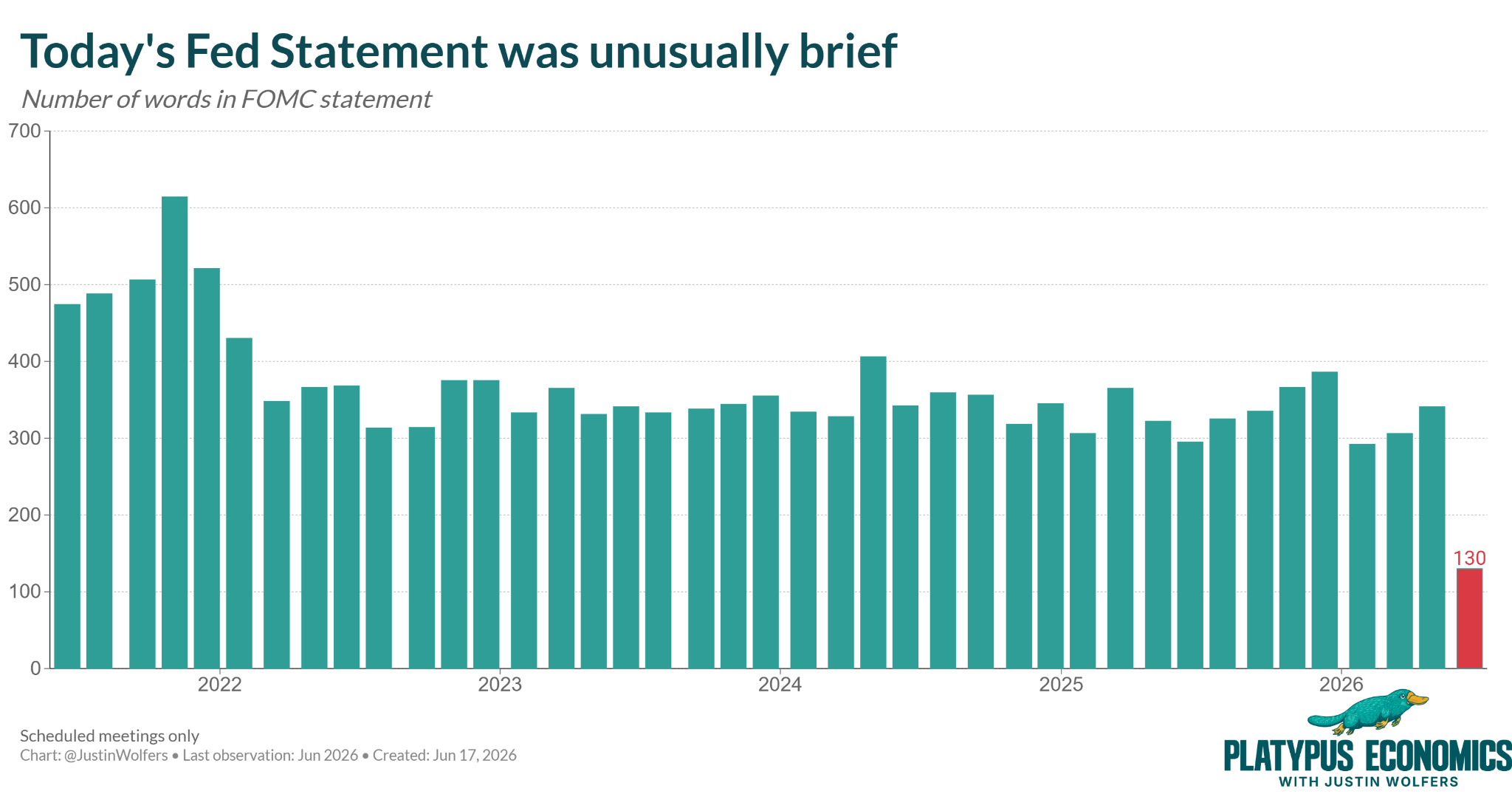
Warsh believes less transparency allows the Fed greater flexibility in its decision-making. But this abrupt shift in communication has led to greater market volatility and uncertainty. And it doesn’t feel like it has much of a payoff.
What we learned today
A few things stood out to me from today’s post-decision press conference.
First, Warsh reiterated the Fed’s commitment to 2% inflation.
Back in June, he had made a comment that he was more concerned with the inflation number “to the left of the decimal point.” This led many to speculate that his Fed may have an implicit, “soft” inflation target of two-point-anything percent.
Today’s appearance put those fears to rest. He began his remarks by stressing the two percent target and confirming that the entire committee was in agreement on this point. (Notably, he did not say that raising rates is the right tool to get us there.)
Second, he doubled down on not providing much insight into the Fed’s thinking.
He says that he’s pulling back on “forward guidance,” but in reality, he’s pulling back on communication, explanation, and accountability.
His stated reason: He wants the Fed to observe “unfiltered” market reactions to economic developments, and wants those markets to learn to “play the ball, not the referee.”
But the idea that markets will respond purely to the state of the economy once the Fed stops talking — as if they're just one giant prediction market — is misguided. Markets are still responding to expectations about the Fed, they’re just doing so with much less clarity or insight.
I found Warsh’s entire argument on this front to be a bit of a muddled mess. And judging by the press corps’s unusually tough questioning, it appears they thought so, too. I’m going to keep following this, and may even write more about it soon. For now, I hope that either Warsh starts to make his case a bit more convincingly or decides to shift gears.
All in all, he continues to sound more like a politician than a boring technician. And if you ask me — when it comes to monetary policy — I quite prefer boring.
Folksy Americana phrases by Trump-adjacent government officials (remember Chief Justice John Roberts's "just calling balls and strikes"?) don't inspire confidence. I think Warsh is trying to avoid being undercut by Trump. Many Trump officials have been left standing on a no-longer-attached branch when Trump announced the exact opposite of what the cabinet member recently assured the press was administration policy or position. Warsh probably doesn't want to join their ranks. The less he says about the rationale for the decision and about how future events might influence future decisions, the less he has to worry about Trump making him a liar after the fact. It's like the Supreme Court, as they are now doing, reporting only the decision on a case without a written opinion. If the Fed board says they'll raise the rate if inflation hits 6 percent and the next day Trump says he thinks 8 percent inflation is good for the economy, the Fed is under pressure for the subsequent meeting. If the Fed doesn't let on which percentages will trigger which actions, they can be inconsistent in their actions and nobody is the wiser because nobody has the Fed's own words to point to. If Warsh is consistently opaque about the rationale, the Fed can obey Trump or disobey Trump without having to justify either action. JMO
Helpful background underlying today’s fed announcement. Wonder how the president will react? Jerome Powell may have to cede the “Too Late” moniker to the new guy if he’s going to actually listen to the OMC instead of DJT