


For months, Americans have been telling pollsters that they were unhappy with the economy. On Tuesday, they told Congress.
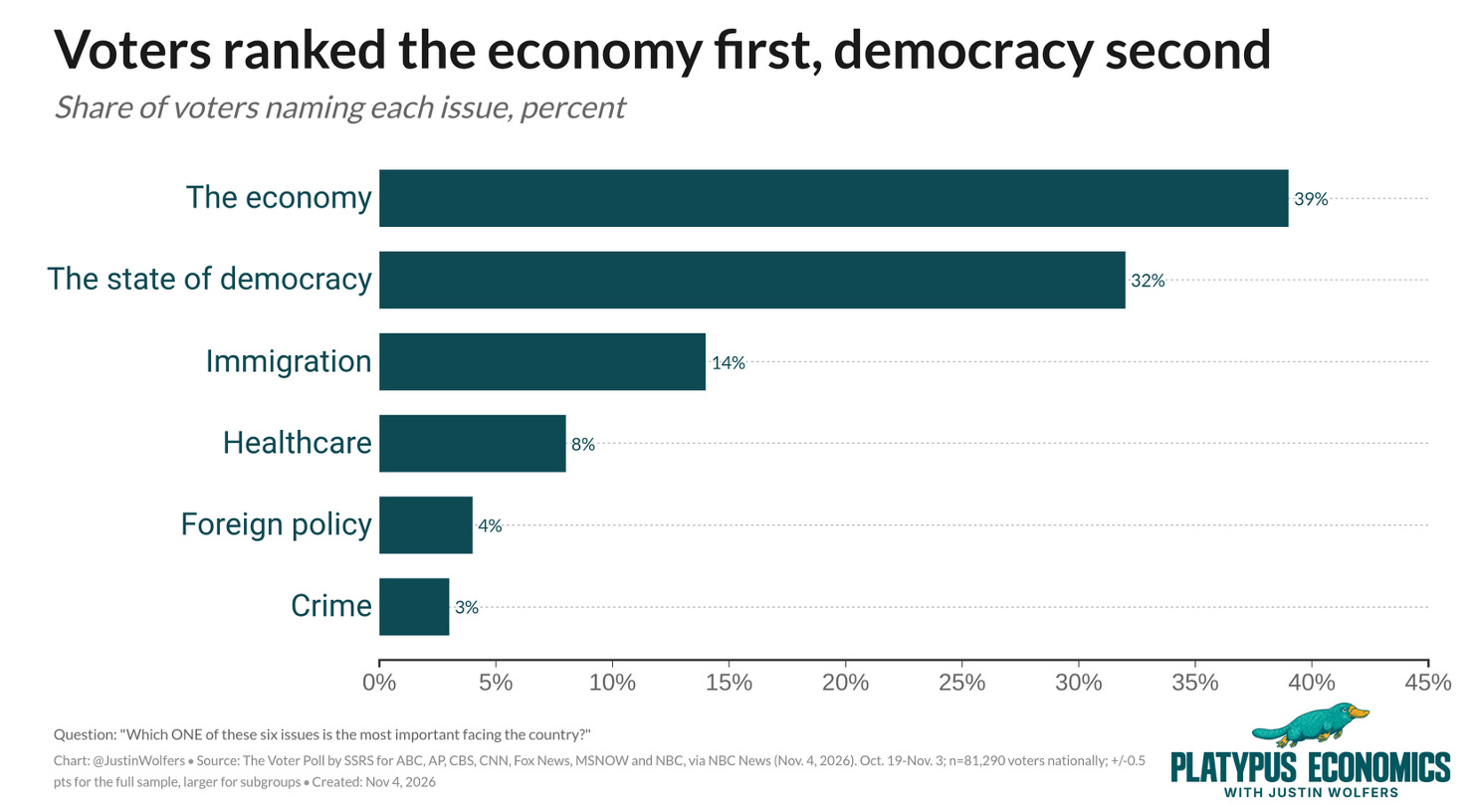
In one poll, three-quarters of voters called the economy “not so good” or “poor.” Four in ten said the economy was the most important issue facing the country, and many place the blame for those economic woes with the current administration.
As economists, we usually look at the big macroeconomic numbers and build a picture from that data. But over the past few months, readers have been telling us at Platypus that those numbers don’t fully capture the economic pain they’re experiencing.
And so we asked you to tell us about it. And you did: readers from across the country wrote in to explain how they’re affected by this economy. So let’s dig into the one part of politics I’m uniquely qualified to talk about — the economics bit.
We all know this is fragile
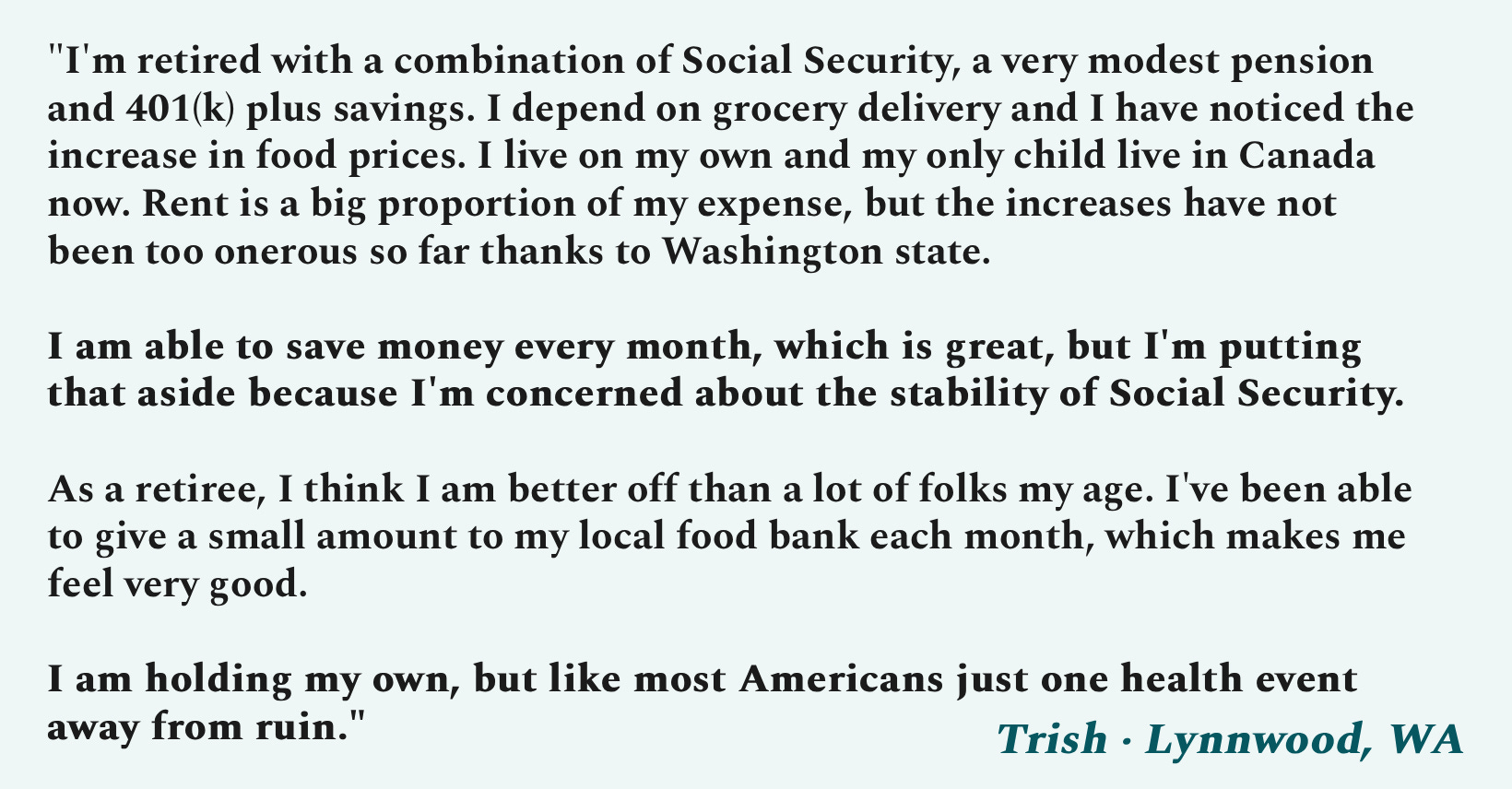
One response that stood out was from Trish in Washington state. Trish is a retiree who feels she’s doing well. She lives on a combination of Social Security, a pension, a 401(k), and savings. Although she’s able to save money every month, she puts some money aside because of her concerns about the future of Social Security.
And Trish wrote this: “I am holding my own, but like most Americans just one health event away from ruin.”
What Trish’s answer highlights is the fragility of it all. Our mainstream economic statistics don’t make that fragility obvious. GDP, unemployment, and inflation are highlighting an average.
Trish isn’t worried about the average. She’s worried about what could happen to her. Her answer highlights two kinds of big economic risks, and I’d add a third.
First: Social Security is fragile
The trust fund behind retirement benefits is projected to run out in late 2032, or about six years from now. Social Security won’t disappear. But if nothing changes, it can only pay what’s coming in from people working now. There are fewer workers paying into Social Security for each retiree drawing benefits, so this would reduce scheduled payments to about 78%. The average retired worker gets $2,170 a month, so that would be cut by about $480 per month. That would make it a lot harder for millions of seniors to get by.
Economists have been warning about this for over 30 years. Congress’s hobby has been doing nothing.
Second: Health is fragile
One bad accident, and life looks very different. For older adults that’s especially true. More than one in four report a fall every year. If that fall takes you to assisted living, that’s a median cost of $74,000 a year, and Medicare generally won’t cover it.
The United States never built a coherent healthcare system. We have one that’s linked to work, and lots of people don’t work. Obamacare was an attempt to make that less incoherent.
Here’s my rule: it takes a policy to beat a policy. If you don’t like the system, you should create another one. Instead, Congress cut Medicaid by a projected $911 billion over a decade and let enhanced Obamacare subsidies expire. The system is fraying, and sadly, that’s by design. There’s no replacement in sight, just folks paying higher premiums, or dropping coverage altogether. Their financial lives just got a whole lot more fragile.
Third: AI
For my entire working life, I’ve assumed I would know what I’d be doing in a decade’s time. That assumption is now gone. That might be true for you, too.
The data so far don’t show that AI has led to widespread job losses, though young workers in the most exposed fields may be starting to feel it. I’m an economist, so I have to also add: “on the other hand,” and indeed, that other hand is pretty important: AI could do tremendous good: help create new vaccines, or cure rare diseases.
But if I’m worried my car might get stolen, I buy car insurance. What’s the equivalent of car insurance for AI?
We don’t know, because Washington hasn’t engaged in a serious, grown-up conversation. We should be talking about this all day, every day. What do we want our relationship with AI to be? Can we guide it to supercharge us, rather than replace us? How should we share the spoils? What do we need to do to stay safe in the face of bad guys with powerful machines? How do we need to rewire our safety net for the tumult that lies ahead? What about our education system? There’s so much more to do, beyond simply refusing to regulate a technology that might determine so much of our economic, social, and political futures.
It turns out we have a Congress
I went to vote on Tuesday, and I learned the most delightful thing. It was right there on my ballot. Apparently, we have a House and a Senate.
I’d been reading the newspapers for two years, and I’d mostly heard about what the president decided to do. Tariffs, immigration, the war in Iran. We’ve covered those, too. Congress played almost no role in any of it.
But let’s look at that list of fears. A retirement fund running low, a healthcare system full of holes, and a new technology that might upend the workforce. These are exactly the kind of problems that a Congress exists to solve.
I don’t know whether this one will. There’s still a veto, a filibuster, and a very real possibility that nothing’s different next year.
But today is a new day. The world does feel different — and change is always possible.
Watch the full episode for the rest.
Nothing about the climate, which is arguably the most important issue we face. Americans still have their heads in the sand and it isn't going to end well.
Why the United States spends roughly double per capita on healthcare compared to other advanced OECD $14,885 in the US vs. a wealthy nation average of ~$7,371), the primary driver is not the volume of care Americans receive, but the price they pay for it. The money goes toward funding the friction of a trillion-dollar insurance billing apparatus (waste) and satisfying the unregulated pricing power of corporate healthcare systems and drug manufacturers (profit).
Providing universal healthcare would instantly change the payee, moving the U.S. closer to the European model of higher taxes in exchange for zero out-of-pocket medical risk. However, whether it successfully reduces the astronomical "price" of American medicine depends entirely on whether the government is politically willing to legally cap corporate healthcare profits, mandate uniform pricing, and dismantle the private insurance bureaucracy.
During the 2026 midterm election cycle, political donations from the healthcare industry and pharmaceutical companies were split nearly evenly (50/50) between the Democratic and Republican parties. Historically, the pharmaceutical and healthcare manufacturing sectors have leaned significantly Republican, averaging roughly 64% of their donations to the GOP since 1990. However, the 2026 midterms saw a dramatic shift toward parity as the industry strategically hedged its bets.
In my opinion when it comes to controlling healthcare costs in United States “we may have a Congress” but we are sadly unlikely to get meaningful reform.