


About a year ago, Lisa New invited me to talk about a poem for her “Poetry in America” series. Lisa is a friend, and so I let her convince me I belonged in a conversation I really have no business being part of. What can an economist have to say about poetry?
Well, when the poem is about manufacturing, it turns out an economist might be just the person for the job. Poetry In America is re-releasing that piece for Labor Day, which is the perfect holiday for it. A year later I remain more than a little proud of my five minutes as a poetry critic. (That’s the story I tell myself, anyway.)
The poem is Martín Espada’s “Who Burns for the Perfection of Paper.” It’s short and it sticks in your head. I’m going to describe it here, but really, you should just go read the whole thing here.
In the poem, Espada is sixteen, working after school in a plant that makes legal pads. Just ordinary legal pads, but a factory’s worth, so they’re seven-foot stacks of yellow paper with cardboard slipped between the pages and red glue brushed up and down the stack. He doesn’t wear gloves, because the job needs fingertips. Late in the shift the paper turns sharp and leaves micro-cuts in the skin. Then, ten years later, the poet is in law school, looking at a legal pad, knowing something that his fellow students might never understand: the work and the cuts that go into each pad.
What it costs and what it took
Hold on, this is going to get a little wonky, but I think it’s the whole poem.
You can read this as an extended act of pondering value. Espada describes everything that went into the legal pad, and it would be hard as a human working on this thing not to conclude that all that work must make it intensely valuable. But what comes out the other end is a legal pad. A simple yellow pad that a lawyer will write on and then, presumably, throw away.
What is value? Economists, political philosophers and lawyers have chewed on that question for generations. I usually tell my students not to bother; it’s too hard.
Because there’s more than one question hiding in there. There’s the price of a thing, which is a fact you can look up. And then there’s how we choose to value a thing, which is an ethical and moral judgment, and it’s not built into the price tag. A price is a magnificent piece of machinery — it coordinates strangers across the world who will never meet, and it does it without anyone in charge.
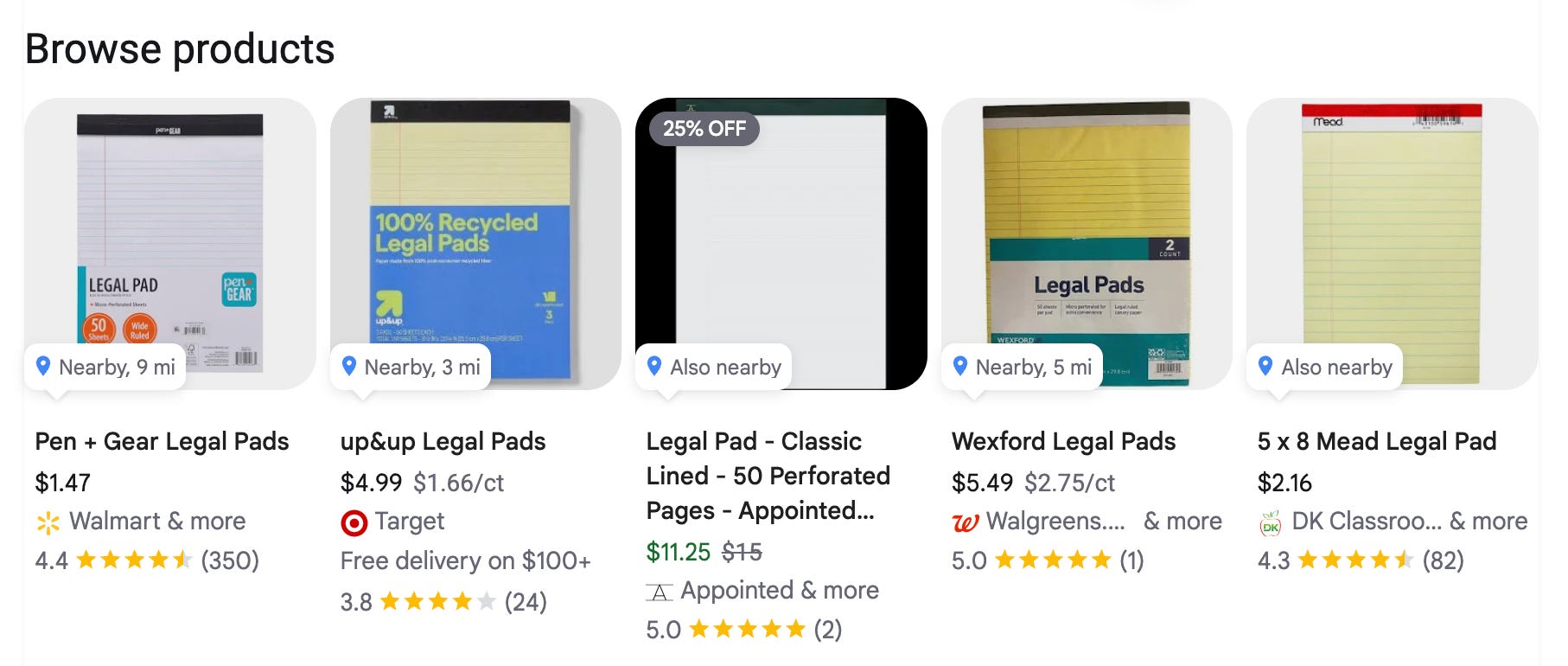
That’s the set of questions I think the poet is inviting us to ponder.
What’s it good for?
Espada turns those questions around on himself as a poet. Nobody, he says, ever disputed that the practice of law had value, or that the work he was doing in the plant was some kind of contribution. But poetry gets interrogated constantly. “What’s it good for? Why do you do it? What’s the outcome? What’s the impact? As if poetry could be weighed, packaged, labeled, boxed and shipped somewhere.”
“As if it were manufactured,” Lisa says.
“And unfortunately, there is no price tag on a poem,” Espada says. “I can’t write a poem today, turn around, go down the street to the local grocery and say, give me a pound of sliced turkey, here’s a poem.”
He’s right, and I’ll add that the grocer’s refusal tells you nothing about the poem.
So what does poetry do that the law can’t? Espada’s answer is that it can make people cry. That it can move them enough to want to do something about those hands, and about the people those hands belong to.
You can watch the full conversation above, or find a bit of my contribution here:
And do go follow Poetry in America — Lisa’s team makes lovely things. My goal for Platypus Economics is to do for econ what she’s doing for poetry, which is what made this collaboration such a joy. You can find Poetry in America on YouTube, Tiktok, and here on Substack at Along These Lines.
It’s memorized and recited poems that carry me through.
I retired in 2007 from prof and chair of the Dept of Economics at the University of Nebraska Omaha. Shortly thereafter, took up photography and poetry. My poetry and photo publications are catching up with my (old) econ publications. I'd like to say I find parallels between writing econ and writing poetry, but in truth, I find almost none, zip. Other than you have to sit there and write! Call me weird but I'm having a great time!