


Here’s my promise: I’m going to send $5,000 to everyone who subscribes to Platypus Economics.
That’s right. $5,000 to every subscriber.
Now you might start by asking: where’s that money from? That’s got to be far more than you’re making on subscriptions.
To you I say, don’t get bogged down in details. I promise I’m good for it.
Well, spoiler: I’m not going to be giving away any checks. But the president is. Or he says he is. Last night, he announced that he’ll be giving every American adult a $5,000 check. That is… if Republicans win the midterms.
Oh, and all the money has to be spent in the United States.
OK, so before you start planning next summer’s vacation, there are five questions we need to ask.
Is this real — has Trump delivered on promises like this before? Will Congress actually pass it? Who really pays for these checks? What economic emergency is it meant to solve? And what does it mean when Trump says you have to spend the money in America?
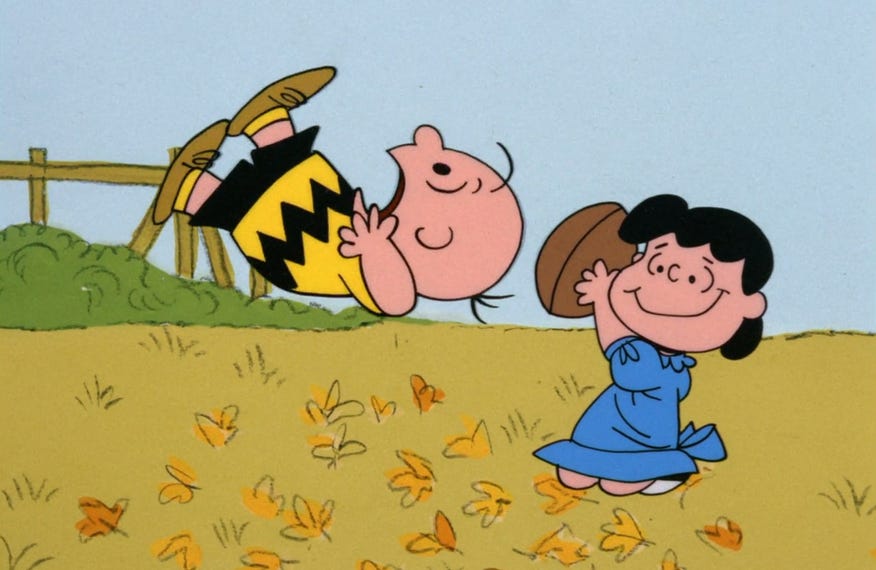
Issue One: Is this Lucy and the football?
This isn’t my first dividend rodeo.
First came the DOGE Dividend — Elon Musk’s Department of Government Efficiency was going to find so much waste that taxpayers would get $5,000 in the mail. I’m still waiting for mine.
Then the Tariff Dividend, roughly $2,000 for most Americans, paid for by tariffs. Again, mine must have gotten lost in the mail.
Then the Warrior Dividend: $1,776 for military families. Those checks actually did go out. But that money wasn’t actually a “dividend.” It was already set aside to help military families with housing, and it was paid for with funds already earmarked for military families. No extra help. Just the Trump brand slapped on the package.
So it isn’t clear why you should believe this particular promise. The last few times, we got the brand announcement but no check. But as Lucy always says, she really means it this time.
Issue Two: There is no bill, and no sign of one
The president can’t just mail you this money on his own. That requires Congress, and I reckon there’s close to no chance Congress — even a Republican Congress — passes it.
There are around 240 million adult American citizens who would be on the list for this check. That adds up to $1.2 trillion, which is… a lot of money. And that’s $1.2 trillion given away in a pre-election pledge, which doesn’t really serve the Republican agenda well. I just can’t see Congress going along with this gimmick.
Now, maybe they’ll decide they no longer care about fiscal responsibility, so really this is all free money. Perhaps.
But the smaller $2,000 tariff-check idea already got a pretty cool reception from Senate Republicans. A lot of them wanted the money used to reduce the deficit instead.
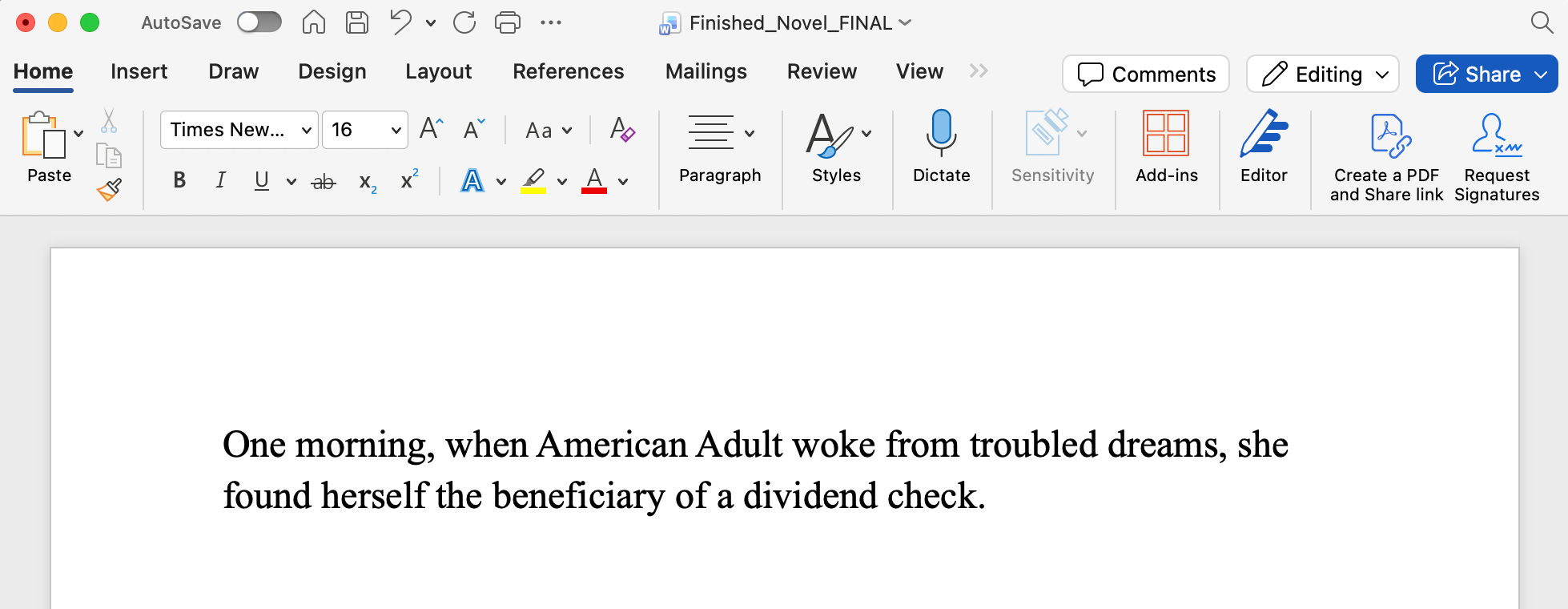
And we’re already getting a little ahead of this announcement. There is no bill, no eligibility rule, no plan for verifying citizenship, no tax treatment, and no delivery system. There isn’t an actual proposal at all.
It’s a policy in the way a heading on a blank Word document is a novel.
Issue Three: Your $5,000 check comes with a $5,000 bill
Trump says the tariffs pay for this. Let’s check.
From January 2025 through June 2026, the government collected roughly $420 billion in gross customs duties. The old tariff system would have brought in about $120 billion over those same 18 months, so the extra is around $300 billion. Then subtract about $160 billion the government has to hand back, because the courts struck down the emergency tariffs — with more possibly to come, since other measures are still in litigation.
Round generously: about $140 billion, against a $1,200 billion promise. Tariffs cover roughly eleven cents of every promised dollar. And that assumes the money has no other job, which is funny, because tariff revenue has already been promised to pay down the debt, replace the income tax, fund a separate $2,000 dividend, help with child care, and help farmers.
The rest gets borrowed. And here’s the key economics: a government can send you a $5,000 check. What it cannot do is make America $5,000 richer by borrowing $5,000 in your name. You get a check. The government gets a debt. And that government is you and me.
You cannot make a country richer by mailing its citizens their own money.
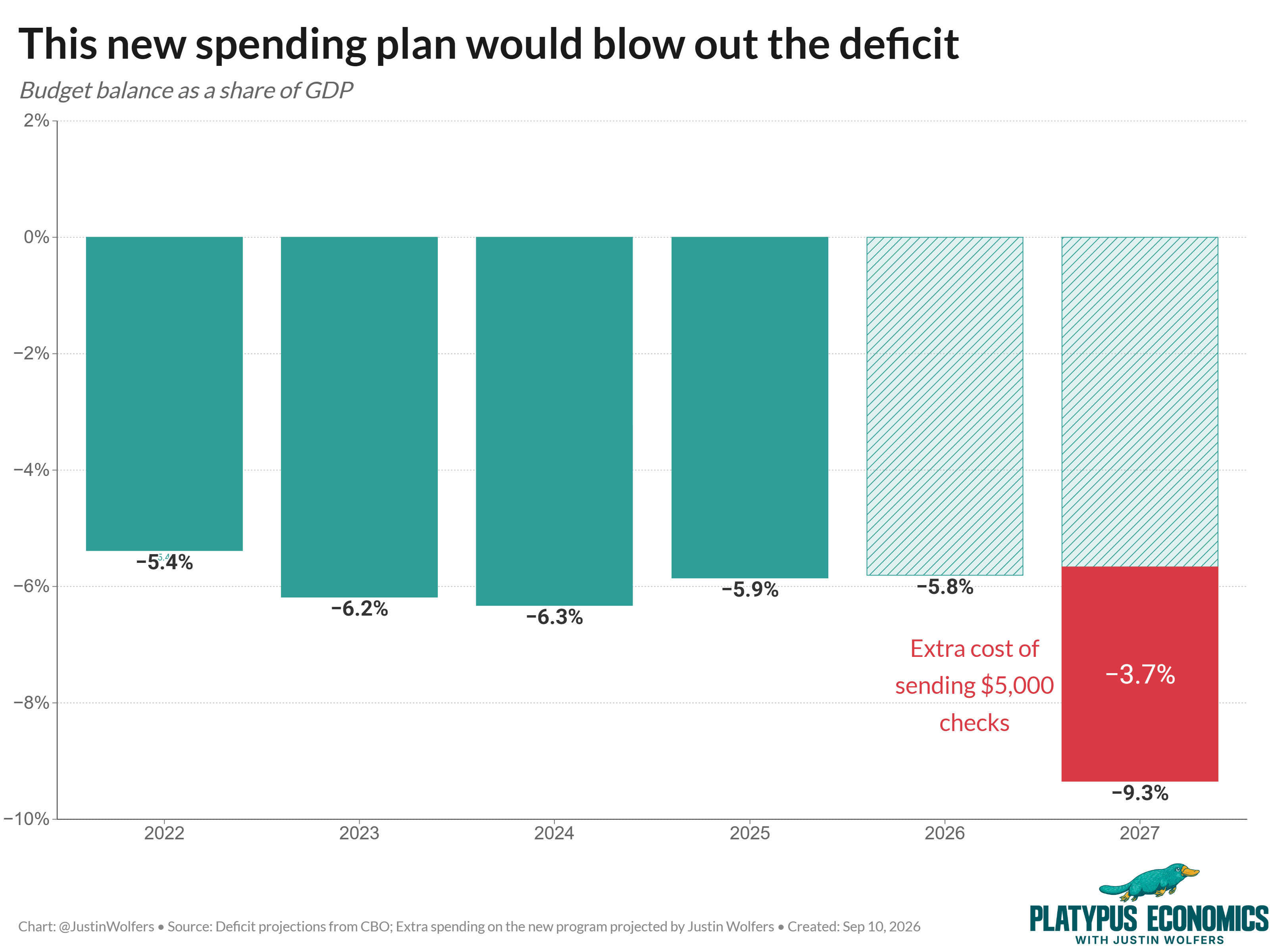
Let’s explore the budget implications. The Congressional Budget Office already projected a deficit near $2.1 trillion this fiscal year. Add the $1.2 trillion cost of this program, and you’re up to a $3.3 trillion deficit, creating the largest deficit in American history.
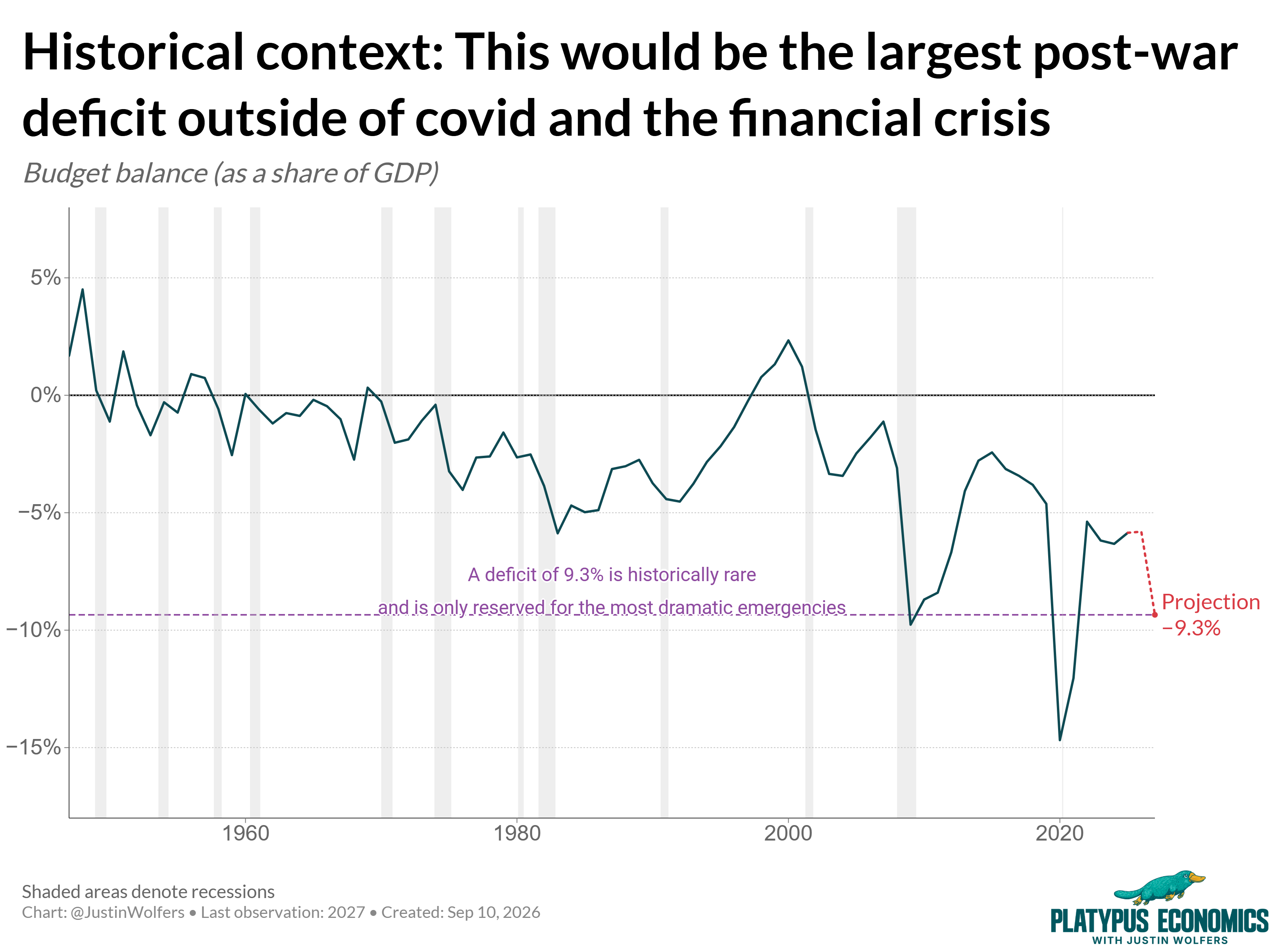
A bit of historical context is useful here. A deficit that big is around 9 or 10 percent of GDP. That’s basically unheard of, outside of genuine emergencies. It was 9.8 percent in 2009 and 14.9 percent in 2020.
Issue Four: In case of emergency, check election results
Which brings us to the emergency.
There are real times to send people money — a recession, a natural disaster, a pandemic, a sudden collapse in household income. You start with the harm, then design the payment.
So, name the harm.
Unemployment is 4.1 percent. Housing, health care and groceries are expensive, inflation is still too high, and plenty of families are stretched. All true.
None of it explains: Why $5,000? Why every adult? Or: Why now?
It also doesn’t explain why the need disappears if Democrats win Congress. Does the president really think that a Republican House and Senate would be so disastrous that it necessitates an immediate large stimulus?
And then we can get to the macroeconomics of all this. As we try to figure out what this could do, I’ll rely on a reasonable benchmark from my friends at the Yale Budget Lab. When they analyzed the president’s previously-promised check, they reckoned that about 25 cents of every dollar would get spent promptly. Nobody knows if that’s exactly right, but it’s a sensible place to start. $1.2 trillion, times 25%, is $300 billion of first-round consumer demand. Roughly speaking, it’s one percent of GDP.
Kevin Warsh, chair of the Federal Reserve, is trying to work out whether inflation is falling fast enough to avoid raising rates. So, Kevin, how do you feel about another one percent of GDP in consumer demand, right now? I have a strong hunch about his answer, and it involves the words “absolutely” and “not.”
Issue Five: Spend it in America, whatever that means
The president said that this money must be spent in America.
Enforcing the “spend it in America” rule would mean ruling on which merchants count, whether online purchases count, whether an imported television bought at an American store counts, whether you can pay down debt with it, whether you can save it. A government telling you what to buy and where to buy it has a name, and the name isn’t freedom.
Even then, it wouldn’t work. Money is fungible — it moves around. I can put my $5,000 toward my rent and then put the check that was earmarked for rent toward a holiday in Manitoba. There’s no little label on a dollar reading “this one came from the Trump Dividend.”
And there’s a bigger problem: Article 3.1(b) of the World Trade Organization’s subsidies agreement also happens to prohibit exactly what Trump just promised. It bans subsidies “contingent … upon the use of domestic over imported goods.”
Not only will the “spend it America” part of this policy not work, it may also start (another!) global trade war.
I promise I’m good for it
Five thousand dollars is real money. But this promise assumes you’ll hear it and stop asking questions.
So ask them. Ask what happened to the last checks. Ask whether Congress will pass it. Ask who pays the bill. Ask what emergency it solves. Ask how the spend-it-here rule could possibly work.
As for my $5,000 — don’t get bogged down in details. I promise I’m good for it. Exactly as much as the president is.
You are so good at your job! Great piece.
Dear Professor Wolfers.. kudos on a rational dissection of the latest version of voodoo economics. When Trump was running for president in 2016 he promised the coal miners he was going to bring back coal. Frankly, the $5K bribe for a vote demonstrates the Orange Man’s cruelty and lack of empathy for those who have lost hope and do not know any better.