


Watch the panelists face freeze as I do math, on live TV
I’ve been asked a lot this week about what economics has to say about trillionaires. I think the most coherent concern lies at the intersection of economics and politics. It comes from the juxtaposition of two facts.
Fact #1: Musk bought the 2024 election
Elon Musk was the biggest individual donor in the 2024 election cycle, and it wasn’t even close. He spent around $288 million on Republican candidates, with most of that directed to help elect President Donald Trump. He pushed that money into his own super PAC, paying thousands of canvassers to knock on doors and get out the vote across key swing states. He also funded a controversial $1 million daily giveaway to swing-state voters who sign a political petition.
His bet paid off: President Trump won. The states that made the difference were Pennsylvania (where Trump won by 120,266 votes), Michigan (80,103) and Wisconsin (29,397). Add it up, and the difference was roughly 230,000 votes across three swing states. And that, in turn, means that if 115,000 thousand voters had voted the other way, we would have a different president.
Next, some simple math. Let’s say that each $1,000 in campaign spending only changes one voter’s mind. (The relevant political science literature suggests that this is a very conservative estimate of the effect of money on elections, and so I’m likely understating Musk’s effect on the election.)
Thus, switching 115,000 voters would cost $115 million, which is much less than he actually spent.
That calculation only works if Musk had known in advance that Pennsylvania, Michigan, and Wisconsin would be the pivotal states. Instead, he focused his spending on a broader set of swing states (which also includes Arizona, Georgia, Nevada, and North Carolina). The total population of this broader set of swing states is about double that of the narrower set of three pivotal states, so perhaps we should double the spending required to win the election, to $230 million.
He spent more than that.
Point is, even with generous assumptions, it’s hard to avoid the conclusion that Musk bought the 2024 Presidential election.
One more note: You might be concerned that this was an unusually close election, and so any factor could be called pivotal. But elections this close are pretty much the norm these days, as the table below illustrates.
Fact #2: The price of an election is cheap, relative to the wealth of the super-rich
The next bit is just arithmetic, but it’s important to work it out explicitly because our minds do so poorly when dealing with millions, billions, and trillions.
The election cost Musk $288 million.
His current wealth is estimated to be $1.1 trillion. You’re going to find this calculation easier to grok if you write his wealth as $1,100,000 million.
Divide one number by the other, and you conclude that this election cost Musk only 0.026% of his wealth.
Let’s put this into a more human scale. For a typical American household worth around $200,000, a donation of 0.026% of your net worth is roughly fifty dollars. Musk’s donation changes world history, and yours barely gets acknowledged.
Or to say this another — more terrifying — way: Yes, Musk bought the 2024 Presidential election. And if future elections come with a similar price tag, then he can still afford to purchase another 3,819 elections.1
When you're a star trillionaire, they let you do it.
Elections sound expensive. And to regular folks, they are. They’re prohibitively expensive, costing millions. But we are now in a world where some people are worth billions and in one politically-engaged case, a trillion. To the super-rich, elections are cheap.
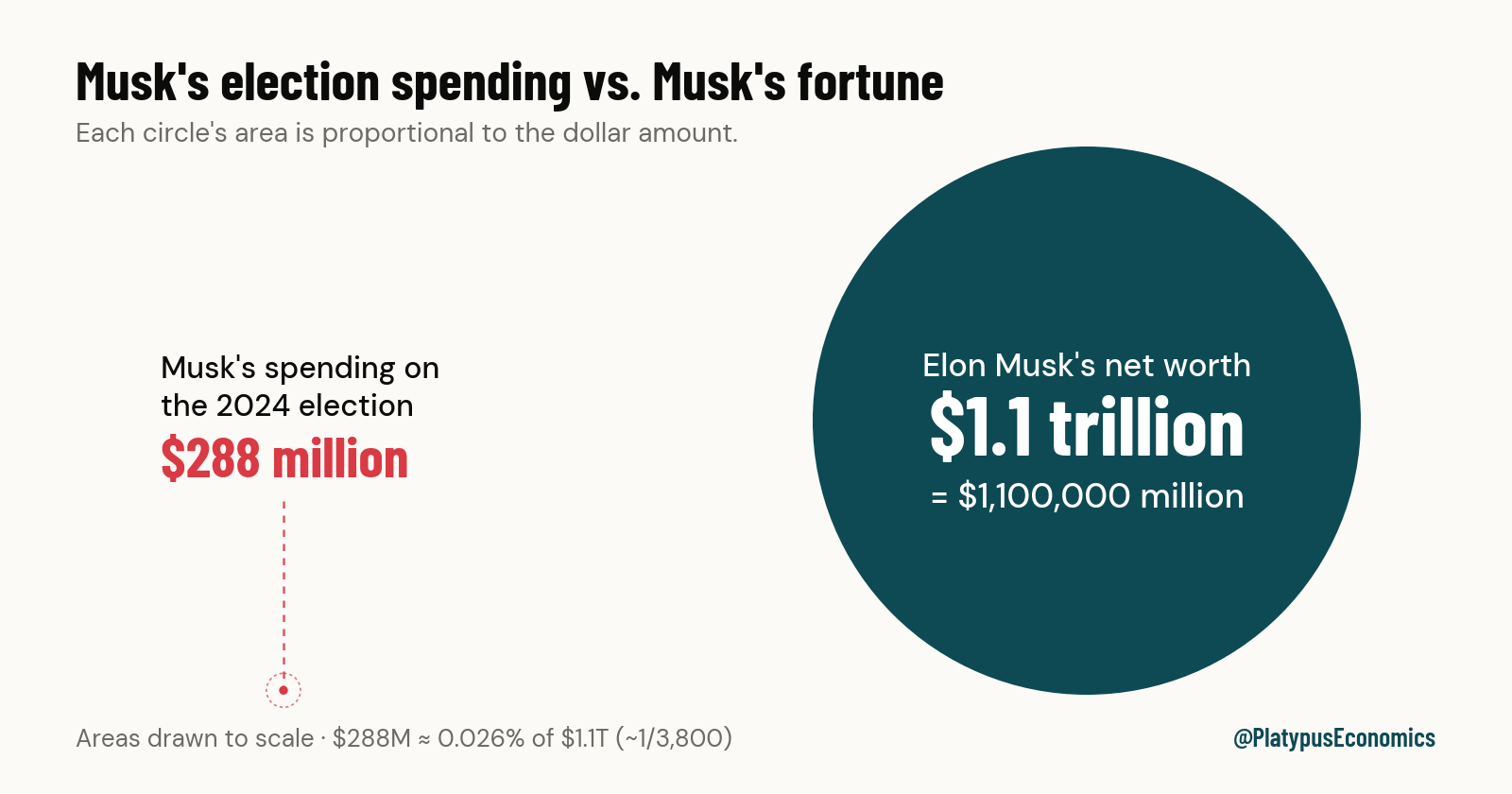
Point is, we are now at a point where the wealth of a single individual is enough to overwhelm our democratic system.
Father’s Day Sale

Actually, he has enough to purchase 3,819.44 more elections. But if we let him off purchasing only the whole number of 3,819.44, instead of buying the last 0.44 elections, he could pocket the last $125 million of his wealth to sustain a pretty good lifestyle.
In 2000, if 537 voters in Florida had voted for Al Gore we would have him as president. In 2016, had 78,000 across MI, PA and WI had voted the other way we would have had HRC as president. In 2024, the number according to Prof Wolfers is 115,000. These are essentially rounding errors in such a large country. Because of the Electoral College they ended in 2024 up giving us leadership by crooks and buffoons. The numbers are even more reasons to get rid of it.
So buying and selling governments hmmm. Isn't that what happens in "banana republics?" How did America sink so low so fast? Never mind I know. They were always for sale if the price was right oh and the religion, lets not forget the power of religion in politics even though it's not supposed to make a difference. Yeah Right!